
Summary Sinspeed is a UK automotive-electronics remanufacturer. You post us the failed unit — an ABS pump or ABS/ESP module, an instrument cluster, an electric power steering column or rack, an immobiliser, a headlight control module, a transmission control unit — and we repair that unit at circuit level and post it back. The module that comes back is the one that came off your car, still carrying its own mileage, VIN and security data, which is why most units go straight back on without being coded to the vehicle.
These answers cover what to send, what happens to it on the bench, whether anything needs programming afterwards, and what the warranty covers. If your question is not here, ask us before you remove anything.
We repair the unit you send us and send that same unit back — no exchange scheme, no donor module, and nothing of your car written over.- Your unit, not a stranger'sWe repair the board you send in and return that same unit — no donor module, no other car's data written over yours
- Tested under loadBespoke in-house Hardware-in-the-Loop platforms run each unit under simulated heat, vibration and load before it is dispatched
- Mail-in, UK-wideOnly the unit travels — your vehicle stays on your drive or with your garage while the repair is done
- 1 What we repair
- 2 Sending your unit in
- 3 The repair itself
- 4 Coding, mileage and security
- 5 Warranty
- 6 Cost, payment, returns and trade
What we repair
5 questionsWe repair the electronics inside the car, not the car itself. If you are not sure which unit has failed, describe the symptoms and we will tell you what to send.
Which units do you repair?
The core lines, each with its own section of the site:
- ABS pumps and ABS/ESP modules — Bosch 5.7 and 8.0, ATE/Teves Mk60 and Mk70 among them
- Instrument clusters and dashboards — dead displays, stuck gauges, immobiliser no-starts
- Electric power steering — columns, racks and their ECUs
- Immobilisers and ignition modules — Mercedes EIS/EZS, BMW CAS, ignition switches and steering locks
- Transmission control modules — mechatronic units, gearbox ECUs, clutch and gear actuators
- Headlight control modules — xenon ballasts, adaptive (AFS) and LED control units
- Air-conditioning compressors, sat-nav and infotainment units, throttle bodies, body and footwell modules
- ECU remapping and tuning
On gearboxes the line is worth drawing early: we repair the control electronics — the mechatronic unit or gearbox ECU — not the mechanical internals. Ongoing research and development work keeps coverage extending to newer models and systems.
How do I know which unit has failed?
Start with the stored fault codes, then look at the pattern. A code names the circuit that reported a problem, not always the part that failed — a wheel-speed sensor code can be the sensor, its wiring, or the input stage inside the ABS module that reads it. Note whether the fault appears from cold, only when the car is hot, constantly or intermittently, send that on the repair form with your vehicle details, and we will confirm what to send before you remove anything.
My part number is not on your list — can you still repair it?
Usually, yes. The part numbers listed on our product pages are the ones we have documented, not the limit of what we can work on — the same circuit board often appears under a dozen part numbers across a model range, and sometimes across several manufacturers who bought the same unit from the same supplier. Send the number printed on the unit's label with your vehicle details and we will tell you whether it is one we repair. If it is a board we have not had on the bench, we will say so rather than take it on blind.
Do you repair engine ECUs?
We remap them; we do not repair them. ECU remapping and tuning is one of our own services and is carried out on the vehicle rather than by post. Repairing a failed engine ECU is a different job, and the place for it is ecu-repairs.com — an independent specialist, not part of Sinspeed.
Do you work on DPFs?
DPF work splits two ways, and they are not interchangeable. Cleaning restores a blocked filter and is the road-legal option for a road-going vehicle. Removal, with the smoke correction that has to accompany it, is carried out for off-road and motorsport vehicles only — the note below sets out the legal position. If the DPF light is on and the engine is otherwise healthy, cleaning is where the conversation starts, and what a DPF actually does explains the filter and its regeneration cycle.
DPF removal is illegal to use on a public road in the UK, and has been an automatic MOT failure since February 2014. Removal is carried out for off-road and motorsport vehicles only. For a road-going vehicle, DPF cleaning is the road-legal route.
Sending your unit in
6 questionsThe unit travels; the vehicle stays where it is. That keeps the car off a ramp and out of a workshop queue while the electronics are repaired.
How does the mail-in repair work, start to finish?
Four stages. You tell us what the vehicle is doing and which unit you think has failed, on the repair form. You remove the unit and post it in. We strip, diagnose, repair and test it. It comes back, and you or your garage refit it. We never see the car, which is the point — no ramp to book, no vehicle left with anyone, and nothing waiting on a recovery truck.
What do I need to send you?
The complete unit, unless we have told you otherwise for your vehicle. On an ABS unit that means the ECU and the hydraulic block together — separating them needs bench tooling to reseal correctly, and a poor reseal is a leak path in a brake circuit.
Send your details with it: your name and contact details in the box, the make, model and year, the registration or VIN, any fault codes that have been read, and a line on what the car is doing. An unlabelled unit with no paperwork is the one thing that genuinely holds a job up.
Where do I post my unit?
To the workshop in Surrey: Sinspeed, Unit 102 Reaver House, 12 East Street, Epsom, Surrey, KT17 1HX.
Use a tracked and insured service. The unit is worth considerably more than the postage, and a signature at our end is worth having if anything goes astray in transit.
Do you collect the unit from me?
No — we do not offer a collection service. Everything travels by post or courier in both directions, the return leg included, so the repaired unit is posted back to you. If a garage is doing the removal and refit, they can post the unit in and take delivery of it directly.
How should I package the unit?
Treat it as static-sensitive and fragile, because it is both. An antistatic bag is ideal; failing that, avoid loose polystyrene beads and do not wrap a bare board in cling film. Protect the connector pins — bent pins are avoidable damage that happens in transit far more often than it should.
Use a rigid box with padding on every face so a heavy unit such as an ABS pump cannot move inside it, and bag an ABS unit before it goes in: it will still hold brake fluid.
How long will my unit be with you?
Tell us the vehicle and what it is doing and we will give you an estimated turnaround before you post anything — an estimate for your part and your fault, rather than one number printed across every page. An ABS pump, an instrument cluster and a steering column are not the same job, and what has actually failed inside a unit is only certain once the board is open.
Once the unit is here and the fault is confirmed, that estimate becomes a date, and we work to get every unit back on its way as quickly as it can be done properly. If anything changes, you hear it from us at the point we know.
The repair itself
5 questionsWhat happens between the unit arriving and the unit going back in the post.
Do I get my own unit back, or a replacement one?
Your own. The unit you post in is the unit that is repaired and the unit that comes back — same serial number, same part number, still carrying everything your car has written to it: VIN, mileage, security data and learned adaptations.
That is the practical difference between a repair and a swap. A replacement module arrives either blank or carrying another vehicle's data, so it has to be matched to your car before it will work properly. Yours does not, because it never stopped being yours.
What actually happens to my unit on the bench?
It is opened, inspected and put under test until it reproduces the fault you described — a unit that behaves perfectly on the bench has not been diagnosed, only powered up. The failure is then traced to the stage of the circuit that has broken down, and to the conditions that break it — temperature, supply voltage, load and bus activity.
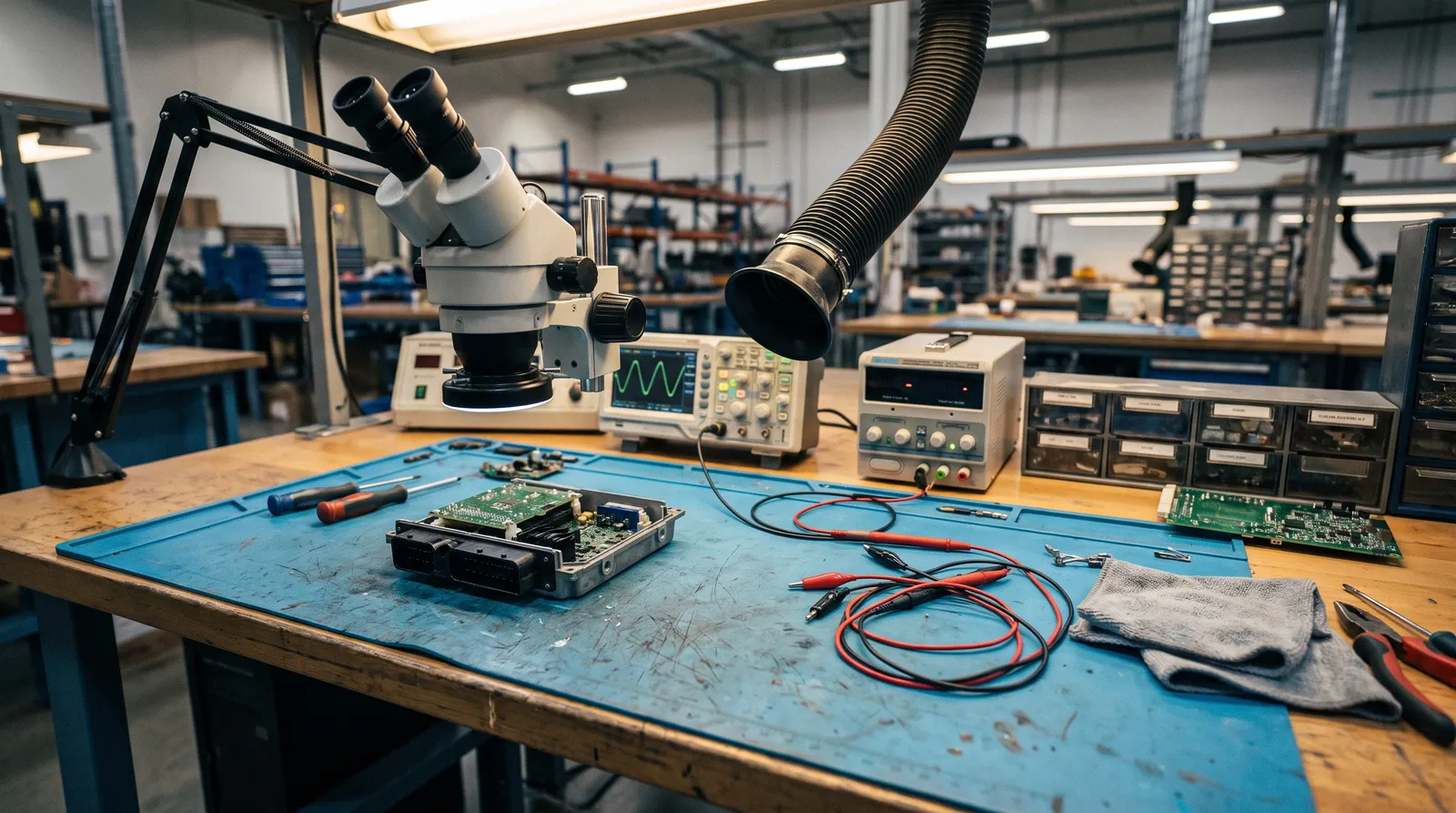
The repair is carried out at circuit level in a cleanroom-standard, ESD-safe workshop, and the known weak points are reinforced while the unit is open. Where the system calls for it, the unit is programmed and calibrated with dealer-level tools before it is packed.
What is Hardware-in-the-Loop testing?
It is a bench rig that convinces the unit it is still in a car. Our in-house Hardware-in-the-Loop platforms feed the module the signals it would see on the vehicle — sensor inputs, bus traffic, real loads on its outputs — and run it under simulated heat, vibration and load.
That matters because most electronic faults are conditional. A unit can behave perfectly on a cold bench with nothing connected to it and fail the moment it is hot, loaded and being asked to do the job it does in the car — which is the only state in which that kind of fault shows itself. Testing under those conditions catches the fault here rather than on your driveway a week later.
What if the fault turns out not to be in the unit I sent?
It happens, and finding it out is better than fitting a repaired unit to a fault that was never in it. Wiring, connectors, sensors and poor earths all throw codes that read like a module failure. If the unit tests good, we tell you so and what the evidence points to instead, so the next thing you check is the right thing. Work is quoted after inspection, with no obligation to proceed.
Can a unit be beyond economical repair?
Occasionally. Fire damage, long-term water ingress that has corroded through the board, impact damage that has cracked the substrate, or a previous repair attempt that has lifted the pads can all put a unit past the point of a reliable fix. When that is the case we say so, rather than send back something that will fail again.
Sinspeed · mail-in repair
Send the module, keep the carTell us the vehicle, the symptoms and any fault codes on the repair form, then post the unit in. It is stripped, repaired at circuit level and tested on our in-house Hardware-in-the-Loop platforms before it goes back to you.
Lifetime, unlimited-mileage warranty on all remanufactured parts · Mail-in, UK-wide · Tested on HIL platforms before dispatch
Coding, mileage and security
5 questionsThe questions asked most often before people commit — and the ones where repairing your own unit behaves differently from fitting a replacement.
Will the repaired unit need coding or programming?
In most cases, no. Many units come back ready to fit: it is your own module with your own data still on it, so there is nothing to marry to the vehicle and nothing to teach it about the car it is going into.
Some systems are the exception — certain immobiliser, cluster and headlight jobs need programming or calibration as part of the repair. That is done here with dealer-level tools before the unit is dispatched, and we tell you at the quote stage if yours is one of them.
Will my mileage change after the repair?
No. The stored mileage is data held in the cluster you sent us, and it stays exactly as it was. We do not alter recorded mileage — not up, not down, not adjusted. It is one of the clearest arguments for repairing a cluster rather than fitting a used one: a second-hand cluster arrives with another car's mileage on it, which then has to be dealt with.
Will my keys still work after an immobiliser or cluster repair?
Yes. Your keys are paired to the security data held in that unit, and that data is still on it when it comes back, so the pairing is intact and there is nothing to re-learn. A replacement immobiliser or cluster is where keys become a problem: the new unit does not know your keys, and either the keys or the module then have to be programmed to match.
Is my vehicle's data kept?
Yes — VIN, security data, stored adaptations and configuration all stay on the unit. Nothing is copied onto a donor board and nothing is wiped as routine. If a repair does mean replacing a memory device, we tell you what that means for the data before we do it.
Will the warning light go out when I refit the unit?
If the failed unit was the cause, yes — though stored codes usually need clearing with a diagnostic tool once it is back on, because they are historic faults rather than live ones. If the light returns immediately after clearing, that points to a second fault still on the car: a sensor, a connector or the wiring in the same circuit.
Warranty
3 questionsA short section, because the cover is simple and there is one exception to it.
What warranty comes with a repair?
Lifetime, unlimited-mileage warranty on all remanufactured parts. No mileage ceiling, and no expiry date on the remanufacturing work.
That cover follows from the method as much as from the paperwork: the failed circuit is repaired and its known weak points reinforced, so the unit does not go back carrying the same design flaw that brought it in.
Why are headlight modules excluded?
Headlight control modules are the one line that sits outside the lifetime cover. They carry a separate, shorter warranty, and the term that applies is confirmed when your repair is quoted rather than assumed here. Ask at that point and you will be told before you commit to anything.
What happens if the same fault comes back?
Contact us and send the unit back. It goes on the bench again — same diagnostic route, same unit, with the record of what was done to it the first time in front of the engineer. A repaired unit that repeats its original fault is rare, and it is exactly what the warranty is for.
Cost, payment, returns and trade
6 questionsThe commercial side: what a repair costs, how the paperwork works, and how we deal with garages.
How much will my repair cost?
It depends on the unit and on what has actually failed inside it, so we quote after inspection rather than publish a headline figure that would be wrong for half the units that arrive. Two identical-looking modules off the same model can need very different work.
You get the quote before anything is done, and you are under no obligation to go ahead with it. If the unit is not worth repairing, we will tell you that too.
How do I pay?
Most customers pay by bank transfer. We can also take card payments online through Stripe for amounts up to £500, and we still accept cheques if that suits you better.
You are told what is due and how to settle it when the repair is quoted, so nothing has to be arranged before you have seen the figure.
Can I return a part I have ordered?
Yes, within the terms we trade on: returned goods must be unused, in their original packaging, and sent back with proof of purchase. That covers parts supplied from the shop. The repair of your own unit is a different arrangement — that unit is coming back to you either way.
What if my order or repair takes longer than expected?
Two outer limits apply. Goods are dispatched no later than 30 days after we accept an order. Where the work is a service, it starts as agreed when you order and you are given a completion estimate at that point.
If a job runs more than three months beyond that estimate, it counts as a long delay and you can cancel and be refunded. Those are backstops rather than the plan, but they are written down, which is the point of a backstop.
Do you work with garages and trade customers?
Yes. Garages, main dealers and independent workshops nationwide send us units, and the mail-in model suits a busy workshop — the customer's car stays on their drive instead of occupying a ramp while the electronics are dealt with. Business customers also get an express warranty under our terms: goods will conform to their description and be free from material defect.
Can I get an update while my unit is with you?
Contact us with the vehicle details and the unit you sent, and the workshop will tell you where it has got to. The office is open weekdays, 9am to 5pm. If a job needs a decision from you — an unexpected finding, or a quote that changes once the unit is open — we come to you rather than wait to be asked.
Sinspeed · mail-in repair
Still not sure which unit has failed?Send us your fault codes and vehicle details and we will tell you which unit is at fault before you remove anything. If you already know, the repair form is the quickest way to get the job booked in.
Cleanroom-standard, ESD-safe workshop · Circuit-level board repair by in-house engineers · Your own unit repaired and returned