
 In short
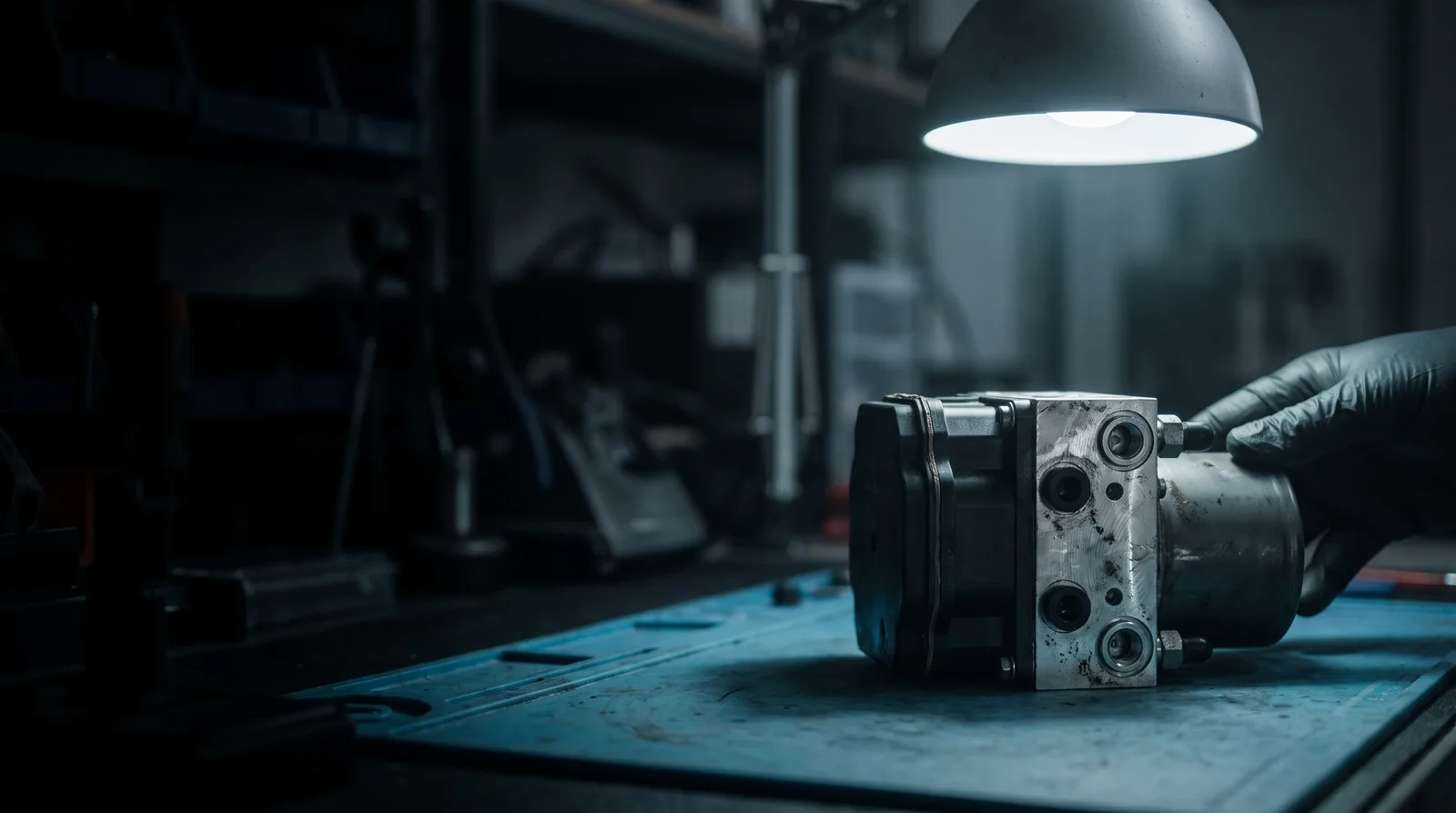
The Bosch 8.0 is the ABS/ESP modulator — the pump, valve block and control unit that run your anti-lock braking and stability system. When it fails we remanufacture your original unit and return it plug and play, no coding required, with a lifetime warranty.
What is the Bosch 8.0 ABS/ESP modulator (and what it's also called)?
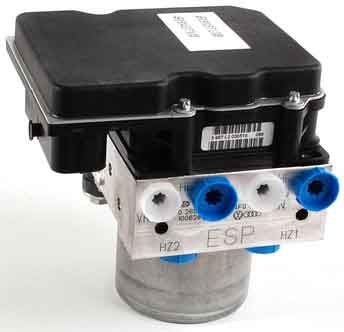
The Bosch 8.0 is the control module — or modulator — that runs your car’s anti-lock braking system (ABS) and, where the vehicle has traction and stability control, its electronic stability programme (ESP) as well. Bosch designed it to succeed the 5.3 and 5.7 ABS units, and it is a noticeably more complex unit than either. Because the same part is fitted across so many makes, it goes by several names — the ABS pump, the ABS ECU, the ABS module, the ABS modulator, the ESP module and the ESP pump are all the one component. The traction and stability side carries its own badges depending on the make: ABS, ESP, ASR and TCS, and on BMW it is DSC (Dynamic Stability Control).
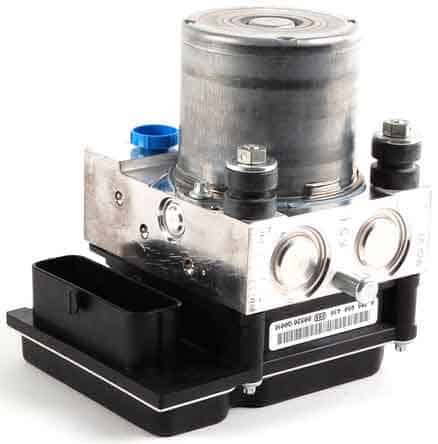
The modulator is built from three parts that cannot work without one another. The pump motor keeps the brake circuit pressurised so the system can react the instant it is needed. The hydraulic control unit (HCU) is the solid aluminium block of valves and channels that meters brake pressure to each wheel. The electronic control unit (ECU) is the brain: it reads the wheel-speed sensors and the brake-pressure sensor, works out what each wheel needs, and drives the valves and the pump to deliver it.
On a car with ESP the ECU does more again. It compares the steering-angle sensor with the yaw sensor — Bosch’s stability sensor, sometimes called the DSC sensor — to judge whether the car is going where the driver is steering it. If it detects understeer or oversteer it brakes individual wheels on its own, without the driver touching the pedal, to bring the car back into line. That is why a single fault in this module can light up ABS, traction and stability warnings all at once.
Bosch’s eighth-generation ABS is lighter and more capable than the 5.7 it replaced, built around a ceramic circuit board carrying very fine, densely packed components — which is why it needs specialist equipment to repair properly rather than a general garage. The failures we see most often come from the Audi A6 and S6 Quattro (4F2 / 4F5) built between January 2005 and June 2006, but the same modulator is fitted far more widely; the full vehicle list is further down this page.
Symptoms of a failing Bosch 8.0 module
A Bosch 8.0 rarely fails all at once. More often the warnings come and go for weeks before the fault settles in permanently, so it pays to act early rather than wait for it to clear on its own. The symptoms we see most often are:
- ABS warning light on — constantly, or flickering on and off as the fault comes and goes.
- Traction or stability light on — the ESP, ASR or TCS warning, or the DSC light on a BMW.
- Several warnings together — ABS, traction and stability lights lit at the same time, which is typical of this module rather than a single sensor.
- No communication with the module — a diagnostic scan tool cannot talk to the unit at all.
- Wheel-speed sensor fault codes stored — frequently logged even when the sensors themselves are in good order.
- Brake-pressure sensor faults — an implausible-signal warning from the pressure sensor inside the HCU.
- The ABS pump motor running on — sometimes continuously, even with the ignition off and the key removed.
- Stability or traction control cutting in oddly, or dropping out altogether.
Because this is part of the braking system, none of these should be left to drift. A failing modulator can switch off ABS and ESP together — and those are the very systems that help you stop in an emergency and hold the road in the wet. If any of these warnings are showing, have the car diagnosed promptly rather than driving on it.
Common Bosch 8.0 fault codes (01435, 01420, 01418)
A stored fault code tells you which part of the system is unhappy, not which component has failed — so it is a starting point for diagnosis, never a verdict on its own. On VAG vehicles (Audi, SEAT, Skoda, VW) the codes we see most often on a failing Bosch 8.0 are:
- 01435 — Brake Pressure Sensor 1 (G201): implausible signal.
- 01420 — Driving Dynamics Regulation High-Pressure Switch Valve 1 (N227): intermittent.
- 01418 — Driving Dynamics Regulation Switch Valve 1 (N225): intermittent.
- ABS / ESP / ASR / TCS / DCS (traction) warning light on.
- Wheel-speed sensor faults.
- No-communication fault.
On non-VAG makes the same underlying faults tend to surface as chassis “C” codes rather than the five-digit VAG numbers. The recurring ones across this generation are C1380 and C1381 (ABS/ASR return pump, electrical fault), C1385 (solenoid-valve supply-voltage fault) and C1110 (ABS power-relay coil circuit failure). Treat these as pointers to an area — the pump circuit, the valve coils, the power supply to the unit — rather than proof the module itself is dead.
That distinction matters, because a number of “ABS module” faults turn out to be something feeding into it — a cracked fuse, a corroded harness plug, a tired wheel-speed sensor — rather than the module itself. We bench-test the modulator to establish whether it is genuinely at fault before any work is agreed, so you are not paying to replace a unit that was never the problem.
Sinspeed · mail-in repair
Send us the ABS unit rather than replacing the whole assemblyFill in the repair form with your vehicle details and the fault codes your scanner is showing. Our engineers strip the module, repair the failed circuit or valve driver and test it on our in-house Hardware-in-the-Loop rigs before it goes back to you.
Lifetime, unlimited-mileage warranty on all remanufactured parts · Mail-in, UK-wide · Tested on Hardware-in-the-Loop rigs before dispatch
What causes Bosch 8.0 ABS/ESP failure?
Most Bosch 8.0 failures are electronic rather than hydraulic, building up over years of heat cycling and vibration. The most common culprit is the brake-pressure sensor in the HCU and the fine bonded connections that tie it into the circuit board. Those hybrid connections fatigue and break down, which is why an implausible brake-pressure-sensor signal (the 01435 code on a VAG car) is one of the most familiar Bosch 8.0 faults — and shows up so often on Audi, SEAT, Skoda and VW.
The solenoid valves are the next weak point. The coils that operate them can lose their supply voltage, so a valve that should be metering brake pressure simply stops being driven — the fault behind the driving-dynamics valve codes (N225 and N227) and the chassis-code equivalent for solenoid-valve supply voltage. Sometimes the coil itself has failed, sometimes the small switching device that feeds it, so we check the coils and their supply together.
The pump motor is a less frequent but more serious failure. A motor that seizes or runs on can take the circuit board with it — components burn out under the load — so by the time the unit reaches us the repair is no longer just the motor but the ECU it damaged. A pump that has started running continuously, even with the ignition off, is the classic early warning that it is on its way out.
This is where many garages go wrong: not every “ABS fault” is the modulator. A good share of units sent in for repair are not actually faulty at all — the real problem is a wheel-speed sensor, a magnetic ring, the unit’s plug, or a fuse. On VAG cars a fuse can look perfect and still carry a hairline crack, and on Peugeot and Citroën the wiring-harness plug is a common offender. We rule those out on test before any module is condemned.
Can the Bosch 8.0 module be repaired or must it be replaced?
Most main dealers and general garages will tell you a Bosch 8.0 has to be replaced. For them that is usually true — it is a sealed, ceramic-board module and they are not equipped to repair it at component level. A specialist remanufacturer is, and that changes the options considerably.
Replacement carries real drawbacks. A new modulator is expensive and, on the older Audi A6 and S6 applications, increasingly hard to source. A salvage-yard unit is a gamble — many have water damage and cannot be reliably repaired — and, like a new one, it is not married to your car. On top of the part cost, a replacement normally has to be coded to the vehicle before the brakes will work properly.
We repair your original unit instead. Our in-house electronic and hydraulic engineers work at circuit-board level, renewing the failed connections and components with new genuine OEM parts and reinforcing the points that fail in the first place — so the rebuilt modulator is brought back to meet and exceed its original specification, rather than swapped for an identical new one that carries the same built-in weakness.
Every unit is then proven on our in-house Hardware-in-the-Loop (HIL) test rigs, which recreate the heat, vibration and electrical load the module sees in service. An intermittent fault that would otherwise reappear on your driveway shows itself on the bench instead, where we can put it right before the unit goes back to you.
Do I need coding, or do I keep my unit?
You keep your own unit — and that is the single biggest advantage of repairing rather than replacing a Bosch 8.0.
Because we rebuild the module that is already coded to your car, its vehicle marriage and configuration stay intact. It comes back as your module, repaired, so there is nothing to programme or code when you refit it: the Bosch 8.0 is returned fully plug and play. You bolt it back on, plug it in, and the car is ready to go.
A new replacement module is the opposite — it almost always has to be programmed and coded to the vehicle with dealer-level equipment before it will work, an extra cost and delay you avoid by keeping your original. Where any calibration is needed as part of the repair, we carry it out before the unit leaves us, so what arrives back is ready to fit — covered by a lifetime warranty with no mileage limit.
Which vehicles use the Bosch 8.0 module?
The Bosch 8.0 is fitted across a very wide range of vehicles. We see it fail most often on the Audi A6 and S6 Quattro (4F2 / 4F5) of 2005–2006, but the same modulator turns up on Audis right across the range, on the BMW X3 and X5, and on Citroën, Fiat, Ford, Honda, Hyundai, Mercedes-Benz, Peugeot, Saab and Volkswagen models among many others. The full list of vehicles known to use this unit is below.
| Vehicle List | Vehicle List | Vehicle List |
|---|---|---|
| Audi A4 | Audi A5 | Audi A6 |
| Audi A7 | Audi S4 | Audi S6 |
| Audi RS4 | Audi Q5 | Audi R8 |
| BMW X3 | BMW X5 | Citroen Berlingo |
| Citroen Berlingo MF | Citroen C1 | Citroen C4 |
| Citroen Nemo | Citroën Xsara Picasso N68 | Fiat 500 |
| Fiat Ducato 3 250 | Fiat Grande Punto 199 | Fiat Idea |
| Fiat Panda 169 | Fiat Punto 188 | Fiat Scudo 270 |
| Fiat Stilo 192 | Ford Mondeo III B5Y | Ford Ranger |
| Ford Transit | Honda Civic | Hyundai Getz TB |
| Iveco Daily | Lancia Musa | LDV Maxus |
| Mercedes B-Class B180 | Mercedes B-Class B200 | Mercedes B-Class B250 |
| Mercedes E-Class E220 | Mercedes E-Class E250 | Mercedes E-Class E350 |
| Mercedes E-Class E500 | Mercedes Smart ForFour | Mercedes Sprinter |
| Mitsubishi Colt VI | Mitsubishi Colt VII | Nissan Kubistar X76 |
| Nissan Qashqai | Nissan Micra III K12 | Peugeot 2007 |
| Peugeot 3008 | Peugeot 5008 | Peugeot Expert |
| Renault Modus | Saab 9-5 | Seat Ibiza |
| Skoda Fabia | Toyota Avensis | Toyota Aygo |
| Vauxhall (Opel) Corsa D | Volkswagen (VW) Crafter | Volkswagen (VW) Polo |
| Lamborghini Gallardo |
Not sure the Bosch 8.0 is the unit you have? The Bosch 5.7 and the Teves MK70 are different ABS pump generations that look similar and share many of the same symptoms. If yours might be one of those, see our Bosch 5.7 ABS/ESP pump module repair and Teves MK70 ABS pump repair services — or send us the part number from your unit and we will identify it for you.
Bosch 8.0 part numbers
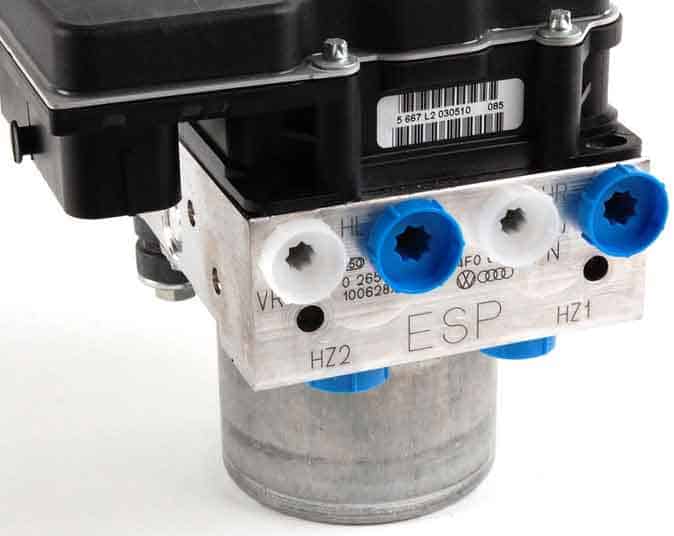
Bosch and the vehicle manufacturers used a long list of part numbers for this modulator across its different applications. The Bosch and OEM numbers we have found associated with the Bosch 8.0 are listed below — checking yours against the list is the quickest way to confirm you are looking at the right unit before you send it in.
| Bosch Partnumber | OEM Partnumber |
|---|---|
| 0265 900 324 | BMW 34516768829-01 |
| 0265 950 318 | PSA 9665106680 |
| 0265 950 353 | VAG 4F0 614 517 D |
| 0265 950 372 | VAG 4F0 910 517 L |
| 0265 950 414 | VAG 4F0 910 517 K |
| 0265 950 430 | VAG 6R0 907 379 H |
| 0265 950 474 | VAG 6R0 907 379 E |
| 0265 950 505 | VAG 8E0 910 517 AK 05 |
| 0265 950 429 | VAG 8E0 914 517 D0 12 |
| 0265 950 545 | Mercedes A2129006201 |
| 0265 950 742 | VAG 4F0 614 517 L |
| 0265 950 749 | VAG 4F0 910 517 L 009 |
| 0265 950 824 | VAG 4F0 614 517 L 03 |
| 0265 950 962 | VAG 4F0 614 517 AA |
| 0265 950 986 | VAG 4F0 614 517 K |
| 0265 951 048 | VAG 4F0 614 517 N |
| 0265 951 213 | 51771148 |
| 0265 951 223 | 3451 6762059 01 |
| 0265 951 738 | Mercedes A0004468289 |
| 0265 955 000 | 5532809 |
| 0265 950 338 | VAG 8E0 614 517 BD |
| 0265 950 351 | VAG 8E0 614 517 BF |
| 0265 950 360 | Mercedes A0054319512 |
| 0265 950 407 | Mercedes A4544202275 |
| 0265 234 263 | Honda 57110SMGG012M1 |
| 0265 235 103 | 4454005071 |
| 0265 950 557 | 445400F030 |
| 0265 234 260 | 9660934580 |
| 0265 800 362 | Mercedes A0064316312 |
| 0265 800 363 | 4A90AL1799 |
| 0265 800 375 | 55831 |
| 0265 800 376 | Mercedes A2124312912 |
| 0265 800 377 | Nissan 47660-JD01D |
| 0265 800 422 | 10330 U0213 |
| 0265 800 441 | 110403-2-0661 |
| 0265 800 461 | 9676244880 |
| 0265 800 495 | 9674677580 |
| 0265 800 511 | VAG 6R0 614 517 H |
| 0265 800 579 | 8200192202 |
| 0265 233 337 | 77BO2AAY2 |
| 0265 234 035 | 6768829 01 |
| 0265 234 097 | VAG 4F0 910 517 D |
| 0265 234 148 | VAG 4F0 614 517 BOJ |
| 0265 234 227 | VAG 4F0 910 517 AD 007 |
| 0265 234 336 | VAG 6Q0 614 417 M |
| 0265 235 054 | VAG 6Q0 614 417 H |
| 0265 235 097 | VAG 6Q0 907 379 AB |
| 0265 235 394 | VAG 6Q0 907 37 R 0001 |
| 0265 235 406 | VAG 6Q0 907 379 R 0003 |
| 0265 230 017 | VAG 6Q0 614 117 L |
| 0265 230 289 | VAG 6Q0 614 117 Q |
| 0265 230 373 | 50407 5551 |
| 0265 236 310 | 024027 |
| 0265 230 686 | 50407 5553 |
| 0265 230 304 | 93188091 |
| 0265 239 000 | 553015 |
| 0265 234 075 | 13236012 AQ |
| 0265 234 095 | 44510 - 0H010 |
| 0265 234 114 | 51761005 |
| 0265 234 212 | VAG 6Q0 614 117 S |
| 0265 231 425 | |
| 0265 231 426 | |
| 0265 231 450 | |
| 0265 231 452 | |
| 0265 231 537 | |
| 0265 231 579 | |
| 0265 231 617 | |
| 0265 231 672 | |
| 0265 231 712 | |
| 0265 230 038 | 400 614 517 E |
If your part number is not on the list, that does not necessarily mean we cannot help — the table is extensive but not exhaustive. Send us the number from your unit, or browse our full ABS pump and module repair category, and we will confirm whether it is one we cover.
How our repair service works
Our Bosch 8.0 repair is a mail-in, repair-and-return service. There is no need to bring the car anywhere — you send us the modulator and we return it ready to fit.
- Get in touch. Tell us your vehicle and what it is doing through our repair form, or contact us if you are not certain which unit you have, and we will confirm what to send.
- Remove and send your unit. Disconnect and remove the Bosch 8.0 modulator and post it to us — we will tell you exactly what we need and how to pack it safely.
- We test and diagnose. Your unit is bench-tested on our Hardware-in-the-Loop rigs to confirm whether the module itself is at fault, and we report what we find before any work goes ahead.
- We remanufacture. Our in-house engineers carry out the board-level repair, renewing the failed components with new genuine OEM parts and reinforcing the known weak points.
- We return it plug and play. The repaired module comes back coded to your car as it was, ready to bolt straight on, and covered by a lifetime warranty.
All of this is carried out in a cleanroom-standard, ESD-safe workshop by our in-house team of electronic and hydraulic engineers, using dealer-level diagnostic tools. If you would rather not handle the unit yourself, we can also arrange professional diagnosis and fitting — just ask when you get in touch.
FAQs
Can a Bosch 8.0 ABS module really be repaired instead of replaced?
Yes. Dealers and general garages replace it because they are not set up for component-level work on a sealed ceramic-board unit, but it can be rebuilt at circuit-board level. We repair your original module, which keeps its coding and avoids the programming a replacement would need.
Will I need to code or programme the unit after the repair?
No. Because we repair the module that is already married to your car, it is returned fully plug and play. You refit it as it is — there is no coding or programming to do. A new replacement unit, by contrast, would normally have to be coded to the vehicle first with dealer-level equipment.
What does the 01435 brake-pressure-sensor code mean?
On a VAG car, 01435 is an implausible signal from Brake Pressure Sensor 1 (G201), which sits inside the HCU. It is one of the most common Bosch 8.0 faults and usually points to the pressure sensor or its fine bonded connections breaking down. It still needs confirming on test, because wiring and supply faults can produce a similar reading.
My ABS pump won’t stop running — what is that?
A pump motor that runs continuously, even with the ignition off and the key removed, is a classic sign the motor and its drive circuit are failing. It is worth acting on quickly, because a seized or overworked pump motor can damage the circuit board it is mounted to and turn a smaller repair into a larger one.
Is it safe to drive with the ABS or ESP light on?
Your ordinary brakes still work — the system is designed so that a fault leaves you with normal braking rather than no braking. But you lose the anti-lock and stability assistance that help you stop and hold the road in an emergency or in the wet, so a lit ABS, ESP or DSC warning means a safety system has switched off. Treat it as a fault to put right promptly, and have the car diagnosed rather than driving on it.
What is the difference between the ABS pump, the ABS ECU and the ESP module?
On the Bosch 8.0 they are all the same part. The names describe the different jobs the one modulator does — pumping brake fluid, controlling the system electronically, and managing stability and traction — but the hardware is a single unit. BMW owners may also know it as the DSC module.
How do I know whether it is the module or a wheel-speed sensor?
Often you cannot tell from the symptoms alone, because a failing module and a faulty sensor can store very similar codes — and a good number of units sent in for repair turn out not to be faulty at all. That is exactly why we bench-test the unit to confirm whether the module itself is at fault before any repair is agreed, so you are not paying to fix the wrong thing.
What do I need to send, and is the repair guaranteed?
Usually just the Bosch 8.0 modulator itself — when you get in touch we will confirm exactly what to include for your vehicle and how to pack it. Every unit we remanufacture is returned with a lifetime warranty with no mileage limit, ready to fit.
Sinspeed · mail-in repair
Repair the unit rather than replace itA remanufactured unit comes back with its known weak points reinforced, which a like-for-like replacement carrying the same design flaw does not.
Your own unit remanufactured, not a like-for-like replacement · Lifetime, unlimited-mileage warranty · Dealer-level programming and calibration