
 In short
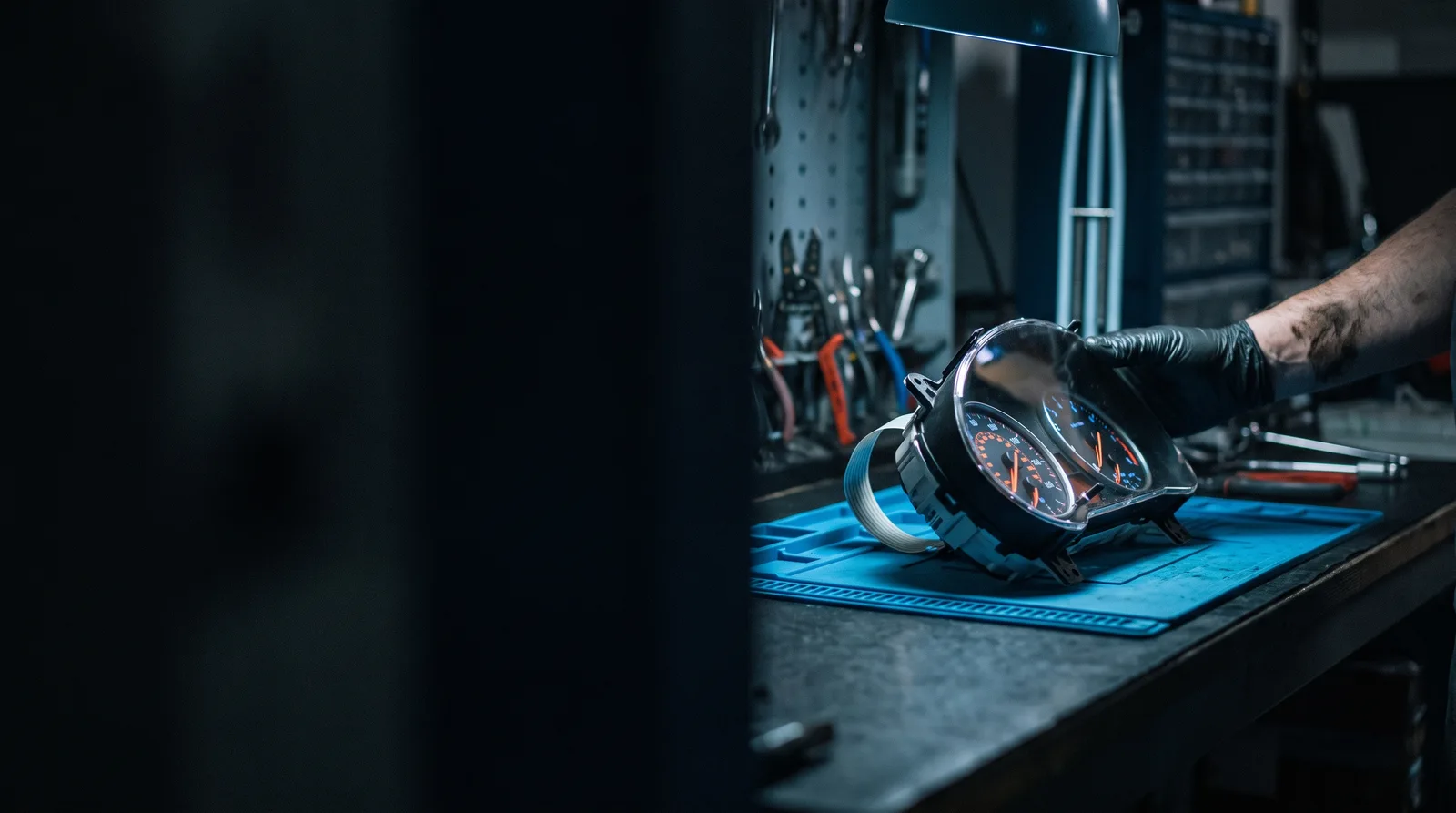
We test, repair and remanufacture the instrument cluster on the Land Rover Freelander 2 (2006–2014). Failed gauges, warning lights, backlighting and the LCD display are restored, and your mileage, keys, VIN and immobiliser coding are retained — the unit comes back plug and play.
What is the Freelander 2 instrument cluster, and why does it fail?
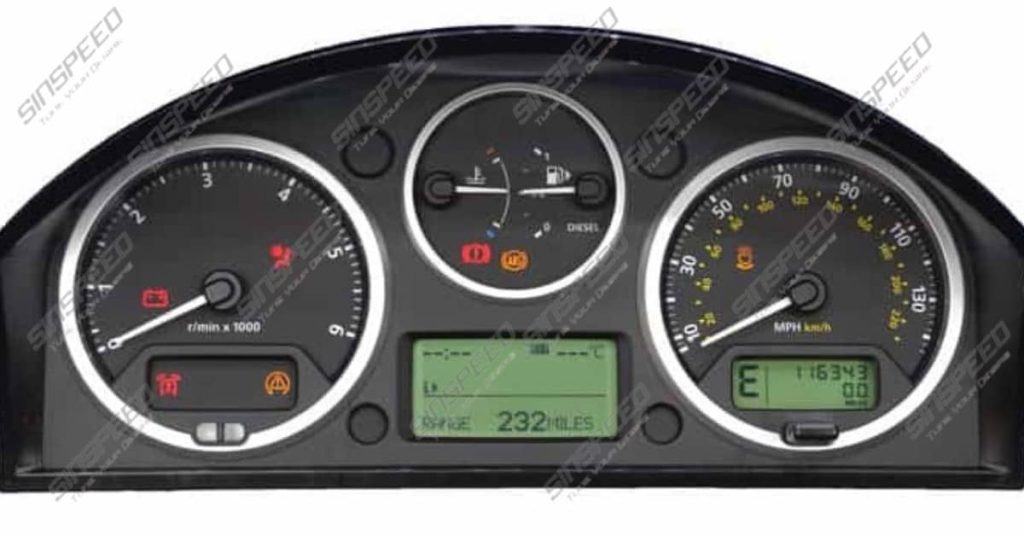
The instrument cluster is the panel behind the steering wheel that holds your speedometer, rev counter, fuel and temperature gauges, warning lights and the central LCD that shows mileage and trip data. On the Land Rover Freelander 2 it is a known electronic weak point, and when it starts to fail the symptoms can range from a single dead gauge to a completely blank dashboard.
The Freelander 2 is factory-fitted with a Nippon Seiki (UK-NSI) instrument cluster. It is not a passive display — it sits on the vehicle’s CAN bus network and is coded to the immobiliser, so it stores and shares data the rest of the car relies on. That is also why a faulty cluster can cause warning messages and running problems that look far worse than a broken gauge.
Failures are usually internal and age-related rather than the result of anything you have done. Years of heat cycling, vibration and moisture fatigue the circuit board and its electronics, and the stepper motors that drive the needles wear over time. Poor or corroded connections, loose wiring and the occasional drink spillage into the dash account for most of the rest.
Symptoms of a failing Freelander 2 instrument cluster
Cluster faults on the Freelander 2 rarely arrive all at once. They tend to start intermittently — a gauge that drops out on a cold morning, a flicker in the display — before becoming permanent. These are the symptoms we see most often on this unit:
- Speedometer, odometer, rev counter, fuel or temperature gauge reading zero, sticking, or dropping out while you drive
- Gauge needles sweeping from side to side, or swinging to full and back on their own
- Dim, flickering or completely failed backlighting and dashboard illumination
- LCD pixelation — missing segments, scrambled characters, or dashes shown in place of the mileage
- No audible warning chimes — seatbelt, indicator and warning sounds going silent
- Warning lights staying on, behaving erratically, or the dash refusing to light up at all
- Intermittent operation — the cluster working one moment and dead the next
- Total cluster failure: a completely blank dashboard, sometimes with the car refusing to start
If you are seeing any combination of these, the cluster is almost certainly the unit at fault rather than the individual sensors behind each gauge. Replacing a sender or a sensor will not fix a cluster that has lost the ability to display or process the signal.
It is worth acting promptly rather than living with the fault. A speedometer that reads zero or wanders leaves you with no reliable idea of your speed, and a vehicle with a non-functioning speedometer will not pass an MOT. Intermittent faults also tend to become permanent, and once the cluster drops off the CAN bus entirely it can take starting and warning functions with it — so a minor flicker is best dealt with before it becomes a dead dashboard.
Common causes and fault codes (U0155-87)
Because the cluster is part of the CAN bus, a failing unit often logs a communication fault rather than a simple gauge error. The code we see tied to this most directly is U0155-87 — lost communication with the instrument cluster control module. It means another module on the network can no longer talk to the cluster, which is exactly what happens when the unit is failing internally.
The underlying causes are physical. The board fatigues with years of thermal expansion and contraction; its electronics and power supply degrade; the stepper motors driving the needles wear; and connector pins corrode or back out. Heat and vibration accelerate all of it, which is why these faults tend to appear as the vehicle ages rather than from a single event.
We diagnose to the component, not the symptom. A scrambled display, a dead gauge and a U0155-87 code can all trace back to the same handful of failure points on the board, and our repair addresses the root cause rather than masking it. We do not list fault codes we cannot stand behind for this specific unit — if your scan shows other codes, send them with your unit and we will tell you what they mean for your repair.
Sinspeed · mail-in repair
Send us the cluster rather than buying a used oneA used cluster brings someone else’s mileage and its own years of heat and vibration. Send us yours with the vehicle details and we repair the failed section at circuit level and return it programmed to your car.
Lifetime, unlimited-mileage warranty on all remanufactured parts · Mail-in, UK-wide · Tested on Hardware-in-the-Loop rigs before dispatch
Can a Freelander 2 instrument cluster be repaired, or must it be replaced?
In almost every case it can be repaired. A main dealer will normally quote you for a brand-new cluster, which then has to be coded to your vehicle’s immobiliser and calibrated to your real mileage before it will work — a slow and expensive route. A used cluster from a breaker is cheaper but carries its own short warranty and still needs reprogramming and recalibration to match your car.
Repairing your original unit avoids both problems. We test, repair and remanufacture the cluster you already have, so there is no coding marriage to perform and no mileage to correct — the figures stay as they were. Where a known weak point caused the failure, we reinforce it during the rebuild rather than fitting a like-for-like part that carries the same original flaw.
Repairs are carried out by our in-house team of electronic engineers and diagnostic specialists doing circuit-level board work in a cleanroom-standard, ESD-safe workshop. Where possible we use genuine OEM or uprated components so the rebuilt unit meets or exceeds the original specification, and every finished cluster is proven on our bespoke in-house Hardware-in-the-Loop test rigs, which simulate real-world heat, vibration and electrical load before the unit is signed off.
Will I keep my mileage, keys and coding?
Yes — this is the single biggest advantage of repairing your original cluster, and it is where dealer replacement causes owners the most worry. We retain all of the data held in your unit: the recorded mileage, the VIN, and the immobiliser coding that pairs the cluster to your car and keys.
Because nothing is swapped for a different module, there is no reprogramming for you to arrange and no recoding bill at the end. Your existing keys continue to work exactly as before. When the repaired unit comes back, it is plug and play — you refit it and drive, with no trip to a dealer or auto-electrician to make it talk to the car.
Keeping the original mileage matters for more than convenience. A cluster showing a mileage that does not match the vehicle’s history can cause real problems at sale and MOT time, so retaining the genuine figure keeps your records clean and your car honest.
Which Freelander 2 models and variants are covered (2006–2014)?
We cover the instrument cluster across the full Land Rover Freelander 2 range built from 2006 to 2014. The same family of Nippon Seiki cluster was fitted throughout the model’s life, so the repair applies whether your car is an early or a later example.
That includes the 2.2-litre TD4 and SD4 turbo-diesels and the 3.2-litre i6 petrol. The cluster hardware is shared across these engines, so the repair is not dependent on which engine your Freelander 2 has. If you are unsure which variant you own, the part number printed on the back of the cluster is the most reliable way to identify the exact unit.
Early and later Freelander 2 clusters differ in detail — trim levels, market and options changed which features the dash displayed — but the underlying unit and its common failure points are consistent across the range. That is why we ask for the part number and a description of the fault: between them they tell us exactly which unit is on the bench and what to check first.
Freelander 2 instrument cluster part numbers
Below are part numbers we have seen on Freelander 2 instrument clusters. They are listed to help you match your unit — they are not a guarantee of fitment by engine or year, and your repair does not depend on finding your exact number here. The numbers are grouped by prefix purely to make them easier to scan; if yours is not shown, send it to us and we will confirm whether we can repair it.
Visteon-style YAC, YAH and T part numbers: YAH500190, T050708, YAC502588, YAC502190, YAC502560, YAC500028, YAC500445, YAC502910, YAC500444, YAC502460, YAH500210, YAC500027, YAC500026, YAC502210, YAC502780PUY, YAC502240, YAC502130, YAC502610, YAC500095, YAC500025, YAC502630, YAC502930, YAC502590, YAC500046, YAC500023, YAC502500, YAC500465, YAC500042, YAC502430, YAC500434, YAC500443, YAC502100, YAC502070, YAH500131, YAC502440, YAC502090, YAC500464, YAC500435, YAC500097, YAC500045.
Alphanumeric 210849 / 14C226 series part numbers: CH1210849AF, 8H2210849BA, BH5210849ED, 6H5210849EH, AH5210849EB, BH1210849AA, 8H3210849PB, 6H5210849EE, 8H2210849DB, 6H5210849ED, 6G5210849EG, 6H5210849EG, 9H5210849EA, FH1210849AB, 8H3210849VA, 8H3210849YA, 9H5210849FA, 7H1214C226AD, 6H5210849LE, 6H5214C226LC, 8H2210849DA, BH5210849EF, 8H3210849SA, 8H3210849PA, 8H2210849BB, BH1214C026AA, CH1210849AE, 6H5210849EF, 7H1210849AD8PUY, CH1210849BF, AH5210849EA, 8H3210849TA, 6H5210849FH, BH5210849EE, 5H2210849TA, BH5210849FE, 6H5210849CE, 6H5210849AE.
LR-prefixed part numbers: LR018481, LR0026005M0C0, LR0030006KOCO, LR0025001M0C0, LR0020002M0C0, LR0024001M0C0, LR0019004K0C0, LR0022002MOCO, LR024301M0, LR0030005MOCO, LR0028005MOCO, LR0025004KOCO, LR0024081M0C0, LR0025002MOCO, LR0019009MOCO, LR0019002MOCO, LR0026009MOCO, LR0027906KO, LR0020001M0C0, LR8024061M0C0, LR0021011MOCO, LR0019004KOCO, LR0025009MOCO, LR0020004KOCO, LR0021003MOCO, LR0022005M0C0, LR005795, LR007564, LR009331, LR019001, LR020117, LR008603, LR009328, LR009327, LR007560, LR006402, LR028001, LR006408, LR005803, LR001638, LR006405, LR005800, LR001635, LR006411, LR005806, LR001641, LR008604, LR007561, LR006403, LR005798, LR001633, LR006409, LR005804, LR003051.
How our Freelander 2 instrument cluster repair service works
We work on a mail-in repair-and-return basis, so you do not need to be local to use us. You send us the failing cluster, we repair and remanufacture it, and we send it back to you ready to refit. The process is the same whether you are a private owner or a garage booking the work in for a customer.
- Tell us about the fault. Start a repair through our repair form, or contact us with your symptoms and the part number from the back of the cluster so we can confirm the unit.
- Remove and send your cluster. Take the instrument cluster out of the dash and post it to us, with any fault codes you have scanned.
- Diagnosis and test. We diagnose the unit on dealer-level equipment to find the root cause rather than the surface symptom.
- Repair and remanufacture. We carry out circuit-level board repairs using genuine OEM or uprated components, reinforcing known weak points as we rebuild.
- Hardware-in-the-Loop testing. The repaired cluster is proven on our in-house HIL rigs under simulated heat, vibration and load before it is signed off.
- Return, plug and play. Your original unit comes back with its mileage, VIN and coding intact — you refit it and drive, with no reprogramming required.
Every repair is backed by our lifetime, unlimited-mileage warranty, and we offer a diagnostic and fitting service if you would rather not remove the unit yourself. We work for private motorists and the trade alike, including garages and workshops who send us units regularly. To get started, complete our repair form or contact us and we will tell you exactly how we can help with your Freelander 2 cluster. You can also see the full range on our instrument cluster repair service.
Frequently asked questions
How long does a Freelander 2 instrument cluster repair take?
Most units are completed within a couple of working days of reaching us, though turnaround depends on the specific fault and on our current workload when your unit arrives.
Will my mileage change after the repair?
No. We retain the recorded mileage, VIN and immobiliser data held in your original cluster, so the figure you send in is the figure that comes back.
Do I need to recode or reprogram the cluster when it returns?
No. Because we repair your original unit rather than fitting a new one, it is returned plug and play and your existing keys continue to work.
My Freelander 2 will not start and the dashboard is dead — is it the cluster?
It can be. The cluster sits on the CAN bus and is tied to the immobiliser, so a failed unit can stop the car starting as well as blanking the dash. Send us the unit with any fault codes and we will confirm the diagnosis.
Can you repair the cluster on any Freelander 2 from 2006 to 2014?
In almost all cases, yes. The same family of Nippon Seiki cluster was used across the range and across the 2.2 TD4/SD4 diesel and 3.2 i6 petrol engines, so the repair is not limited to one variant.
What if my part number is not in your list?
The list is not exhaustive. Send us your unit or your part number and we will confirm whether we can repair it — in most cases we can.
Sinspeed · mail-in repair
Repair the unit rather than replace itA remanufactured unit comes back with its known weak points reinforced, which a like-for-like replacement carrying the same design flaw does not.
Cleanroom-standard, ESD-safe workshop · Circuit-level board repair by in-house engineers · Most units returned ready to fit