
 In short
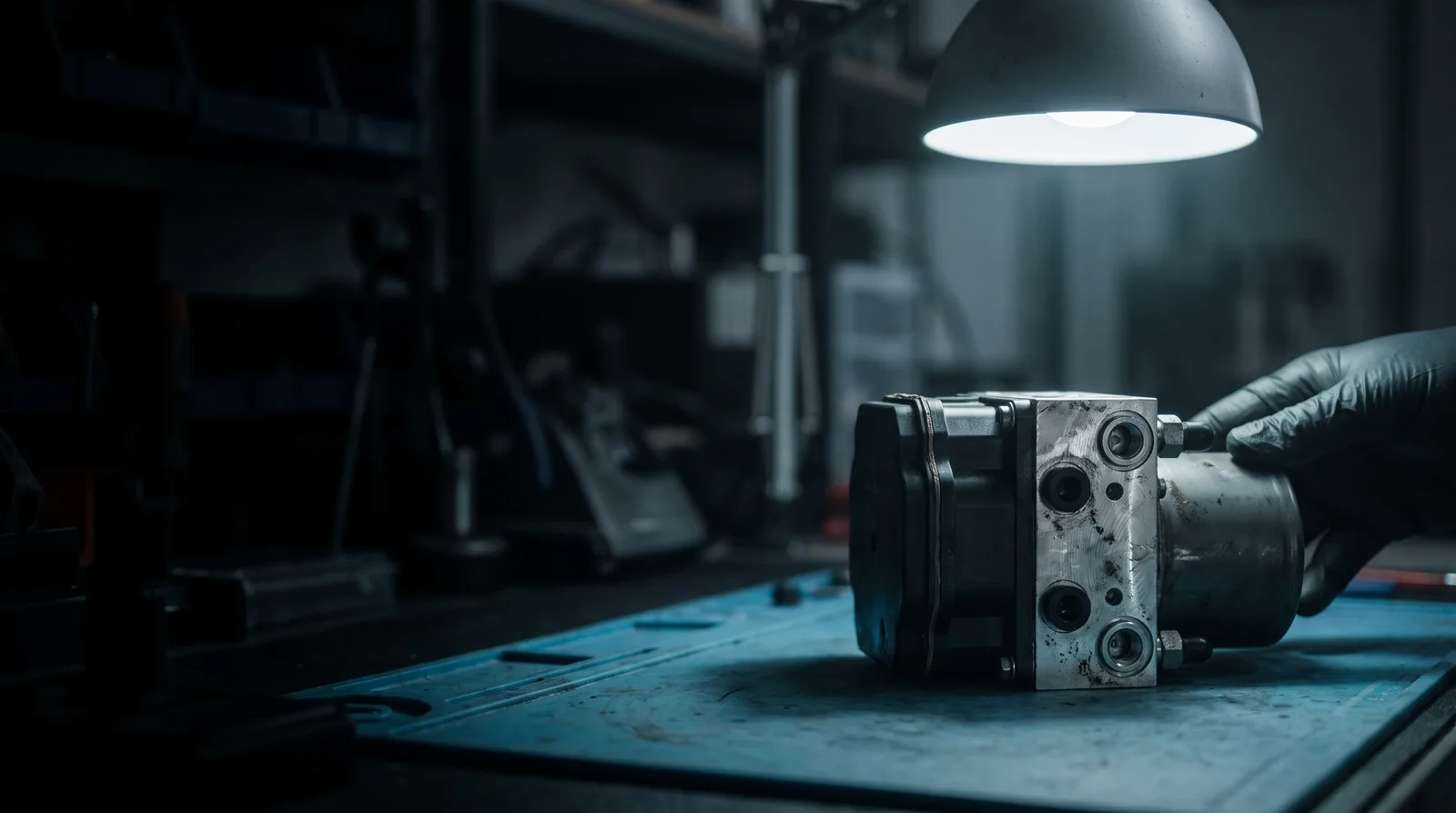
The Teves MK70 — also called the ATE or Continental Teves MK70 ABS/ESP module — is the pump, hydraulic block and control unit that run your anti-lock brakes and stability system. When it fails we rebuild your original unit, permanently curing the G201 design flaw, and return it self-calibrating with no coding and a lifetime warranty.
What is the Teves MK70 (ATE) ABS pump (and what it's also called)?
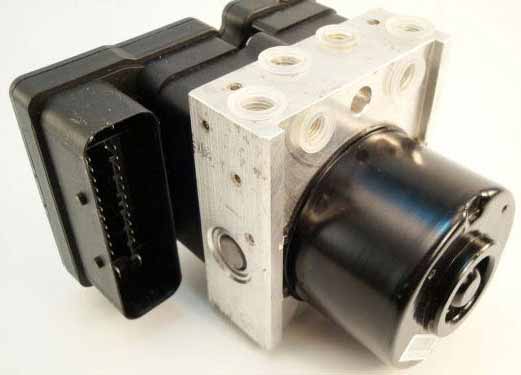
The Teves MK70 is the unit that runs your car’s anti-lock braking system (ABS) and, where the vehicle has it, the electronic stability programme (ESP) as well. It is the development of the earlier Teves MK60, and because the same component is fitted across so many makes it goes by several names. ATE MK70, Continental Teves MK70, the ABS pump, the ABS module, the ABS ECU and the ESP pump are all the one part — and many garages and parts catalogues label it the EBCM, the Electronic Brake Control Module.
Whatever it is called, the unit is built from three parts that depend on one another. The pump motor keeps the brake circuit pressurised so the system can act the instant it is needed. The hydraulic control unit (HCU) is the aluminium block of valves and channels that meters brake pressure to each wheel. The ABS ECU is the electronic brain: it reads the wheel-speed sensors and the internal brake-pressure sensor, decides what each wheel needs, and drives the valves and the pump to deliver it.
On a car with stability control the ECU does more again, working with the steering and yaw inputs to brake individual wheels and keep the car pointing where it is steered. That side carries different badges by make — ABS, ESP, ASR, TCS and on some cars DCS — which is why one fault inside this single module can light the ABS, traction and stability warnings together.
Mechanically the MK70 is a tidier unit than the MK60 it replaced — more compact, lighter, with a more powerful pump motor. What it did not change is the part that gives the most trouble. Unlike Bosch’s later units it kept a conventional circuit board rather than moving to ceramic, and it carried over the MK60’s design weakness: an internally built brake-pressure sensor with a low maximum-pressure rating. That carried-over flaw is behind the failure we see most on these units, and it is the one we cover next.
Symptoms of a failing Teves MK70 ABS pump
A Teves MK70 often warns you before it fails outright — the dashboard lights come and go for a while before the fault settles in for good. Because this is part of the braking system, those early warnings are worth acting on rather than waiting for them to clear. The symptoms we see most often are:
- ABS warning light on — steady, or flickering on and off as the fault comes and goes.
- ESP, ASR, TCS or DCS (traction/stability) warning light on — often alongside the ABS light rather than on its own.
- Brake-pressure-sensor fault stored — the G201 implausible-signal fault that is the hallmark of this unit.
- No communication with the module — a diagnostic scan tool cannot talk to the ABS ECU at all.
- Wheel-speed sensor faults logged — frequently stored even when the sensors themselves test sound.
- Traction and stability control behaving oddly, cutting in when it should not, or dropping out altogether.
None of these should be left to drift. A failing Teves MK70 can switch off ABS and stability control together — the very systems that help you stop in an emergency and keep grip in the wet. Your ordinary brakes will usually still work, but a lit ABS or ESP warning means a safety system has gone offline, so have the car diagnosed promptly rather than driving on it.
The G201 brake-pressure-sensor fault (DTC 01435) — the common Teves MK70 failure
If there is one fault that defines the Teves MK70, it is the brake-pressure sensor — known on VAG vehicles as G201. The MK70 carries this sensor built inside the ABS module itself, and the version fitted has a low maximum-pressure rating. Over time it drifts out of tolerance and starts sending the ECU a reading it cannot trust, which is exactly the weakness the unit inherited from the MK60.
On Audi, SEAT, Skoda and VW cars that failure logs as fault code 01435 — Brake Pressure Sensor 1 (G201). It most often appears as an “implausible signal”, though the same code can also be stored as an electrical fault in the circuit or as a missing basic setting. Typically it brings on the ABS and traction or stability warning lights, and on some cars a warning chime at start-up. People searching “G201”, “01435” or “brake pressure sensor ESP fault” are almost always chasing this one problem.
It is worth ruling out the cheap causes first. The 01435 code can also be triggered by a faulty or maladjusted brake-light switch rather than the sensor itself, and the switch is a far simpler item to check and set than anything inside the module. A proper diagnosis confirms the switch and its wiring are sound before the module is condemned — which is what we do on test, so you are never paying to rebuild a unit that was not the problem.
Where the G201 sensor genuinely is the fault, the catch is that it is not a bolt-on part on the MK70 — it sits inside the module, so it cannot simply be unplugged and swapped at the roadside. And fitting a standard replacement only resets the clock, because that unit carries the very same low-rated sensor that failed first time around. That is the problem our repair is built to solve permanently, covered in the next section.
Sinspeed · mail-in repair
Send us the ABS unit rather than replacing the whole assemblyFill in the repair form with your vehicle details and the fault codes your scanner is showing. Our engineers strip the module, repair the failed circuit or valve driver and test it on our in-house Hardware-in-the-Loop rigs before it goes back to you.
Lifetime, unlimited-mileage warranty on all remanufactured parts · Mail-in, UK-wide · Tested on Hardware-in-the-Loop rigs before dispatch
What causes Teves MK70 failure?
Most Teves MK70 failures are electronic rather than hydraulic, building up gradually under years of heat cycling and vibration. Alongside the G201 brake-pressure sensor above, the complaints we see most are wheel-sensor faults and loss of communication with the ABS ECU — and they turn up across every make that uses the unit, regardless of badge.
The wheel-sensor faults usually trace back to the circuit board inside the module rather than the sensors on the hubs. Components on the board — in particular its processors — break down and interrupt the wheel-speed signals on their way into the ECU. Renewing these is genuinely specialist work: each processor carries 128 connections to the board and sits against a large heat sink, which is why it cannot be renewed reliably without the right equipment, and why the unit has to be proven under load afterwards rather than simply refitted.
The same board components are usually behind the no-communication and CAN-bus faults, where a diagnostic tool can no longer talk to the ABS ECU at all. Less often the trouble is the pump motor, which can suffer where moisture or leaking brake fluid has found its way inside. Water-damaged motors cannot always be repaired — in those cases a fully remanufactured exchange unit is the answer.
This is also where a good diagnosis earns its keep, because not every “ABS fault” is the module. A surprising number of these codes trace to the battery’s bolt-down power fuse, which can look perfect and still be the cause, or to a corroded plug or harness. We rule those out on test before any module is condemned, so the repair fixes the real fault rather than replacing a unit that was never at fault.
Can the Teves MK70 be repaired, or must it be replaced?
Most main dealers and general garages will tell you a failed Teves MK70 has to be replaced. For them that is usually true — it is a sealed module and they are not equipped to repair it at component level. A specialist remanufacturer is, and that changes the picture completely.
Replacement carries real drawbacks. A new module is expensive, a salvage-yard unit is a gamble — many have water damage and cannot be relied upon — and a replacement normally has to be coded to the vehicle before the brakes will work properly. Worse, a like-for-like unit brings back the same low-rated G201 sensor that failed first time, so you have bought yourself the same fault a second time.
We repair your original unit instead — and on the Teves MK70 we do more than simply put the failed part back to standard. When we rebuild one of these modules we look for the flaw in the original design, and rather than refit the same low-rated brake-pressure sensor we modify and uprate the unit so the weakness that caused the failure is permanently rectified. The rebuilt module is brought back to exceed its original specification, so the G201 fault that brought it to us does not come back.
The work is carried out at circuit-board level by our in-house team of electronic and hydraulic engineers, using new genuine OEM components. Every unit is then proven on our in-house Hardware-in-the-Loop (HIL) test rigs, which recreate the heat, vibration and electrical load the module sees in service — so an intermittent fault that would otherwise reappear on your driveway shows itself on the bench, where we put it right before the unit goes back to you. The repair is backed by a lifetime warranty with no mileage limit.
Do I need programming? Self-calibrating exchange units
No. Keeping your own unit is the single biggest advantage of repairing rather than replacing a Teves MK70. Because we rebuild the module that is already coded to your car, its configuration stays intact — so when it comes back there is nothing to programme. You refit it, and the car is ready to go.
We have rebuilt thousands of these units, and for many of the common applications we hold remanufactured exchange units on the shelf for a faster turnaround. Our exchange units are self-calibrating, so they too go on without dealer programming — you avoid the coding cost and dealer trip a new replacement module would mean.
Some MK70 installations do call for a basic setting or a system re-initialisation as part of refitting. Where any calibration of that kind is needed, we carry it out before the unit leaves us, so what arrives back is ready to fit. If you would rather not handle the unit at all, we also offer a fitting service — and either way the work is covered by a lifetime warranty.
Which vehicles use the Teves MK70?
The Teves MK70 is fitted to a very wide range of vehicles across almost every major manufacturer — Audi, Citroën, Ford, Mazda, Nissan, Peugeot, Renault, SEAT, Skoda, Suzuki, Toyota, Vauxhall and Volkswagen among many others. The full list of models we have seen this unit fitted to is below.
| Vehicle | Vehicle | Vehicle | Vehicle |
|---|---|---|---|
| Audi A3 | Ford Transit | Renault Laguna | Suzuki Swift |
| Citroen C2 | Mazda 2 | Renault Twingo | Toyota Yaris |
| Citroen C3 | Mazda 3 | Seat Altea | Volkswagen (VW) Caddy |
| Daihatsu Sirion | Nissan Pixo | Seat Leon | Volkswagen (VW) Eos |
| Ford C-Max | Opel / Vauxhall Agila | Seat Toledo | Volkswagen (VW) Golf |
| Ford Fiesta | Opel / Vauxhall Astra | Skoda Octavia | Volkswagen (VW) Jetta |
| Ford Focus | Opel / Vauxhall Zafira | Skoda Superb | Volkswagen (VW) Touran |
| Ford Fusion | Peugeot 206 | Skoda Yeti | |
| Ford KA | Peugeot 207 | Suzuki Alto | & Many More.. |
Not certain the Teves MK70 is the unit you have? The Bosch 5.7 and Bosch 8.0 are different ABS pump generations that can look similar and share many of the same symptoms. If yours might be one of those, see our Bosch 5.7 ABS/ESP pump module repair and Bosch 8.0 ABS/ESP module repair services, or browse our full ABS pump and module repair category — and if you are still unsure, send us the details and we will identify it for you.
How our repair service works
Our Teves MK70 repair is a mail-in, repair-and-return service. There is no need to bring the car anywhere — you send us the module and we return it ready to fit.
- Get in touch. Tell us your vehicle and what it is doing through our repair form, or contact us if you are not sure which unit you have, and we will confirm what to send.
- Remove and send your unit. Disconnect and remove the Teves MK70 module and post it to us — we will tell you exactly what we need and how to pack it safely.
- We test and diagnose. Your unit is bench-tested on our Hardware-in-the-Loop rigs to confirm whether the module itself is at fault, and we report what we find before any work goes ahead.
- We remanufacture. Our in-house engineers carry out the board-level repair, renewing the failed components with new genuine OEM parts and uprating the G201 weak point so the original design flaw is permanently rectified.
- We return it ready to fit. The repaired module comes back coded to your car as it was, self-calibrating where an exchange unit is supplied, and covered by a lifetime warranty.
All of this is carried out in a cleanroom-standard, ESD-safe workshop using dealer-level diagnostic tools. If you would rather not remove or refit the unit yourself, we can arrange professional fitting at competitive rates — just ask when you get in touch.
FAQs
What does the G201 / 01435 fault code mean on a Teves MK70?
On a VAG car, 01435 is the fault for Brake Pressure Sensor 1 (G201), most often stored as an implausible signal. On the Teves MK70 that sensor is built inside the module and has a low maximum-pressure rating, which is why it is the most common failure on these units. It still needs confirming on test, because a faulty brake-light switch or its wiring can produce the same code.
Will the G201 fault just come back after the repair?
That is exactly what we set out to prevent. Rather than refitting the same low-rated sensor, we modify and uprate the unit so the original design weakness is permanently rectified, and the repair is backed by a lifetime warranty with no mileage limit.
Will I need to code or programme the unit after the repair?
No. Because we repair the module already married to your car, it is returned ready to refit with nothing to programme. Our self-calibrating exchange units go on without dealer programming too — where any basic setting is needed, we carry it out before the unit leaves us.
Is it safe to drive with the ABS or ESP light on?
Your ordinary brakes still work — the system is designed so that a fault leaves you with normal braking rather than none. But you lose the anti-lock and stability assistance that help you stop and hold the road in an emergency or in the wet, so a lit ABS or ESP warning means a safety system has switched off. Have the car diagnosed promptly rather than driving on it.
How do I know whether it is the module, a wheel-speed sensor or something else?
Often you cannot tell from the symptoms alone, because a failing module and a faulty sensor can store very similar codes — and some “ABS” faults trace to a cracked battery fuse or a corroded plug rather than the unit at all. That is why we bench-test the unit to confirm whether the module itself is at fault before any repair is agreed, so you are not paying to fix the wrong thing.
Sinspeed · mail-in repair
Get the fault confirmed before you spend anythingTell us the symptoms and the codes your scanner is showing. Our engineers will tell you what they expect to find and what the repair involves.
Your own unit remanufactured, not a like-for-like replacement · Lifetime, unlimited-mileage warranty · Dealer-level programming and calibration