
Summary: Most car air conditioning problems come down to one of three things: refrigerant lost through a leak, a fault that stops heat escaping or air moving, or a compressor that has stopped pumping. The first two are garage jobs, and a regas is often part of the fix. The compressor is different — a regas will not bring it back, and it is the part we bench test and rebuild when your garage sends it in. The symptom table below shows which of the three you are most likely facing.
- How does car air con work, and where does it go wrong?
- Car air conditioning problems by symptom
- Low gas and leaks: why a regas comes first
- Faults that are not the compressor
- Air con compressor failure symptoms
- Why air con compressors fail
- Regas or compressor? When a regas will not fix it
- What happens when the compressor is the fault
- Car air con questions, answered
- Final thoughts
How does car air con work, and where does it go wrong?
Car air con moves heat rather than making cold. Refrigerant picks up heat from the cabin air at the evaporator behind the dashboard, carries it to the front of the car and sheds it through the condenser, then comes back for more. The compressor is the pump that keeps that loop moving — driven by the engine’s auxiliary belt on most cars, and electrically from the high-voltage battery on hybrids and electric cars.
Every fault on this page breaks that loop at one point. Finding the point is the diagnosis.
- Compressor: turns low-pressure refrigerant gas into hot, high-pressure gas and keeps it circulating. Its lubricating oil travels round the system with the refrigerant.
- Condenser: the radiator-like panel in front of the engine radiator where the heat leaves, cooled by road speed or an electric fan.
- Expansion valve and drier: the valve drops the pressure so the refrigerant can boil and absorb heat; the drier traps moisture and debris.
- Evaporator and blower: the cold core inside the dashboard, and the fan that pushes cabin air across it through the cabin filter.
- Refrigerant: R134a on older cars, R1234yf on most newer ones. They are not interchangeable.
It is more than a comfort feature. Air con dries the air as it cools it, which is why it clears a misted windscreen so quickly — a failed system makes wet-weather visibility harder to keep on top of.
Car air conditioning problems by symptom
Start from what the car is doing. The third column separates the faults that genuinely are the compressor from the far larger number that only look as if they might be.
| Symptom | Likely cause | Is it the compressor? | First check |
|---|---|---|---|
| Cooling fades slowly over months | Gradual refrigerant loss | No | Pressure and leak test before any regas |
| Cold on the move, warm in traffic | Condenser fan not running, or a clogged condenser | No | Whether the fan runs with the air con on |
| Cold after a regas, warm again within weeks | An active leak — pipe joints, condenser, evaporator, occasionally the compressor’s shaft seal | Rarely | Dye or nitrogen leak test, not another regas |
| Clutch never clicks in; air stays warm | Low pressure holding it off, a fuse, relay or pressure sensor, or a worn clutch | Sometimes — once gas and supply are ruled out | Static pressure, then the clutch supply |
| Warm air on a full charge; pressures barely move with the air con on | Compressor not pumping: internal wear or a failed control valve | Yes, most likely | Running pressures on gauges |
| Grinding or knocking only with the air con on | Internal compressor wear | Yes | Switch the air con off and have it inspected before it seizes |
| Squeal as the air con switches on | Belt slipping under load, or a compressor starting to drag | Possibly | Belt condition, and whether the compressor turns freely |
| Musty smell, or water in the front footwell | Mould on the evaporator, a blocked drain, an old cabin filter | No | Evaporator drain, cabin filter, evaporator clean |
| Cold air, but weak flow | Blocked cabin filter, or the blower motor or its speed controller | No | Airflow at each fan speed |
Three rows point firmly at the compressor, and the clearest of them — pressures that barely move when the air con is switched on — needs gauges to confirm. Everything else is more common and worth ruling out first.
Low gas and leaks: why a regas comes first
No car system is perfectly sealed. Refrigerant seeps slowly through hose walls and seals, so a car that cooled hard when new can lose its edge with no single fault. That gradual fade is what a regas is for: the old charge is recovered, the system is held under vacuum to prove it is tight, and the manufacturer’s weight of refrigerant and oil goes back in.
Faster loss means a leak. Condensers take stone chips behind the grille, pipe joints and seals dry out, and evaporators corrode out of sight inside the dashboard. Regassing a leaking system buys weeks at best, so the leak test belongs before the recharge.
Low gas matters to the compressor too. Its oil travels with the refrigerant, so a system running short starves the pump; the pressure switch or sensor that stops the compressor engaging on a nearly empty system is there to protect it.
Faults that are not the compressor
Condenser fan. At speed, air is forced through the condenser for free; in traffic an electric fan has to do the work. When that fan stops, the air con cools on the motorway and goes warm in a queue. The condenser shares the front of the car, and often its fan, with the engine radiator, so the same fault can nudge the temperature gauge up — our guide on how to prevent your car from overheating covers that side.
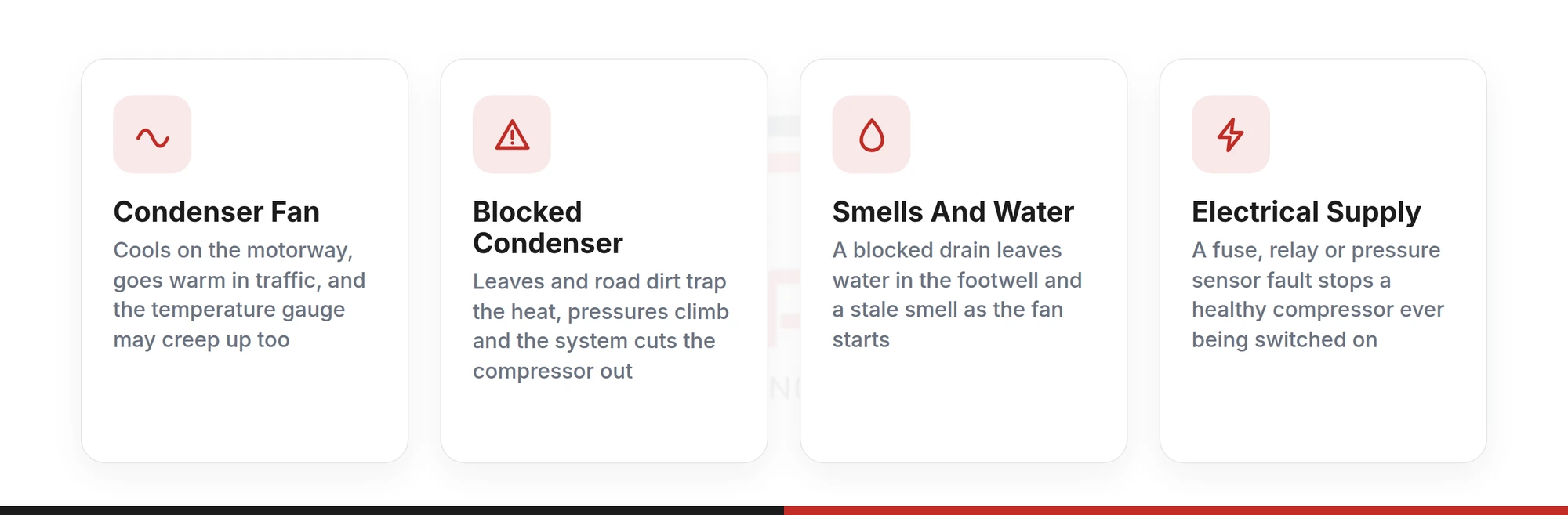
Blocked condenser. Leaves, road dirt and insects packed between condenser and radiator stop heat escaping. Pressures climb, and the system may cut the compressor out to protect itself.
Smells and water. Moisture condenses on the evaporator whenever the air con runs and should drain out under the car. If the drain blocks, water collects in the case, can reach the front footwell, and mould grows on the evaporator — the stale smell as the fan starts. An evaporator clean and a fresh cabin filter deal with it.
Electrical supply. A fuse, relay or failed pressure sensor can stop a healthy compressor ever being switched on, because the climate control will not run the pump if it cannot read system pressure.
Sinspeed · air con compressor repair
Warm air, and a regas already tried?If the table points at the compressor, put the make, model, what the air con is doing and what has been checked so far on the repair form. We will give you a straight view on whether the compressor is the likely culprit.
Compressors bench tested to confirm the fault · Rebuilt with genuine OEM components
Air con compressor failure symptoms
A failing compressor usually shows itself in one of four ways, and which one tells your garage a lot about what else in the system needs attention.
The clutch will not engage
On a belt-driven compressor with a clutch, switching on the air con should bring a click and set the centre plate of the pulley turning. If it never does, the compressor may still be innocent: low pressure, a fuse, a relay or a pressure sensor will all keep the clutch off. It comes into the frame once the charge and the supply are proved good and the clutch still will not pull in — heat and wear eventually defeat the coil and the friction faces.
Many newer compressors have no clutch at all. The pulley turns whenever the engine runs and output is controlled inside the pump, so there is no click to listen for.
Noise with the air con switched on
Grinding, rumbling or knocking that starts with the air con and stops when it is switched off is coming from inside the compressor, usually where lubrication has broken down and moving parts have begun to wear. Switch the air con off and have it looked at: a grinding compressor is shedding metal into the system. A rumble that carries on with the air con off points more to the pulley bearing, which spins with the engine regardless.
Seized
A compressor that locks up either sets the belt squealing or, on a clutched unit, makes the clutch slip and overheat. Clutchless designs usually have a pulley built to break its drive if the pump seizes, so the belt keeps turning everything else. Either way, a seizure generally means debris has already travelled round the system.
Turning, but not pumping
This is the quiet failure, and the one most often mistaken for low gas. The compressor turns, there is no noise and no warning light, yet the air stays warm and the pressures hardly move when the air con is switched on. It is the classic presentation of the Sanden PXE16 fitted across VW Group cars: no change in engine sound, nothing on the dashboard, simply no cold air.
On variable-output compressors, how hard the pump works is set by a control valve that the climate control drives electrically. When that control fails, the pump sits at minimum output and behaves exactly like a system short of gas — which is why these cars are often regassed more than once before anyone measures what the compressor is actually doing.
Why air con compressors fail
A compressor seldom fails without a cause, and the cause decides what else needs doing when it is repaired.
- Lubrication loss. A leak or a long spell on a low charge starves the pump of oil. On some designs the shortfall is built in: the VW Group compressor behind many Golf Mk5 air con faults suffers from a lack of lubrication inside the unit, leading to metal fatigue and, in the end, a broken shaft.
- Contamination. Moisture from a system left open or leaking reacts with the oil to form acids, and metal particles from one failure are carried round to block pipes, the expansion valve and the drier.
- Clutch and bearing wear. The clutch coil runs hot, and the friction faces and pulley bearing wear with every engagement and every mile.
- Control faults. On variable-output units the electrically driven control valve can fail on its own, leaving a mechanically sound pump that no longer responds.
- Weak original designs. Early revisions of the Denso 7SEU17C fitted to Mercedes models failed often enough to be superseded, and the Sanden SD6V12 on BMW Mini models is another known common failure.
Regas or compressor? When a regas will not fix it
A regas answers one question: was the system short of refrigerant? If it was and nothing is leaking, the regas is the fix. If the compressor has stopped pumping it cannot help — the charge will be correct and the vents will still blow warm.
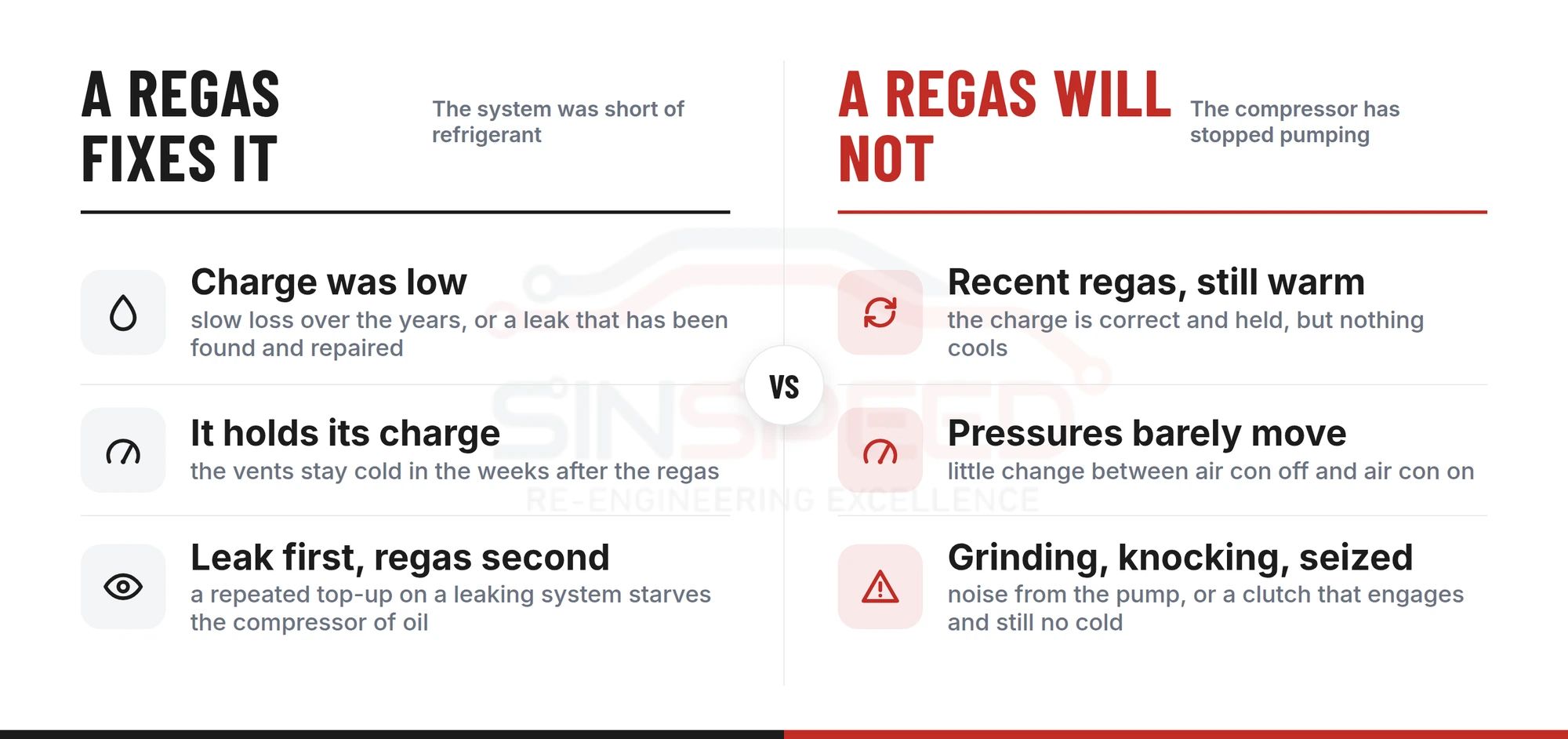
A regas is unlikely to be the answer when:
- the car was regassed recently, has held its charge, and still does not cool;
- the pressures barely change between air con off and on;
- the compressor grinds, knocks or has seized;
- the clutch engages normally, or there is no clutch, and the air stays warm on a correct charge.
The reverse catches people out. A leaking system regassed again and again runs its compressor short of oil between visits, so the quick fix, repeated, can become the reason the compressor fails. Leak first, regas second.
What happens when the compressor is the fault
Your garage removes the compressor and posts it to us. We bench test it to confirm the failure and find what caused it, then rebuild it with genuine OEM components — or, where a superseded design is the better answer, supply a replacement unit instead, since we stock both. Either way it goes back ready for your garage to fit, and our air conditioning repair range lists compressors by type and vehicle.
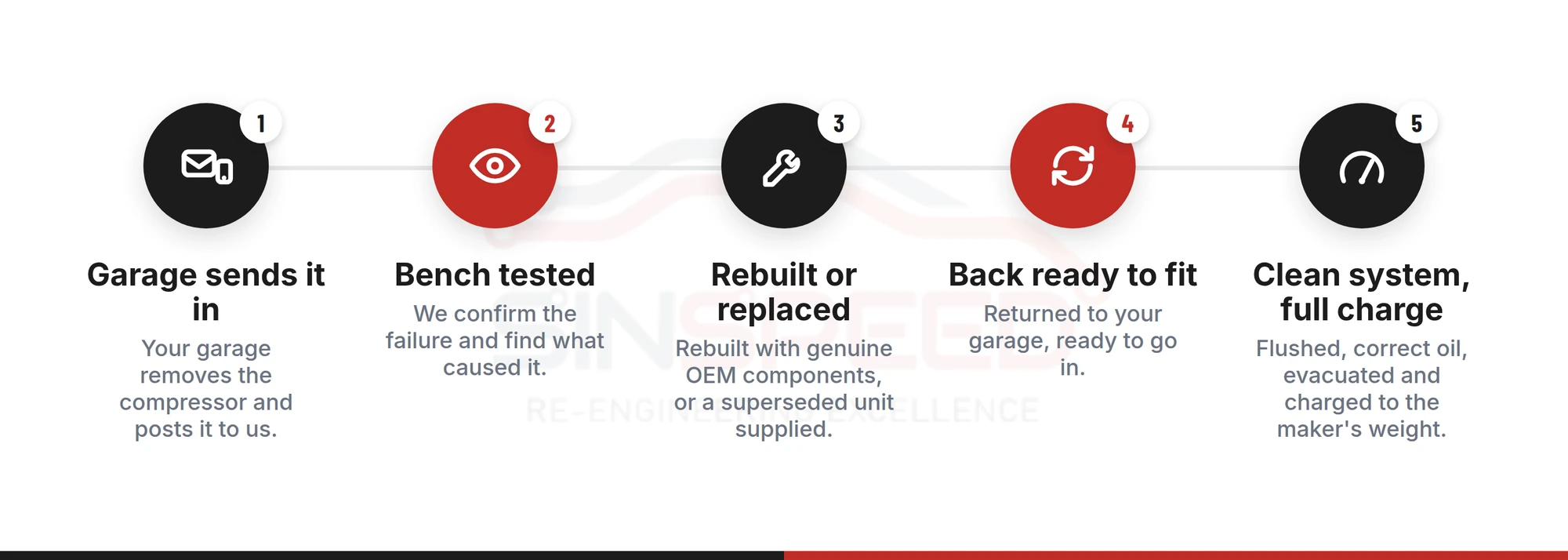
Refitting after a compressor failure is more than bolting it in, and each step is part of the job rather than an extra. The system is flushed to clear debris, the drier and expansion valve are renewed where contamination has reached them, the correct oil goes in, and the system is evacuated and charged to the manufacturer’s weight. That gives the rebuilt compressor a clean system to work in.
Car air con questions, answered
Is car air conditioning checked at the MOT?
No. Air con is not part of the MOT test, and a routine service does not always include it either, so a fault can go unnoticed until the first warm day. It still earns its keep in winter: because the system dries the air, it clears a misted windscreen far faster than the heater alone.
How often does car air con need a regas?
There is no single interval for every car, but many manufacturers and garages suggest servicing the system roughly every two years; your handbook gives the figure for your model. A system that needs topping up much more often than that has a leak, and the leak is the job.
Can an air con compressor be repaired, or does it need replacing?
Many can be repaired. We bench test the unit your garage sends in, find why it failed and rebuild it with genuine OEM components. Where the original design is known to fail and a superseded version exists, a replacement unit can be the better answer, and we supply those too — the bench test decides which.
Will a failed compressor damage the rest of the air con system?
It can. A compressor that fails mechanically sheds fine metal particles that travel round the system and block pipes, the expansion valve and the drier. That is why fitting a compressor after a failure includes flushing the system and renewing the drier and expansion valve where they are contaminated — otherwise the debris can damage the next compressor.
Can I drive with a broken air con compressor?
Usually, provided the pulley still turns freely and the belt is intact — with the air con switched off, the car will generally run as normal. A compressor that has seized or is grinding is different: on many engines the same belt drives the alternator and water pump, so a seizure that damages the belt affects more than the air con. Have it checked promptly rather than waiting for summer.
Sinspeed · compressor rebuilds
Compressor confirmed as the fault?Send us the make, model and engine, and what the air con does when it is switched on. Your garage removes the compressor and posts it in; it comes back tested and ready to refit, with the system work around it explained.
Bench tested before it leaves · Rebuild or superseded replacement, whichever the fault calls for
Final thoughts
Most car air con complaints turn out to be gas, airflow or heat with nowhere to go, and a garage with a leak tester and a set of gauges settles them. The compressor is the exception worth learning to spot: warm air on a correct charge, a noise that follows the air con switch, or a pump that turns without moving the pressures.
Catch it at that stage, stop running it, and the rest of the system has a far better chance of coming through the repair intact.