
Summary: P0171 is not a complaint about a part. It is the engine control unit reporting that it has spent its whole fuel-trim authority — adding fuel, then learning to add more of it, to correct a mixture the upstream lambda sensor keeps reading as lean — and still cannot bring the mixture back to target. Read that way, the code does a good deal of the diagnostic work for you, because everything capable of setting it either lets in air the ECU never measured or withholds fuel it believes it delivered, and the live trim figures say which half you are in. This page works through both: what the trims mean at idle against under load, the causes on each side, the UK engines this keeps happening to, and the parts most often replaced for a P0171 that were never at fault. Some of that ends at a unit we rebuild on the bench. A good deal of it ends at a split hose, and the page says so rather than pretending otherwise.
- What a P0171 fault code actually means
- Fuel trim: the number P0171 is really a complaint about
- What a lean-running engine feels like to drive
- What causes a P0171: air the ECU never saw, or fuel that never arrived
- The UK engines where P0171 keeps coming back
- How a P0171 is diagnosed, in order
- The parts replaced first that are rarely the fault
- What the rest of the scan narrows down
- When lean running gets blamed on the gearbox
- Is P0171 a diesel code?
- Can you keep driving with a P0171?
- How much does it cost to fix a P0171?
- How a P0171 is actually fixed
- P0171 FAQs
- Final thoughts
What a P0171 fault code actually means
P0171’s official description is System Too Lean, Bank 1, and the load-bearing word in it is system. The code does not name a part. It names a state the engine control unit has ended up in.
A petrol engine running in closed loop holds its mixture against a target ratio, and the upstream lambda sensor in the exhaust is what tells the ECU whether it is hitting that target. When the sensor reports lean, the ECU injects a little more fuel. That correction is fuel trim, and the ECU is allowed only so much of it. P0171 is stored at the point where it has used all of that allowance, for long enough and consistently enough to be sure, and the mixture is still reading lean.
So the code is a statement about the correction rather than about the cause. The engine has been running lean for some time before the lamp comes on, quietly, absorbed by the trims. The code records the moment the absorbing ran out.
Two things follow that are worth having straight before anything is unbolted. The first: P0171 does not prove the engine is getting too much air. It proves the mixture is being reported lean, and an exhaust leak ahead of the lambda sensor produces exactly that complaint on an engine which is fuelling perfectly well. The second: a lean ratio can be a fuel shortage as easily as an air surplus. The ratio moves the same way whichever end of it changes, and the code cannot tell you which end moved.
“Bank 1” means the side of the engine containing cylinder number one. A four-cylinder has only one bank, so P0171 covers the whole engine and its counterpart P0174 will never appear on one. On a V6 or V8 the two can arrive together, and whether they do is one of the more useful things in the whole scan. Some scan tools and parts listings print the code as PO171 with a letter O, or simply as 0171; it is the same generic OBD-II code and it means the same thing on any make.
Fuel trim: the number P0171 is really a complaint about
If you read one live value on a P0171, read the fuel trims. They are the only figures on the scan tool that describe the fault rather than its consequences, and the pattern they make across different engine loads narrows the cause further than any other single test.
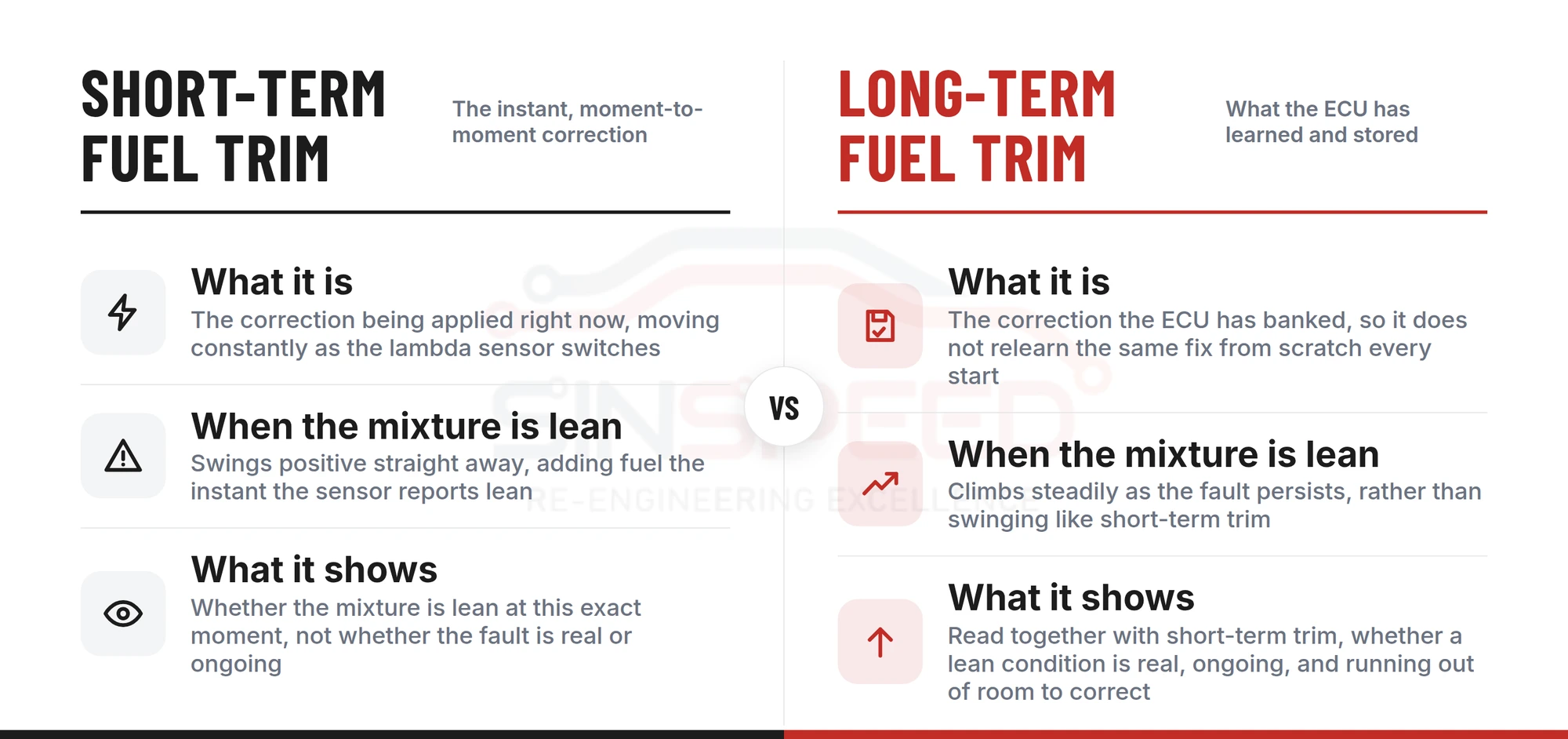
There are two of them. Short-term fuel trim is the correction being applied at this instant, moving constantly as the lambda sensor switches. Long-term fuel trim is what the ECU has learned and stored, so it does not have to work the same correction out from scratch every time you start the car. Positive numbers mean fuel is being added because the mixture is reading lean. Negative numbers mean fuel is being taken away.
Read them warm, and read them twice: once at a settled idle, and once at a steady load, which usually means a constant throttle opening at cruising speed. A cold engine runs rich by design and its trims are not evidence of anything. What matters is how the correction changes between those two conditions, because different faults scale differently with airflow.
| What the trims do | What that points at | What settles it |
|---|---|---|
| Strongly positive at idle, close to normal under load | A fixed-size air leak downstream of where the air is measured. At idle the engine breathes very little, so a small leak is a large share of it; under load the same leak is close to a rounding error. | A smoke test through the intake with the throttle closed. |
| Positive at idle and worse as load rises | A proportional error rather than a fixed one — an air flow sensor reading low across its range, or a fuel supply that cannot keep pace. | The live airflow figure against the manufacturer’s value for that engine, then fuel pressure and delivery under demand. |
| Near normal at idle, climbing only at high load | Fuel delivery reaching its ceiling: a tiring pump, a restricted filter, partly blocked injectors or a failing pressure regulator. | Fuel pressure and volume measured with the engine working, not idling. |
| Positive everywhere, yet the car smells rich and the plugs are sooty | The ECU is being told lean by something that is wrong. Most often an exhaust leak ahead of the lambda sensor, drawing fresh air onto it; sometimes a lazy or biased sensor. | Inspect the exhaust joints ahead of the sensor, and watch the sensor switching on live data. |
| Trims near normal with P0171 stored | The condition is intermittent, or specific to something you were not doing when you looked. | The freeze-frame data captured when the code set — then go back and reproduce those conditions. |
Rows two and three are the pair that catch people out, and it is worth being honest about it: both get worse as the engine works harder, so the trim pattern alone will not separate a sensor reading low from a fuel supply falling behind. That one is settled by measurement rather than inference — the live airflow figure compared against the manufacturer’s number for that engine, and fuel pressure and delivery checked while the engine is genuinely being asked for fuel rather than ticking over on a forecourt.
What a lean-running engine feels like to drive
A lean mixture disturbs how cleanly and evenly the engine burns, so the symptoms show up in how it idles, pulls and drinks. You may have one of these or several together.
- The engine management lamp — usually the reason the code gets read at all. A steady lamp is a stored fault; a flashing one is an active misfire and means something different, dealt with further down.
- A rough, lumpy or hunting idle, sometimes stalling as you come to a stop. Classically worse when the air-conditioning compressor cuts in, because the extra load exposes a mixture that was only just holding together.
- Hesitation or a stumble on acceleration — a flat spot pulling away from a junction, worst when the engine is warm.
- A faint hiss under the bonnet at idle, which on a quiet driveway is often the leak announcing itself before any tool is plugged in.
- Economy sliding over several weeks with no change in how or where you drive, as the ECU quietly adds fuel to compensate.
- A noticeable loss of power, most obvious under load: uphill, loaded, or overtaking.
- Hard starting, or a stall shortly after start-up, particularly when the engine is cold.
- An occasional cough back through the intake when accelerating hard from low revs.
None of these names a part. A rough idle comes from a split breather hose exactly as readily as from a contaminated air flow sensor, and the two need entirely different work. What the symptoms confirm is that the engine is running lean. Everything after this point is about finding out why.
What causes a P0171: air the ECU never saw, or fuel that never arrived
This is where generic code lookups stop being useful, because they hand you an undifferentiated list of eight parts. The code’s own logic sorts that list for you. A mixture goes lean because the cylinder received more air than the fuelling accounted for, or less fuel than the fuelling intended — and there is a third possibility, which is that neither happened and the measurement is lying. Four families, and knowing which one you are in decides what gets tested first.
Air the ECU never measured. This is the commonest family by a wide margin. Air enters the engine after the point at which it was metered, so the ECU never counts it and never fuels for it.
- A split or perished vacuum hose, or a brake servo hose that has hardened at the union.
- A torn crankcase ventilation (PCV) diaphragm — on many modern engines this is built into the rocker or cam cover rather than sold as a separate valve.
- A leaking or distorted intake manifold gasket, and on some engines a cracked plastic manifold itself.
- A split intake boot between the air flow sensor and the throttle, or on a turbocharged engine a split charge pipe or a weeping intercooler joint.
- A worn throttle-body shaft seal or base gasket, letting air past the plate rather than through it.
- Small and frequently missed: a dipstick not seated, or an oil filler cap with a perished seal.
Air that was measured, but measured wrongly. Nothing is leaking here. The air path is intact and the number describing it is wrong, so the fuelling is wrong by the same amount.
- A contaminated mass air flow sensor. This is the one part on the whole list that produces a lean condition without a leak anywhere. Its heated element gives up heat to the air going past it; a film of oil mist or dust insulates that element, so it sheds heat more slowly, so it reports less air than is really flowing. The ECU fuels for the smaller figure, the mixture goes lean, the trims climb positive, and P0171 stores — frequently with an airflow code of its own alongside it. If your scan carries both, what a contaminated air flow sensor does to the fuelling sets out the direction of that error and how the trims separate it from a leak.
- A coked or sticking throttle body. Carbon around the butterfly and in the bore changes what actually reaches the engine and upsets idle control, and on a drive-by-wire throttle an electronic fault does the same by another route. Where the scan carries throttle codes alongside the lean one, work through what a coked or sticking throttle plate sets on its own before anything is condemned.
- Carbon in the exhaust gas recirculation path. The fuelling map for many engines assumes the intake charge is diluted with a measured amount of inert exhaust gas. When those passages soot up, the cylinder gets more fresh air than the map expects, and the result at the lambda sensor is a lean reading. The next section covers the engines where this is close to a signature fault.
- A manifold pressure sensor drifting, on engines that calculate airflow from pressure and engine speed rather than measuring it directly.
Fuel that never arrived. The air side is honest and the fuelling cannot keep up with what the ECU is commanding.
- A tiring fuel pump that holds pressure at idle and falls away under demand.
- A restricted fuel filter, on the vehicles that still have a serviceable one.
- Partly blocked or leaking injectors, delivering less than the commanded quantity.
- A failing fuel pressure regulator, so rail pressure sits below specification.
A measurement that was never true. Small family, badly under-diagnosed, and the reason plenty of P0171s survive an otherwise competent repair.
- An exhaust leak ahead of the upstream lambda sensor. Exhaust pulses draw fresh air in through the leak, the sensor sees the oxygen and reports lean, and the ECU adds fuel the engine never needed. The engine ends up running genuinely rich while the code says lean.
- A lazy or biased lambda sensor. One that switches slowly, or sits offset, can bias the trims and store a lean fault on a correctly fuelling engine. This is a diagnosis made on live data, not on age or mileage.
Because four families of cause produce one identical code, replacing parts on a hunch is how a P0171 becomes expensive without ever becoming fixed. The order things are checked in matters more than the checks themselves.
The UK engines where P0171 keeps coming back
Lean codes are not evenly distributed across the car park. A handful of design weaknesses account for a large share of the P0171s that UK garages see, and if your car is on this list the fault is worth ruling in before anything else is touched.
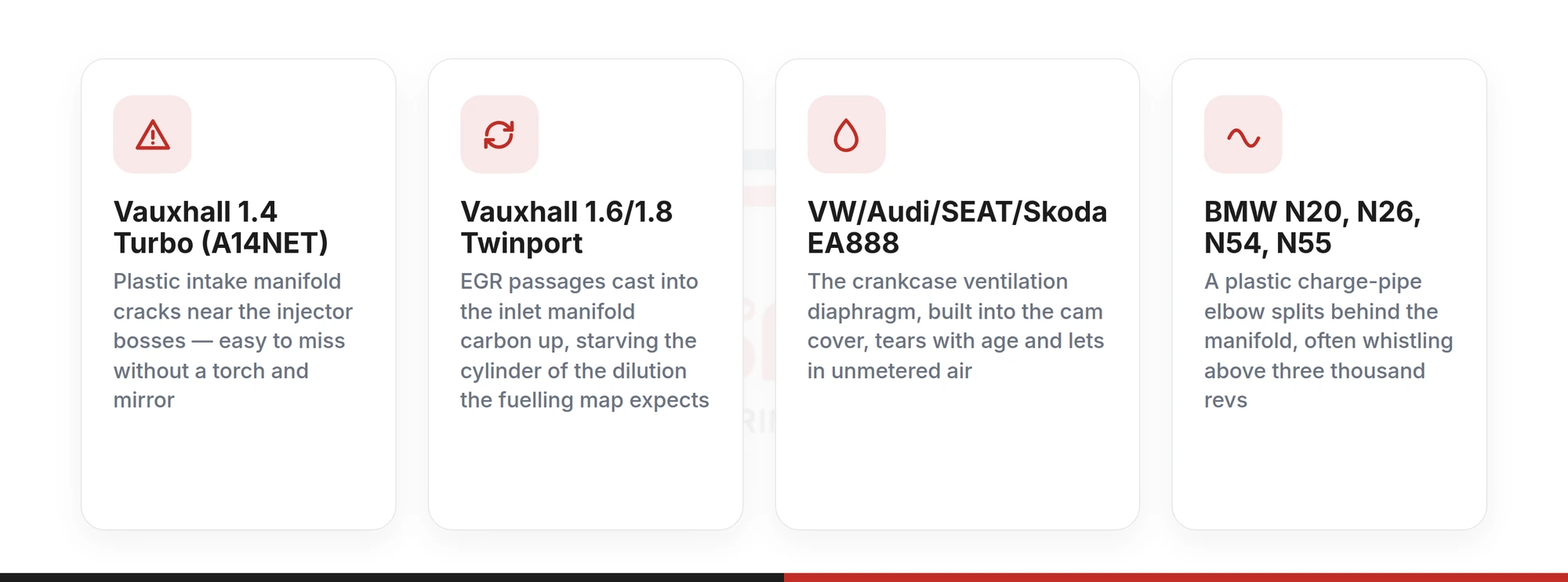
- Vauxhall 1.4 turbo (A14NET) — Astra J, Corsa E, Mokka and Adam. The plastic intake manifold cracks, usually around the runners near the injector bosses, and it takes a torch and a mirror to see. A sturdier replacement manifold is what actually ends it on these cars.
- Vauxhall 1.6 and 1.8 Twinport (Z16XE1, Z16XEP, Z16XER, Z18XER) — two separate faults on the same family. The exhaust gas recirculation passages cast into the inlet manifold carbon up until they are effectively closed, and with no dilution reaching the cylinder the mixture reads lean and the trims climb. The rocker cover’s ventilation diaphragm splits, which is a straightforward unmetered-air leak. The first of those is a lean code with a carbon root cause, and it commonly gets blamed on the lambda sensor for months; carbon in the EGR path, and what it sets covers the rest of that family, including the flow codes stored when the valve itself is the part that has stopped moving.
- VW, Audi, SEAT and Skoda 2.0 TSI (EA888) — the crankcase ventilation diaphragm is integrated into the cam cover and tears with age. A quick pointer: at a warm idle, lay a piece of stiff card flat over the open oil filler. If the idle changes noticeably, the diaphragm is a strong suspect.
- BMW N20 and N26, and N54 and N55 — the plastic charge-pipe elbow behind the manifold splits, often announcing itself as a whistle above three thousand revs, and the crankcase vent diaphragm fails on the older six-cylinder pair.
- Ford 1.0 and 1.6 EcoBoost — intake manifold gasket weep and split degas hoses. On the 1.0 in particular, a lean code alongside a coolant level that keeps dropping is worth taking seriously rather than treating as two unrelated jobs.
- Mercedes M271 supercharged 1.8 — the inlet manifold flap actuator and the tumble flaps themselves. Deposits can hold a flap where it should not be, and the swirl arrangement in the inlet manifold is a known contributor to lean codes on this engine.
One caution that does not fit the pattern above. On the 1.2 PureTech engines used across Peugeot, Citroën, DS and Vauxhall, a stretched timing chain shifts cam timing, and the ECU reads the consequence as a lean condition. If a lean code arrives on one of those alongside a rattle at start-up or any of the cam and crank correlation codes, the chain is the fault and clearing P0171 achieves nothing at all.
How a P0171 is diagnosed, in order
The order below is deliberate: cheapest and most conclusive first, and nothing bought until something has been proved. Every expensive P0171 story starts with someone beginning at step five.
- Make sure the scan itself is sound
Record every stored code with its freeze-frame data, not just the lean one. And check the tool is actually talking to the engine module. A P0171 is a conclusion the ECU reached from data it trusted; a communication fault means the tool never got an answer from a module at all, and while one of those is present, stored codes from that module are not evidence of anything. That is the subject of a controller that has dropped off the bus.
- Look and listen before touching anything
Engine warm and idling: a hiss from a split hose, oil mist in the airbox, perished breather pipes, the boot between the air flow sensor and the throttle, the seams of a plastic manifold, and the oil filler and dipstick seals. A worthwhile share of P0171s end here.
- Read short-term and long-term trims at idle and at load
The test in the table above, and the one step that reorganises everything after it. It tells you whether the error is fixed or proportional, and therefore whether you are looking for a leak or for a measurement.
- Smoke-test the intake
A smoke machine fills the intake tract at low pressure with the throttle closed and shows a leak as smoke you can see, including the ones behind the manifold that no visual check will find. Do not substitute the old trick of spraying a flammable gas or aerosol around a running engine to hunt for an idle change — it works, and it is a fire in a hot engine bay waiting to happen. The smoke machine is both safer and more conclusive.
- Prove the metering
Compare the live airflow figure with the manufacturer’s value for that engine, at a stated idle and under load — not against a number lifted from a general write-up, because the expected figure scales with engine size and design. On a pressure-and-speed system, do the same with the manifold pressure reading.
- Prove the fuel side under demand
Fuel pressure and delivered volume while the engine is being asked to work. A pump that reads correctly at idle and collapses at load is invisible to a static test, which is exactly why a fuel-side fault gets missed until everything else has been replaced.
- Prove the measurement last
The exhaust joints and manifold ahead of the upstream lambda sensor, and the sensor’s own switching behaviour on live data. This step is last in the list and first in the mind of most people who arrive with a P0171, which is the subject of the next section.
Sinspeed · automotive electronics
Trims still climbing after the obvious checks?
Send us the codes exactly as your scan tool prints them, with the vehicle details, the trim figures at idle and at load if you have them, and what the car is doing. We will tell you what they point at — including when the honest answer is a smoke machine at a local garage rather than anything on our bench.
Mail-in, UK-wide · Units repaired at circuit level and bench-tested before dispatch
The parts replaced first that are rarely the fault
Three parts get bought for a P0171 more often than any others, and all three are usually innocent. They are worth naming, because the pattern is so consistent.
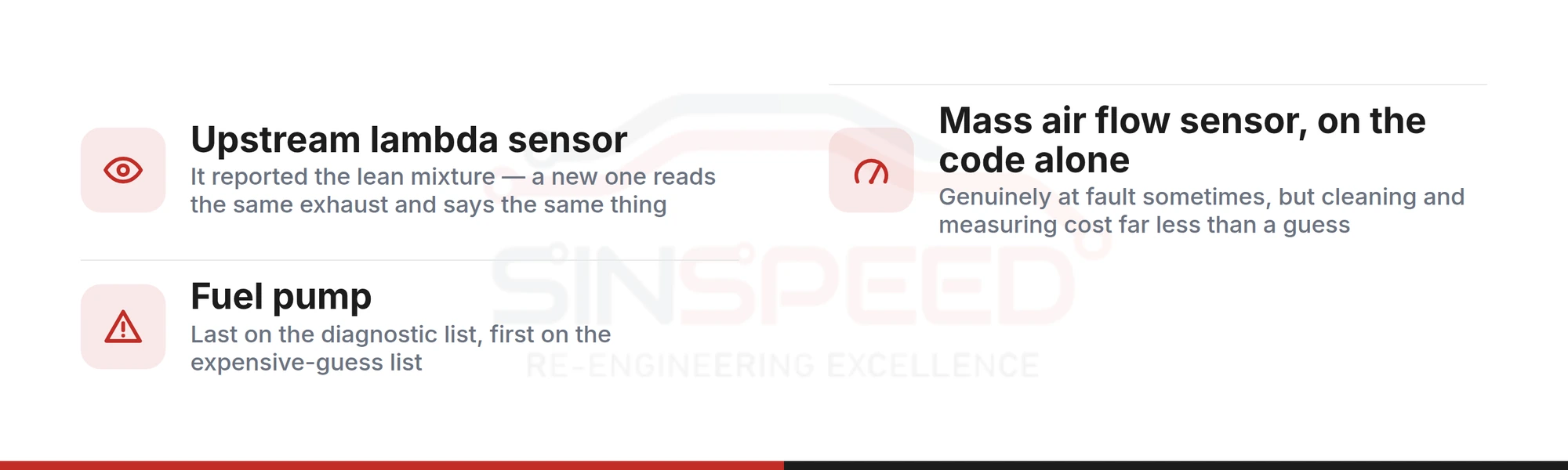
The upstream lambda sensor. It is the first thing suggested and it is almost never the answer, for a reason that is obvious once stated: that sensor is the part which reported the lean condition. Replacing it changes the reporter, not what is being reported, and a new sensor looking at the same lean exhaust says the same thing. It earns replacement when it is proved slow to switch or offset on live data, and not before.
The mass air flow sensor, bought on the code alone. A contaminated one genuinely causes P0171, which is what makes this so tempting. But it can be cleaned and it can be measured, and both cost far less than fitting a part on a guess. A new sensor on a car whose real fault is a split breather hose sets the code again within the week.
The fuel pump. Last on the diagnostic list and near the top of the expensive list, so guessing at it is the costliest way to be wrong. It belongs in the frame only once the trims show a fault that worsens with demand and a pressure test under load has backed that up.
What gets missed while those three are being changed is usually mundane: the crankcase breather, a manifold gasket, a plastic manifold with a hairline crack in it, or carbon somewhere the fuelling map assumed would be clear. Unglamorous parts, and between them they account for most of the lean codes in the country.
What the rest of the scan narrows down
A P0171 rarely arrives on its own, and the other codes are more useful for what they tell you about the scope of the problem than for what they name.
Start with P0174, which is the same lean complaint on bank 2. On an engine with two cylinder banks, its presence or absence splits the search in half. Both codes together means the cause is shared by the whole engine: the air flow sensor, the fuel supply, a vacuum source feeding both sides, or a manifold gasket that spans them. P0171 on its own, with bank 2 trimming normally, means the cause is specific to one side — a leak on that bank’s runners, an injector on those cylinders, or that bank’s own lambda sensor and the exhaust ahead of it. On a four-cylinder there is only one bank and this test is unavailable, which is why the trim-versus-load pattern carries so much more weight on a small engine.
After that, sort the remaining codes into parents and consequences. An airflow circuit or range code alongside the lean one usually names the parent, and repairing the airflow fault clears both. Misfire codes are almost always downstream: the mixture went beyond what the trims could disguise and the burn started failing. Catalyst efficiency codes are downstream of the misfire in turn, on a car that has been running lean for a long time. Fix from the top of that chain, clear everything, drive the car properly and rescan — then judge what genuinely comes back, rather than chasing four codes simultaneously.
When lean running gets blamed on the gearbox
A surprising number of P0171s arrive at a garage described as a gearbox fault, and it is easy to see why. The driver’s account — it hesitates pulling away, it feels like it slips, it will not pick up cleanly — fits both.
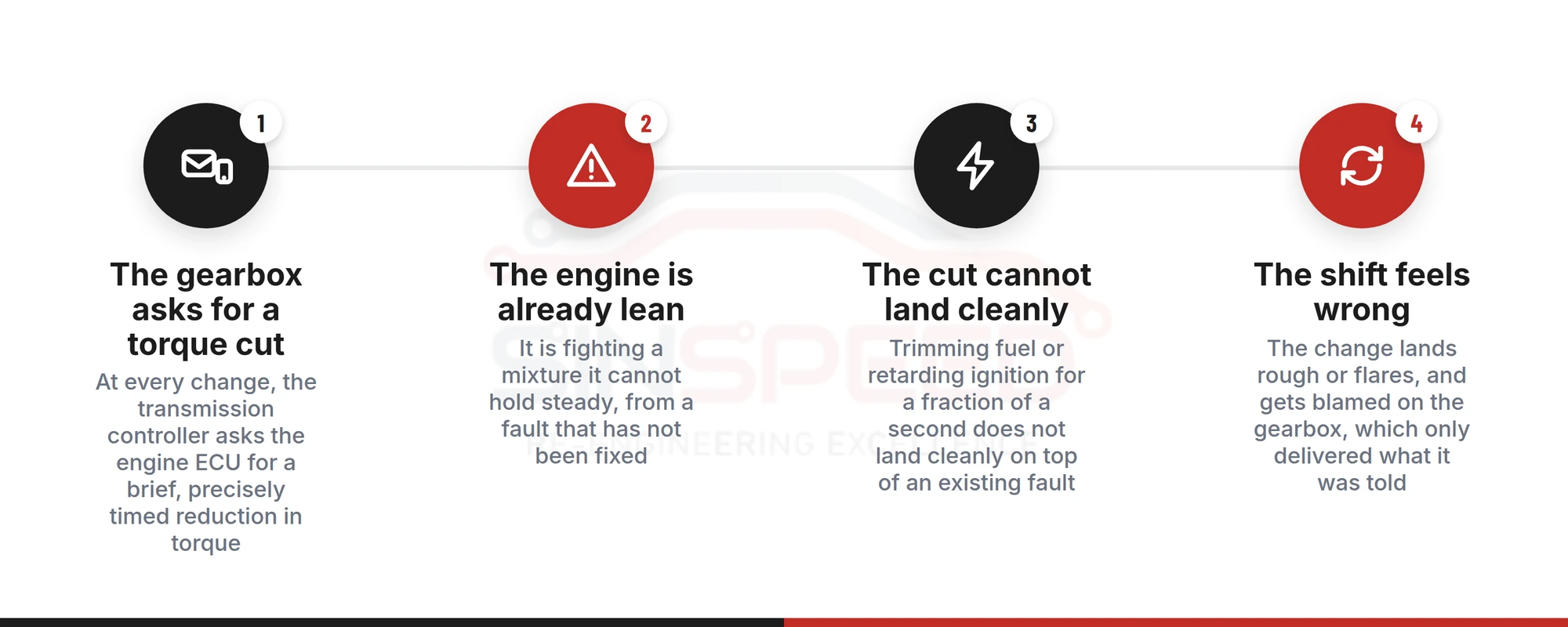
There is a real mechanism behind the confusion on an automatic, not just a coincidence of words. At every change the gearbox controller asks the engine control unit for a brief, precisely timed reduction in torque, so the clutches or bands can take up without shock, and the engine delivers it by trimming fuel or retarding ignition for a fraction of a second. An engine that is already struggling to hold a stable mixture performs that handshake badly, and the change lands rough or flares. The gearbox is doing exactly what it was told; the engine is not.
The discriminator is simple and costs nothing. A lean fault is present with the car standing still and in every gear — a rough or hunting idle at the lights is the tell. A genuine gearbox fault is tied to particular changes or particular gears and leaves the idle alone. If the roughness is there at a standstill, do not start at the gearbox.
A stored P0700 is a different matter and is worth reading correctly. It is not a gearbox diagnosis: it is the gearbox controller asking the engine ECU to light the lamp on its behalf, which means that controller is holding a fault of its own that a basic code reader may never show you. If one is in your scan alongside the lean code, two controllers have logged something and both need reading — what the gearbox controller stores when it asks for the lamp explains what sits behind it.
The same handshake happens at every change on an automated manual, where the clutch is operated by an actuator rather than by your left foot, and the overlap is sharper still: an engine with an unstable idle makes take-up jerky, and jerky take-up is the classic description of a worn clutch actuator. Ask the same question in a different place. If the car is smooth once it is rolling at a steady throttle and only misbehaves at the moment of engagement or during a change, start with a worn clutch actuator on an automated manual. If it is unhappy at a steady cruise as well, the fuelling is where to look.
Is P0171 a diesel code?
Effectively, no — and if you have arrived here with a diesel and a running fault, this is the wrong page and it is better to say so than to be vague about it.
Fuel trim in the sense P0171 uses it belongs to closed-loop petrol fuelling: the engine is throttled, it holds its mixture against a target ratio, and the correction applied to hold that ratio is the thing the code reports on. A diesel does not work that way. It is unthrottled, it runs lean by design at almost all times, and it meters fuel to driver demand rather than to a chemically ideal ratio. There is no equivalent correction to run out of.
So a diesel’s air and fuelling complaints are recorded differently: as rail-pressure and injection-control faults, as air-mass and exhaust gas recirculation faults, and as the manufacturer’s own engine-management codes. The symptoms overlap enough to mislead — flat power, black smoke, hard starting — but the codes and the diagnostic route do not. How a diesel’s fuelling faults are recorded instead is the right family to start from.
Can you keep driving with a P0171?
In most cases, yes, for a short period. A P0171 rarely leaves a car undriveable, and with mild symptoms you will usually reach a garage without difficulty. It is not a code to live with, though, and the reason is worth understanding rather than taking on trust.
A lean mixture burns hotter, which over time is hard on pistons, valves and exhaust seats. The faster and more expensive damage comes from a step further on: when the mixture goes lean enough to misfire, unburnt fuel and unused oxygen pass into a catalytic converter that is already hot, burn there instead, and can take the ceramic substrate with them. That is why a flashing engine management lamp is a stop-driving signal rather than a book-it-in-next-week signal — it means an active misfire, and the catalyst is at risk now.
Short of that, treat stalling, a serious loss of power or a car that will not idle as reasons to have it recovered rather than driven. And there is an MOT consideration on top: an engine management lamp illuminated for a stored fault counts as a major defect at test, so a P0171 left alone will fail the car however well it happens to drive.
How much does it cost to fix a P0171?
There is no single price for fixing a P0171, because the code does not tell you what has failed — and anyone quoting a flat figure before diagnosis is guessing. The cost depends entirely on the root cause. A perished vacuum hose or a clean-up of a contaminated air flow sensor sits at the modest end. A failing fuel pump, a faulty throttle body, a cracked intake manifold or a lambda sensor is a larger job.
The spread is wide for a specific reason, and it is the argument for spending on diagnosis first: the cheap cause and the expensive cause set an identical code. Nothing in the scan distinguishes a four-pound hose from a fuel pump. That makes the diagnostic appointment the part of the bill that saves money rather than adds to it, because it is the only part that stops you paying to replace components which were never the problem.
Where the fault turns out to be an electronic engine-management component — a throttle body, or a mass air flow meter built into a unit — remanufacturing your existing unit is normally considerably less than a new dealer part, and it keeps your vehicle’s original coding intact. We quote against your specific unit and fault rather than against a generic price list.
How a P0171 is actually fixed
The fix is whatever the diagnosis pointed at, done properly. A vacuum or intake leak means replacing the failed hose, gasket, breather diaphragm or manifold. A contaminated air flow sensor may clean up, using a purpose-made cleaner and never a cloth or a brake cleaner, or need renewing if it has failed electrically. A fuel-side fault means the pump, the filter or the injectors. Carboned intake or recirculation passages need physically cleaning, and the passage behind a part matters as much as the part. A leaking exhaust joint ahead of the lambda sensor gets sealed or replaced — and on that one, the mixture often needs no attention at all once the sensor can see the truth.
Most of that list is work on the vehicle, and most of it belongs to a garage or an auto electrician. Fuel pressure and hot exhaust components are professional work rather than something to attempt from a video, and the tolerances involved mean fitting the wrong part cures nothing.
Our end of the list is the electronic one. Sinspeed is a UK automotive-electronics remanufacturer: we work at circuit-board and component level on engine-management units, so when a P0171 traces back to the throttle bodies we rebuild, or to a mass air flow meter built into a unit rather than sold as a loose sensor, we find the actual fault in your unit and repair it rather than selling you a complete new part carrying the same design weakness. Repairs are done in a cleanroom-standard, ESD-safe workshop by an in-house team of engineers, and every remanufactured unit is proved on our own Hardware-in-the-Loop rigs, which recreate the heat, vibration and electrical load the part meets on a running engine. Most come back ready to fit with no coding required, and they carry a lifetime, unlimited-mileage warranty.
The service is mail-in, so your vehicle stays where it is and only the unit travels. If the diagnosis has already landed on the throttle body or the air flow meter, our repair form is the quickest way to start. If it has not, tell us what the scan says and we will tell you which side of the line you are on — including when the answer is a vacuum leak, which is a garage job and not ours.
P0171 FAQs
What is the most common cause of a P0171 code?
Unmetered air, by a wide margin — air getting into the engine after it has been measured. A split vacuum or breather hose, a torn crankcase ventilation diaphragm, a leaking or cracked intake manifold, or a split boot between the air flow sensor and the throttle. A contaminated air flow sensor that under-reads is the next most common. Both leave the ECU fuelling for less air than the engine is actually receiving, so the mixture runs lean and the trims climb to compensate.
What is the difference between P0171 and P0174?
They are the same lean complaint on opposite cylinder banks — P0171 on bank 1, P0174 on bank 2 — and only engines with two banks, such as a V6 or V8, can store both. A four-cylinder has one bank, so it will only ever store P0171. Where both codes are present together, the cause is something shared by the whole engine: the air flow sensor, the fuel supply, or a vacuum source or gasket that spans both sides. Where only one is present, the fault is specific to that bank.
Can a faulty oxygen sensor cause a P0171 code?
It can, but far less often than it gets blamed. The upstream lambda sensor is the part that reported the lean mixture, so replacing it usually changes nothing — the new one looks at the same exhaust and says the same thing. A sensor that is genuinely slow to switch or sitting offset can bias the trims and set a lean code, and so can an exhaust leak ahead of it, which lets fresh air reach the sensor and makes a correctly fuelling engine read lean. Both are proved on live data before anything is replaced.
Can I still drive my car with a P0171 code?
Usually yes in the short term, if the symptoms are mild, but it is not a code to leave. A lean mixture burns hot and is hard on pistons, valves and the catalytic converter over time. If the engine management lamp is flashing, stop — that means an active misfire, which puts unburnt fuel and oxygen into a hot catalyst and can destroy it quickly. Stalling, a serious loss of power or an engine that will not idle are also reasons to have the car recovered rather than driven.
Why did P0171 come back after the part was replaced?
Nearly always because the part replaced was not the cause. The usual findings afterwards are a leak that was never found — behind the manifold, at a breather union, or in charge pipework on a turbocharged engine — or carbon in the intake and recirculation passages, or a fuel supply that only falls short under load and passed a static test. There is a second possibility worth knowing: a car with two small leaks that has had one of them repaired can set the code again, because the trims had been hiding the second one behind the first.
How much does it cost to fix a P0171?
It depends entirely on the root cause, so there is no single price. A perished hose or an air flow sensor clean-up sits at the modest end; a fuel pump, a throttle body, a cracked manifold or a lambda sensor is a larger job. Because the cheap cause and the expensive cause set an identical code, the diagnosis is the part of the bill that saves money. Where the fault is an electronic unit such as a throttle body or an air flow meter, remanufacturing the one you have is normally considerably less than a new dealer part, and we quote against your specific unit.
Sinspeed · automotive electronics
When the diagnosis names an electronic unit
We are an automotive-electronics remanufacturer rather than a garage, so we do not chase vacuum leaks or fit fuel pumps. Throttle bodies and air mass meters built into a unit are exactly what the bench is for: the fault is found at circuit level and your original unit is repaired, rather than swapped for a new one carrying the same design weakness.
Lifetime, unlimited-mileage warranty on remanufactured parts · Most units returned ready to fit, no coding required
Final thoughts
A P0171 is late news. The condition it describes did not begin on the morning the lamp came on. It began weeks or months earlier, small enough that the ECU absorbed it without saying anything, and it grew until the absorbing ran out. What the code records is the moment the compensation failed — not the moment the fault started.
Two useful things follow. The fault is almost always bigger by the time you read the code than it was when it began, which is why the hose that was merely perished is split by the time anyone looks at it. And trims can hide a second fault as readily as a first: a car with two small leaks that has had one of them repaired can come back with the lamp on and its owner convinced nothing was fixed, when in fact something was, and the remaining leak has simply stopped being hidden.
So the honest way to close a P0171 is not to clear it and hope. Fix what the diagnosis found, drive the car properly, and read the trims again. If they have come down and stayed down, the job is finished. If they have not, the scan tool will tell you long before the lamp does.