
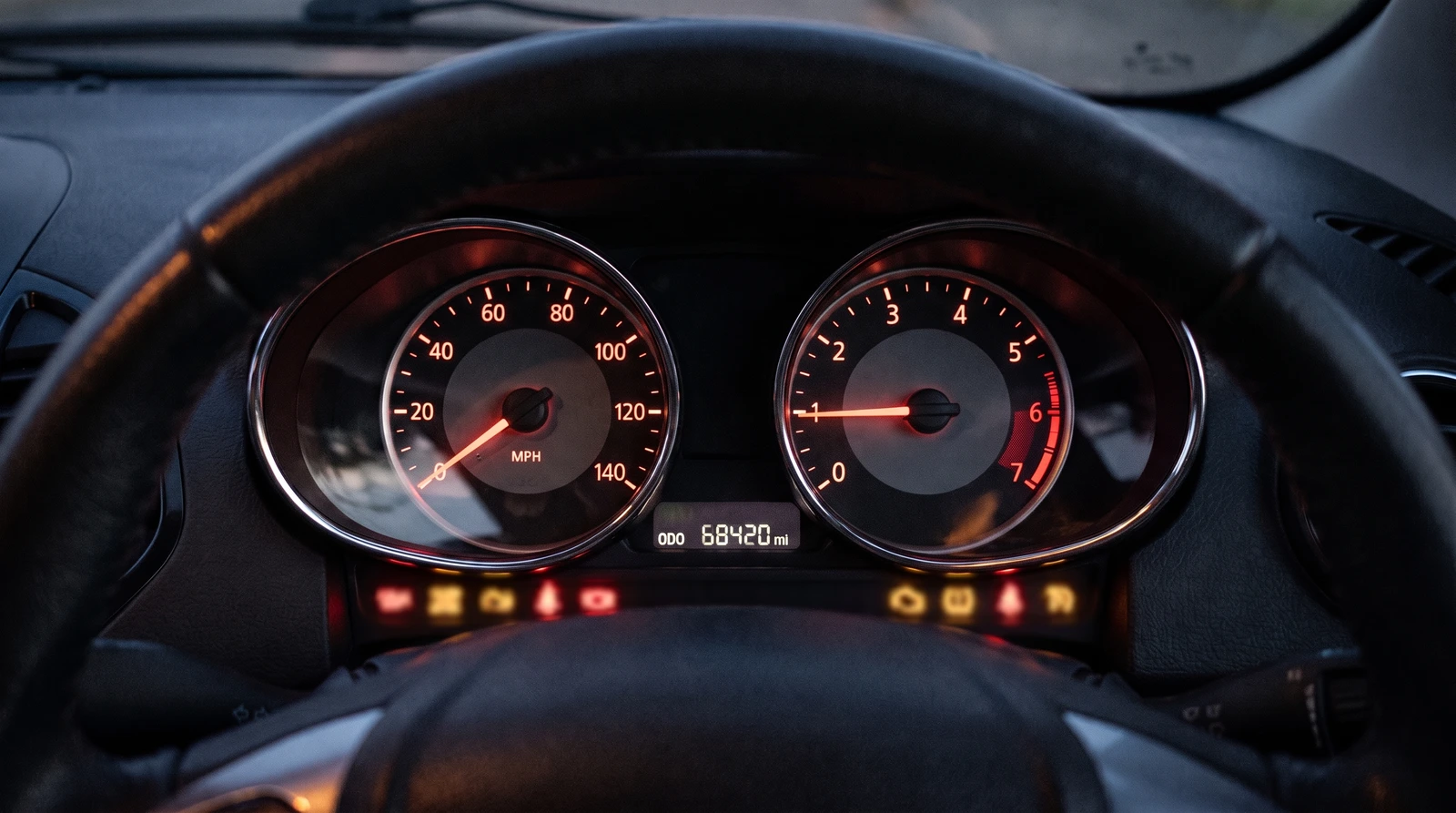
Summary: On a Ford Ka the warning light owners ask about most is the triangle with an exclamation mark, and it is also the most misunderstood. It is not a fault in itself but a master warning — it tells you the car has a message waiting in the instrument cluster, and the real story is whatever that message points to. This guide explains the triangle light and every other Ka dashboard symbol, sorted by colour and urgency, and works through them generation by generation, because the original Ka, the Fiat 500-based Mk2 and the later Ka+ are three very different cars under the dashboard.
In this guide
- How Ford Ka warning lights work: colour and generation
- The most common Ford Ka warning lights, including the triangle
- The lights that mean an electronic module has failed
- Ford Ka generations and their known issues
- What to do when a warning light comes on
- Frequently asked questions
How Ford Ka warning lights work: colour and generation
Every Ford Ka uses a colour-coded warning system that works like a set of traffic lights. The colour tells you how urgently you need to act, long before you know exactly what has gone wrong — so read the colour first and the precise symbol second. That order is what keeps you safe.
There are three bands to recognise:
- Red — stop. A red light signals a serious, potentially dangerous fault. The brake system, engine coolant temperature, oil pressure, the airbag, the charging system and the power steering all warn in red. Pull over as soon as it is safe and check before driving on.
- Amber or yellow — caution. An amber light means “get this looked at soon”, not an emergency. The car will usually still drive, but something needs attention: the engine management light, the ABS, the stability system, a low tyre or — on the Ka in particular — the general-warning triangle.
- Green or blue — information. Green and blue symbols simply confirm that a system is switched on or working normally, such as the indicators, the main beam or the front fog lights. They are not faults and need no action.
Before you match a symbol to a meaning, though, you need to know which Ka you are looking at, because three completely different cars wear the badge and their electronics are not the same. The original Ka (Mk1, 1996 to 2008) is a simple city car with minimal electronics and only a handful of warning lights. The second-generation Ka (Mk2, 2008 to 2016) is the important one for fault diagnosis: it was built on the Fiat 500 platform and shares that car’s instrument cluster, its Blue&Me hands-free system and its electronic power steering — which is why several of the faults below are Mk2-only. The Ka+ (2016 to 2019) is a different, larger car again on a separate global platform, sold as a basic 1.2 petrol. A meaning that is true for one generation is often wrong for another, so this guide flags which is which throughout.
The Mk2 and Ka+ also carry a small message centre in the instrument cluster that can display written text alongside a symbol. That matters most for the triangle light, covered next: on those cars the symbol is only half the warning, and the message is the half that actually tells you what to do.
The most common Ford Ka warning lights, including the triangle
Here are the Ford Ka dashboard symbols owners search for most, grouped by colour, with a plain-English meaning and the action to take. Where a light points to a recurring electronic fault, the module-fault section below explains it and how it is repaired.
Red warning lights — stop and act now:
| Symbol | What it means | What to do |
|---|---|---|
| Brake system (! in a circle) | A serious braking fault, low brake fluid, or the handbrake left partly on | Stop as soon as it is safe and check the fluid; do not keep driving on it |
| Engine coolant temperature (thermometer) | The engine is overheating — the coolant is too hot or the level is too low | Stop — continuing risks serious, expensive engine damage |
| Oil pressure (oil can) | Critically low oil pressure, which can wreck an engine in minutes | Stop now and switch off; do not run the engine until it is checked |
| Battery / charging (battery box) | The battery is not charging — usually an alternator or electrical fault | Get it checked quickly; the car can stop once the battery drains |
| Airbag / SRS (person with airbag) | The airbag system has logged a fault and may not deploy in a crash | Get it diagnosed promptly so its protection is restored — never disable or ignore it |
| Power steering (steering wheel with !) | A serious electric power-steering fault; the steering will feel heavy | The steering still works but takes far more effort — drive with care and get it checked |
| Seatbelt / door ajar | A belt is unfastened, or a door or the boot is not fully closed | Stop safely, fasten the belt or close the door before driving on |
Amber and yellow warning lights — caution, get it checked:
| Symbol | What it means | What to do |
|---|---|---|
| General warning (! in a triangle) | A master warning — the car has logged something and put a message in the cluster | Read the message centre to see which system it is pointing at, then act on that (see below) |
| Engine management light / EML (engine outline) | An engine or emissions fault has been logged, or a service is due | Get the fault code read before assuming the worst — it has many possible causes |
| ABS (ABS in a circle) | An anti-lock braking fault; on its own, your ordinary brakes still work | Get it checked soon — the ABS is not intervening if you have to brake hard |
| Stability / traction control (skidding car) | The traction control system is intervening or has logged a fault | Normal in brief flashes on a slippery road; if it stays on, get it checked |
| Tyre pressure / TPMS (later cars only) | One or more tyres is below the correct pressure | Reinflate to the figures on the door pillar and check for a puncture |
| Engine oil (oil can, amber) | Oil level is low or a service is due — distinct from the red oil-pressure light | Check and top up the oil when the engine is cool; book a service if it is a reminder |
| Glow plug / pre-heat (coil symbol, diesel) | The diesel is pre-heating before start; if it stays on, a pre-heat fault | Normal for a few seconds; get it checked if it persists |
| DPF (diesel Mk2 only) | The diesel particulate filter is full and needs to regenerate | A steady run at speed often completes a regeneration; if it stays on, get it diagnosed |
| Stop-start (A with a circular arrow, Mk2) | A fault with the automatic stop/start system | Get it checked when convenient; the engine simply stops restarting on its own |
| Bulb / lamp failure | An exterior bulb has failed | Replace the bulb; a failed bulb can also trigger the triangle on later cars |
| Service / spanner | A routine service is due | Book the service; it is a reminder, not a fault |
The triangle warning light deserves its own explanation, because it is the single most-searched Ford Ka light — and the most misread. The triangle with an exclamation mark is a general, or master, warning light. It is not tied to one part of the car. Instead it tells you the Ka has detected a problem somewhere and has written a message into the instrument cluster’s message centre. In other words, the triangle is the car saying “there is a message for you” — the message itself is what names the actual fault, whether that is the stop-start system, a bulb, the brakes, traction control, oil or tyre pressure.
So the right first step when the triangle appears is always the same: read the message in the cluster, and note any other warning light that has come on at the same time. The triangle rarely arrives alone — it usually pairs with a second symbol or a line of text, and that pairing is what tells you how urgent it is. A triangle alongside a red brake or oil light is serious and means stop; a triangle with a bulb-failure or stop-start message is a get-it-checked job rather than an emergency. On the Fiat 500-based Mk2 in particular, the triangle commonly appears together with the stop-start light or the engine light, which is why it is worth reading the whole picture rather than reacting to the triangle on its own. The original Mk1 is simpler and has far less to report, so the triangle is much rarer on those cars.
The lights that mean an electronic module has failed
Most Ka warning lights are not a failed module at all. They are sensors, the battery, low fluids, a bulb or a routine service — and saying otherwise would be misleading. But a few lights genuinely can mean an electronic unit has failed, and that unit can often be repaired rather than replaced. We are a UK automotive-electronics specialist: we diagnose, test and remanufacture the electronic units behind these warnings — instrument clusters, ABS pumps and modules, power-steering ECUs and immobilisers among them — repairing the circuit board itself and testing each unit under simulated heat, vibration and load before it goes back. Here is where that applies on a Ka, generation by generation.
Instrument cluster faults — lead here on the Mk2. A failing cluster is a known weak point on the second-generation Ka, because it shares the Fiat 500’s instrument pack. The tell-tale signs are the cluster misbehaving as a whole rather than one honest warning: dead or flickering displays, gauges that drop to zero or read randomly, a backlight that comes and goes, or several warning lights stuck on with no real fault behind them. When the cluster itself is at fault, the lights it shows cannot be trusted — so the first job is to establish that the cluster is the problem. This is the one Ka-specific unit we stock and remanufacture: see our Ford Ka Mk2 instrument cluster repair and the wider instrument cluster repair category. Because we repair the original board rather than fitting another cluster carrying the same weak points, the fix tends to last, and most of our remanufactured units carry a lifetime, unlimited-mileage warranty.
Flashing mileage or a Blue&Me fault — Mk2 only. This is the clearest example of why the generation matters. Because the Mk2 is built on the Fiat 500 platform, it can develop the same electronic faults the Fiat 500 is known for. If your Ka Mk2 shows a flashing mileage or dashes where the odometer should be, that is typically a proxy-alignment or CAN-bus fault carried straight over from the Fiat 500 — our Fiat 500 flashing mileage guide walks through the exact fault and how it is repaired. And if your Mk2 has Blue&Me, the Fiat-and-Microsoft hands-free and media system, the same Blue&Me module faults can appear; our Fiat 500 Blue&Me repair page covers that unit. Both of those apply to the Mk2 only — the original Mk1 and the later Ka+ do not share the Fiat 500 electronics, so do not apply this routing to them.
Immobiliser, no-start or a flashing security light. If the Ka will not start and a security or engine-with-a-key symbol is flashing, the immobiliser system (Ford’s PATS) is not recognising the key, and the car will refuse to crank or will start and immediately cut out. This has its own diagnosis path, which we set out in full in our Ford PATS no-start guide — start there if a security light is involved in a no-start.
The ABS warning light. There is no Ka-specific ABS part, so we will be honest about this one: a great many ABS lights come down to a single wheel-speed sensor, which is a simpler and cheaper job. Where the fault code instead points to the ABS pump or module itself — a persistent light with stored codes rather than a one-off sensor fault — that is the repairable-unit case, and our ABS ECU repair category is where that kind of pump and module work is done. The deciding factor is always the fault code: if it names a wheel sensor, fix the sensor; if it names the pump or module, that is where it is repaired. Read the code before replacing anything.
Power steering (heavy steering with the warning on). The Ka used electric power steering across the range — the Mk1 column and the Mk2’s Fiat-platform EPS are both known for going heavy — so if the steering is suddenly far heavier than usual and the steering warning is lit, the cause is usually inside the EPS unit rather than anything mechanical. That is the kind of work covered by our steering repair category. Frame it as a get-it-diagnosed warning: the steering still works, it just takes much more effort, so drive gently and have it checked rather than carrying on.
The engine management light. Be straight about the EML: it has dozens of possible causes, so the only sensible first step is to get the fault code read rather than guess. On a Ka most EML cases turn out to be sensors, ignition or fuelling — not the engine ECU. Only where diagnosis points to a genuine internal failure of the engine ECU itself does it become a module repair, and that specific work is handled by the independent specialists at ecu-repairs.com. That internal-ECU outcome is the rare one; read the code and fix the actual cause first.
The DPF light (diesel Mk2 only, and uncommon). Only the diesel Ka — the 1.3-litre MultiJet-derived engine in the Mk2 — has a diesel particulate filter, so this light never appears on the petrol Mk1, the petrol Ka+ or a petrol Mk2. When it does show, it usually means the filter is full and needs to regenerate, and a longer, steady run at motorway speed often completes a regeneration and clears it. If it stays on after that, the filter or a related sensor needs diagnosis — our DPF explainer covers how the filter works and what regeneration involves. One thing we will not do is push DPF removal: removing the filter is for off-road and motorsport use only and is illegal to use on a road car, so it is never the answer to a warning light on a Ka you drive on the road.
Ford Ka generations and their known issues
Because the three Kas are so different, a quick run through each generation makes the warning lights above much easier to read. Treat the faults in each as belonging to that generation only.
Ka Mk1 (1996 to 2008) — the simple one. The original Ka is a small, light city car with minimal electronics. Early examples have only a basic set of warning lights, no message centre and little to go wrong electronically, so warnings here are usually straightforward — oil, coolant, battery, a bulb, or heavy electric steering on cars fitted with it. There is no Blue&Me, no Fiat 500 cluster and no diesel, so none of the Mk2-specific routing above applies. If you have a Mk1, the colour-and-symbol basics are almost the whole story.
Ka Mk2 (2008 to 2016) — the Fiat 500 underneath. This is the generation that produces the faults owners search for, and the reason is that it was built on the same platform as the Fiat 500 and shares its electronics. That brings the Fiat 500 instrument cluster (and its known weakness), the Blue&Me hands-free system, the Fiat-platform electric power steering, the proxy-alignment behaviour behind a flashing mileage, and — on the diesel — a DPF. It is also why the general-warning triangle is more talkative on the Mk2: there is simply more for the car to report, and it often pairs the triangle with a stop-start or engine message. If you are diagnosing a Ka and it is a Mk2, the Fiat 500 connection is the most useful single fact you have.
Ka+ (2016 to 2019) — a different, basic car. The Ka+ is larger, sits on a separate global platform and was sold in the UK as a simple 1.2-litre petrol. Its electronics are basic: it has the usual engine management, ABS and stability systems and a small message centre, but it does not share the Fiat 500 cluster, Blue&Me or the diesel DPF, so the Mk2 routing does not carry across. Warnings on a Ka+ are best read straight from the colour code and the message centre.
What to do when a warning light comes on
When a light appears on your Ka, work through it calmly and in order. The steps below keep you safe, stop a small fault becoming a big one, and stop short of any repair you should not attempt yourself — anything involving the brakes or the airbag belongs with a professional.
If it is red, stop safely
Treat any red light as a stop-and-check instruction. Pull over as soon as it is safe to do so, switch off, and do not drive on until you understand what it is. The red brake, coolant-temperature and oil-pressure lights in particular can cause real damage or danger if they are ignored.
If it is the triangle, read the message
Because the general-warning triangle only tells you a message is waiting, your job is to read that message in the instrument cluster and note any other light that is on with it. The message names the system; the colour of the accompanying light tells you how urgent it is. Act on the more serious of the two.
Do the simple owner checks
For an amber light, a few quick checks rule out the easy causes: make sure the fuel cap is on tight, check the engine oil and coolant levels when the engine is cool, check your tyre pressures, and have a quick look for a failed exterior bulb. On a Ka, also check the battery and its terminals — a low or poorly connected battery can upset several modules at once and bring on a cluster of lights that clears once it is sorted.
Get the fault code read
If the light stays on after the basic checks, have the fault code read with a diagnostic tool. This is the single most useful step for any electronics or engine warning, because it names the system and often the exact component — the difference, for example, between an ABS wheel sensor and the ABS pump itself, or between a sensor and a failed instrument cluster.
Book the right repair if it is a module fault
If the code points to a failed unit — most often the Mk2 instrument cluster, or an ABS pump, EPS unit or immobiliser — that unit can usually be repaired and reinforced rather than replaced. You can send us the details through our repair form with your fault code, Ka generation and model year, or get in touch if you are not sure which unit you need. For an airbag fault, contact us for diagnosis rather than ordering a part, because the SRS must be assessed before anything is done to it — and never simply clear a safety light to make it disappear.
Frequently asked questions
What does the triangle warning light mean on a Ford Ka?
The triangle with an exclamation mark is a general, or master, warning light. It does not point to one specific part — it tells you the Ka has detected a problem and has put a message in the instrument cluster’s message centre. The triangle is the car saying “read this”; the message is what names the actual fault, whether that is the stop-start system, a bulb, the brakes, traction control, oil or tyre pressure. So the first step is always to read the message in the cluster and note any other light that has come on with it. The triangle rarely arrives alone, and the light beside it tells you how serious it is — a triangle with a red brake or oil light means stop, while a triangle with a bulb or stop-start message is a check-it-soon job. On the Fiat 500-based Mk2 it commonly appears with the stop-start or engine light.
What is the yellow or amber warning light on my Ford Ka?
Amber or yellow means caution rather than emergency — the car will usually still drive, but something needs looking at soon. On a Ka the common amber lights are the engine management light, the ABS, the stability and traction system, a low tyre (on later cars with TPMS), the amber oil or service reminder, and the general-warning triangle itself. Do the simple owner checks first — oil, coolant, tyres, fuel cap, a failed bulb, and the battery — and if the light stays on, get the fault code read. A yellow oil warning is the one amber light to take more seriously: it means the oil level, pressure or temperature is wrong, so check the oil promptly to avoid engine damage.
What is the most serious warning light on a Ford Ka?
The red lights are the ones to act on immediately — the brake system, engine coolant temperature, oil pressure, the airbag, the charging system and the power steering. Each means that continuing to drive could be dangerous or could turn a repairable fault into a far bigger one. If any red light shows, stop as soon as it is safe and check before going on. Never drive on a red brake, overheating or oil-pressure warning, and never disable or ignore the airbag light.
My Ford Ka mileage is flashing, or my Blue&Me has a fault — what is it?
Both of these are second-generation (Mk2) issues, and they exist because the Mk2 Ka was built on the Fiat 500 platform and shares its electronics. A flashing mileage, or dashes where the odometer should read, is typically a proxy-alignment or CAN-bus fault carried straight over from the Fiat 500 — our Fiat 500 flashing-mileage guide covers the exact fault and the repair. A Blue&Me fault affects the Fiat-and-Microsoft hands-free and media system and is a module repair in its own right. Neither applies to the original Mk1 or the later Ka+, which do not share the Fiat 500 electronics — so this only holds if your Ka is a 2008 to 2016 Mk2.
My Ford Ka has the ABS light on — what is it, and can I drive it?
More often than not, an ABS light on a Ka is a single wheel-speed sensor — a simpler, cheaper job. Sometimes, though, it is the ABS pump or module itself, which shows as a persistent light with stored fault codes rather than a one-off. The fault code tells you which, so get it read before replacing anything. You can still drive with the ABS light on, but gently: your ordinary brakes still work, you simply have no anti-lock assistance if you have to brake hard, so get it checked soon. Where the cause is the pump or module rather than a sensor, that is the kind of unit we repair.
Which Ford Ka warning lights mean a module needs repairing?
Only a few. Most Ka lights are sensors, the battery, low fluids, a bulb or a routine service — not a failed module. The clearest module faults are the Mk2 instrument cluster (flickering or dead displays, or lights stuck on with no real fault), an ABS pump or module when the code points to the pump rather than a wheel sensor, a failed electric power-steering unit when the steering goes heavy, and the immobiliser when the car will not start. On the Mk2 specifically, a flashing mileage or a Blue&Me fault comes from the shared Fiat 500 electronics. In every case, read the fault code first: it is what tells you whether you are looking at a cheap sensor or a unit worth repairing and reinforcing.
Final thoughts
The triangle light captures what makes the Ford Ka different from most warning-light guides: the symbol on its own rarely tells the whole story, so the first move is always to read the message behind it and note which other lights are on with it. From there, work by colour — anything red means stop and check before you drive on, while amber means investigate soon rather than panic. And keep the generation in mind, because a Mk2 sitting on the Fiat 500 platform can throw cluster, Blue&Me and flashing-mileage faults that the simpler original Ka and the later Ka+ never will. Where a light does trace back to a failed electronic unit, that unit can usually be repaired and reinforced rather than replaced — and the fault code is what tells you whether you are looking at a cheap sensor or a module worth the repair.
If it turns out to be the module, we repair and return your original unit rather than supplying a replacement. Send us the details through our repair form and we will tell you what the fault involves.