
Summary: A first-generation Audi TT built between 1998 and 2006 carries an instrument cluster that, with age, can lose its centre display, misread its gauges, flicker its lighting or fail outright, often with several of those faults at once. Our rebuild takes the whole cluster from your car, deals with every fault it has, and tests each function before it comes back. It refits plug-and-play with no programming, keeps the car’s recorded mileage and carries a lifetime warranty. Every Mk1 part number we rebuild is listed further down this page.
Still working out whether the cluster is to blame? Our guide to Audi TT instrument cluster problems goes through each symptom and the checks worth making on the car first. This page picks up once the cluster is the suspect: which units we rebuild, what the rebuild covers and how it runs. The second-generation TT has a different cluster, with its own Audi TT 2006–2014 cluster rebuild page. The rest of the range sits under our Audi dashboard cluster repairs, part of every make of instrument cluster we repair.
- The car: the first-generation Audi TT (8N), built 1998–2006
- The numbers: Audi part numbers beginning 8N1 or 8N2, plus the other label references in our table
- Where to look: the label on the back of the cluster
- What the rebuild covers: the display, every gauge, the warning LEDs, the panel lighting and the speaker, not only the fault you noticed
- At refit: plug-and-play, with no additional programming
- Mileage: the car’s own recorded figure, never altered
- Warranty: lifetime, on the rebuilt cluster
- Which Mk1 TT cluster faults does the rebuild cover?
- Which Audi TT Mk1 cluster part numbers do we rebuild?
- What does a rebuild involve beyond fixing one fault?
- Why does a Mk1 TT cluster wear out?
- Rebuild your own cluster or fit a replacement?
- How does the Mk1 cluster rebuild work, step by step?
- Mk1 TT cluster rebuild FAQs
- Final thoughts
Which Mk1 TT cluster faults does the rebuild cover?
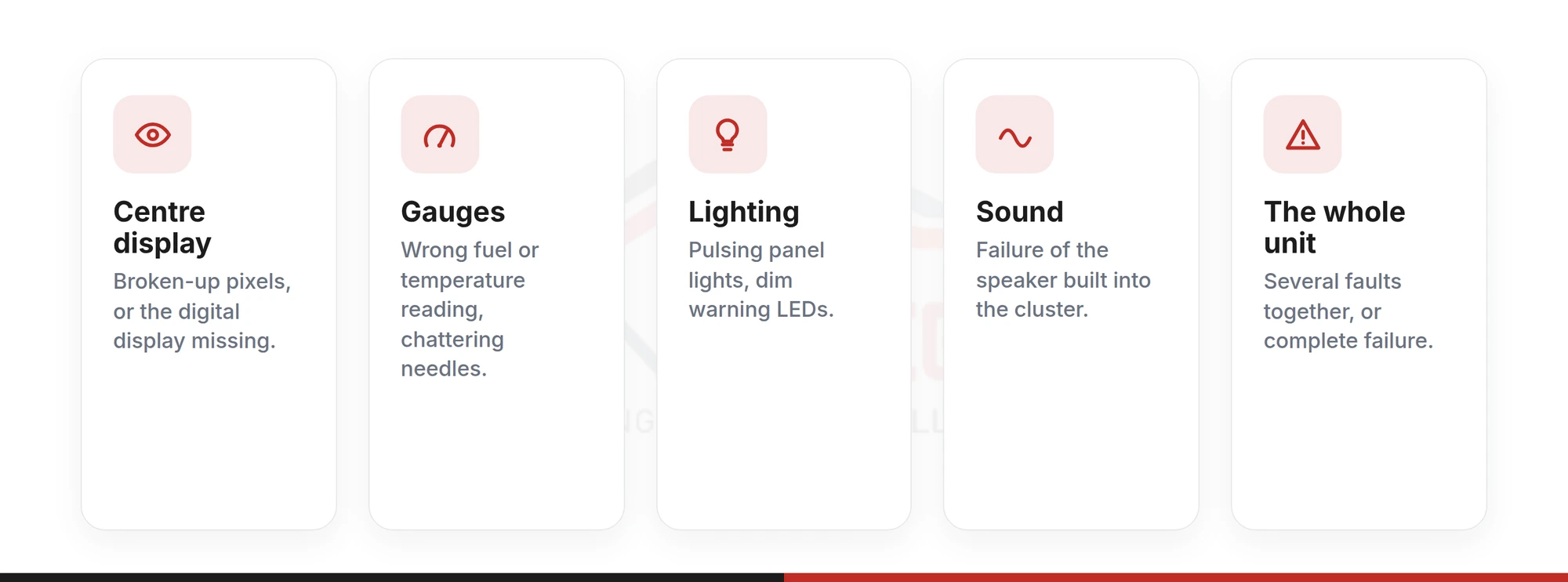
We rebuild Mk1 TT clusters for a wide spread of faults, and they fall into five areas of the unit. Seeing them grouped this way explains why we rebuild rather than patch: trouble in one area is often a sign that another is not far behind.
| Area of the cluster | Faults we rebuild it for |
|---|---|
| Centre display | Broken-up screen pixels; loss of the digital display in the speedometer; digital information missing altogether |
| Gauges | A fuel gauge reading inaccurately; a temperature gauge giving incorrect information; needles that chatter instead of holding steady |
| Lighting | Instrument panel lights that pulse; one or more warning LEDs glowing dimly |
| Sound | Failure of the speaker built into the cluster |
| The whole unit | Several of the faults above at the same time, or complete cluster failure |
Most of these creep in. A few missing pixels, a needle that twitches now and then, a warning light that is fainter than its neighbours. Left alone, they seldom settle down.
There is no fault-code table here, because we have no codes on record for these faults and none is needed to spot them: a broken display or a chattering needle is diagnosed by what you see on the dash. How a scan helps rule the rest of the car in or out is covered in our TT cluster problems guide.
This cluster reports your speed, fuel and engine temperature. A fault in any of those is worth putting right, not learning to read around.
Which Audi TT Mk1 cluster part numbers do we rebuild?
The table lists every Mk1 TT cluster number we rebuild. Find the label on the back of your cluster and match the number against it. The Audi numbers in our list start 8N1 or 8N2, and a label may print them with spaces, so 8N2 920 980 A and 8N2920980A are the same unit.
| Number family | Numbers we rebuild |
|---|---|
| 8N1 920 860 | 8N1920860A, 8N1920860C, 8N1920860E, 8N1920860H, 8N1920860J, 8N1920860L |
| 8N1 920 880 | 8N1920880A, 8N1920880C, 8N1920880D, 8N1920880G, 8N1920880H, 8N1920880K |
| 8N1 920 900 | 8N1920900, 8N1920900C |
| 8N1 920 930 and 931 | 8N1920930C, 8N1920930E, 8N1920930J, 8N1920930M, 8N1920930N, 8N1920930Q, 8N1920930R, 8N1920930S, 8N1920930T, 8N1920931, 8N1920931D |
| 8N1 920 980 | 8N1920980A, 8N1920980E |
| 8N1 919 | 8N1919860B, 8N1919860C, 8N1919880C, 8N1919880E, 8N1919930B |
| 8N2 920 | 8N2920910A, 8N2920910C, 8N2920930A, 8N2920930C, 8N2920930G, 8N29209300C, 8N2920950, 8N2920950A, 8N2920980, 8N2920980A, 8N2920980D |
| 8N2 919 | 8N2919910A, 8N2919930B |
| Other label references | 09052209902, 0905220009X, 09052239901, 09053259802, 09053259902, 09053269808, 09056209801, 09056429902, 09056629902, 503000354300, 503000355500, 990700120710084, 008AUZ5Z0YD012042D |
Some labels carry one of the references in the last row alongside, or instead of, an Audi number. Match whichever yours shows. If your number is missing from the table, add it to the repair form all the same and we will confirm whether we can rebuild it before the cluster comes out. A number we have not listed is a question for us, not a refusal.
Sinspeed · Audi TT 8N clusters
Found your number? Tell us what the cluster is doingSend the number from the label and the faults you have noticed. We will confirm the rebuild before you take anything out of the dash.
Whole unit checked, not one fault · Plug-and-play refit · Covered by a lifetime warranty
What does a rebuild involve beyond fixing one fault?
A repair can stop at the fault you reported. A rebuild treats the cluster as one unit, because on the Mk1 the display, the gauges, the lighting and the speaker all share the same housing and have aged side by side.
So a cluster sent in for a pixelated screen does not stop at the screen. Every area in the table above is powered and checked: the display, each needle through its range, the warning LEDs, the panel lighting and the speaker. Anything already failing is dealt with in the same visit, and the weak points this cluster is known for are reinforced rather than left to go next.
That is the difference between a cluster that comes back working and one that comes back with its next fault already waiting. It is also why the details you give us matter: a faint LED you barely noticed is worth mentioning.
Why does a Mk1 TT cluster wear out?
The youngest Mk1 TTs left the factory in 2006, so every one of these clusters has lived through a very large number of heat cycles. Each drive warms it behind the dash and each parked night lets it cool, while summer sun through the windscreen piles on more. Damp cabin air gets in over the winters, road vibration travels through the dash panel on every journey, and the supply voltage sags each time the starter turns the engine over.
None of that is dramatic on its own. It adds up, and in a unit that packs so many jobs into one housing, the result is rarely a single clean failure. That is why the same cluster can show a dim warning LED one month and a chattering needle the next, and why a fault often comes and goes before it stays.
It is also why a failing cluster gets mistaken for other faults. Because it reports on the rest of the car, a misreading unit makes healthy parts look guilty: the fuel tank sender, the coolant sensor, a fuse or the wiring behind the dash. Those are worth checking first. If a replacement goes in and nothing changes on the dash, look at the cluster.
Rebuild your own cluster or fit a replacement?
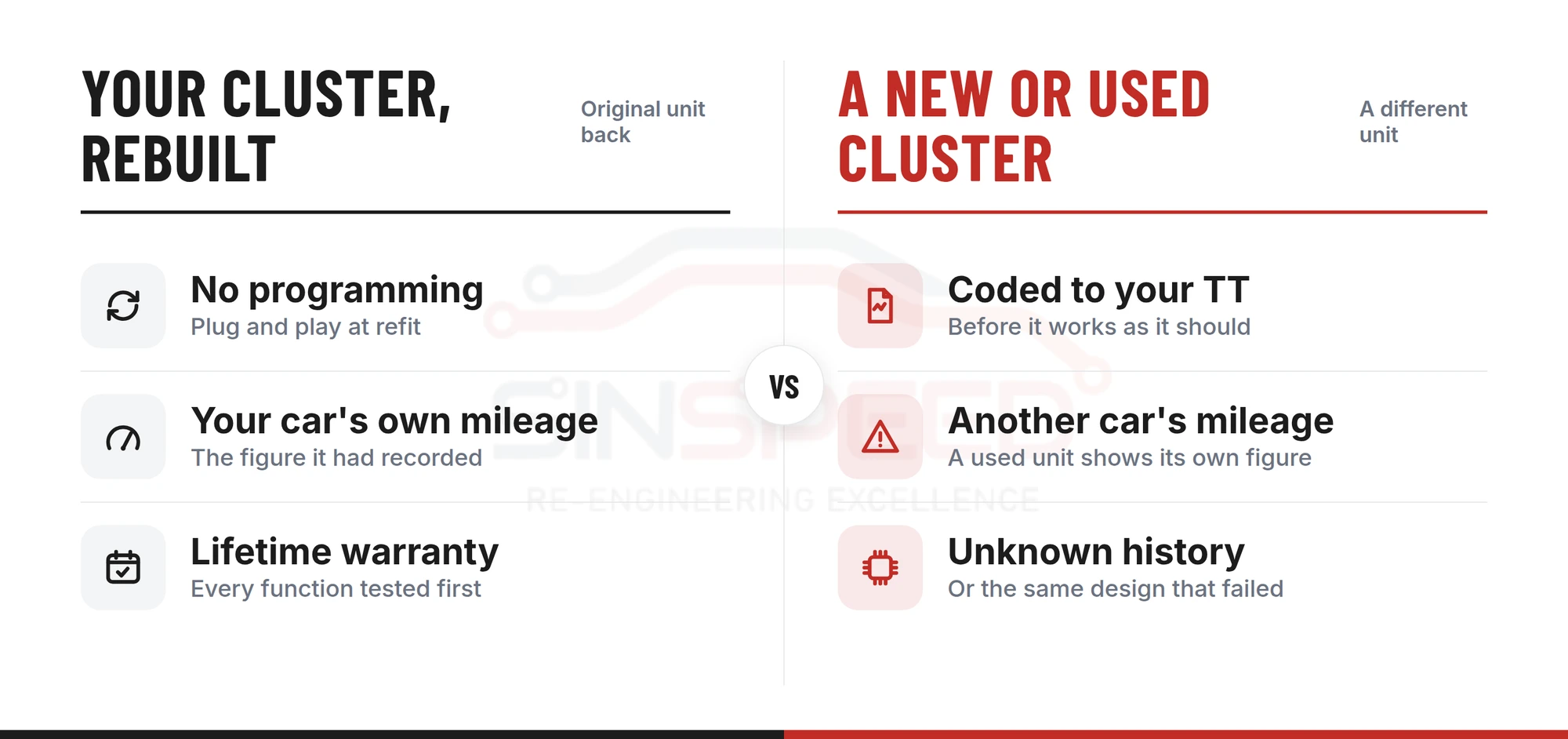
A cluster from another Mk1, or a new one, arrives knowing nothing about your car. It has to be coded to your TT before it works as it should. Your own cluster, rebuilt, goes back plug-and-play with no additional programming.
| Your own cluster, rebuilt by us | A new or used replacement | |
|---|---|---|
| Programming at refit | None; it is plug-and-play | Has to be coded to your TT |
| Mileage on the display | The figure your car has recorded | A used unit carries another car’s figure |
| Condition | Every function tested and the known weak points reinforced | A new unit carries the same design as the one that failed; a used one has an unknown history |
| Cover | Lifetime warranty on the rebuild | Whatever the seller offers |
On mileage specifically: the rebuilt cluster comes back showing exactly what your TT had recorded when it went in. We never alter recorded mileage.
How does the Mk1 cluster rebuild work, step by step?
Your TT stays at home or at your garage throughout. This is the order things happen in.
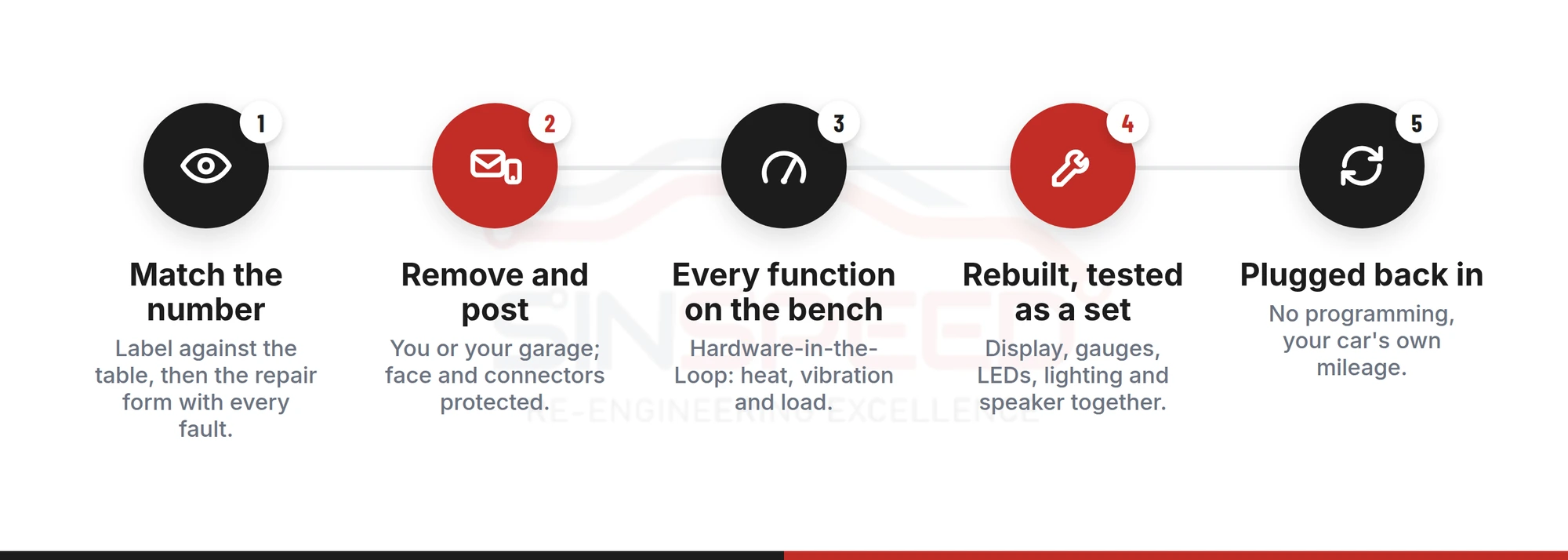
- Match your number, then tell us about the car
Check the label against the table above, then complete the repair form with the car’s details, the number and every fault you have noticed, however minor. Small faults count here, because the rebuild covers the whole unit.
- You or your garage take the cluster out
Wrap it well enough that the face and the connectors cannot knock against anything, and post it to our workshop.
- Every function run on the bench
We power the cluster with the signals it would see in the car and run it on our in-house Hardware-in-the-Loop platforms, which simulate heat, vibration and load. We confirm the faults you reported and look for any you had not spotted yet.
- Rebuilt, then tested as a set
Our engineers rebuild the cluster in our cleanroom-standard workshop. The display, gauges, warning LEDs, lighting and speaker are then tested together before it is packed for return.
- Plugged back in, ready to drive
No additional programming is needed at refit. The cluster shows your car’s own mileage and works as a complete unit again.
Mk1 TT cluster rebuild FAQs
My cluster’s number is not in your table. Can you still rebuild it?
Possibly. Add the number to the repair form with the car’s details and we will confirm before the cluster is removed. Labels sometimes print the number with spaces or carry a second reference, so send whatever yours shows.
Is a rebuild more than a repair of the one fault?
Yes. The whole cluster is tested, from the display and gauges to the warning LEDs, panel lighting and speaker, and anything failing is dealt with in the same visit, not only the fault you sent it in for.
Does the rebuilt cluster need coding to the car?
No. It is your TT’s own cluster, so it goes back in plug-and-play with no additional programming. A replacement from another car has to be coded to your TT first.
What mileage will the rebuilt cluster show?
The mileage your TT had recorded before the cluster came out. We never alter recorded mileage.
Does this cover both early and late Mk1 TTs?
It covers Mk1 TTs built from 1998 to 2006. The number on the cluster label is what confirms the unit, so check it against the table. A second-generation TT from 2006 onwards is covered on our Audi TT 2006–2014 cluster rebuild page.
Can my garage remove the cluster and post it for me?
Yes. Whoever takes it out, you or your garage, packs it and posts it to us. It comes back rebuilt and refits without programming.
Final thoughts
A Mk1 TT cluster that has started to fail in one place has usually aged in every place. Fixing only the fault you can see leaves the rest exactly where it was.
Match the number on the label, list everything the dash has been doing, and have the whole unit rebuilt. It goes back into the car it came from, plug-and-play, showing that car’s own mileage.
Sinspeed · Audi TT 1998–2006
Have your Mk1 TT cluster rebuilt as a wholeSend the part number from the label and every fault you have seen. We will confirm the rebuild before the cluster leaves the car.
Run on HIL test rigs before return · Mileage exactly as recorded · Lifetime warranty on the rebuild