
Summary: On a first-generation Audi TT (1998–2006), the two instrument cluster faults recorded most often are a centre display that turns distorted, pixelated or blank, and a fuel gauge that reads wrong or not at all. Both start in the cluster itself. We repair your own unit by post, so it keeps its key coding and the car’s own recorded mileage, and it comes back with a lifetime warranty.
This page is about recognising those faults and getting the cluster repaired. The full run of Mk1 cluster part numbers, and the rebuild itself, are on our Mk1 TT instrument cluster rebuild page. Clusters from the rest of the Audi range sit under Audi instrument cluster repairs, and every make we work on is gathered in our instrument cluster repair section.
- The unit: the instrument cluster, or dashpod, of the first-generation Audi TT
- Build years: 1998–2006
- Number we see most: 8N2 920 980 A, on the label at the back of the cluster
- Faults recorded most: a distorted, pixelated or blank centre display, and a fuel gauge that reads wrong or not at all
- Why refit matters: the cluster is key-coded to the car, so a different one has to be programmed in
- What we do: repair your own cluster by post and test it before it comes back
- Cover: lifetime warranty on the repair
- What goes wrong with the Mk1 TT instrument cluster?
- Will a diagnostic scan point to the cluster?
- Which TTs and part numbers does this page cover?
- Why do Mk1 TT clusters fail, and why are they misdiagnosed?
- Repair the cluster you have, or fit a different one?
- How does the mail-in cluster repair work?
- Audi TT instrument cluster questions
- Final thoughts
What goes wrong with the Mk1 TT instrument cluster?
Two faults are recorded against this cluster more than any other. The centre display becomes distorted or pixelated, and in time can fail completely. The fuel gauge starts giving readings that do not match the tank, or stops reading at all.
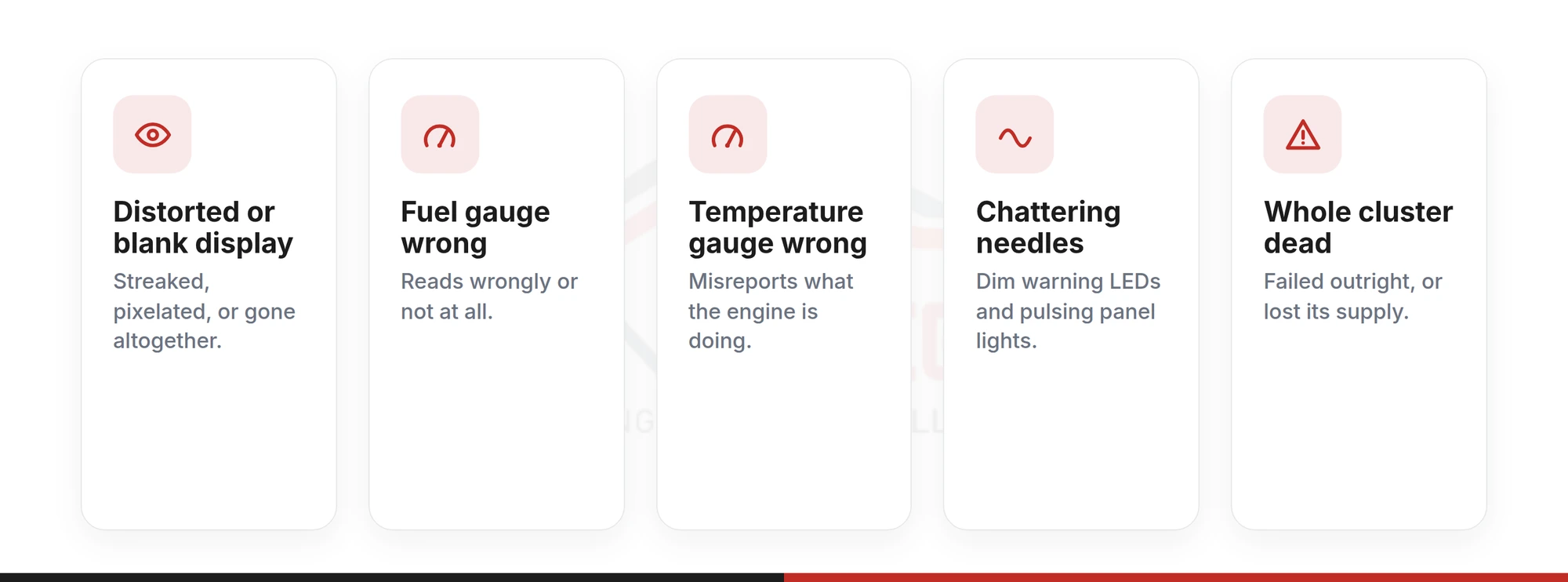
They are not the only ones. The same unit can misreport engine temperature, twitch its needles, pulse its panel lighting or go dark altogether. The table sets out what each fault looks like and what is worth checking on the car before the cluster takes the blame.
| What you see | What it usually means | Rule this out first |
|---|---|---|
| Centre display distorted, streaked or pixelated | The display inside the cluster is starting to fail, and it tends to get worse rather than better | Nothing on the car — this fault lives in the cluster |
| Centre display blank while the rest of the cluster works | The display has failed completely | As above |
| Fuel gauge reads wrong | The cluster may be misreading a healthy signal from the tank | The fuel level sender and its wiring |
| Fuel gauge shows nothing | The cluster may have stopped reading the fuel signal | The sender, its wiring and the connector at the back of the cluster |
| Temperature gauge gives the wrong reading | The cluster may be misreporting what the engine is doing | The coolant temperature sensor, and whether the engine really is running hot or cold |
| Chattering needles, dim warning LEDs or pulsing panel lights | The cluster is struggling to drive its own gauges and lamps | Battery condition and charging voltage |
| Whole cluster dead | The unit has failed outright, or has lost its supply | Fuses and the cluster connector |
None of these stops the TT from driving, which is exactly why they get put off. A fuel gauge you cannot trust leaves you guessing at range, though, and a temperature needle that reads wrong could hide an engine that really is overheating. Have the cluster looked at rather than learning to drive around it.
Will a diagnostic scan point to the cluster?
Sometimes, but do not rely on it. We have no fault codes on record for the display and fuel-gauge faults on this page, and a code is not what diagnoses them: the broken-up display or the wandering needle is the evidence. A scan earns its place by what it rules in and out around the cluster.
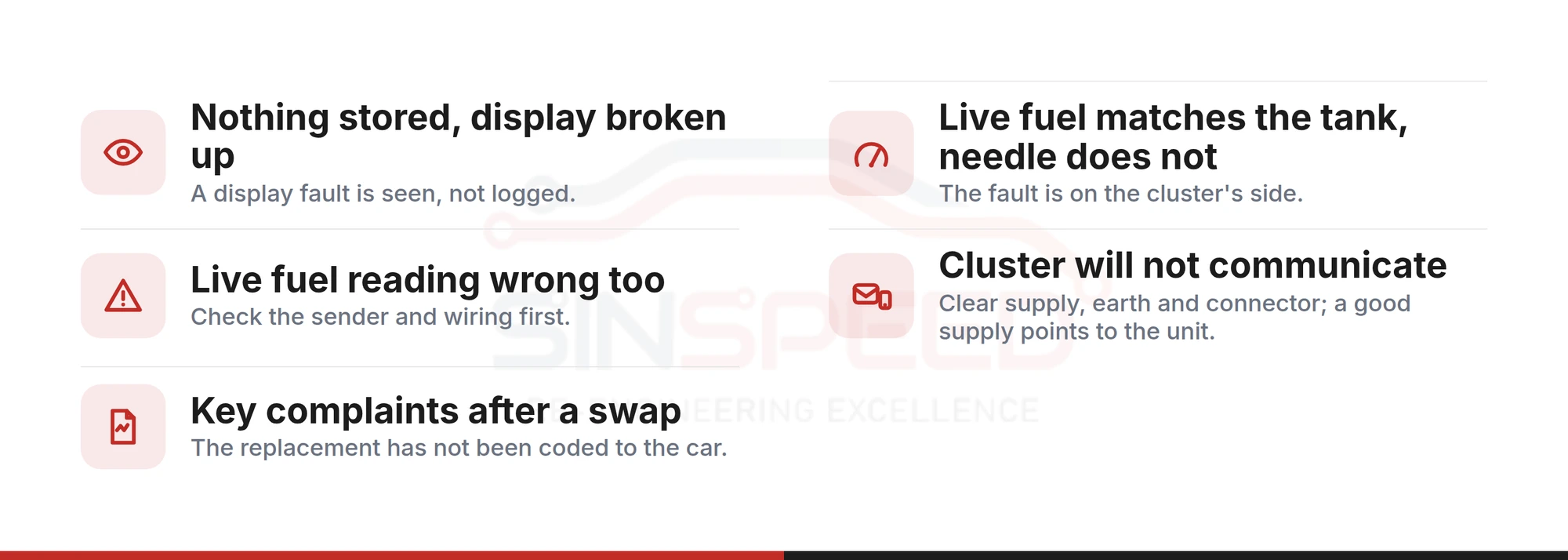
| What the scan shows | What it suggests | What to do next |
|---|---|---|
| Nothing stored, but the display is broken up | A display fault is seen rather than logged | Note what the display is doing and send us the details |
| The fuel level the cluster reports in live data matches the tank, but the needle does not | The fault is on the cluster’s side | Have the cluster repaired |
| The live fuel reading is wrong as well | The signal reaching the cluster may be at fault | Check the sender and its wiring before the cluster |
| The cluster will not communicate | It could be the cluster, or its supply, earth or connector | Clear those first; a silent cluster with a good supply points back at the unit |
| Key-related complaints after a different cluster was fitted | The replacement has not been coded to the car | Refit the original once repaired, or have the replacement programmed in |
Sinspeed · Audi TT Mk1 clusters
Seeing one of these faults? Talk to us before you buy a clusterSend the symptoms, any scan results and the number from the back of your cluster. We will confirm it is one we repair before the unit comes out of the dash.
Your own cluster, repaired · Key coding kept · Lifetime warranty
Which TTs and part numbers does this page cover?
This page covers the first-generation Audi TT, built from 1998 to 2006. The part number we see most often on its cluster is 8N2 920 980 A, printed on the label on the back of the unit.
It is not the only number the Mk1 cluster carries. Our Mk1 cluster rebuild page lists the others in full, so check your label against it. If your number appears on neither page, add it to the repair form and we will confirm it before the cluster comes out.
A later TT has a different cluster; the 2006–2014 second-generation panel has its own page, Audi TT 2006–2014 cluster rebuild. Otherwise, send the number from the back of yours through the repair form, or look through our Audi cluster repairs for the models we list.
Why do Mk1 TT clusters fail, and why are they misdiagnosed?
The cluster sits behind the dashboard, warming up and cooling down on every journey and taking sun through the windscreen in summer. Road vibration reaches it through the dash on every mile. Its supply voltage dips each time the engine cranks, and cabin humidity finds its way in over the years.
None of that is unusual on its own. Added up over a car whose last examples were built in 2006, it explains why the display and the fuel gauge are recorded as common failures rather than rare ones.
The misdiagnosis comes from what the cluster does. It is the part that shows you every reading, so when it misreads, the fault looks as if it belongs to whatever the gauge is measuring. A wrong fuel reading looks like a failing tank sender. A low temperature needle looks like a thermostat stuck open. Dim lamps and twitching needles look like a wiring fault.
Each of those parts can genuinely fail, which is why they get replaced first. The pattern that gives the cluster away is a new part fitted and the fault unchanged.
Repair the cluster you have, or fit a different one?
The Mk1 cluster is key-coded to its car. Any cluster that has not been in your TT, new or used, has to be programmed in before it works as it should. Repairing the one already fitted removes that step.
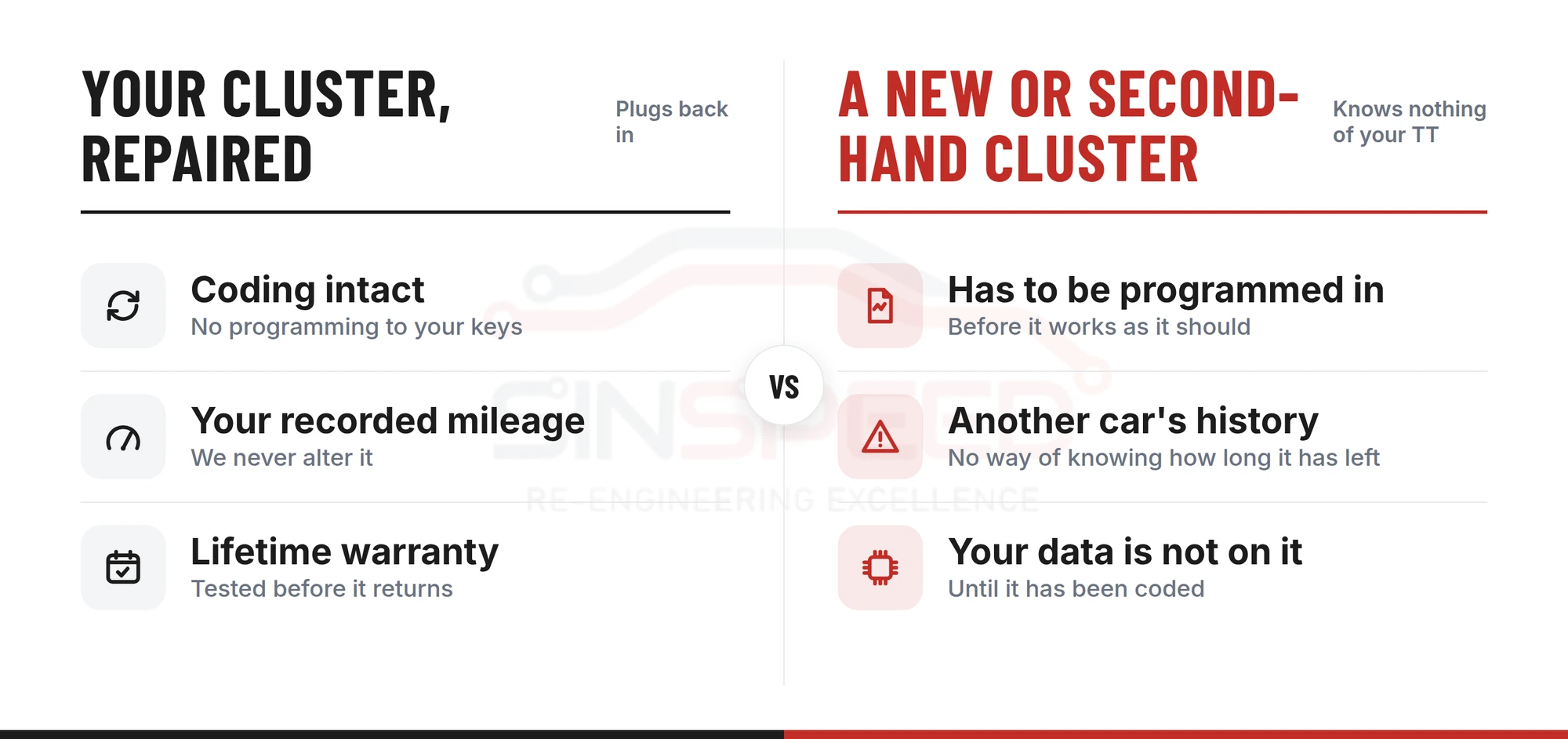
| Route | At refit | What comes with it |
|---|---|---|
| A new cluster | Has to be programmed to your car | A unit that knows nothing of your TT until it is coded |
| A second-hand cluster | Has to be programmed to your car | Another car’s coding and history, and no way of knowing how long it has left |
| Your own cluster, repaired by us | Plugs back in with its coding intact | Your car’s own recorded mileage, testing before return and a lifetime warranty |
Mileage is the other reason to keep the original. A repaired cluster goes back showing the figure your car had already recorded. We never alter recorded mileage, and with your own unit there is nothing to set up or carry across.
How does the mail-in cluster repair work?
The car never needs to come to us. You or your garage take the cluster out, post it, and refit it when it returns.
- Tell us what the cluster is doing
The repair form asks for the car’s details, the faults you are seeing and the number on the cluster’s label. If anything you describe points away from the cluster, we will say so before it is removed.
- You or your garage remove and post it
Pack the cluster so its face and connectors are protected in transit. The TT stays where it is.
- We make the fault show itself
On the bench the cluster is powered and fed signals as if it were still in the dash, and our in-house Hardware-in-the-Loop platforms put it through simulated heat, vibration and load. The reported fault has to appear before any work begins.
- Repaired, then proved again
Our engineers repair the cluster in our cleanroom-standard, static-controlled workshop, then retest the display, every gauge and the warning lamps before it is packed for return.
- Back in the dash, nothing to program
Because it is your car’s own cluster, it keeps its key coding and its mileage. It plugs back in and reads as it should.
Audi TT instrument cluster questions
Can I keep driving the TT with a broken display or a wrong fuel gauge?
The car will still drive, but you lose information you rely on. Keep the tank well topped up while the fuel gauge cannot be trusted, and do not ignore a temperature needle that behaves oddly. Get the cluster looked at rather than living with it.
Will the repaired cluster have to be programmed to my keys?
No. It is the cluster that came out of your TT, so it keeps the key coding it already had and plugs straight back in. A new or second-hand cluster, by contrast, has to be programmed in.
Will my TT show a different mileage after the repair?
No. The repaired cluster keeps the mileage your car had already recorded. We never alter recorded mileage.
How do I know it is the cluster and not the fuel sender?
Compare the fuel level the cluster reports in live data with what is actually in the tank. If the live reading is right and the needle is wrong, the cluster is at fault. If the live reading is wrong too, check the sender and its wiring first.
Where do I find the part number, and which one should it be?
It is on the label on the back of the cluster. The number we see most on the Mk1 is 8N2 920 980 A, and our Mk1 rebuild page lists the others. Whatever yours says, add it to the repair form.
My TT is a later model. Can you still help?
Send us the number from the back of its cluster through the repair form and we will confirm it. This page is written around the first-generation car, and our Audi instrument cluster repairs page lists the other Audi clusters we cover.
Final thoughts
A broken-up display or a fuel needle that cannot be trusted is irritating on its own, and misleading once parts start being replaced around it. On a first-generation TT, both faults usually start and finish inside the cluster.
Check the number on the back, rule out the sender if the fuel gauge is the complaint, and have the unit that belongs to the car repaired. It goes back in with its own coding and its own recorded mileage, and the dash tells the truth again.
Sinspeed · first-generation Audi TT
Get your TT’s cluster reading true againTell us what the display and gauges are doing and the number on the label. We will confirm the repair, or ask what else we need, before anything is removed.
Proved on a simulated car before return · Recorded mileage never altered · Lifetime cover on the repair