
Summary: When a Mercedes flashes its mileage, or shows a row of dashes where the figure should be, the instrument cluster is refusing to display a reading it cannot confirm — usually because the supply voltage dropped, a module stopped communicating on the car’s network, or a changed cluster’s stored mileage no longer agrees with the figure held elsewhere in the car. There is no dashboard button that resets it; the lasting fix is to find which of those is behind it, and where the cluster itself has failed, we repair your own unit by post and return it showing the same recorded mileage.
- Why a Mercedes swaps its mileage for dashes or a flashing figure
- When it started tells you most of the cause
- Can you reset flashing mileage on a Mercedes?
- Four checks worth making before anyone blames the cluster
- Signs the instrument cluster itself has failed
- Your recorded mileage stays exactly as it is
- Mercedes odometer dashes: common questions
- Final thoughts
Why a Mercedes swaps its mileage for dashes or a flashing figure
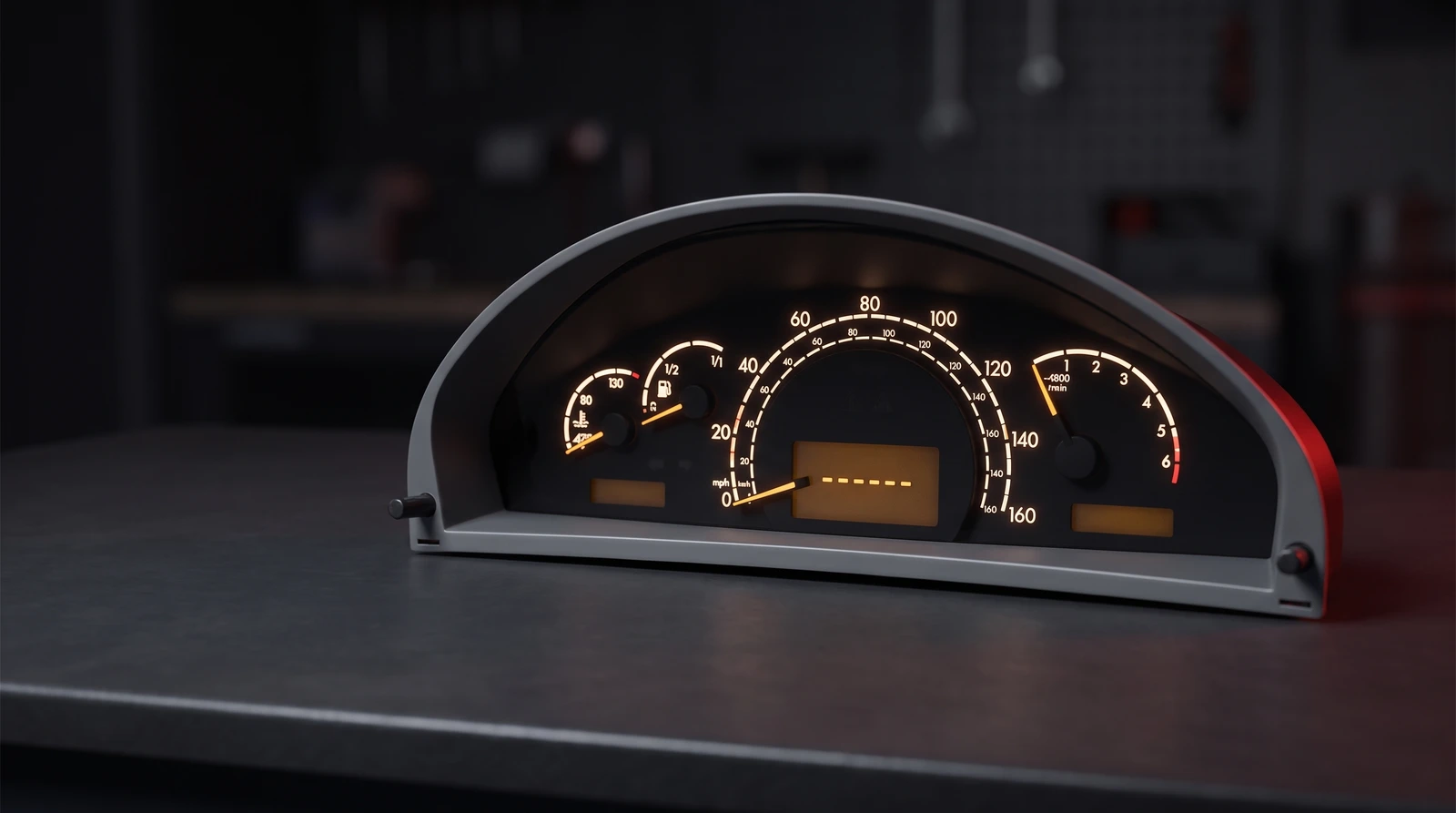
A Mercedes that flashes its mileage, or shows dashes in its place, is not reporting a fault with the number itself. The cluster is withholding a reading it cannot confirm. On a modern Mercedes the total mileage is a stored electronic figure, and owners who have swapped clusters report that it is held in more than one place around the car — the panel expects those copies, and the modules that share them, to agree.
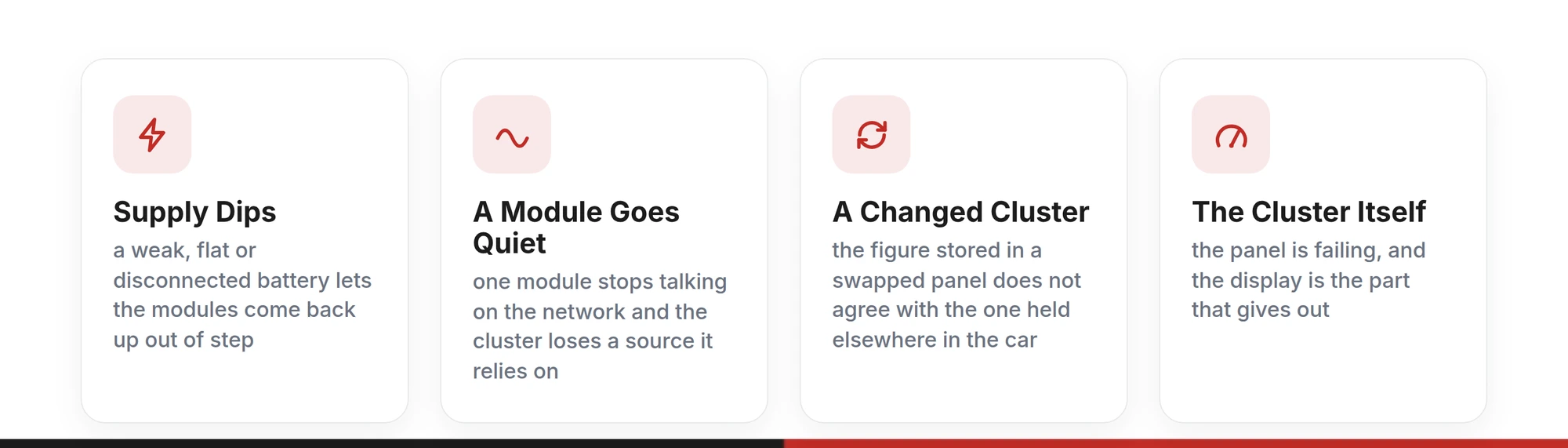
Four things commonly stop that happening. The supply voltage drops or is interrupted, and modules come back up out of step. A module stops communicating on the car’s CAN-bus network, so the cluster loses a source it relies on. A cluster has been changed, and the figure stored in it does not match the one held elsewhere. Or the cluster itself is failing, and the display is the part giving out.
The look of it varies between cars. One owner describes six flashing dashes; an A-Class (W169) owner reports the mileage showing for about two seconds before four dashes replace it; E-Class (W211) owners describe dashes flashing where the reading should be. The number of dashes is not worth decoding. When it started, and what else the car is doing, tell you far more.
If you have arrived from a Fiat, the symptom looks the same but the cause works differently — our guide to mileage flashing on a Fiat 500 covers that car, and our instrument cluster repair hub covers other makes.
When it started tells you most of the cause
The moment the figure disappeared is the best clue you have. Most reports fall into one of five patterns, and each points somewhere different.
| When it started | What owners describe | Likely cause | Check first |
|---|---|---|---|
| After a battery disconnect, a flat battery or a spell standing unused | Dashes or a flashing figure as the battery is reconnected — one owner saw six flashing dashes after two weeks away | Low or interrupted supply leaving modules out of step | Battery condition and charging voltage, then a full diagnostic scan |
| After a used or replacement cluster was fitted | Dashes from the first start with the new panel | The cluster’s stored mileage does not agree with the figure held elsewhere in the car | Whether the correct figure was carried across when it was fitted |
| After diagnostic work on another system | Dashes once the car came back from a workshop — reported on an SL after brake-system work | A diagnostic session not closed out cleanly, leaving modules out of step | Back to the workshop that did the job, with its diagnostic equipment |
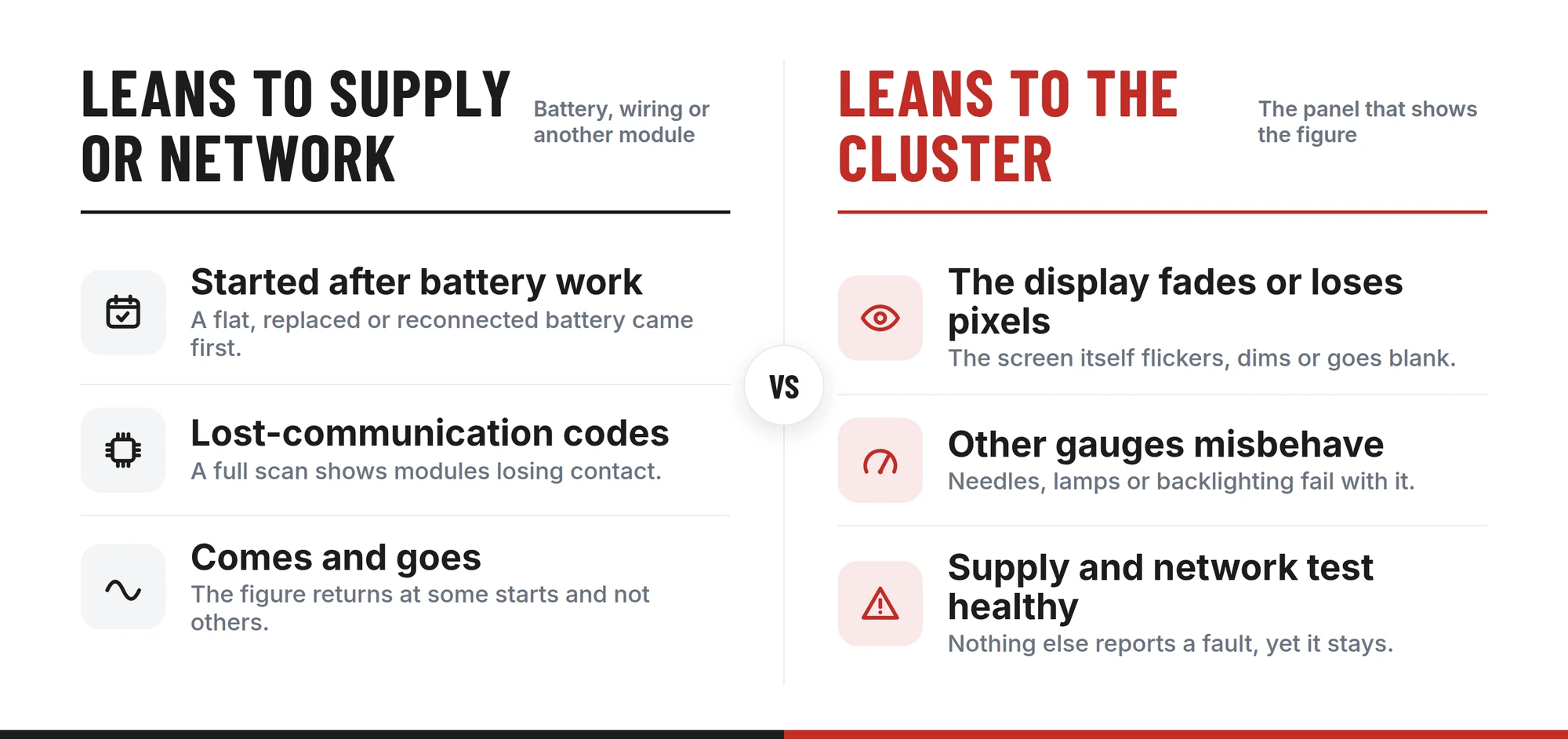
| At random, alongside other gauge or warning-lamp faults | Dashes that come and go, sometimes gone at the next start | Lost communication between modules — supply, wiring or a module | A scan for communication faults; wiring and connections checked |
| The display fades, loses pixels or goes dark | Figure unreadable, or the whole top display out — reported on an R350 | The cluster’s own display or its power | Supply to the panel, then the cluster itself |
If more than one row fits — a battery that went flat the week after a cluster was fitted, say — rule out the supply first. It is the quickest thing to check and the one most likely to muddy everything else.
Can you reset flashing mileage on a Mercedes?
Not from the dashboard, and not for good unless the cause goes with it. The dashes are not a stored message waiting to be dismissed. The cluster produces them whenever it cannot confirm the figure, so they return at the next start for as long as the cause is still there.
Mercedes’ own owner’s manual does describe resetting values on the on-board computer’s trip menu, where pressing and holding the control returns the trip figures to zero. That is a different thing altogether. It clears the trip distance and journey data, leaves the total mileage alone, and has no effect on a flashing reading or dashes.
The two other suggestions that circulate are disconnecting the battery and clearing fault codes with a scan tool.
- Disconnecting the battery. If a brief supply dip left the modules out of step, they may come back up in agreement. But an interrupted supply is one of the triggers in the first place — one owner’s dashes appeared as the battery was reconnected — so it can start the problem as readily as end it, and it does nothing for a mismatched or failing panel.
- Clearing codes. Erasing stored faults deletes the record, not the condition. If a module is still off the network, the fault and the dashes both return, minus the history that showed which module was involved.
What genuinely resets it is dealing with the cause. A weak battery is replaced and the modules settle. An unfinished diagnostic session is completed properly: one SL owner’s dashes appeared after work on the car’s brake-control system and were put down to that session being exited in the wrong order, with the car needing to go back on the diagnostic equipment to finish it. A replacement cluster has the correct figure carried across by whoever fitted it. A failed cluster is repaired.
Occasionally it is configuration. One E-Class (W211) owner reported the reading returning once a warning-buzzer setting that had been switched off was switched back on — an unusual case, but a reminder that not every set of dashes means failed hardware.
Sinspeed · Mercedes odometer display
Dashes still there after the obvious checks?Send us the model, the chassis code, what the car was doing when the figure disappeared and any codes read beforehand. From that we can usually say whether the panel is the likely culprit before anything is taken out.
Advice before anything leaves the car · Recorded mileage never altered
Four checks worth making before anyone blames the cluster
None of these involve taking anything apart, and between them they usually show whether the cluster needs to come out at all.
- Test the battery and charging voltage
A battery near the end of its life, or one that has been left flat, can drop the supply low enough for modules to lose contact with each other. Any garage or battery fitter can test its condition and the charging voltage in a few minutes. If the dashes appeared after the car stood unused, this is the first suspect.
- Work out what changed just before
A battery replaced or reconnected, a jump start, a cluster swapped, a workshop visit for something unrelated. Match it against the table above; the answer often narrows the cause to a single row.
- Get a full diagnostic scan, and keep a copy
A scan across all the modules, not just the engine, shows whether any have logged lost communication with the cluster or with each other. Write the codes down or photograph the screen before anyone clears them — they are the evidence that separates a network fault from a panel fault.
- List what else the dashboard is doing
Needles that drop or stick, lamps lit with no fault stored behind them, backlighting that fails, a display that fades — each points more firmly at the cluster. If warning lamps have come on with the dashes, our guide to what dashboard warning lights mean sorts the ones that need attention now from the ones that can wait.
Signs the instrument cluster itself has failed
When the supply tests healthy, no other module reports lost communication and the dashes or dark display stay put, the cluster becomes the likely source. The signs that point that way are display faults rather than wrong figures: a mileage display that fades, loses pixels, flickers or goes blank, often taking other information on the same screen with it, or a panel whose power comes and goes.
Those faults are well known on several generations. The W168 A-Class loses pixels in the display that carries the mileage and temperature. The W202 C-Class, W208 CLK and W210 E-Class have a display that goes blank or distorted, covered on our W202, W208 and W210 cluster LCD repair page. Facelifted W203 C-Class panels can flicker or go dark, and the SL (R230) display can fade or die. One R350 owner reported the whole top display going out, taking the odometer with it.
All of these are repaired here by post. Your garage — or you, if you are comfortable doing it — takes the panel out and sends it in. We track down the fault on test rigs that reproduce the conditions inside the car, repair it, calibrate the gauges with dealer-level diagnostic equipment and send the same cluster back. Most Mercedes clusters go back in without coding; where a car does need coding once the panel is refitted, that is a normal part of fitting it. Most repairs carry our lifetime, unlimited-mileage warranty.
Some models already have their own listing — the Mercedes CL-Class (1999–2006) instrument cluster and the Mercedes Vito instrument cluster — and the full range sits on our Mercedes-Benz instrument cluster repairs page.
There is also a practical reason to repair your own panel rather than fit a used one. A second-hand cluster arrives holding the mileage of the car it came from, which is exactly the mismatch that produces dashes in the first place. Your original already agrees with the rest of your car.
Your recorded mileage stays exactly as it is
We never alter recorded mileage. A cluster we repair goes back to your car showing the reading it arrived with, and nothing in our work changes, winds back or resets that figure.
Dashes on the display do not usually mean the figure has gone. In several owner reports the reading came back once the cause was dealt with. Until then, note the last reading you saw and keep the invoices for any work done on the cluster, so the car’s history stays easy to follow.
If a replacement cluster has already been fitted and the dashes started then, go back to whoever fitted it. Carrying the car’s correct figure across belongs to that job, and they should be able to show it was done.
Mercedes odometer dashes: common questions
Why does my Mercedes show dashes instead of the mileage?
The cluster shows dashes when it cannot confirm the stored mileage: after a drop in supply voltage, when a module stops communicating on the network, when a changed cluster’s stored figure does not match the rest of the car, or when the cluster itself is failing. When it started — after battery work, a cluster swap, a workshop visit or at random — is the best guide to which.
Will disconnecting the battery clear flashing mileage on a Mercedes?
Sometimes briefly, rarely for good. If a supply dip left the modules out of step, they may come back up in agreement, but an interrupted supply is also one of the things that causes the dashes. It does nothing for a mismatched or failing cluster. Having the battery tested and the fault memory read is the better first move.
Is the trip reset in the Mercedes manual the same thing?
No. The trip reset returns the trip distance and journey figures to zero. It does not touch the total mileage and has no effect on dashes or a flashing reading.
Has my car lost its mileage?
Not usually. The dashes mean the cluster cannot confirm the figure, not that it has been wiped, and in several owner reports the reading returned once the cause was put right. Note the last reading you saw and keep records of any cluster work.
Do I need to send the whole car?
No — only the instrument cluster. Your garage, or you, removes it and posts it to us after booking it in through the repair form. We repair it and return the same unit showing the same recorded mileage. Most Mercedes clusters go back in without coding; where coding is needed, it is part of refitting.
Sinspeed · Mercedes instrument panels
Figure still missing? Post us the clusterIf the checks point at the panel, your garage takes it out and sends it to us. We find the fault, repair it and return the same cluster, showing the same recorded mileage, ready to go back in.
Same panel, same recorded mileage · Lifetime, unlimited-mileage warranty on most repairs · Proven on our own test rigs before dispatch
Final thoughts
Dashes where the mileage should be look alarming because the total is the number everyone checks. In practice they are the cluster declining to show a figure it cannot stand behind, and the reasons it cannot are few and findable.
Start with what changed and with the battery, have the fault memory read before anything is wiped, and let that decide whether the panel needs to come out. If it does, the repair brings back a steady reading — the same one your car carried before the dashes appeared.