
Summary: BMW X3 dashboard warning lights work on a traffic-light scale: red for a serious, possibly dangerous fault and a stop once it is safe, yellow for a fault to have checked soon, and green for a system that is on or working. Below is what each lamp generally means and how fast to act. For the first-generation E83 X3 (2004–2010), the guide then follows the warnings to units we repair by post: the Bosch 8.0 ABS/ESP unit, whose symptoms include the ABS and stability lamps, and the 2.0d’s electronic turbo actuator. It also covers the X3 instrument cluster and the EGS gearbox control unit on X3s with a ZF automatic.
- What do red, yellow and green mean on a BMW X3 dashboard?
- What is a red lamp on an X3 dashboard warning you about?
- How urgent are the X3’s yellow lamps and its other fault warnings?
- What do the X3’s green and Check Control symbols tell you?
- What should you do when DSC or the brake lamp joins the X3’s ABS lamp?
- The E83 X3 and ZF automatics: which units behind the warnings do we repair?
- Your BMW X3 warning-light questions
- Final thoughts
What do red, yellow and green mean on a BMW X3 dashboard?
Colour gives the first reading; the lamp itself gives the rest. General guidance for BMW lamps uses three colours, and one lamp’s instruction can be firmer than its colour: the yellow oil lamp asks you to stop.
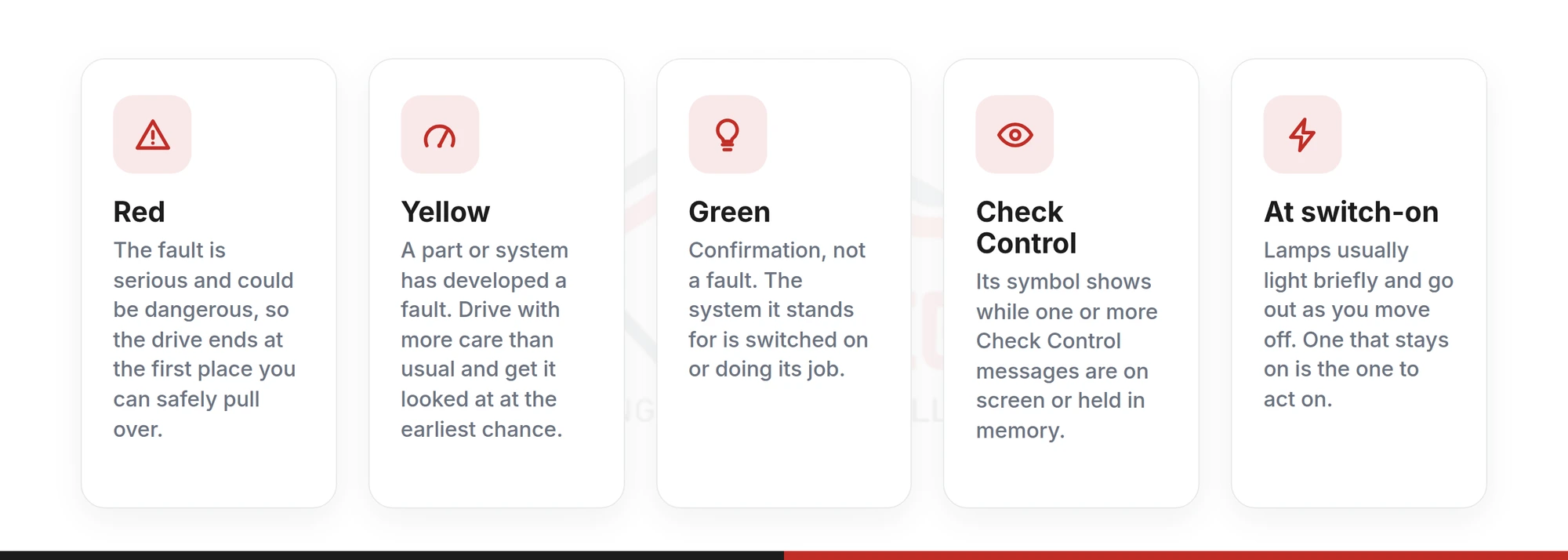
- Red: the fault is serious and could be dangerous, so the drive ends at the first place you can safely pull over.
- Yellow: a part or system has developed a fault. Drive with more care than usual and get it looked at at the earliest chance.
- Green: confirmation, not a fault. The system it stands for is switched on or doing its job.
- Check Control: its symbol shows while one or more Check Control messages are on screen or held in memory.
- At switch-on: lamps usually light briefly and go out as you move off. One that stays on is the one to act on.
These are general meanings for BMW lamps, not a page from an X3 handbook. Lamps and colours differ between the E83 and later X3s and with specification; your own X3’s handbook, read with any Check Control message, has the final say.
BMW has no hand in this page: Sinspeed is an independent repair business, not a BMW dealer or agent. Read “Our advice:” as Sinspeed speaking; every unmarked instruction is the general BMW guidance.
What is a red lamp on an X3 dashboard warning you about?
On the colour scale, a red lamp means finding a safe place to stop. Each row adds what that lamp is reporting and what follows the stop.
| Warning | What it is telling you | How to respond |
|---|---|---|
 Brake system | Comes on while you are driving: the brake fluid level may be low. | Stop once it is safe. Checking the fluid is a job for a professional unless you know how to do it yourself. With the ABS lamp lit as well, call for recovery (see the pairings below). |
 Engine coolant temperature | The engine is running too hot. A coolant level that has dropped, perhaps through a leak, can cause it, or something more serious such as a failed head gasket. | Stop straight away: short of coolant, an engine can damage itself beyond repair. Once cool, check the level, top up and look for leaks. No leak and the lamp stays out: the guide lets you carry on. Back on: have the fault found. |
 Airbag | At least one part of the restraint system is not working correctly: the airbags, the front passenger occupant classification that judges a passenger’s weight and position, or the seat belt pretensioners. | A faulty system may not deploy in a crash, or in some cases could go off unexpectedly. Have it checked immediately. |
 Steering lock (red) | The anti-theft steering lock, which holds the wheel in place when the ignition is off, shows red while you are driving. | Stop immediately and carefully, then call for roadside assistance: the wheel could lock in position, a potentially life-threatening situation. |
| Diesel exhaust fluid (red) | On diesels that use the fluid: the level has dropped so low that the engine will not start again once it is switched off. | Our advice: get it topped up before the engine is next turned off. |
How urgent are the X3’s yellow lamps and its other fault warnings?
Yellow asks for an early check, though the oil lamp asks for a stop. The second table holds fault lamps the guide gives no colour.
Lamps the guide shows in yellow
| Warning | What it is telling you | How to respond |
|---|---|---|
 Engine oil level or pressure | The oil is running too hot, or its level or pressure is too low. | Stop somewhere safe at the first chance and switch off. Look underneath for leaks, then check the level and top up if needed. If the level was fine, the oil pump may be at fault: call for recovery, as driving further could damage the engine. |
| Coolant level | The coolant is running low. | Avoid long journeys. Stop and top up as soon as possible, once the engine has cooled. If the lamp keeps returning, have the car checked for a leak. |
| Steering lock (yellow) | A fault in the anti-theft steering lock. | Get the lock looked at without delay. If it turns red on the move, the red row applies. |
| Diesel exhaust fluid (yellow) | The fluid level is low; left alone, it will eventually stop the engine starting. | Have it topped up as soon as you can, before the lamp turns red. |
Fault lamps the guide gives no colour for
The general guide names no colour for these, so take the colour from your own dashboard.
| Warning | What it is telling you | How to respond |
|---|---|---|
| ABS | Staying lit: the anti-lock system may have a fault. Normal braking, without anti-lock, should still be there. | The guide allows the journey to continue with extra care and a longer gap, with a check booked promptly. Should the red brake lamp light too, treat it as the pairing below: off the road, and the X3 recovered. |
| DSC (Dynamic Stability Control) | Flashing: the system is at work, for example where grip is poor. Steady: DSC is not working properly. Shown with OFF: DSC has been deactivated, and that may not have been intended. | Steady without OFF: have it checked at a garage, as DSC is an important safety feature. Our advice: if OFF shows and you did not intend it, turn DSC back on; an OFF lamp that will not clear belongs with a garage. |
| Engine management (check engine) | Also called the Malfunction Indicator Lamp. An engine fault, often with lost power or stuttering under acceleration; causes run from a broken sensor to the emission control system or catalytic converter. | Book a diagnostic check promptly to find the cause; carrying on risks adding to the damage, possibly beyond repair. |
| Battery charging | Lit with the engine running: charging has stopped. The guide’s suspects are the alternator, the battery itself, a poor connection or damaged cabling. | The car runs on what is left in the battery, and when that is gone nothing electrical works, so head for a garage promptly. |
| Transmission | A possible transmission fault, often fluid running hotter than normal, or a low fluid level. | Have a professional check it: carrying on could cause more damage, and an automatic gearbox can be expensive to replace. |
| Steering system (Integral Active Steering) | On BMWs with Integral Active Steering, which also steers the rear wheels, the lamp first asks for a system check with the car parked and the engine running. If it stays on beyond that, a fault is possible. | Book it in promptly. |
| Tyre pressure | Pressure has dropped in a tyre, slowly or through a puncture. | Slow down, avoid sudden braking or sharp steering, then inflate to the handbook figure. |
| Brake pad wear | The wear sensor has detected thinning pads, warning before they reach a dangerous state. | Arrange new pads without delay, as braking on a fully worn pad could be extremely dangerous. |
| Diesel particulate filter | Diesels: a problem with the filter that traps exhaust soot, possibly a blockage. | A garage should look at it promptly. Left blocked, the filter could lead to more serious damage. |
For how a power steering fault tends to show itself, see our explainer on the electric power steering warning light.
What do the X3’s green and Check Control symbols tell you?
A green lamp is a confirmation: the system it stands for is on or working. The Check Control symbol means at least one Check Control message is on screen or stored, and that message is where to start reading.
What should you do when DSC or the brake lamp joins the X3’s ABS lamp?
The general guide gives the brake-and-ABS pair an instruction of its own, but has no entry for DSC with ABS. Neither pairing, by itself, tells you which part has failed.
- Red brake lamp with the ABS lamp. The guide treats this pairing as a braking system malfunction, where braking may not be reliable. Get off the road at the first safe place, braking gently, then call for recovery rather than drive on.
- DSC with ABS. With no combined entry, each lamp keeps its own instruction: careful driving and a prompt check for ABS, a garage check for a steady DSC lamp. Our advice: until then, drive as if neither system will step in. For background, what ESP does covers the stability side, and ABS and traction control lights on together explains where it meets anti-lock braking.
- On an E83. Our E83 ABS page lists an ABS lamp and a traction or stability lamp, separately, among symptoms of a failing Bosch 8.0 unit. That is a symptom list, not a rule: your garage’s codes decide.
The E83 X3 and ZF automatics: which units behind the warnings do we repair?
The general guide stops at the lamp. From here the facts come from our own repair pages, which cover the E83 X3 (2004–2010) and X3s with a ZF automatic. A later X3’s units are not assumed to match.
The E83 Bosch 8.0 ABS/ESP unit
Our E83 page puts the 2004–2010 X3 among the cars fitted with the Bosch 8.0 ABS/ESP pump module, a unit it describes as commonly failing. The Bosch 8.0 combines the pump, the valve block and the control unit that run anti-lock braking and stability control. Symptoms our page lists for it on the E83 include the ABS and stability lamps, brake pressure and wheel speed sensor faults and no communication with the ABS system; replacing wheel speed sensors may not cure it.
Fitting a new unit means coding it to the car. Ours is the other route: the X3’s existing unit is remanufactured and refits with nothing to code, backed by a lifetime warranty. The fault is covered in more depth on our BMW X3 E83 Bosch ABS/ESP pump repairs page, and you can book the BMW X3 E83 (2004–2010) ABS pump repair directly. The unit itself is explained on our Bosch 8.0 ABS/ESP module repair page, other BMW units sit under BMW ABS pump repairs, and DSC brake pressure sensor faults on other BMW models have their own page on BMW DSC brake pressure sensor faults.
The instrument cluster
The cluster shows you every lamp above, so a panel that goes dark or misbehaves is worth a look in its own right. The X3 is among the BMWs on our BMW instrument cluster repairs page, which holds that a BMW cluster is seldom too old or too new to repair. The panel that leaves your X3 by post is the one that comes back, still holding the same mileage and coding, so it simply refits.
The 2.0d’s electronic turbo actuator (2004–2007)
The E83 2.0d built from 2004 to 2007 has an electronic turbo actuator, controlled by the engine ECU, that governs the turbocharger’s flow and output. It fails often enough for our page to single it out, and it cannot be bought on its own, only with a complete turbo. The signs it lists are fault codes pointing to “Charge Air Pressure Control” and an actuator arm that does not move.
An engine lamp alone does not name the actuator. If your garage’s diagnosis points there, we fully remanufacture it: see our BMW X3 2.0d (E83) electronic turbo actuator repairs.
Gearbox warnings on a ZF automatic: the EGS
Our valve body page lists the ZF 6HP and 8HP among the X3’s automatics. BMW calls their control unit the EGS, integrated with the valve body in the ZF mechatronic. Signs of a failing valve body or control unit include slipping, flaring, harsh or delayed changes and limp mode, which can mimic worn clutches so closely that the wrong part gets replaced.
When diagnosis points at the EGS, your garage removes the unit with the gearbox left in the car and posts it to us. Because the unit that comes back is the one that left, the gearbox does not start from scratch: its coding and learned adaptation data travel with it. Details are on our transmission valve body repair page.
Airbag, engine and starting faults: diagnosis comes first
An airbag lamp needs a garage’s diagnosis before any part is blamed. Where the trail leads to the control unit itself, we repair airbag control units: send the part number and we will confirm, or see airbag control unit repairs.
Engine management and particulate filter lamps also start with a diagnostic check. An X3 that will not start at all is a separate question; our guide to whether a no-start is the immobiliser sets out the signs.
None of this needs the X3 itself to leave your garage. They remove the unit their diagnosis has named, post it to our Epsom workshop and refit it on its return, with any coding or calibration counted as part of the job. Units are tested on our in-house Hardware-in-the-Loop rigs, which simulate real-world heat, vibration and load.
Sinspeed · X3 electronics, repaired and returned
ABS and DSC lamps on an E83, or charge-pressure codes on a 2.0d?Tell us the X3’s year, engine and gearbox, the lamps or messages you have seen and your garage’s codes. We will say whether the unit behind them is one we repair.
Board-level fault-finding and repair, done in-house · Bosch 8.0 units return plug and play, with no coding
Your BMW X3 warning-light questions
Is my X3 safe to drive with the ABS lamp lit on its own?
With the ABS lamp on by itself, the general BMW guidance says normal braking without anti-lock should remain, so you can continue carefully: keep a longer gap, take extra care and have it checked as soon as possible. If the red brake lamp comes on with it, the advice changes: stop as soon as it is safe and call for recovery. On an E83, an ABS lamp is one of the symptoms our page lists for a failing Bosch 8.0 unit; your garage’s codes decide whether that is the cause.
My X3 shows DSC OFF. Is something broken?
Not necessarily. OFF beside the DSC lamp means it has been turned off, which can happen without you meaning to. Flashing means DSC is at work on a surface with little grip. A steady DSC lamp without OFF means the system is not working properly, and because DSC is an important safety feature, a garage should check it.
Do charge-pressure fault codes on a 2.0d X3 mean the turbo actuator has failed?
Not by themselves. On the E83 2.0d built from 2004 to 2007, our page lists fault codes pointing to “Charge Air Pressure Control” and an actuator arm that does not move as signs of a failing electronic turbo actuator, a part that only comes with a whole turbo. Your garage’s diagnosis decides. If it points to the actuator, we remanufacture it.
Does the gearbox have to come out of an X3 to repair the EGS?
No. On the ZF 6HP and 8HP automatics our valve body page lists for the X3, the control unit BMW calls the EGS is integrated into the mechatronic. Your garage takes that unit out, leaving the gearbox where it is, and posts it to us. The same unit comes back for them to refit.
What does the Check Control symbol mean on an X3 dashboard?
It means at least one Check Control message is on screen or stored. The message carries detail the lamp cannot, so read it before deciding whether to drive on. Lamps, colours and messages vary between the E83 and later X3s, and your own X3’s handbook has the final word.
Sinspeed · E83 X3 repairs by post
Send the unit, keep the X3: we repair it and post it backWhether diagnosis lands on the Bosch 8.0 unit, the cluster, the 2.0d turbo actuator or the EGS, your garage posts that unit to us, and it returns to the same car once retesting shows the fault has gone.
Warranty for life, whatever the mileage, on most remanufactured parts · Engineers, technicians and diagnosticians all in-house
Final thoughts
On an X3 the colour of a lamp is the first clue, not the whole answer. The Check Control message beside it, and the codes stored behind it, finish what the lamp starts.
On the X3, several of those trails end at a unit that can travel by post: the Bosch 8.0 ABS/ESP unit and the 2.0d’s turbo actuator on the E83, the cluster, and the EGS on ZF automatics. A garage’s diagnosis decides which one, and the unit already fitted is then a repair job, not a write-off.