
Summary: Mercedes E-Class dashboard warning lights are mostly red or yellow, but Mercedes-Benz’s owner’s manual for the 2016–2023 E-Class (S213) ties the instruction to each lamp, not to its colour: one red lamp means pull over and go no further, another only wants a seat belt fastened. Below is what that manual says each lamp means and asks of you. Then come the older W210, W211 and W212, where a brake message, a key that will not turn or a blank display can lead back to a unit we repair by post: the W211’s SBC brake unit, the ignition switch and steering lock, the 722.9 conductor plate and the instrument cluster.
- How does the E-Class manual grade its warning lamps?
- Red lamps on an E-Class: what is each one asking of you?
- What do the yellow E-Class warning lamps mean?
- The blue lamp and the driving-mode lamps
- ESP with ABS, or brake with ABS: reading two lamps at once
- The W210, W211 and W212: units behind the warnings that we repair
- Questions from E-Class drivers
- Final thoughts
How does the E-Class manual grade its warning lamps?
Lamp by lamp. The S213 manual gives most lamps a colour, but the instruction belongs to the individual lamp, and two of the same colour can ask for very different things. Several red lamps say do not continue driving; the red seat belt lamp asks for a fastened belt. Several yellow lamps say drive on carefully; the lit yellow tyre pressure lamp says stop and check the tyres.
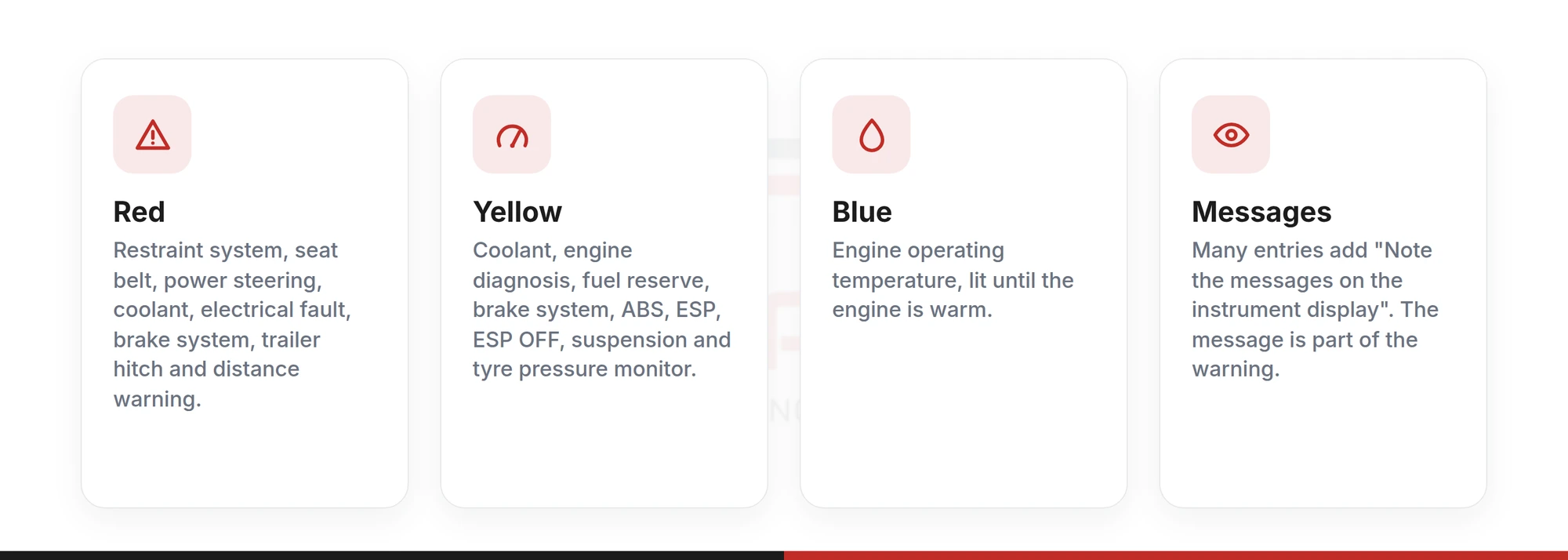
- Red: restraint system, seat belt, power steering, coolant, electrical fault, brake system, trailer hitch and distance warning.
- Yellow: coolant, engine diagnosis, fuel reserve, brake system, ABS, ESP, ESP OFF, suspension and tyre pressure monitor.
- Blue: engine operating temperature, lit until the engine is warm.
- Messages: many entries add “Note the messages on the instrument display”. The message is part of the warning.
This is one generation’s manual. The W210, W211 and W212 show many of these warnings differently, some as lamps and some as display messages, and the lamps fitted vary with specification. Your own car’s handbook is the final word, and nothing here means an S213 lamp behaves the same way on a W211. The lamp sections used here list no oil-pressure or battery-charge lamp, and plug-in hybrid warnings are left out.
We are not part of Mercedes-Benz or its dealer network. The meanings and instructions in the tables are Mercedes-Benz’s, including its “qualified specialist workshop”; a suggestion of ours is labelled Our advice:.
Red lamps on an E-Class: what is each one asking of you?
Four of these include an instruction not to continue driving: power steering, coolant, brake system and trailer hitch.
| Lamp | What Mercedes-Benz says is wrong | What the manual asks you to do |
|---|---|---|
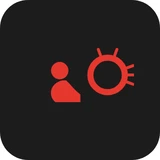 Restraint system | Lit while the vehicle is on: the restraint system is malfunctioning. Parts of it may be triggered unintentionally, or fail to deploy as intended in an accident. | Have it checked and repaired immediately at a qualified specialist workshop. |
| Seat belt | Flashing, with an intermittent tone: the driver or front passenger is unbelted while the vehicle is moving, or objects are on the front passenger seat. Lit once the vehicle has started: a reminder to belt up. | Fasten the belt and clear the front passenger seat; objects left there can keep the lamp lit. |
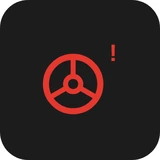 Power steering | Lit while the vehicle is running: the power assistance or the steering itself is malfunctioning. | Pull over and stop safely as soon as possible, minding road and traffic, and do not drive on under any circumstances. Consult a qualified specialist workshop. |
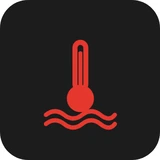 Coolant (red) | Lit while the engine is running. Possible causes: a faulty temperature sensor, radiator fan or coolant pump, low coolant, or a blocked air supply to the radiator. An added warning tone means the coolant has passed 120°C. | Stop as traffic allows, switch the vehicle off and do not continue driving. Temperature display at the low end: consult a qualified specialist workshop. At the high end: keep clear of the car until the engine cools, check the coolant level and the radiator’s air supply, then drive to the nearest workshop without high engine loads, keeping below 120°C. Let the engine cool before opening the bonnet; with an engine-bay fire, keep it shut and call the fire service. |
| Electrical fault | There is a fault in the electrics. | Note the messages on the instrument display. Our advice: write the message down for whoever diagnoses the car. |
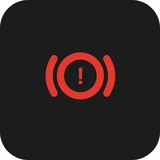 Brake system (red) | Lit while the vehicle is running. Either “the brake force boosting is malfunctioning”, so more pedal force may be needed and an emergency stop can take longer, or the brake fluid level is too low. | Boosting fault: stop in a safe location immediately. Low fluid: stop as soon as road and traffic allow, and do not top up the fluid. In both cases, do not continue driving, and consult a qualified specialist workshop. |
| Trailer hitch | The hitch is not operational, or is swivelling. If the ball neck is not locked, the trailer may come off. | Stop immediately as traffic allows and do not drive on. Uncouple the trailer and secure it against rolling away; if the hitch is swivelling, wait for the ball neck to reach its operational position. Re-couple only after a new swivelling procedure, once the display message has gone. |
| Distance warning | Lit while moving: the gap to the vehicle ahead is too small for the selected speed. With a tone, you are closing on an obstacle too fast. | Be ready to brake immediately, and increase the distance. |
For the red power steering lamp in general, see how electric power steering warnings work. On a W211 with SBC, brake warnings can come from the SBC unit itself, covered below.
What do the yellow E-Class warning lamps mean?
Only one yellow lamp here asks you to stop: the tyre pressure lamp when it is lit. The others ask for care, a workshop or fuel.
| Lamp | What Mercedes-Benz says is wrong | What the manual asks you to do |
|---|---|---|
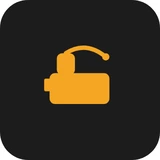 Engine diagnosis | Lit while the engine is running: a malfunction in the engine, exhaust or fuel system. Emissions limits may have been exceeded, and the engine may be in emergency operation mode. | Have the vehicle checked as soon as possible at a qualified specialist workshop. On a diesel the tank may have been run dry: after refuelling, start the engine three to four times, and if the lamp goes out, emergency mode is cancelled and the manual says no check is needed. |
| Coolant (yellow) | Lit while the engine is running. Possible causes: a faulty temperature sensor, faulty charge-air, transmission-oil or battery cooling, or blocked or defective radiator shutters. | Drive to the nearest qualified specialist workshop, avoiding high engine loads. |
| Brake system (yellow) | Lit while the vehicle is running: the brake system is malfunctioning, and braking may be impaired. | Drive on carefully, adjusting your speed and keeping a suitable gap. Have the brake system checked immediately at a qualified specialist workshop. |
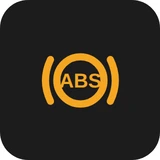 ABS | Lit while the vehicle is running: ABS is malfunctioning; with an added tone, EBD is. Other systems may also be malfunctioning. Wheels may lock under braking, steerability and braking are heavily impaired, and other driving safety systems are switched off. | Drive on carefully and have the brake system checked immediately at a qualified specialist workshop. |
 ESP, lit | Lit while the vehicle is running: ESP is malfunctioning and cannot stabilise the car. Other systems, such as BAS, may be affected, and other driving safety systems are switched off. | Drive on carefully and consult a qualified specialist workshop immediately. |
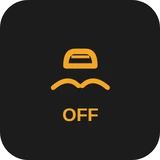 ESP OFF | Lit while the vehicle is running: ESP has been deactivated, and other systems may be inoperative too. | Drive on carefully, keeping ESP off only as long as the situation requires. If it cannot be activated, ESP is malfunctioning: have it checked immediately at a qualified specialist workshop. |
 Tyre pressure, flashing then lit | Flashes for about a minute, then stays lit: the monitoring system is malfunctioning and cannot warn of pressure loss. | Have the system checked at a qualified specialist workshop. |
| Tyre pressure, lit | Pressure loss detected in at least one tyre. A tyre can burst, and driving, steering and braking may be greatly impaired. | Stop as traffic conditions allow, check the tyres and their pressures, and adjust to the recommended pressures if necessary. |
| Suspension | AIR BODY CONTROL or AMG RIDE CONTROL+ lamp: a fault in that system. | Note the messages on the instrument display. |
 Fuel reserve | Lit while the engine is running: the fuel has dropped into the reserve range. | Refuel. |
The blue lamp and the driving-mode lamps
Some lamps report a state, not a fault. The blue engine operating temperature lamp stays lit until the engine is warm, and output and torque stay reduced until then. A yellow ESP lamp flashing while you are moving means one or more wheels have reached their grip limit: adapt your driving to the road and weather. The Active Brake Assist lamp means either that dirty sensors or a malfunction have left the system unavailable or restricted, or that it is switched off or restricted, possibly because another driving system is active. On Mercedes-AMG versions a lamp confirms ESP SPORT, in which ESP stabilises the car only to a limited extent; DRIFT MODE, where fitted, is for closed race circuits only.
ESP with ABS, or brake with ABS: reading two lamps at once
The manual has no entry for a pair of lamps, so each keeps its own meaning and instruction, and it does not say whether two lamps mean one fault or two.
- Yellow ESP and yellow ABS. Each entry warns that other driving safety systems may be affected, and the instructions agree: drive on carefully, and have a qualified specialist workshop check the car immediately. Our explainers cover each system on its own: what ESP does and our piece on ABS and traction control lights on together.
- ABS with a warning tone. The ABS entry says an added tone means EBD is malfunctioning.
- Red brake with yellow ABS. The instructions differ: drive on carefully for ABS, stop and do not continue for the red brake lamp. Our advice: where lit lamps disagree, follow the stricter instruction, here the red brake lamp’s.
- Yellow brake with yellow ABS. Both entries say drive on carefully and have the brake system checked immediately at a qualified specialist workshop.
On an older E-Class the pairing may be a message and a lamp instead; SBC on the W211 is covered next.
The W210, W211 and W212: units behind the warnings that we repair
From here the guide draws on our own repair pages rather than Mercedes-Benz’s manual. Those pages cover the older cars: the W210, W211 and W212, and E-Classes with the 722.9 automatic. On these, not every warning is a lamp; some are display messages, and some show in how the car starts or drives.
Brake and stability warnings: SBC on the W211, ABS/ESP on the W212
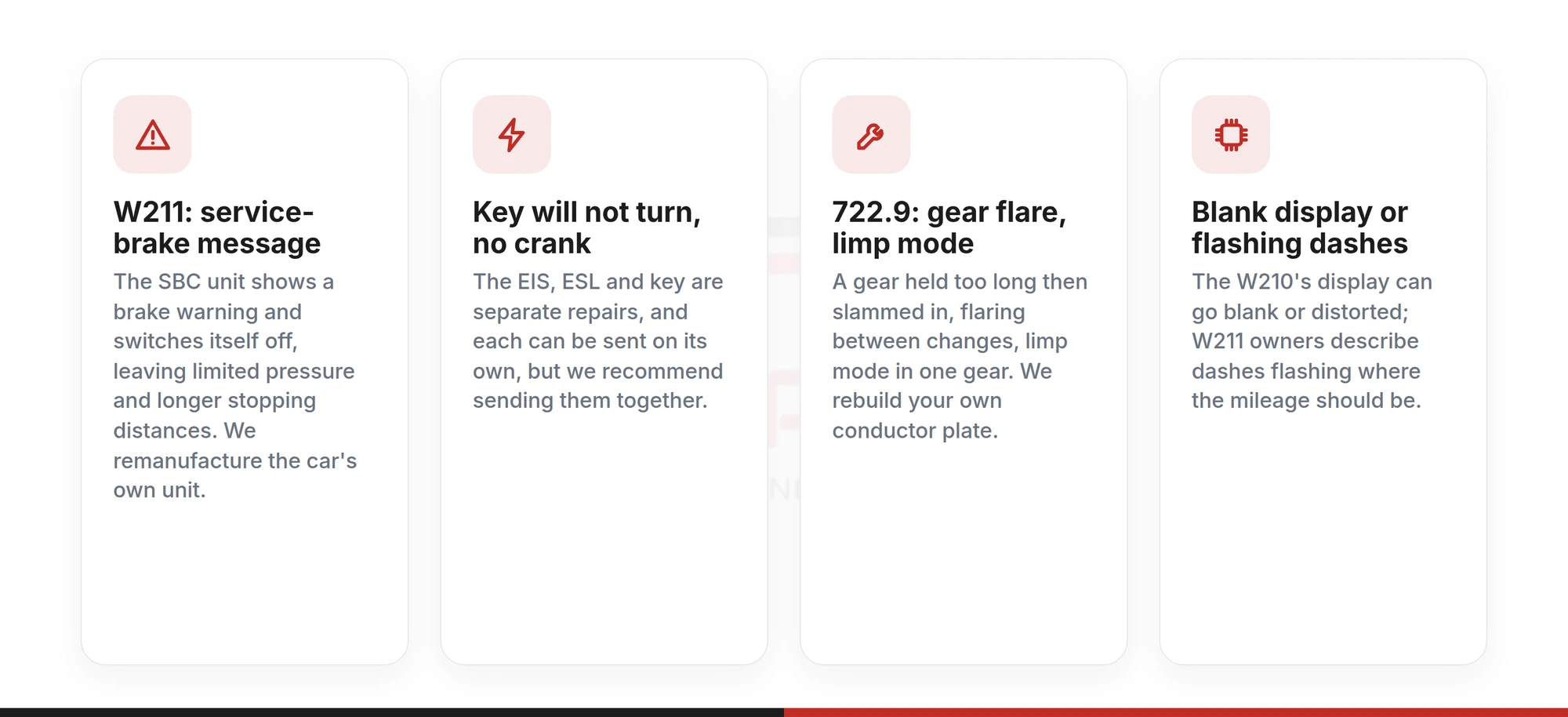
Sensotronic Brake Control (SBC) is the brake-by-wire system Mercedes-Benz developed with Bosch, fitted to cars including the W211 E-Class and the R230 SL, CL and CLS. When the unit reaches the service limit programmed into its control module, or can no longer hold its pressure, it shows a brake warning and switches itself off. The brakes then fall back to a hydraulic mode with limited pressure and longer stopping distances.
Reported warnings include “Service Brake! Visit Workshop”, most commonly seen with code C2498 and often logged with C249F; red messages along the lines of “Brake defective, stop vehicle”, which mean exactly that; and on some cars a warning lamp as the first sign instead of a message. Our Mercedes SBC brake unit repair page explains the codes and how we remanufacture the car’s own unit.
On the W212 (2009–2016), the ABS and ESP unit is among those we repair; see our Mercedes ABS and SBC repairs.
Key, ignition and steering lock: the EIS and ESL
The Electronic Ignition Switch (EIS, also called the EZS) sits behind the key slot. It checks the key, clears the immobiliser and, where an electronic steering lock (ESL) is fitted, lets it release the column. The W210, W211 and W212 all have one. Its warnings are starting faults: a key that will not turn or is not recognised, no crank, intermittent starting, or a Steering Lock warning on the dash.
On the W212, a failing steering lock is a common cause of a no-start: the key turns but the ignition stays off, the dash is dark or half lit, and a steering-lock fault is stored. Never force a key that will not turn, and a column stuck locked cannot be steered, so that car needs recovering.
The EIS, ESL and key are separate repairs, and each can be sent on its own, but we recommend sending them together: on the car it is hard to tell which has failed. See our Mercedes EIS, steering lock and key repairs, the EZS ignition switch fault guide, and whether a no-start is the immobiliser.
E-Class 2002–2015: the 722.9 gearbox’s conductor plate
E-Classes from 2002 to 2015 have the 722.9 7G-Tronic. Its control unit, the VGS, which the trade calls the conductor plate, bolts onto the valve body inside the gearbox sump. The signs our page lists are in the driving and the stored codes: a gear held too long then slammed in, flaring between changes, limp mode in one gear (most often second), and codes such as P0717 or P2200.
Each plate is programmed to its own car’s immobiliser and chassis number, so a second-hand one cannot be made to work in yours. We rebuild your own and return it with its programming intact. Your garage takes it out from underneath with the sump off; the gearbox stays in the car, and only the plate comes to us. See our 722.9 conductor plate repair.
W210 and W211: a cluster display that blanks, distorts or shows dashes
The cluster is where the lamps appear, so a failing one matters. The W210’s display can go blank or distorted. W211 owners describe dashes flashing where the mileage should be, which can follow a supply-voltage drop, a module dropping off the car’s network, a replacement cluster whose stored mileage disagrees with the car, or the cluster itself failing.
A lamp the panel lights on its own looks like a real warning, and failed panel lighting can hide a real one after dark. Our Mercedes mileage flashing guide covers what to rule out first. The cluster we send back is the one that came out, showing the same recorded mileage; most Mercedes clusters refit with no coding, and where coding is needed it is part of fitting. Other generations are on our Mercedes instrument cluster repairs page.
Airbag and engine lamps, and how a unit reaches us
A red restraint lamp goes to a workshop first. Should the airbag control unit turn out to be the culprit, we repair those units; send the part number first and we will confirm, through our airbag control unit repairs. Engine diagnosis and coolant lamps belong with a garage’s diagnostic read: the manual’s own causes for them run across the engine, fuel, exhaust and cooling systems.
Getting a unit to us is a parcel, not a trip for the car. Once diagnosis has named it, the garage that took it out posts it to our Epsom workshop and later fits the repaired one, with any coding the car needs. Each unit runs on our own Hardware-in-the-Loop rigs, loaded with the heat, vibration and electrical demand of a working car, first to catch the fault and later to prove the circuit-level repair.
Sinspeed · older E-Class electronics
A brake message, a key that will not turn, or a blank display?Give us the chassis code, the exact wording of any message and the codes your garage has read, and we will tell you, before anyone lifts a spanner, whether the unit behind it is one we take on.
Programmed and calibrated with dealer-level tools · Every unit tested again before it leaves
Questions from E-Class drivers
Do older E-Classes like the W211 and W212 show the same lamps as the S213?
Not necessarily. The meanings in this guide come from Mercedes-Benz’s owner’s manual for the 2016–2023 E-Class (S213). Older E-Classes show many warnings differently, some as display messages rather than lamps, and the lamps fitted vary with specification. On a W211 with SBC, for example, a brake fault can appear as a service-brake message. Your own car’s handbook is the final word.
The red brake lamp is lit in my E-Class. Can I carry on driving?
Not according to the S213 manual. It gives two possible causes when the lamp is lit while the vehicle is running: the brake force boosting is malfunctioning, or the brake fluid level is too low. For the first, stop in a safe location immediately; for the second, stop as soon as road and traffic allow and do not top up the fluid. Either way, do not continue driving.
What does “Service Brake! Visit Workshop” mean on a W211?
On a W211 with Sensotronic Brake Control (SBC), it is the message most commonly seen with code C2498, usually read as the unit reaching the service limit programmed into its control module. Some sources describe a loss of pressure reserve instead, so diagnosis settles which. SBC may switch itself off, leaving limited braking pressure and longer stopping distances, so treat it as urgent. We remanufacture the car’s own SBC unit by post.
Is a flashing ESP lamp on an E-Class a fault?
Not when it flashes while you are moving. The S213 manual says a flashing yellow ESP lamp means one or more wheels have reached their grip limit, and asks you to adapt your driving to the road and weather. A yellow ESP lamp that stays lit while the vehicle is running is a fault: drive on carefully and consult a qualified specialist workshop immediately.
My W212’s key turns but the dashboard stays dark. What has failed?
On the W212 a failing electronic steering lock is a common cause: the key turns, the ignition stays off and the dash is dark or half lit. The ignition switch (EIS) or the key can produce the same signs, because all three must agree before the car starts. Each is a separate repair and can be sent alone, but we recommend sending them together so the fault can be pinned down on the bench.
Sinspeed · E-Class units by post
Your E-Class’s own unit, repaired and sent back to your garageWhen diagnosis has named the SBC unit, ignition switch, steering lock, conductor plate or cluster, your garage posts it to us. It comes back repaired, retested and ready to refit.
Most remanufactured parts carry a lifetime warranty with no mileage limit · Many units go back ready to fit, no coding needed
Final thoughts
An E-Class lamp is best read through the instruction Mercedes-Benz attached to it, not its colour alone. Two red lamps can ask for quite different things, and one yellow lamp still tells you to stop.
On the older cars, several of the warnings that matter most are messages and symptoms rather than lamps: a service-brake message on a W211, a key that will not turn on a W212. When a garage’s diagnosis lands on the unit behind one of them, the car’s own unit can be repaired and go back in.