 In short
A diesel remap rewrites your engine’s ECU calibration to sharpen throttle response, lift low-down torque and improve fuel economy – without removing your DPF, EGR or any emissions hardware, so it stays road-legal. At Sinspeed the map is matched to your exact vehicle rather than a generic file, we install it safely through our mail-in or mobile service, and we keep your original ECU file on record so the change can always be reversed.
What does a diesel remap actually do?
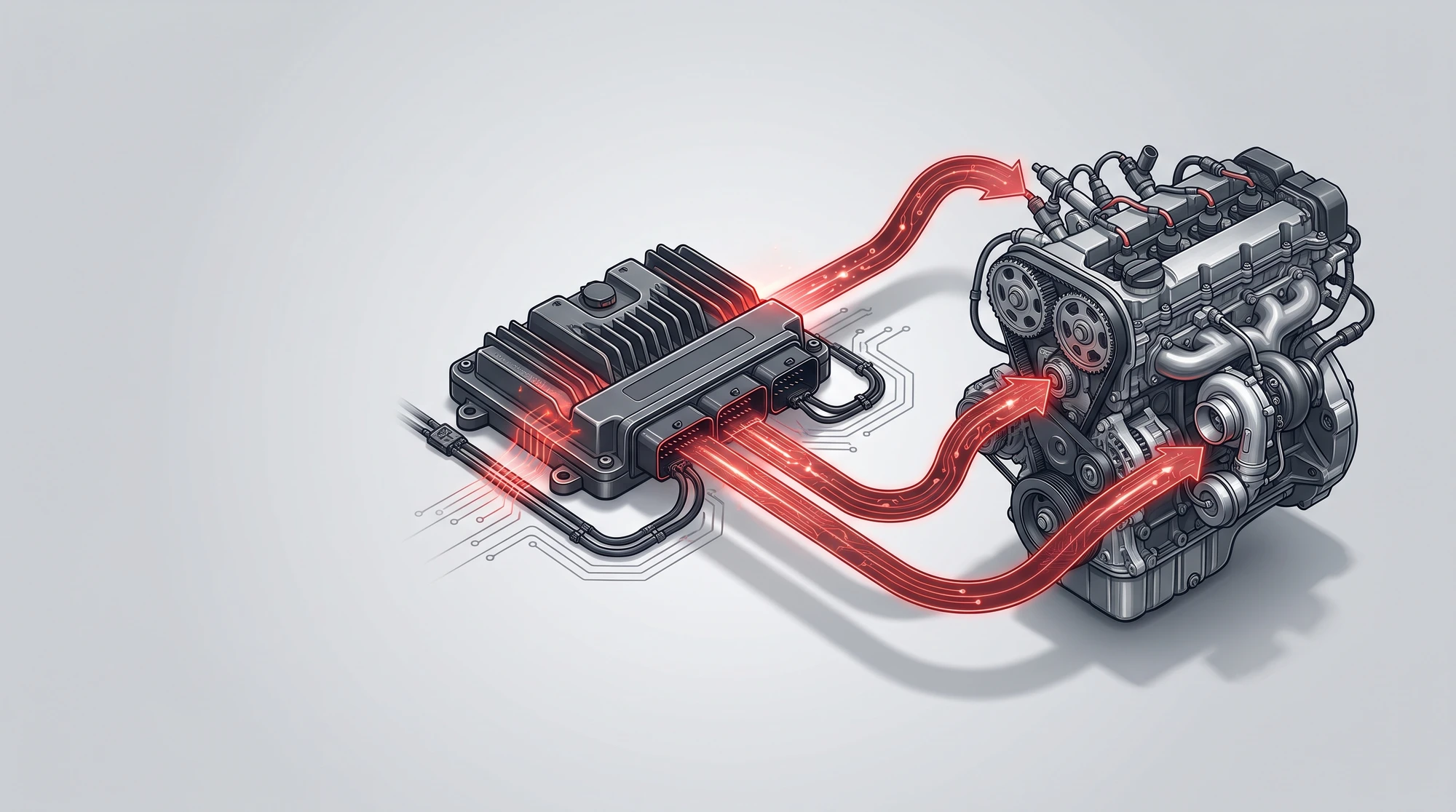
If your diesel feels flat off the mark, hangs on turbo lag before the boost arrives, or works noticeably harder when it is loaded or towing, the engine is almost certainly capable of more than the factory settings allow. A diesel remap addresses that directly. It is a rewrite of the software map inside your engine control unit – the ECU – and specifically the tables that decide how much fuel is injected, precisely when it is injected, and how much boost the turbocharger delivers across the rev range.
Every diesel leaves the production line with a deliberately conservative calibration. Manufacturers build in headroom to cope with poor-quality fuel, skipped services, extreme climates and a single global map that has to suit dozens of markets and driving styles. A remap reclaims that headroom on a vehicle you actually service and fuel properly. It sharpens throttle response and fills in the flat spots the factory map leaves behind, and it does all of that in software – without changing a single mechanical component on the engine.
That software-only nature is the whole point. Nothing is bolted on and nothing is removed; the pistons, injectors and turbo you already own simply work to a smarter set of instructions. For most owners the result is not about chasing a headline power figure. It is about a diesel that pulls cleanly from low revs, sits more relaxed on the motorway, and stops feeling like it is straining every time the road tilts uphill.
Why diesel engines respond so well to remapping
Turbo-diesel engines are unusually responsive to calibration changes, and the reason is in how they make power. A modern common-rail diesel meters fuel at extremely high pressure and can vary injection timing very precisely, while the turbocharger forces in the extra air needed to burn that fuel completely. The factory map keeps all three of those levers – fuelling, injection timing and boost – well inside the engine’s mechanical capability, which leaves a genuine, usable margin for a careful map to work with.
Torque is where the gains matter most. Diesels make their pull low in the rev range, which is exactly where you drive most of the time – pulling away in traffic, holding a gear on a motorway incline, or moving a fully loaded car with a caravan on the back. By raising the fuelling and boost targets sensibly and advancing injection timing only where the engine can take it, a remap lifts mid-range torque and makes the car feel stronger and more effortless, rather than simply faster at the very top end where a diesel spends little of its life.
There is also the matter of the artificial restrictions the factory map imposes. Many diesels carry a conservative torque limiter or an early boost taper that creates a frustrating flat spot between gears – the engine seems to ‘wake up’ and then hesitate. Easing those limits within the mechanical margin removes the flat spot, so power arrives smoothly and predictably instead of in a sudden lump. That smoother delivery is often what owners notice first, ahead of any change in outright pace.
Economy remap or performance remap: which is right for you?
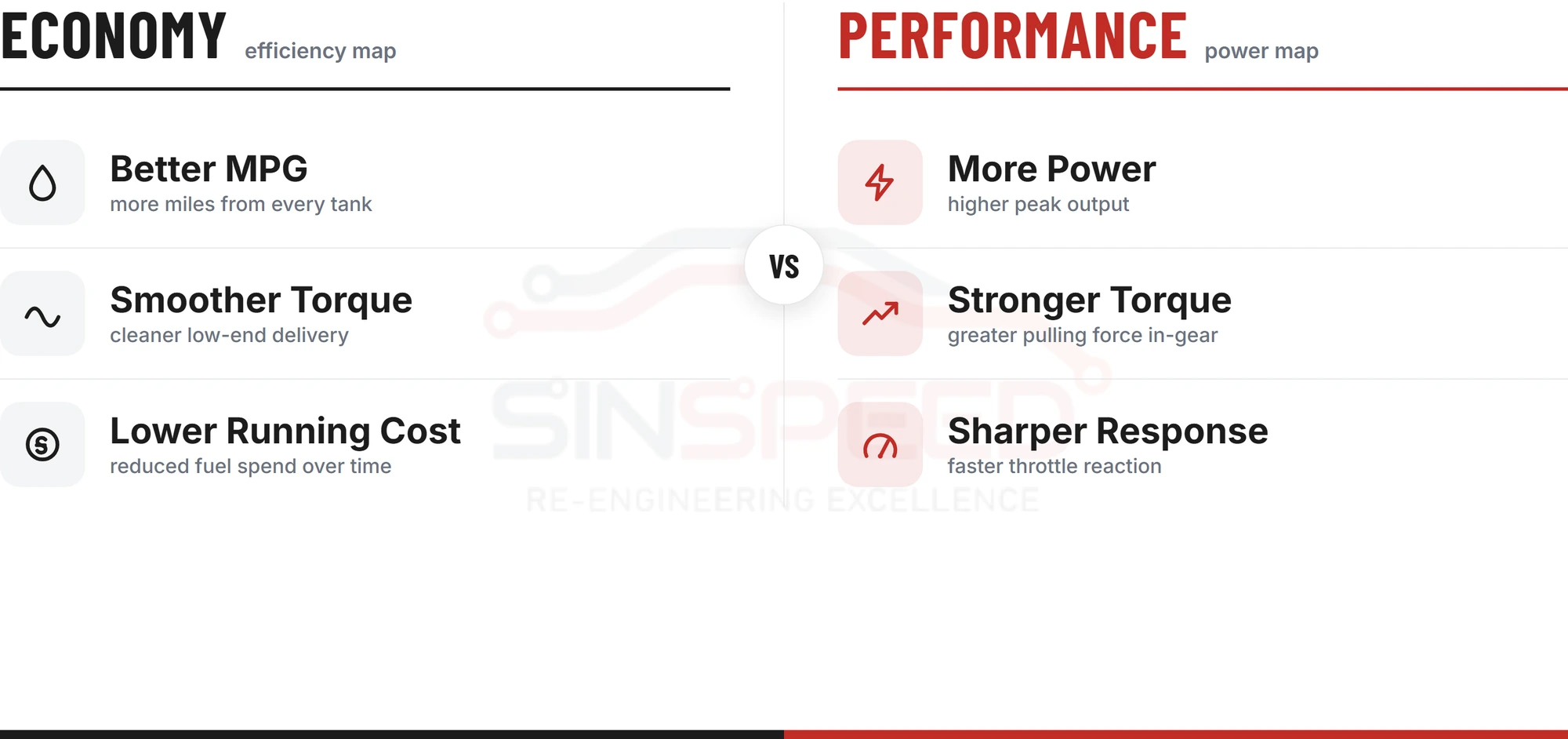
Not every diesel owner wants the same thing from a remap, so the map is matched to your priority. Broadly there are two directions, and a well-developed calibration can blend the two rather than treating them as opposites.
An economy-biased diesel map targets efficiency first. By improving low-rev torque, the engine pulls a taller gear more comfortably, so you change down less often and use less throttle to hold a steady speed. On a long-distance or high-mileage diesel that can translate into a real improvement in MPG over a tank, particularly for motorway commuters and drivers who cover big miles. If fuel returns are your main concern, our dedicated economy remap service is built specifically around that goal.
A performance or torque map prioritises drivability and pulling power – stronger overtaking, easier towing, sharper response from the throttle and a more confident feel when the car is loaded. In practice most diesel drivers benefit from a map that leans one way while still improving the other, because the extra low-down torque that makes a diesel quicker is the same torque that lets it cruise efficiently. The right balance depends on how you actually use the car, which is a conversation worth having before a map is chosen for your vehicle.
Sinspeed · ECU remapping
Talk to an engineer about what your engine will actually gainEvery map we write is built for the specific engine, its condition and how the vehicle is used — not pulled off a shelf. Tell us the vehicle and what you want from it and we will tell you what is realistic.
Mapped for your specific engine and its condition · Dealer-level diagnostic and programming tools · Written by our in-house engineers
What a diesel remap changes, what you gain, and the trade-offs
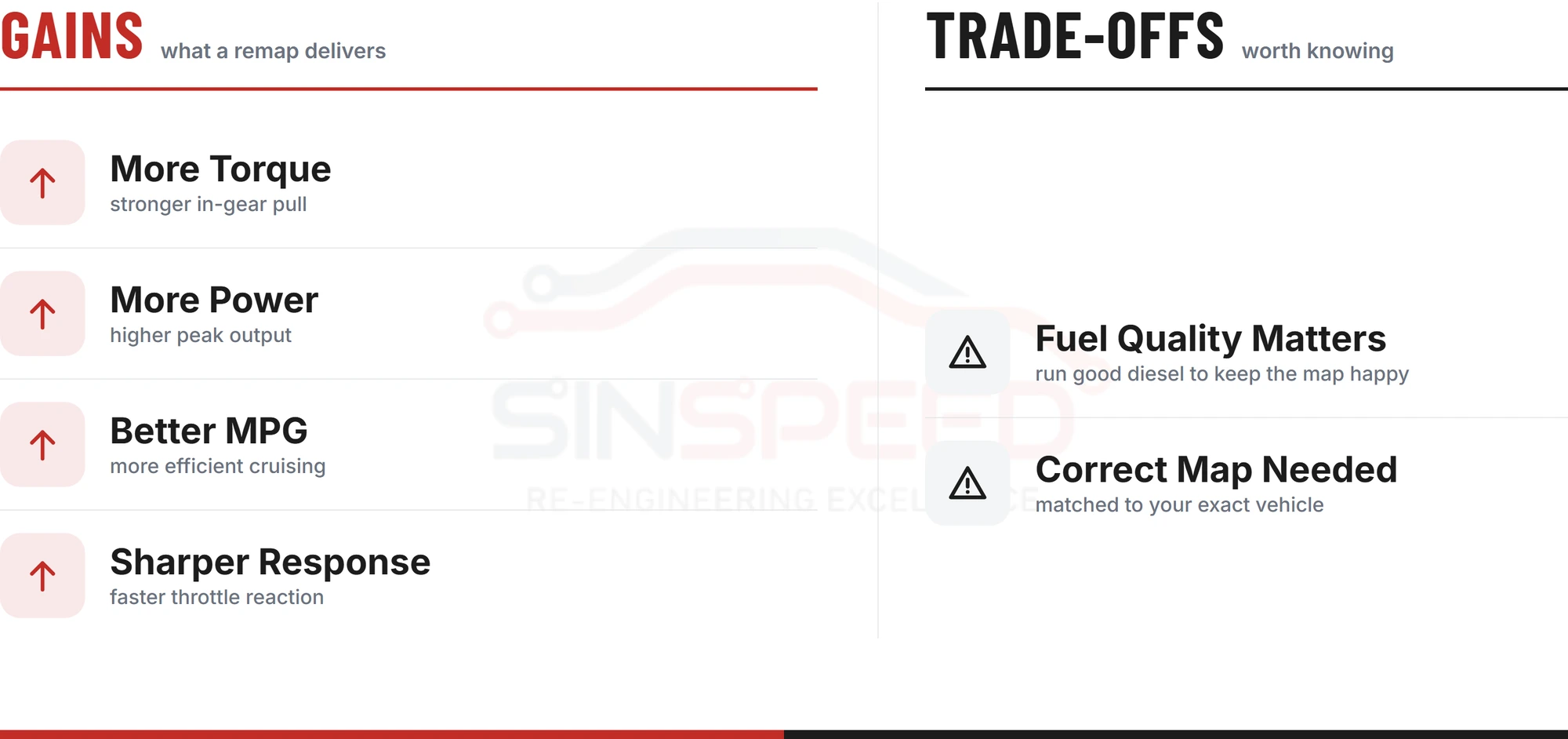
A remap is not a single dial that gets turned up. It is a set of coordinated changes to several calibration tables, each with a genuine gain and each with an honest limit. The table below sets out what a diesel remap recalibrates, what you stand to gain, and where a properly matched map deliberately stops.
| What the remap recalibrates | What you gain | The honest limit |
|---|---|---|
| Fuelling (injected quantity) | More torque and a cleaner, more immediate throttle response | Raised only as far as the turbo can supply the matching air; over-fuelling causes smoke and excess heat, so a properly matched map does not chase it |
| Injection timing | Smoother combustion and improved efficiency | Advanced only where the specific engine tolerates it without knock or undue strain |
| Boost pressure and turbo targets | Stronger mid-range pull and reduced turbo lag | Kept within the standard turbocharger’s safe operating map |
| Torque limiters | Removes the artificial flat spots felt between gears | Set below the sensible limit of the clutch and dual-mass flywheel |
| Rev and speed governors (where applicable) | A more usable, less restricted rev range | Left at safe mechanical limits, never raised for the sake of a bigger number |
The trade-offs are worth being straight about, because the competitor pages that rank for this term rarely mention them. A remap declared to your insurer may affect the cost of cover, and it should be declared. On an engine that is already tired, more torque can expose a worn clutch. And a map written too aggressively for the sake of headline figures will trade reliability for a number you cannot safely use. None of these are reasons to avoid a diesel remap – they are reasons to have it done properly, within limits, on an engine that is in good health.
Is a diesel remap road-legal?
Yes. A diesel remap of the kind described here changes only the engine’s software calibration. Your diesel particulate filter (DPF), exhaust gas recirculation (EGR) valve and the rest of the emissions system stay fitted and fully working, so the car remains road-legal and ready for its MOT. A well-written map that keeps the engine burning fuel cleanly can actually help a healthy DPF regenerate more predictably, because consistent, complete combustion is good for the whole exhaust after-treatment system rather than a strain on it.
Two practical points are worth making plainly. First, you should tell your insurer about any remap – it counts as a modification, and declaring it keeps your cover valid. It is a short phone call, not an obstacle. Second, keep a road-legal remap clearly separate in your mind from emissions-delete work: physically removing or disabling a DPF or EGR is a different, off-road and motorsport-only service that we handle separately, and a road-legal diesel remap does not remove or disable any emissions equipment on your car.
Will a remap harm my diesel engine?
A sensible remap should not shorten the life of a healthy diesel, and ‘sensible’ is the operative word. The gains come from headroom the manufacturer already built in – the engine is not being asked to do something it was never designed to handle. The risk in remapping comes almost entirely from over-aggressive files that chase headline numbers with no regard for the mechanical margin, and that is precisely the kind of map that has no place in a properly matched remap.
There are real limits that any responsible remap respects on every diesel. The turbocharger, clutch and dual-mass flywheel each have a sensible torque ceiling; push past it and you trade long-term reliability for a bigger figure on paper. On a high-mileage or already-worn diesel, a tired clutch may begin to slip once torque rises, which is why we will flag it honestly rather than press on regardless. It is also why we will confirm your engine is a sound candidate before any remap is applied – if it has an existing fault or a component near the end of its life, you hear about it first, not after.
How the Sinspeed diesel remap service works
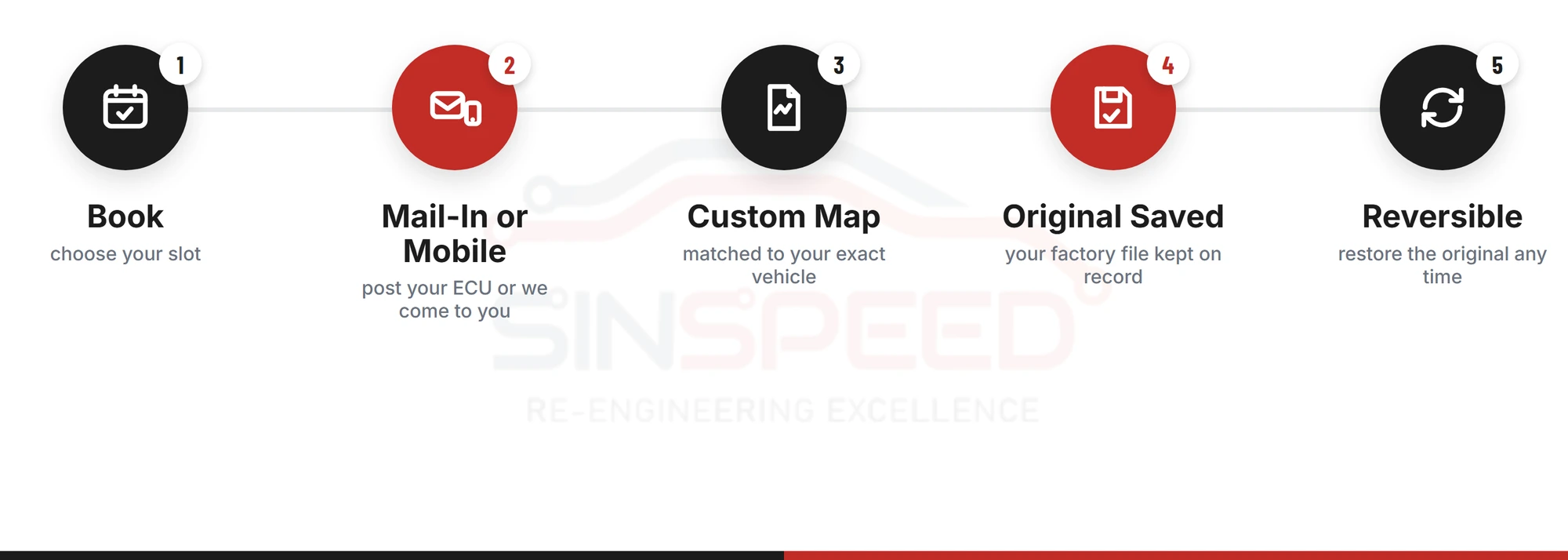
Every diesel remap is matched to your specific vehicle – not a generic file pulled from a folder and flashed on regardless. It is a custom map developed for your exact engine, ECU variant and state of tune. Before it is applied we save your original factory calibration in full, so your vehicle can always be returned to standard if you ever need it – for a dealer service, a warranty visit or resale. Nothing we do is a one-way door.
Our role is the service around that map, and we take it seriously. We help you choose the right map for your engine and how you actually use the car, install it safely through our mail-in or mobile service, and keep your original file on record so the vehicle can be returned to standard whenever you need. We would always rather match a map to driveability and long-term reliability than to a peak figure the engine can never safely deploy – so if a remap is not the right answer for your vehicle’s condition, we will tell you straight rather than take the work. And once it is done, we are here for the aftercare if anything needs looking at.
To get started, send us your vehicle details through our online repair and enquiry form and we will confirm exactly what is available for your engine, or contact our team if you would rather talk it through first. A diesel remap is one part of our wider ECU remapping service – explore the hub to see the full range of tuning and calibration work we carry out.
Diesel remap FAQs
Will a diesel remap improve my MPG?
It can, particularly with an economy-biased map. Stronger low-down torque lets the engine pull a taller gear with less throttle, so you change down less and work the engine less to hold a steady speed. The real-world improvement depends on your engine and how you drive – a long-distance motorway diesel tends to see the clearest benefit, and we will not promise a fixed figure we cannot stand behind.
Can a diesel remap be reversed?
Yes. We store your original factory calibration before any remap is applied, so the vehicle can be returned to its standard map at any time – for a service, a warranty visit or when you sell the car. The remap is a change, not a permanent alteration you are stuck with.
Is my diesel suitable for remapping?
Modern common-rail turbo-diesels respond very well, because their fuelling, injection timing and boost are all electronically controlled. Naturally aspirated and very old diesels have far less to gain. Either way, we will confirm your engine is mechanically sound first; a remap is only worthwhile on an engine that is in good health to begin with.
Will a remap damage my turbo or DPF?
Not when it is done sensibly. A properly matched map keeps boost within the standard turbocharger’s safe operating range and never over-fuels the engine, so combustion stays clean. A healthy DPF is unaffected and can even regenerate more predictably behind a well-calibrated map. The damage people hear about comes from aggressive, poorly written files – not from careful tuning within limits.
How much power and torque will I gain?
It varies by engine, generation and state of tune, so we do not quote guaranteed figures up front. What we can say honestly is that the most useful gains on a diesel are in mid-range torque and drivability rather than peak headline power. Send us your vehicle details and we will tell you what is realistic and safe for your specific engine.
Does a remap affect my warranty or insurance?
A remap is a modification, so you should declare it to your insurer to keep your cover valid – a quick call, not a barrier. It can also affect a manufacturer’s powertrain warranty, which is one reason we keep your original file on record so the car can be returned to standard if needed. We would always rather you go in with the full picture.
Is a diesel remap legal to drive on the road?
Yes. A road-legal diesel remap changes only the software; your DPF, EGR and emissions equipment stay fitted and working, and the car remains MOT-ready. Physically removing or disabling emissions hardware is a separate, off-road-only service and is not part of a road-legal remap.
Sinspeed · ECU remapping
Find out what your engine will actually gainTell us the vehicle, its mileage and how you use it. We will tell you what a custom map can realistically deliver for that engine, and where the honest limits are.
Mapped for your specific engine and its condition · Dealer-level diagnostic and programming tools · Written by our in-house engineers