
A BMW xenon or adaptive headlight that flags a malfunction on the iDrive, drops one side, or loses its indicators after a flat battery is almost always an electronics fault — the xenon ballast, the Light Control Module (LCM) or the Footwell Module (FRM), not the bulb or the whole headlamp. Sinspeed diagnoses and repairs these BMW lighting modules at circuit-board level, recovers and codes them to your car, and returns your own unit ready to fit with a lifetime warranty on the reman.
Which BMW headlight modules do we repair?
BMW spreads its exterior lighting across several different control units, so the right repair starts with knowing which one has failed. On a BMW the lighting is rarely run by a single box — the work is shared between a central lighting module and the xenon or LED electronics inside each headlamp. We repair the full range at circuit-board level:
- Light Control Module (LCM / LSZ) — fitted to earlier models such as the E38, E39, E46 and E53, this central module runs the exterior and interior lighting. When it fails you tend to see phantom bulb-out warnings, dead dipped beams or indicators that behave erratically.
- Footwell Module (FRM / FRM2 / FRM3) — used across the E8x, E9x, E6x and X-series, the FRM sits in the driver’s footwell and controls the exterior lighting, indicators and daytime running lights. It is notorious for corrupting its own memory after a flat battery or a jump start, taking the lights, indicators, windows or wipers with it.
- Xenon control units and ballasts — the bi-xenon (HID) systems on most E- and F-series BMWs use a ballast to regulate the arc and an igniter to strike it. These are typically Automotive Lighting (AL) or Hella units, and they fail independently of the bulb.
- Adaptive headlight (AFS / TMS) modules — the units that swivel the beam into bends and level it over crests. A failed adaptive module throws the familiar ‘Adaptive Headlight — Malfunction’ message and often leaves the projector stuck straight ahead.
- Angel-eye and DRL LED drivers — the halo rings and daytime-running signatures are driven by small LED driver boards that typically fail one ring or one section at a time.
- F-series and newer LED headlight modules — the driver and control electronics behind the later full-LED headlamps.
This is the BMW side of our wider headlight control module repair service. The modules above are built on the same AL and Hella electronics found across many marques — which is exactly why they are repairable rather than throwaway.
How do I know if my BMW headlight control module has failed?
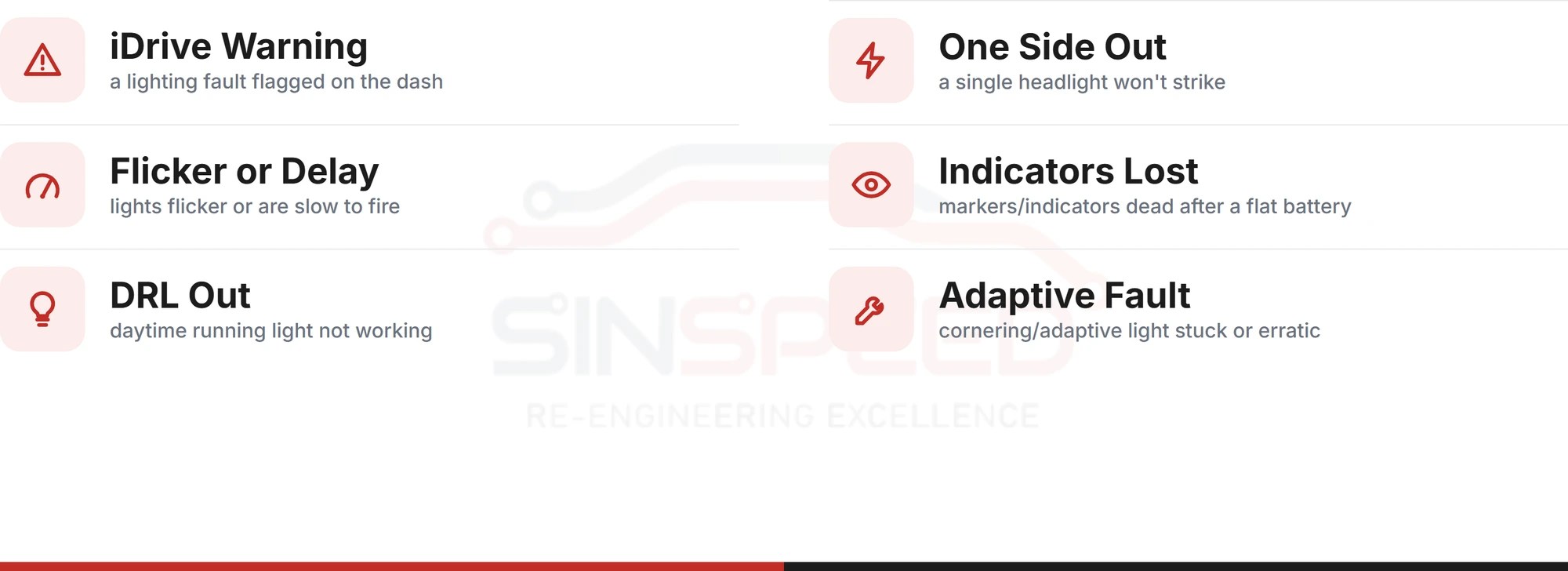
BMW lighting faults are misread constantly, because a dead headlight, a dashboard warning and a stored fault code can each point at a different part. Reading the pattern of the fault — not just ‘the light is out’ — is what tells you whether the bulb, the ballast, an adaptive module or the FRM has actually failed.
| Symptom on your BMW | Most likely module | What it usually is not |
|---|---|---|
| ‘Adaptive Headlight — Malfunction’ on the iDrive, beam stuck straight | Adaptive (AFS/TMS) control module or stepper motor | Rarely the bulb |
| One xenon strikes, glows pink or blue, then cuts out | Xenon ballast failing to hold the arc | Not the bulb |
| No dipped beam one side, bulb works when swapped over | Xenon control unit or ballast | Not the bulb |
| Indicators, lights, windows or DRLs dead after a flat battery or jump start | Corrupted Footwell Module (FRM) | Not a blown fuse in most cases |
| One angel-eye ring or DRL section dark, the rest fine | Angel-eye / DRL LED driver | Not the whole headlamp |
| Intermittent flicker, worse over bumps | An internal fault in the module or ballast | Not a failing bulb |
| Random bulb-out warnings for lamps that clearly work | Light Control Module (LCM) | Not the bulbs |
On many BMW systems the headlight electronics also talk to the rest of the car over the vehicle bus, so a failure usually stores a fault code — a xenon control unit that has stopped communicating, or a headlight module that will no longer talk to the Footwell Module. Before you buy anything, swap a known-good bulb to the affected side. If the light still will not work with a good bulb, the fault is upstream in the module or ballast — and that is where a board-level repair belongs, not another bulb.
Sinspeed · mail-in repair
Send us the control module rather than the whole headlightThe headlight itself is usually sound — it is the ballast or control module that has failed. Send us the unit with your vehicle details and we repair it at circuit level and test it under load before it goes back.
Lifetime, unlimited-mileage warranty on all remanufactured parts · Mail-in, UK-wide · Tested on Hardware-in-the-Loop rigs before dispatch
Ballast, igniter, control module or FRM — what has actually failed?
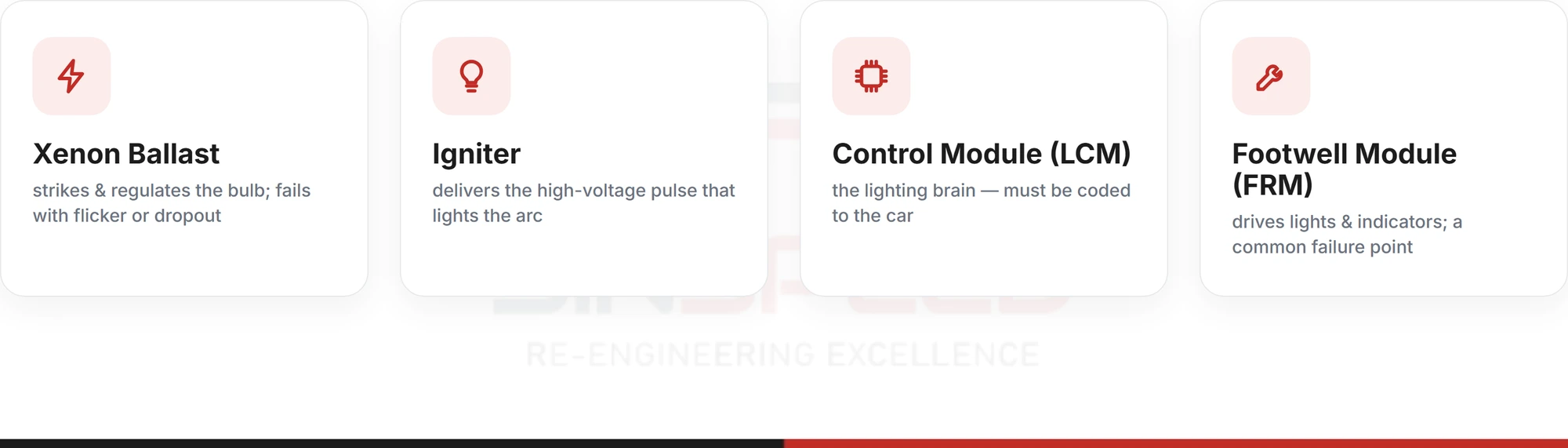
On a BMW headlamp, four different things can produce ‘my light does not work’, and they are not interchangeable. Getting the diagnosis right is the difference between a repair that lasts and one that fails again within the fortnight.
The bulb (D1S, D2S, D3S or D4S on xenon cars) is the gas-discharge lamp itself; at the end of its life it dims and turns pink or purple gradually. The igniter is the high-voltage element that strikes the initial arc — when it fails the lamp will not light at all, or strikes and dies instantly. The ballast, or xenon control unit, regulates the current once the arc is lit; a failing ballast lets the light strike and then cut out, flicker, or refuse to run even with a perfect bulb. The control module — the LCM, FRM or adaptive TMS unit — is the circuit board that switches, levels and codes the lighting, and it can fail while the bulb, igniter and ballast are all fine.
We keep these distinct because repairing the wrong one is wasted money. A ballast fault is not cured by a bulb; a corrupted FRM is not cured by a new headlamp. We test the unit you send, identify what has genuinely failed — heat damage from repeated under-bonnet heat cycling, water damage, or a module left scrambled by a flat battery — and repair that, rather than replacing a part that was never the problem.
Can a BMW headlight module be repaired instead of replaced?
In the large majority of cases, yes — a BMW headlight module can be repaired rather than replaced, and on a modern BMW that is usually the sensible route. Each of these units is a circuit board, and board-level faults can be put right at board level rather than replacing the whole unit — the failed stage identified and repaired, weak points reinforced, and a corrupted FRM recovered and rewritten.
The alternative is more involved than it first looks. A genuine BMW bi-xenon or adaptive LED headlamp assembly is one of the pricier lighting components on the car, and many now arrive as a bare housing with the control electronics supplied blank and unprogrammed — which then have to be coded to the car before they will work. We mention that only as neutral context for why board-level repair is usually the better call, not as a saving to be claimed: keeping your original, correctly-matched unit on the car removes the fault at its root and avoids the coding and matching that a new module drags in behind it.
Because we repair rather than swap, we can also reinforce the section of the circuit that failed in the first place — so the remanufactured module is built to outlast the weakness that brought it in. Replacement genuinely makes sense when a housing is smashed or the optics are destroyed. But where the headlamp is sound and only the electronics have failed, repair is the stronger call.
Why BMW headlight modules must be coded to the car
Programming is where BMW lighting differs from most other cars, and it is the step people most often get caught out by. Many BMW lighting modules are married to the vehicle: they carry coding tied to the VIN and the car’s options, and they have to be programmed before the car will accept them. Drop in a blank replacement FRM or adaptive module and, without coding, the lights, indicators or adaptive function simply will not respond.
The Footwell Module is the classic example. When an FRM corrupts after a low battery or a jump start, it is often not a hardware failure at all — the module’s memory has been scrambled, and it needs its firmware and coding recovered and rewritten to come back to life. We recover these modules and rewrite them on dealer-level equipment rather than condemning a unit that is mechanically fine.
That is why we return BMW modules coded and ready to fit wherever the system requires it. We retain your unit’s original programming where we can, and where a module must be coded to the car we program and calibrate it on dealer-level diagnostic tools before it leaves us. In most cases the unit arrives ready to bolt back on and drive — with none of the separate dealer programming trip that a blank new module would still need.
How our BMW mail-in and mobile repair service works
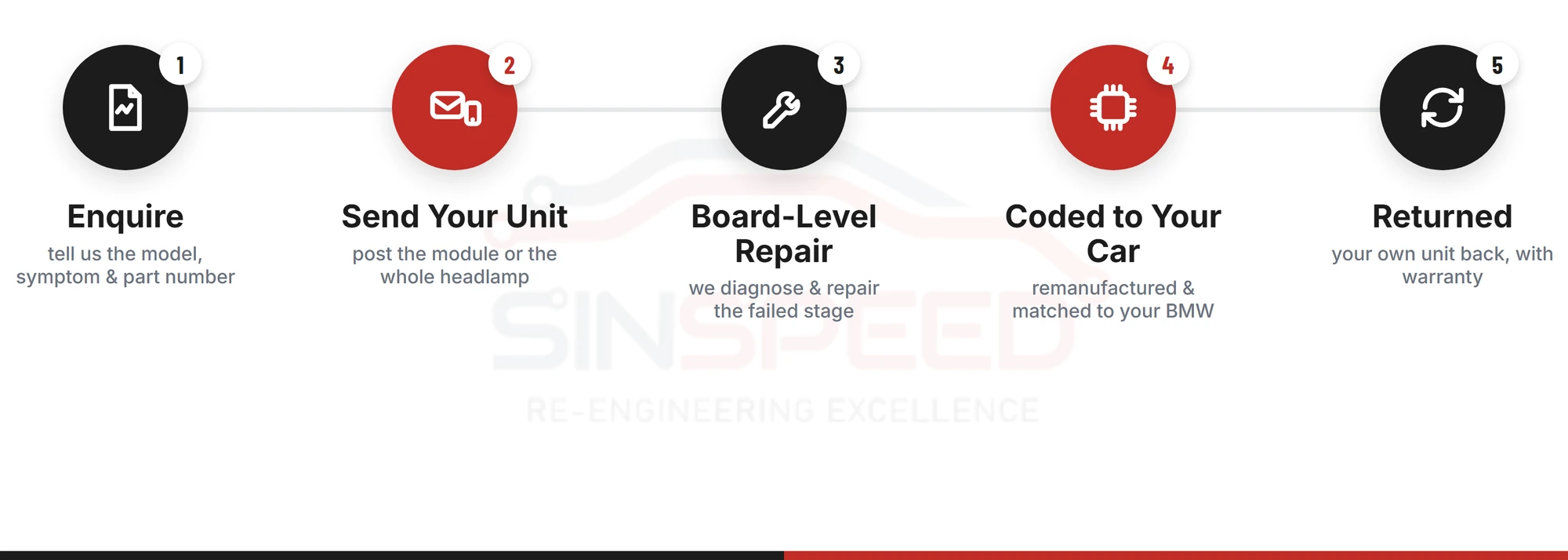
Our BMW headlight repair runs on a mail-in, repair-and-return model, with a mobile option for the areas we cover. You are sending us your own module to be remanufactured, not buying a mystery exchange unit off a shelf.
1. Tell us what has failed. Start a repair enquiry through our repair form with your BMW’s model, the symptom and — if you have it — the part number stamped on the module. If you are not sure which unit has failed, contact us with the symptom and the warning message and we will point you at the right one. 2. Send us the unit. Remove and post the failing module — the FRM, LCM, xenon ballast or adaptive control unit — or send the complete headlamp where the fault sits inside the lamp. Independent garages and trade workshops send us BMW modules the same way. 3. We diagnose and repair. We test the unit, identify the failed stage, repair it at board level and reinforce the known weak points, then program and calibrate it to your car where the system needs it. 4. We return it ready to fit. The remanufactured module comes back coded and ready to install, with a lifetime, unlimited-mileage warranty on the reman.
Because the repair keeps your original unit, there is no VIN-matching lottery and, in most cases, no separate trip to a dealer to code a new part.
Frequently asked questions
Can a BMW headlight control module be repaired?
Yes, in most cases. Whether it is the Light Control Module, the Footwell Module, a xenon ballast or an adaptive control unit, the fault sits on a circuit board — blown output stages, heat damage, water-damaged connectors or a scrambled module — and we repair that on the bench, then reinforce the weak points rather than fitting a whole new headlamp.
Does BMW use xenon headlights?
Yes. Bi-xenon (HID) headlamps were fitted widely across the E- and F-series ranges, alongside halogen on lower trims and full-LED on later models. Xenon systems use a bulb, an igniter and a ballast, and it is usually the ballast or control unit that fails rather than the bulb.
How do I know if my BMW headlight control module is bad?
Swap a known-good bulb to the affected side first. If the light still will not work, the fault is upstream in the ballast or module. An adaptive-headlight malfunction message, a xenon that strikes then cuts out, or lights and indicators lost after a flat battery all point at the control electronics, and the car will usually have logged a fault code.
How do you program a BMW headlight module after repair?
Many BMW modules must be coded to the car’s VIN before they will work. We retain the original programming where we can, and where the system needs it we program and calibrate the repaired unit on dealer-level equipment before it ships — so it arrives ready to fit, with no separate dealer coding trip needed.
Why did my BMW lose its lights or indicators after a flat battery or jump start?
That is the classic Footwell Module (FRM) fault. A voltage drop can scramble the module’s memory rather than damage the hardware, taking out exterior lights, indicators and sometimes windows or wipers. We recover and rewrite these modules on dealer-level equipment rather than condemning a unit that is otherwise sound.
Do I send the whole headlight or just the module?
Usually just the module — the FRM, LCM, ballast or adaptive control unit — which keeps postage simple. Send the complete headlamp only where the fault sits inside the lamp itself. If you are unsure, contact us with the symptom and we will tell you what to send.
Is a faulty BMW headlight an MOT failure in the UK?
Yes. A headlamp that does not work, is insecure, or is badly misaligned is an MOT failure, and using a vehicle on the road with a defective obligatory lamp can be an offence under the Road Vehicles Lighting Regulations. Repairing and correctly calibrating the unit keeps the car both legal and safe.
Why choose Sinspeed for BMW headlight electronics
BMW lighting electronics are a specialism here, not a sideline. We work on the BMW Light Control Module, Footwell Module, xenon ballasts and adaptive control units routinely, and we know the Automotive Lighting and Hella platforms they are built on — including the FRM corruption a flat battery leaves behind and the coding a BMW demands before it will accept a module back. Repairs are carried out at circuit-board level in an ESD-safe, cleanroom-standard workshop by an in-house team of electronic engineers, then tested on bespoke Hardware-in-the-Loop rigs that simulate the heat, vibration and electrical load a headlight actually sees on the car. Every module is programmed and calibrated to your BMW on dealer-level tools before it ships, and most reman parts carry a lifetime, unlimited-mileage warranty. Independent garages and main-dealer workshops send us their BMW lighting modules too — because a repaired, reinforced and correctly coded unit goes back on the car ready to work.
Sinspeed · mail-in repair
Get the fault confirmed before you spend anythingTell us the symptoms and the codes your scanner is showing. Our engineers will tell you what they expect to find and what the repair involves.
Your own unit remanufactured, not a like-for-like replacement · Lifetime, unlimited-mileage warranty · Dealer-level programming and calibration