
Summary: We test, repair and remanufacture the instrument cluster on the Ford Focus, Galaxy and S-Max. Failed gauges, dead backlighting, a corrupted LCD and immobiliser faults are put right, and your mileage, keys, VIN and coding are retained — the unit comes back plug and play.
In this guide
- What is the Ford Focus, Galaxy and S-Max instrument cluster, and why does it fail?
- Symptoms of a failing Ford instrument cluster
- Common causes and fault codes
- Can a Ford instrument cluster be repaired, or must it be replaced?
- Will I keep my mileage, keys and coding?
- Which Ford models, generations and years are covered?
- Ford instrument cluster part numbers
- How our Ford instrument cluster repair service works
- Frequently asked questions
What is the Ford Focus, Galaxy and S-Max instrument cluster, and why does it fail?
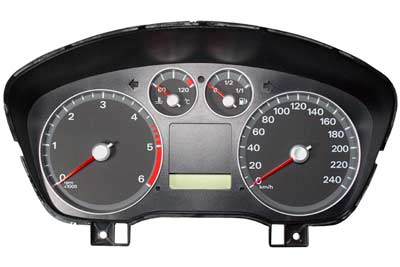
The instrument cluster is the panel behind your steering wheel that holds the speedometer, rev counter, fuel and temperature gauges, the warning lights and the central LCD that shows your mileage, trip and economy data. On the Ford Focus, Galaxy and S-Max it is a well-known electronic weak point, and when it begins to fail the symptoms range from a single dead gauge to a completely blank dashboard.
It is not a passive display. The cluster sits on the vehicle’s CAN bus — the high-speed data network the control modules use to talk to one another — and it is coded to the immobiliser (Ford’s PATS anti-theft system). It stores and shares information the rest of the car depends on, which is why a faulty cluster can trigger warning messages, communication errors and even a no-start, rather than simply a broken gauge.
Failures are almost always internal and age-related rather than the result of anything you have done. Years of heat cycling and vibration fatigue the solder joints and electronic components on the circuit board, the stepper motors that drive the needles wear, and the multi-function LCD degrades over time. Corroded connector pins, poor connections and the occasional spill into the dash account for most of the rest. Across these Ford clusters the underlying weak points are consistent, which is exactly why a targeted repair works where a like-for-like replacement does not.
Symptoms of a failing Ford instrument cluster
Cluster faults on the Focus, Galaxy and S-Max rarely arrive all at once. They tend to start intermittently — a gauge that drops out on a cold morning, a flicker in the backlight — before becoming permanent. These are the symptoms we see most often when customers send these units in:
- Dials and needles not working — the speedometer, rev counter, fuel or temperature gauge reading zero, sticking, or dropping out as you drive
- Erratic gauges — needles flickering up and down, swinging to full and back, or refusing to follow their normal smooth sweep
- Gauges dropping to zero together — complete loss of readings across the speedometer, temperature and rev counter
- Dim, flickering or completely failed backlighting and dashboard illumination
- Pixel and LCD loss — missing segments, scrambled characters, a distorted display, or dashes (—) shown in place of the mileage
- Loss of the audible bleeper — seatbelt, indicator and warning chimes going silent
- Warning lights staying on, behaving erratically, or the dash failing to light up at all
- Intermittent power to the whole unit — the cluster working one moment and dead the next
- Complete power failure — a blank dashboard, sometimes with the engine cutting out or the car refusing to start
- The immobiliser light flashing and the vehicle not starting
If you are seeing any combination of these, the cluster itself is almost certainly the unit at fault rather than the individual senders behind each gauge. Replacing a sensor will not fix a cluster that has lost the ability to display or process the signal it is sent.
It is worth acting promptly rather than living with the fault. A speedometer that reads zero or wanders leaves you with no reliable idea of your speed, and a vehicle with a non-functioning speedometer will not pass an MOT. Because the cluster communicates over the CAN bus, an intermittent fault also tends to worsen — once the unit drops off the network entirely it can take starting and warning functions with it, so a minor flicker is best dealt with before it becomes a dead dashboard.
Common causes and fault codes
The root causes are physical. Fatigued solder joints crack with thermal expansion and contraction, surface-mounted components and voltage regulators degrade, the stepper motors that drive the needles wear, and the LCD module loses segments as it ages. Connector pins corrode or back out, and heat and vibration accelerate all of it. That is why these faults appear as the vehicle gets older rather than from a single event.
Because the cluster is part of the CAN bus and tied to the immobiliser, a failing unit often logs a communication or theft-related code rather than a simple gauge error. These are the codes we regularly find stored in failed Ford clusters:
- U1900 — CAN bus communication fault (the code most commonly tied to these failing clusters)
- P1260 — theft detected / vehicle immobilised, an immobiliser (PATS) flag
- U0155 — lost communication with the instrument cluster control module
- U0140 — lost communication with the body control module
- U0121 — lost communication with the ABS module
- P0500 — vehicle speed sensor signal fault
On the second-generation Focus in particular, the combination of a U1900 with a P1260 and a U0155 is a classic signature of a cluster that needs rebuilding. We diagnose to the component rather than the code, though — a scrambled display, a dead gauge and a comms fault can all trace back to the same handful of failure points on the board, and our repair addresses the root cause rather than masking it. If your scan shows codes other than these, send the results in with your unit and we will tell you what they mean for your repair.
Can a Ford instrument cluster be repaired, or must it be replaced?
In almost every case it can be repaired. A main dealer will normally quote you for a brand-new cluster, which then has to be coded to your vehicle’s immobiliser and calibrated to your real mileage before it will work — a slow and costly route. A used cluster from a breaker brings its own short warranty and still needs reprogramming and recalibration to match your car, and it carries exactly the same age and design weaknesses as the one it replaces.
Repairing your original unit avoids all of that. We test, repair and remanufacture the cluster you already have, so there is no coding marriage to perform and no mileage to correct — the figures stay as they were. Where a known weak point caused the failure, we reinforce it during the rebuild rather than fitting a like-for-like part that will fail the same way later on.
Repairs are carried out by our in-house team of electronic engineers and diagnostic specialists doing circuit-level board work in a cleanroom-standard, ESD-safe workshop. Where possible we use genuine OEM or uprated components so the rebuilt unit meets or exceeds the original specification, and every finished cluster is proven on our bespoke in-house Hardware-in-the-Loop test rigs, which simulate real-world heat, vibration and electrical load before the unit is signed off and returned.
Will I keep my mileage, keys and coding?
Yes — and this is the single biggest advantage of repairing your original cluster. It is also where dealer replacement causes owners the most worry. We retain all of the data held in your unit: the recorded mileage, the VIN, and the immobiliser coding that pairs the cluster to your car and your keys.
Because nothing is swapped for a different module, there is no reprogramming for you to arrange and no recoding bill at the end. Your existing keys continue to work exactly as before, and there is no trip to a dealer or auto-electrician to make a new unit talk to the car. When the repaired cluster comes back, it is plug and play — you refit it and drive.
Keeping the original mileage matters for more than convenience. A cluster showing a figure that does not match the vehicle’s recorded history can cause real problems at sale and at MOT time, so retaining the genuine reading keeps your records clean and your car honest.
Which Ford models, generations and years are covered?
We repair the instrument cluster across the Ford Focus, Galaxy and S-Max, through every generation in which the cluster is a known failure point. The fault has followed these models throughout their lives, so the repair applies whether your car is an early or a later example — including the Focus ST. The most reliable way to identify your exact unit is the part number printed on the back of the cluster.
Ford Focus Mk1 (approx. 1998–2004). The most basic of these clusters typically loses its backlighting illumination and shows the odometer as a row of dashes (—) when it fails. In more extreme cases the internal fault causes a complete failure that can prevent the engine from starting. You can also view our dedicated Ford Focus Mk1 instrument cluster service.
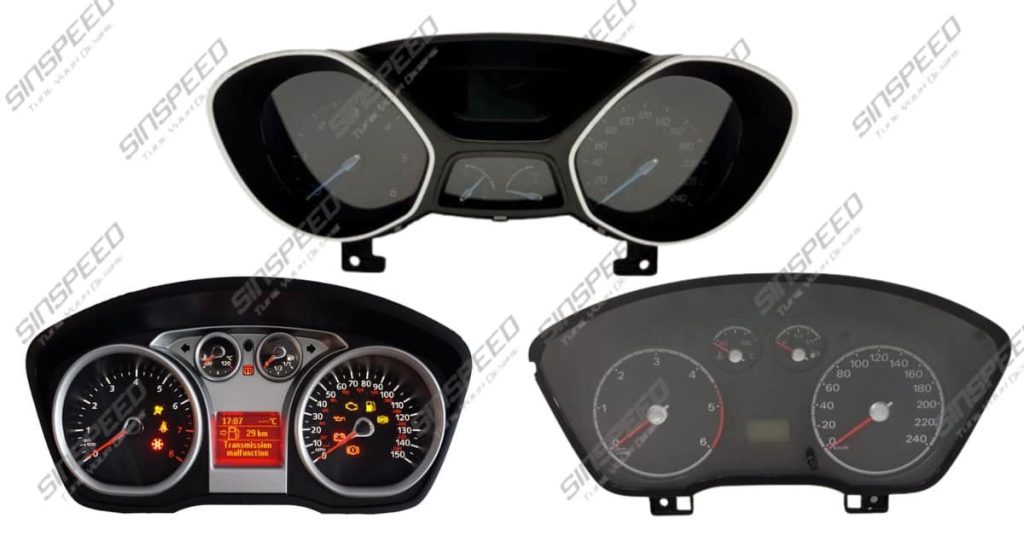
Ford Focus Mk2 (approx. 2004–2010). The second-generation Focus was fitted with two different dashboards over its life, split around the 2008 facelift, and both are renowned for failing. Symptoms include a loss of gauge function, the dashes (—) mileage fault, and engine problems such as cutting out and failing to start, frequently alongside U1900, P1260 and U0155 fault codes. The post-facelift cars added a multi-function liquid-crystal display that degrades over time, leaving a distorted or completely blank screen.
Ford Focus Mk3 (approx. 2010–2018). The third-generation car brought the most significant redesign, with the multi-function display upgraded and relocated to the upper part of the dashboard. Like its predecessor it suffers from LCD corruption: it usually begins gradually, making fuel economy and mileage hard to read, before the display is rendered blank until the cluster is repaired. You can also view our dedicated Ford Focus Mk3 instrument cluster service.
Ford Galaxy and S-Max Mk1 (approx. 2006–2015). The Galaxy and S-Max share the same generation of cluster, including the high-line unit, and show a very similar pattern of faults: intermittent or faulty gauges, loss of power to the vehicle, immobiliser issues and non-starting, flickering or permanently lit warning lights, background illumination problems and a dead or failing LCD display, through to a completely dead cluster. The exact cluster varies by engine and specification, which is again why the part number is the surest way to confirm your unit.
Ford instrument cluster part numbers
Below is a representative selection of the Ford cluster part numbers we regularly see in for repair, grouped by model and generation to make them easier to scan. They are listed to help you match your unit — they are not a guarantee of fitment by engine or year, and your repair does not depend on finding your exact number here. If yours is not shown, send it to us with a description of the fault and we will confirm whether we can repair it; in most cases we can.
Focus Mk1 (1998–2004): 98AB10849DJ, 98AB10849DK, 98AB10849KH, 98AB10849KJ, 98AB10849DF, 98AB10849DL, 1M5F10849RB, 1M5F10849RC, 1M5F10849RD, 1M5F10849UB, 1M5F10849UC, 1S4F10849MA, 1S4F10849HD, 2M5V10849BF, 2M5V10849BE.
Focus Mk2 (2004–2010): 3M5T10849BH, 3M5T10849DJ, 3M5T10849FH, 3M5T10849GJ, 4M5T10849AM, 4M5T10849BH, 4M5T10849FR, 4M5T10849FS, 4M5T10849KR, 4U7T10849BM, 4U7T10849FR, 6M5T10849PG, 7M5T10849BB, 7M5T10849FB, 8V4T10849FF, 8V4T10849FH, 8V4T10849FJ, 8V4T10849FK, 8U4T10849MJ.
Focus Mk3 (2010–2018): BM5T10849DP, BM5T10849DN, BM5T10849DJ, F1ET10849BKG, F1ET10849BMG, F1ET10849BMK, F1ET10849BMH, DV4T10849ML, DV4T10849MM, DT1T10849DF, DT1T10849DE, GJ5T10849TH, GJ5T10849TM, DJ5T10849SA, DJ5T10849SB, CJ5T10849TF, CJ5T10849TE.
Galaxy and S-Max Mk1 (2006–2015): 3M5F10841A, VP6M2F10890A, 8M2T10849DD, 8M2T10849SA, 8M2T10849HD, 6M2T10849BN, 6M2T10849HN, 6M2T10849DM, 6M2T10849DK, CS7T10849HB, CS7T10849DF, BS7T10849DF, BS7T10849DC.
How our Ford instrument cluster repair service works
We work on a mail-in repair-and-return basis, so you do not need to be local to use us. You send us the failing cluster, we repair and remanufacture it, and we send it back to you ready to refit. The process is the same whether you are a private owner or a garage booking the work in for a customer — we are trusted by independent workshops and the trade as well as private motorists.
- Tell us about the fault. Start a repair through our repair form, or contact us with your symptoms and the part number from the back of the cluster so we can confirm the unit.
- Remove and send your cluster. Take the instrument cluster out of the dash and post it to us, along with any fault codes you have scanned.
- Diagnosis and test. We diagnose the unit on dealer-level equipment to find the root cause rather than the surface symptom.
- Repair and remanufacture. We carry out circuit-level board repairs using genuine OEM or uprated components, reinforcing known weak points as we rebuild.
- Hardware-in-the-Loop testing. The repaired cluster is proven on our in-house HIL rigs under simulated heat, vibration and load before it is signed off.
- Return, plug and play. Your original unit comes back with its mileage, VIN and coding intact — you refit it and drive, with no reprogramming required.
Every repair is backed by our lifetime, unlimited-mileage warranty, and many units are returned ready to fit with no coding required. To get started, complete our repair form or contact us with your model, symptoms and part number, and we will tell you exactly how we can help with your Ford cluster. You can also browse the wider range on our instrument cluster repair service.
Frequently asked questions
How long does a Ford instrument cluster repair take?
Most units are completed within a couple of working days of reaching us, though turnaround depends on the specific fault and on our current workload when your unit arrives.
Will my mileage change after the repair?
No. We retain the recorded mileage, VIN and immobiliser data held in your original cluster, so the figure you send in is the figure that comes back.
Do I need to recode or reprogram the cluster when it returns?
No. Because we repair your original unit rather than fitting a new one, it is returned plug and play and your existing keys continue to work as before.
My Ford will not start and the immobiliser light is flashing — is it the cluster?
It can be. The cluster sits on the CAN bus and is coded to the immobiliser, so a failed unit can stop the car starting as well as blanking the dash. Send us the cluster with any fault codes and we will confirm the diagnosis.
Do you repair the Galaxy and S-Max as well as the Focus?
Yes. The Galaxy and S-Max use the same generation of cluster, including the high-line unit, and we repair them to the same standard, retaining your mileage, keys and coding.
Do you cover the Focus ST and the higher-specification clusters?
Yes. The repair applies across the Focus range, including the ST and the multi-function LCD clusters fitted to later cars.
What if my part number is not in your list?
The list is only a representative selection, not every number we repair. Send us your unit or your part number and we will confirm whether we can repair it — in most cases we can.
Final thoughts
A failing instrument cluster on a Ford Focus, Galaxy or S-Max does not have to mean a costly dealer replacement and a recoding bill. The original unit can almost always be repaired and remanufactured, keeping your mileage, keys and coding exactly as they are and returning the dashboard to full working order — reinforced at its known weak points, proven on test, and backed by a lifetime warranty before it comes back to you.