
Summary: Mercedes SBC (Sensotronic Brake Control) is the brake-by-wire system fitted to cars including the W211 E-Class and R230 SL. When the unit reaches the service limit programmed into its control module, or can no longer hold its pressure, it shows a brake warning, often with C2498 stored, and switches itself off. We remanufacture your own SBC unit by post at our Epsom workshop, restore its service life and return it with a lifetime warranty.
On these cars SBC is the service brake itself, not an add-on, so a warning from it needs a fast and accurate answer. This page covers what the system does, the warnings a failing unit gives, what C2498 means, why units fail and how the brakes behave once SBC switches off, then how the repair works. Other Mercedes brake units are covered in our Mercedes ABS pump and module repairs hub.
- The unit: the SBC hydraulic unit and its control module, working as one assembly
- Fitted to: Mercedes E-Class, SL, CL and CLS, most often the W211 and R230
- The codes: C2498, commonly logged with C249F
- The warning: a service-brake message, or a red brake warning
- When it switches off: hydraulic fallback, longer stopping distances
- Our repair: your own unit remanufactured, service life restored, lifetime warranty
- What is Mercedes SBC, and which cars have it?
- What warnings does a failing SBC unit give?
- What does fault code C2498 mean on an SBC unit?
- Why does an SBC unit fail?
- What happens to the brakes when SBC switches off?
- New, used or repaired: which SBC route makes sense?
- How our SBC repair works by post
- Questions owners ask about SBC
- Final thoughts
What is Mercedes SBC, and which cars have it?
Sensotronic Brake Control (SBC) is the electro-hydraulic, brake-by-wire system Mercedes-Benz developed with Bosch. Sensors at the brake pedal tell a control unit how hard and how quickly you are braking, and the unit sets the pressure at each wheel through a high-pressure hydraulic unit. It was fitted to Mercedes models including the E-Class, SL, CL and CLS.
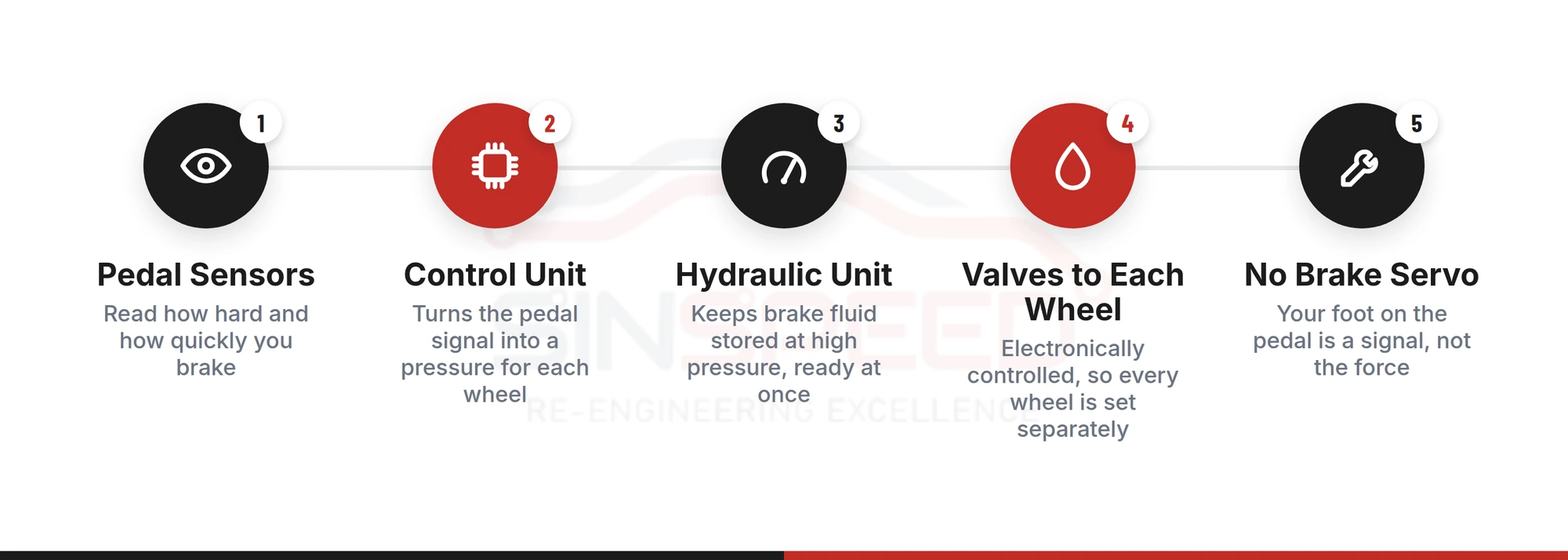
There is no brake servo. Your foot on the pedal is a signal, not the force. The hydraulic unit keeps brake fluid stored at high pressure, in the region of 140 to 160 bar, and the control module releases it to each wheel through electronically controlled valves, so full pressure is available almost the moment you ask for it.
Because each wheel is controlled separately, SBC can vary braking force when you brake in a corner or on a slippery surface. It also brakes on your behalf: Traffic Jam Assist slows the car in stop-and-go traffic once you lift off the accelerator, and Soft-Stop smooths the end of a stop in town.
SBC first appeared on the R230 SL, launched in Europe in October 2001. The W211 E-Class and the R230 SL are the cars it is most associated with, and the CL and CLS also used it. The common unit numbers are below; if yours is not among them, check it with us before the unit comes out.
| Numbering | Common SBC unit numbers |
|---|---|
| Mercedes-Benz | 005 431 0012 · 005 431 0612 · 005 431 3412 · 005 431 7112 |
| Bosch | 0265 250 065 · 0265 250 067 · 0265 250 077 · 0265 250 092 · 0265 960 012 · 0265 960 019 · 0265 960 025 |
What warnings does a failing SBC unit give?
A failing SBC unit usually shows itself on the instrument cluster before anything is felt through the pedal. The wording varies with the car and its software version, but the reported warnings follow a pattern:
- A service-brake message. Text such as “Service Brake! Visit Workshop”, often reported as a grey message, is the warning most commonly seen with C2498.
- A red brake warning. Messages along the lines of “Brake defective, stop vehicle” mark a more serious state, and the instruction means what it says.
- The SBC or brake lamp. On some cars the first sign is a warning lamp on the dash rather than a message.
- Stored codes. C2498 and C249F are the pair most often read from these units, sometimes with other SBC codes alongside.
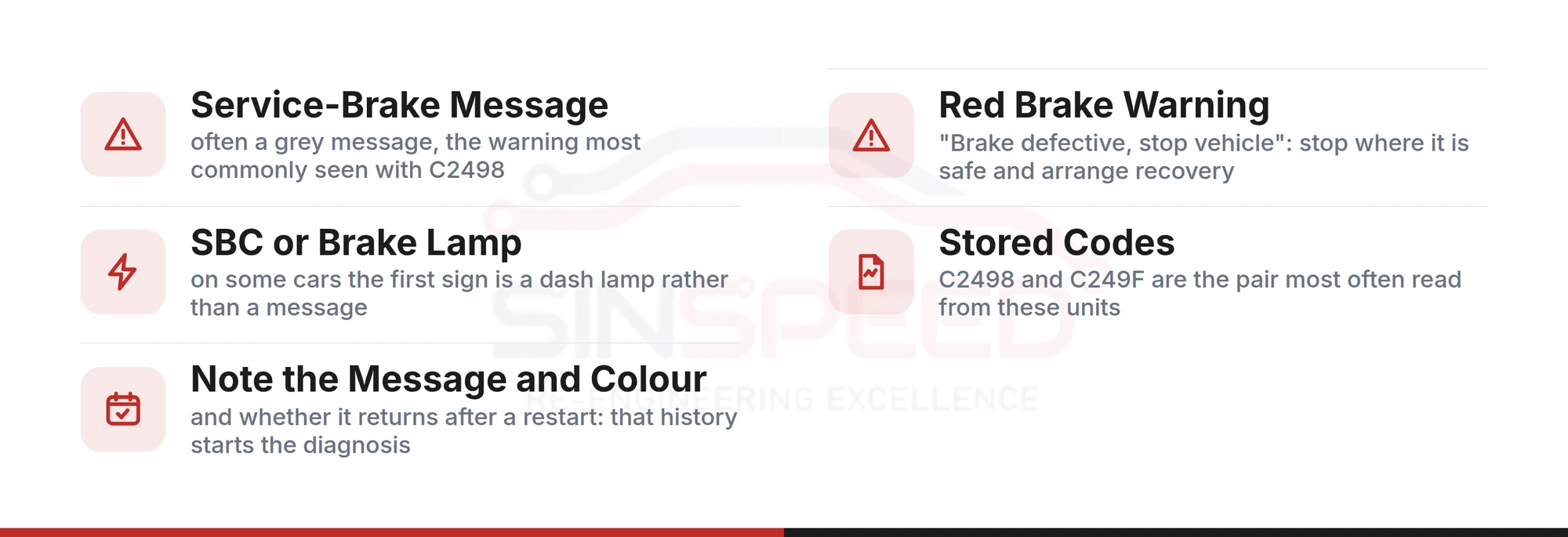
Note which message appeared, its colour, and whether it returns after a restart. Together with the codes, that history is where the diagnosis starts.
SBC is the service brake, so treat any SBC warning as urgent. If the message tells you to stop, stop where it is safe and have the car recovered. If it asks for a workshop visit, book the car in straight away, leave far more distance to the vehicle ahead and keep the journey short.
What does fault code C2498 mean on an SBC unit?
C2498 is the code owners most often find with the service-brake warning, and it is usually read as “Service threshold reached”: the unit’s own monitoring of its brake actuations has hit the service limit programmed into its control module. It is commonly logged together with C249F. A diagnosis confirms which fault is actually present before any work is agreed.
That confirmation matters because the sources do not agree. Most give C2498 as the service-limit code, which is how the Mercedes diagnostic system describes it. Others describe it as a loss of the high-pressure reserve, an active hydraulic fault. Both conditions occur on SBC units, they bring up similar warnings, and a code reader alone does not separate them.
The limit is a count of brake applications held in the unit’s software. The exact figure and the message it triggers vary with the software version. Reaching it does not mean the unit has to be replaced.
| Code | Commonly read as | What the diagnosis settles |
|---|---|---|
| C2498 | Service threshold reached; some sources describe a loss of high-pressure reserve instead | Whether the unit has reached its service limit, is losing pressure, or both |
| C249F | Logged alongside C2498 when the SBC warning appears | Whether it belongs to the same event or points to a separate fault |
Write down every stored code exactly as the tool shows it and put them all on the repair form. Clearing them and driving on wipes the history the diagnosis depends on.
Sinspeed · Sensotronic Brake Control
C2498 on the scan tool, or a brake message on the dash?Book the unit in through the repair form with every code and the exact wording of the warning, or ask us first if you are not certain the SBC unit is at fault.
Pressure tested in-house before and after the work
Why does an SBC unit fail?
An SBC unit works on every stop the car makes, and its control module keeps count. These are the system-level reasons units reach the end of their service life or start to lose pressure.
The actuation count adds up. Every brake application is logged against the programmed limit. Town driving, with frequent stops and slow queues, gets there far sooner than motorway miles, so two cars of the same age can be a long way apart on the count.
Holding high pressure is demanding work. The unit has to keep a reserve of fluid at well over 100 bar ready at all times. As it ages it can struggle to build or hold that pressure, and the control module flags the loss.
Heat and age under the bonnet. The unit goes through a heat cycle on every journey, and on cars of this age that has worked on the electronics and the hydraulics together.
Moisture in the brake fluid. Brake fluid absorbs water over time. Fluid left too long between changes carries that moisture into a hydraulic unit built to fine tolerances.
The electronics are part of the brake. On SBC the control side and the hydraulic side are one assembly, so an electronic fault shows up as a braking fault. That is why a warning can look identical whether the unit has hit its limit, is losing pressure or has a control fault, and why testing the unit itself is the reliable answer.
Before the unit comes off, your garage can rule out the quick causes: the battery, the fluid level and the connectors at the unit.
What happens to the brakes when SBC switches off?
When SBC reaches its service limit, or detects a fault it cannot work around, it deactivates and the car drops into a hydraulic fallback mode. The brakes still work, but with limited pressure applied to the front brakes, and stopping distances increase.
On the road, the car stops less sharply than you expect. Leave much more room, avoid fast roads where you may need to brake hard, and take the car straight to the garage that will remove the unit. A red brake message is a different matter: stop where it is safe and arrange recovery. Treat the fallback as a way to get the car off the road safely, not a mode to keep driving in.
New, used or repaired: which SBC route makes sense?
Once the unit is confirmed as the cause, there are three ways to put the car right. They differ in what you know about the unit you end up with.
| Route | What you get | What to weigh up |
|---|---|---|
| New from Mercedes-Benz | An unused unit with a full service life | A new part to buy, fit and set up to the car |
| Used | A unit taken from another car | It has already spent part of its own service life, and you cannot see how much |
| Your own unit, remanufactured | The unit from your car, with its service life restored | The car waits at your garage while the unit is with us; lifetime warranty |
The used route is the one to be wary of. Every SBC unit counts its own applications, so a second-hand one arrives with an unknown history and the same wear as the unit it replaces. Remanufacturing your existing unit avoids that: it is tested, put right and returned with its service life restored, and you know exactly where it has been.
How our SBC repair works by post
The repair is mail-order. The car stays at your garage, and only the SBC unit travels to our workshop in Epsom.
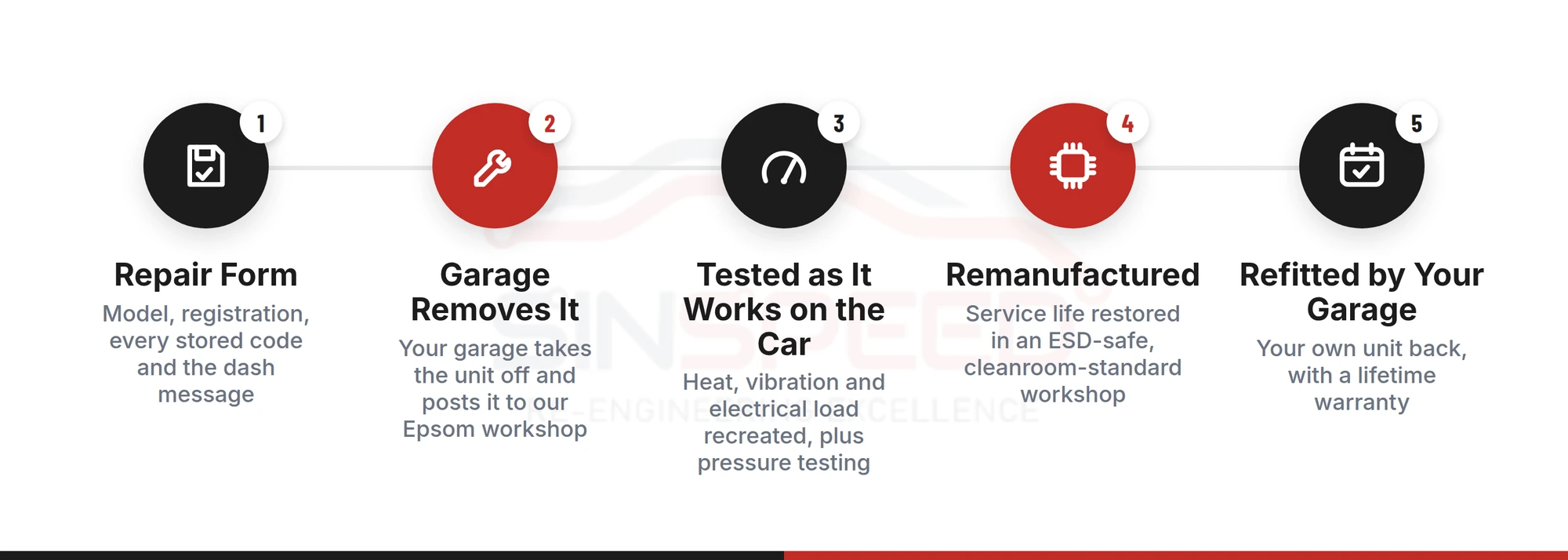
- Start with the repair form
List the model and registration, every stored code, the wording and colour of the dash message, and the number on the unit’s label. Print the form to pack with the unit.
- The unit comes out at your garage
Removing an SBC unit is brake hydraulic work that a garage familiar with these cars handles routinely. They cap the open ports, pack the unit firmly and send it on to us.
- Tested as it works on the car
On our in-house Hardware-in-the-Loop platforms the unit runs with heat, vibration and electrical load recreated, and is pressure tested, so we know whether it has reached its service limit, is losing pressure or has both faults before work starts.
- Remanufactured, service life restored
Our electronic and hydraulic engineers remanufacture the unit in an ESD-safe, cleanroom-standard workshop and restore its service life. It is set up on dealer-level diagnostic equipment, then runs the full pressure and function tests again before it is cleared to leave.
- Refitted by your garage
Your garage refits the unit and bleeds the brakes, as after any work on the brake hydraulics. It is your car’s own SBC unit, covered by our lifetime warranty.
If testing shows a unit cannot be saved, you hear that from us, with the findings, before anything further happens.
Questions owners ask about SBC
Final thoughts
An SBC warning is one message covering more than one fault. Usually the unit has reached the service limit written into its own software; sometimes it is losing the pressure it exists to hold; sometimes both. The code alone will not say which, and that is exactly what testing is for.
Take the warning seriously, keep the journey short or have the car recovered, and record every code and message before anything is cleared. The unit already on the car is the one worth keeping: remanufactured, with its service life restored, it goes back on with a lifetime warranty behind it.
Sinspeed · Mercedes SBC units
Get your Mercedes braking on SBC againPut the codes, the dash message and the unit’s number on the repair form, then have your garage post the SBC unit to our Epsom workshop. Not sure SBC is the cause? Talk it through with us before anything is removed.
Remanufactured in Epsom · Service life restored · Lifetime warranty