
Summary: When a Mitsubishi Shogun loses power, idles unevenly, stops answering the accelerator or drops into limp mode with the engine management light on, a failing Mitsubishi Shogun throttle body is one of the first things worth testing. If the fault is electrical, a clean will not settle it, so we bench test your own unit, repair it, prove it again under load and post it back for your garage to refit.
Everything below is about the Shogun’s throttle body: how it fails, what to rule out first and how the repair is handled. Other makes and models are covered from our main throttle body repair service page.
How does a failing Shogun throttle body show itself?
We are asked about Shogun throttle bodies often, and the same handful of complaints comes up each time. Owners usually describe one or more of these:
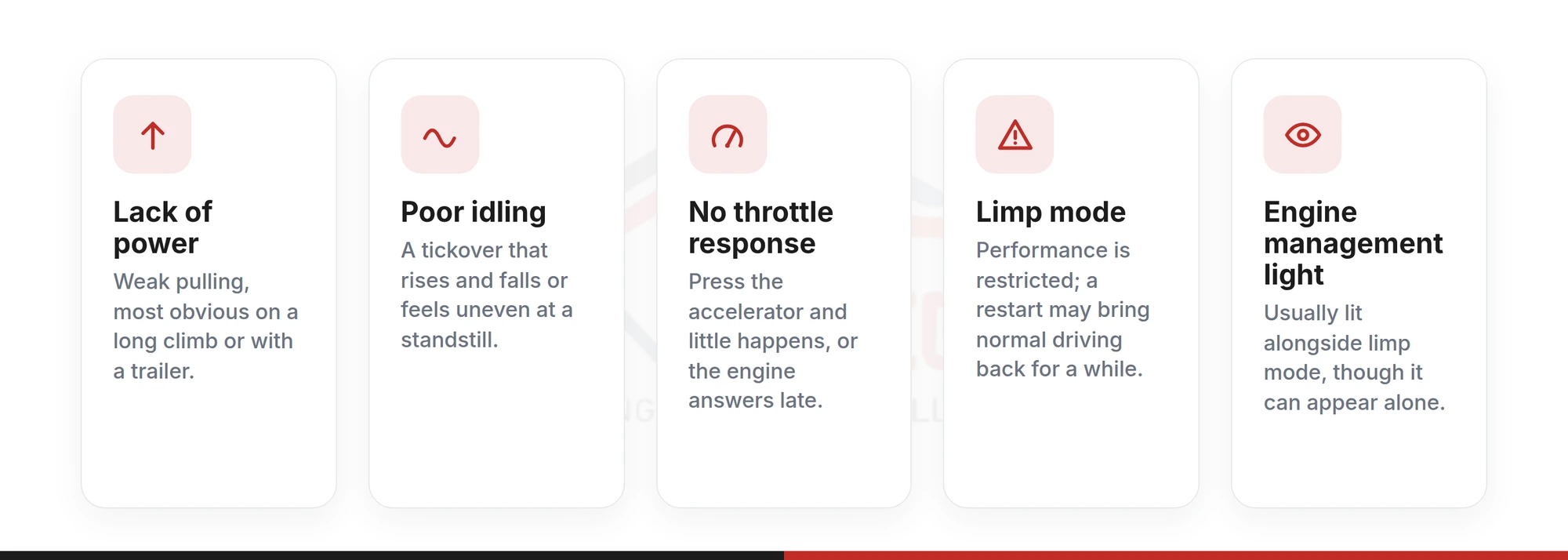
- Lack of power. The Shogun pulls weakly, and it shows most when the engine is working hard, such as on a long climb or with a trailer behind.
- Poor idling. A tickover that rises and falls or feels uneven with the vehicle at a standstill.
- No throttle response. You press the accelerator and little or nothing happens, or the engine answers late.
- Limp mode. Performance is restricted to protect the engine. Switching off and restarting may bring normal driving back for a while.
- Engine management light. Usually lit alongside limp mode, though it can appear on its own.
Any one of these could have a cause elsewhere. When the engine management light and limp mode arrive together, though, the throttle body moves up the list, because that combination is how the engine’s control unit reacts when the readings coming back from the throttle stop adding up.
- The part: a butterfly valve between the air intake filter and the intake manifold
- Its job: controlling how much air reaches the engine
- Signs: lack of power, poor idling, no throttle response, limp mode, engine management light
- Rule out first: intake leaks, the air-flow sensor, the accelerator pedal sensor and wiring
- Our side: your own unit bench tested, repaired and load tested, then posted back
Why does a Shogun hold back its own power?
The throttle body sits between the air intake filter and the intake manifold. Its butterfly valve opens and closes to regulate how much air goes into the engine, and the control unit decides that opening using the throttle position sensor and other inputs. Our guide explains how a throttle body works in more detail.
Those position readings are how the control unit knows how much air it is letting in. When they become unreliable, it does not carry on with figures it cannot trust: it stores a fault, switches on the warning light and cuts the engine back. That cut-back is what owners call limp mode, and it is the system protecting the engine rather than a second failure.
A restart often brings full power back, because the checks begin again from scratch each time the engine starts. The fault has not been fixed by that. It tends to return once the engine bay is hot or the vehicle is under heavy load.
On a vehicle that may be towing or fully laden, an unexpected loss of power at a roundabout or on a slip road is the real danger. Until the unit has been repaired, keep journeys gentle and avoid towing.
Which fault codes point towards the throttle body?
A scan of the engine control unit helps narrow things down. The codes below are the generic throttle codes; the list and the wording on your Shogun’s scan can differ, so treat them as pointers. Our guide to throttle body fault codes takes each one further.
| Code | What the scan is saying | Where it tends to lead |
|---|---|---|
| P0121 / P0122 | Throttle position signal A makes no sense (P0121) or reads too low (P0122) | For a low reading, check the wiring and plug first; if the circuit is sound and the signal still makes no sense, suspect the unit |
| P0221 / P0222 | The same two checks, on position signal B | On some makes B is the second accelerator pedal sensor, so establish which sensor is meant before anything is removed |
| P0638 | The valve did not reach the opening it was told to | Carbon can cause it; if it returns once that is dealt with, test the unit |
| P2100 / P2101 | Throttle actuator circuit open (P2100), or not performing as commanded (P2101) | Wiring first; then the unit, or less often the engine control unit that drives it |
| P2135 | Signals A and B no longer agree with each other | Points at the throttle body’s own position signals, or the wiring that carries them |
| P2104 / P2110 | Forced idle / forced limited engine speed | These describe limp mode itself; the cause is in the code stored next to them |
Keep the codes. A cleared scan tells us nothing, so ask your garage for a printout or a photo of the screen and add the list to the repair form.
What else can make a Shogun behave like this?
Several faults elsewhere in the intake and its controls produce the same complaints. They are worth eliminating before the throttle body is unbolted.
- Intake or vacuum leaks. A split hose or a poorly sealed joint lets in air the engine has not accounted for, and both the tickover and the pulling power suffer.
- A dirty air-flow sensor. If its reading drifts, the engine misjudges how much air is arriving, and the result can feel very like a throttle fault.
- The accelerator pedal sensor. The pedal reports your foot’s position to the control unit. Give the throttle body bad instructions and it will follow them, however healthy it is.
- Wiring and connectors. The loom to the throttle body lives with heat and vibration. A loose plug, corrosion or a poor earth can set throttle codes on a sound unit.
Testing the throttle body away from the vehicle is what removes the doubt. On our bench it is the only component in the circuit, so a fault in it has nowhere to hide. If it passes, we report it as sound and your garage can turn back to the list above.
Where cleaning fits in
Carbon does gather around the butterfly valve, and when deposits are the only problem, removing them helps. A clean cannot reach an electrical fault, though. If the warning light and limp mode return after a clean, the unit needs testing rather than a second clean.
Mitsubishi Shogun · bench-tested repair
Hoses, sensors and wiring ruled out? Let the bench decideBook the repair with the registration, the numbers or markings on your throttle body and any codes your garage has read. We confirm the fault before repairing anything, then test the unit again under load before it is posted back.
Tested on in-house Hardware-in-the-Loop rigs that simulate heat, vibration and load · Circuit-level work by our own engineering team
Why do Shogun throttle bodies fail?
The throttle body is mounted on the engine and works for as long as it runs. A Shogun may spend much of its working life towing, carrying heavy loads or going off-road, so that work is often done under sustained demand. Four things wear the unit down.
- Heat cycling. Every drive takes it from cold to engine-bay heat and back. Over time that cycle tells on its electronics, and a fault that starts this way tends to show warm and vanish cold.
- Vibration. Engine shake, rough tracks and the strain of a heavy load act on the unit and its connector constantly, so a weakness that seems fine at rest can break up on the move.
- Carbon build-up. Soot and oily residue settle in the throat of the unit, and the valve has to work against them, most noticeably around tickover.
- Age. Wear accumulates quietly. Once a fault starts coming and going, it usually becomes more frequent rather than clearing up.
Repair, second-hand or new: what are the options?
Once the throttle body is confirmed as the fault, there are three honest routes. A unit from a breaker comes off a vehicle of similar age and use, so it arrives carrying wear that nobody has measured. A new unit starts with no wear at all, though it is built to the same design as the part that failed.
Repairing your own throttle body means the part that goes back on is the one that came off your Shogun, with the fault found and put right and its behaviour proven on our rig before it leaves us. It returns under our repair warranty.
From booking to refit: how the Shogun repair runs
We need the unit, not the vehicle.
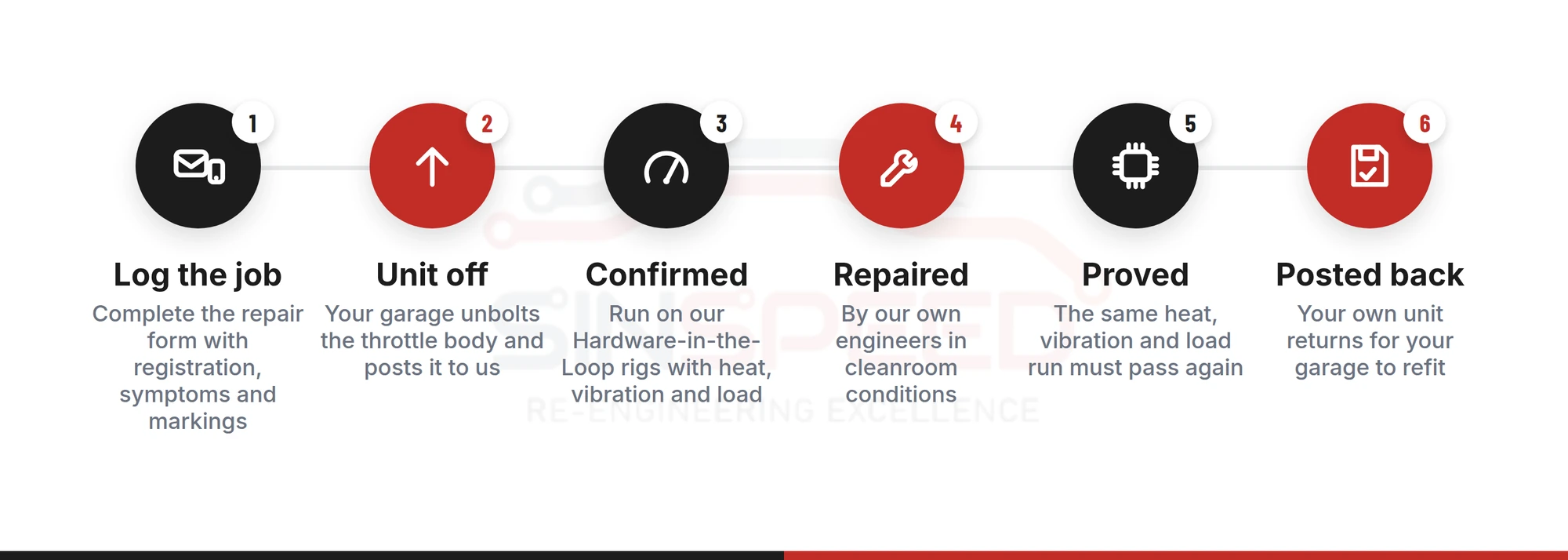
- Log the job with us
Complete the repair form with the registration, what the Shogun is doing, the numbers or markings on the throttle body and any codes that have been read.
- Unit off and into the post
Your garage unbolts the throttle body, or you do if you are confident with the job, and posts it to our workshop. Wrap it so nothing can knock the valve or the electrical plug in transit, and slip a note of the symptoms in the box.
- Fault confirmed on the bench
Before any repair starts, the unit is run through its opening range on our Hardware-in-the-Loop rigs, which recreate engine-bay heat, vibration and load.
- Repaired by our own engineers
Our in-house engineers carry out the repair at circuit level, working in cleanroom conditions with static-safe handling throughout.
- Proved under load again
The repaired throttle body goes back on the rig and has to pass the same heat, vibration and load run before it is cleared to leave.
- Returned for refitting
Your own unit is posted back for your garage to refit.
Which numbers and markings do Shogun units arrive with?
These are the numbers and markings we see on Shogun throttle bodies sent in to our workshop. They are listed exactly as they appear on the units, so compare them with the label or casing on yours.
| Numbers and markings we see on Shogun throttle bodies sent in |
|---|
| 4M41U |
| CAD5051 |
| 1540A033 |
| 12H28 |
| 0020 |
| 00272 |
| 12H15 |
Not seeing yours? Ask us before you post it, with the registration and the markings on your unit, and we will check it.
Questions Shogun owners ask about the throttle body
My Shogun only feels flat when it is towing or climbing. Could it be the throttle body?
It could. A throttle body with an intermittent fault can behave at light load and give trouble when the engine is hot and working hard. Lack of power has other causes too, so have the codes read and the intake checked first; if they point at the throttle, send the unit for testing.
Is it worth having the throttle body cleaned before sending it to you?
Where carbon is the whole problem, a clean helps. It will not cure an electrical fault, so if the engine management light or limp mode comes back afterwards, the unit itself needs testing.
What should I do if the Shogun goes into limp mode on a journey?
Find somewhere safe to stop. A restart may bring full power back, but the fault is still there and can return without warning, so avoid towing and fast, busy roads until the throttle body has been tested and repaired.
None of the markings on my throttle body match your list. Should I still send it?
Get in touch first with the registration and the numbers or markings from the unit. We will confirm whether it is one we can repair before you post anything.
Can I send in a throttle body from a Shogun Pinin?
Yes, Shogun Pinin owners can send theirs in too, and we repair throttle bodies across a wide range of models through our throttle body hub.
What goes in the box with the throttle body?
Just the throttle body, wrapped so the valve and the electrical plug are protected, with a note of the symptoms. Complete the repair form before posting so we can match the unit to your Shogun when it arrives.
Sinspeed · Shogun throttle bodies
Get the Shogun answering the pedal againBook the repair, or message us first if you would like a second opinion on the codes. Once the unit reaches the bench, it is tested, repaired, tested again under load and posted back for refitting.
Repairs carried out in cleanroom conditions · In-house electronic engineers · No need to bring the Shogun to us