
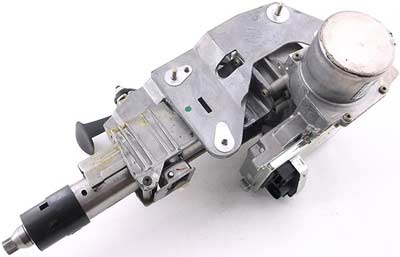
On a 2002–2009 Renault Megane Mk2, steering that turns heavy, a warning light that comes and goes, or the codes C1606 and C1608 usually mean the electric power steering column is failing. We repair your own column and send it back ready to refit — it calibrates itself once it is back in the car, needs no coding and carries a lifetime warranty.
What are the signs of a failing Megane EPS column?
The column on the Mk2 Megane seldom gives up without warning. In most cars it fails in stages, and the stage you catch it at decides how much driving you can sensibly do while you arrange the repair.
- A steering warning light that clears itself. The lamp appears briefly on the dash, then goes out, and the steering feels normal again. This is usually the first sign.
- Heavy steering one way, or both. The wheel suddenly takes real effort to turn — sometimes only to the left or only to the right, more often in both directions.
- A “Steering fault” message. The display reports the fault in words, often with the red STOP warning lit alongside it.
- Assistance that comes back after a restart. Switching the engine off and on again can restore normal steering for a while. The system has reset; the fault has not gone.
- A permanent light and no assistance. The end stage: the warning stays on and the steering is heavy in both directions, with no power assistance at all.
Steering that is heavy in only one direction is no reason to wait. The heaviness can be in one direction or in both, more commonly both, and a steering light that comes and goes alongside it is the pattern to act on.
This is very much a Mk2 problem. The 2002–2009 Megane was the generation that replaced the hydraulic power steering of earlier models with an electric column, so there is no fluid to top up and no pump to check — when the assistance goes, the electric column is where the diagnosis starts. If you also run a Peugeot, we have a separate page on Peugeot 207 power steering failure.
What do Renault codes C1606 and C1608 mean?
Any garage with a diagnostic scanner can read the power steering module through the car’s OBD port. On a failing Megane column, two codes turn up far more often than any others.
C1606 — motor driver malfunction. The steering control unit is reporting that it cannot drive the assistance motor the way it expects to. In plain terms, the system is asking for help to be applied and is not getting the response it should.
C1608 — control unit malfunction. The control unit has detected a fault within itself. It is the car’s way of saying that the part making the steering decisions can no longer be trusted, so assistance is reduced or withdrawn.
On the Mk2, the assistance motor and its control unit are both part of the steering column assembly, which is why either code points to the same unit. Code descriptions vary a little between scan tools, and other codes may be logged alongside them, so send the full readout with the column rather than just the headline code.
A code records what the system saw, not why it happened. A fault stored during a flat-battery start can sit in the memory long after the battery has been replaced, which is why a code that returns after being cleared tells you far more than one that does not.
- Car: Renault Megane Mk2, most commonly 2002–2009
- Unit: electric power steering column, including the assistance motor and its control unit
- Codes most often seen: C1606 (motor driver malfunction) and C1608 (control unit malfunction)
- Typical signs: heavy steering one or both ways, an intermittent steering light, a “Steering fault” message
- Service: mail-in repair of your own column, from anywhere in the UK
- After refit: the column calibrates itself and needs no coding
- Warranty: lifetime, unlimited-mileage
Why does “Steering fault” appear after battery work?
A “Steering fault” warning that appears straight after a battery has died, been jump-started or been replaced is one of the most common Megane complaints. It has two possible explanations, and from the driver’s seat they look identical.
The first is the supply. The steering control unit needs a healthy voltage before it will apply any assistance. If the battery is weak, or a terminal or earth connection is poor, the unit may not power up properly and will flag a fault even though the column itself is sound.
The second is a column that was already close to failing. The voltage dip of a dying battery, or the disturbance of a jump start, is often the event that tips an ageing unit over the edge or exposes a fault that had been building quietly. In that case a new battery does not bring the steering back.
So before the column is condemned, have the battery tested under load, the terminals and main earth connections checked, and the codes cleared. If the warning stays away on a healthy supply, the column was never the problem. If it returns with C1606 or C1608 on a battery that tests well, the column is.
Why does the Megane Mk2 steering column fail?
The failure sits in the column’s electronics, and three things drive it.
- Heat. The motor and control unit sit on the column behind the dashboard, and every journey puts them through another cycle of warming and cooling.
- Voltage events. Flat batteries, jump starts and charging faults put the electronics through supply conditions they were never designed to see regularly.
- Vibration and age. The column takes every road shock that comes up through the steering, and over a long service life that steady shaking adds up.
Why it feels like a mechanical fault
When the electric assistance drops out, you are steering the car on its mechanical parts alone, and the front wheels suddenly feel very heavy. Drivers often assume something has seized — a tight rack, a stiff joint, a soft tyre — because that is what heavy steering used to mean.
The giveaways are the warning light and the way the fault comes and goes: a seized part stays seized, whereas a failing control unit or motor can work normally on one journey and drop out on the next. Steering that is heavy only some of the time, with the steering light involved, points to the electronics.
Is it the column, or something else?
Not every heavy wheel is the column, and a garage will want to clear the simple causes before taking it out. Once the supply has been checked as described above, these are the signs that separate a column fault from everything else.
- No warning at all. If the steering is heavy but no lamp or message has ever appeared and no codes are stored, look at tyre pressures, the front suspension and the steering joints first. A failing column usually logs a code.
- The codes. C1606 or C1608 stored in the power steering module on a healthy battery is the strongest pointer to the column.
- The pattern. Intermittent heaviness that arrives with the steering light, and help that returns after a restart, is the column’s signature.
Confirming it on the bench
On the car, a column fault and a supply problem can look exactly the same. On our bench the column is powered and turned from lock to lock with no car attached, so its behaviour can be measured rather than guessed at — and you know what has failed before any work begins.
Is it safe to drive with heavy steering?
Treat it as a safety issue and have it checked promptly. Without assistance the Megane can still be steered, but it takes far more effort than you expect, and the real risk is the moment the help disappears — on a roundabout, at a tight junction or while parking — rather than the heaviness itself.
An intermittent fault is the hardest to plan around, because you cannot predict when it will strike. If the steering light has come on even once, drive gently, avoid long or demanding journeys, and book the column in before the fault becomes permanent. If the steering is heavy all the time, keep driving to the minimum needed to get the car to your garage.
Sinspeed · mail-in repair
C1606 or C1608 on your Megane? Book the column inTell us the codes and what the steering is doing, then have your garage take the column out and post it to us. We confirm the fault on the bench, repair your own unit and return it to go straight back in.
Lifetime, unlimited-mileage warranty · Mail-in from anywhere in the UK · Load-tested on Hardware-in-the-Loop rigs
Should you repair the column or replace it?
Once the column is confirmed as the fault, there are three ways to get the assistance back. They differ less on whether the steering works afterwards than on what you know about the part you end up with, and what has to happen when it is fitted.
| Route | What you know about the part | Fitting | Warranty |
|---|---|---|---|
| Repair your own column | Your car’s own unit, with its fault found and repaired and the whole column load-tested | Direct refit; calibrates itself, no coding | Lifetime, unlimited-mileage |
| Used column from a breaker | Same age and design as yours, with a history you cannot see | Has to be the right match for your car, and you are relying on it working once fitted | Varies by seller |
| New column from a main dealer | New, but built to the same design as the one that failed | Dealer labour plus coding | The dealer’s own terms |
A used column looks like the cheapest route, and its risk is simple: you cannot know how long it will last. It comes off a car of the same age, built to the same design, with an unknown history of heat, voltage events and use — the very conditions that wore out yours.
A new column from the dealer removes the second-hand uncertainty, but it brings labour and coding with it, and it is the same design as the unit that failed.
Repairing your own column keeps the unknowns to a minimum. Its history is one you already know, and it goes back in as a direct fit: once refitted it calibrates itself, with no coding required. The work is carried out by our in-house electronic engineers in a cleanroom-standard, ESD-safe workshop, and rather than fitting a like-for-like part with the same weakness, we reinforce the known weak points behind the failure.
How our Megane EPS column repair works
- Book it in
Complete the repair form with the car’s year and engine, what the steering is doing and the full code readout. If you are not sure the column is at fault, contact us first with the symptoms and codes.
- Post the column to us
Removing and refitting the column is routine work for any garage or auto electrician. They pack it securely and send it in, and the car waits with them while the column makes the trip.
- Bench diagnosis
We power the column on its own and confirm which part of the assembly has failed, using dealer-level diagnostic equipment, before any repair starts.
- Repair
Our engineers repair the fault at circuit level and reinforce the weak points that led to it, so the repair deals with the cause as well as the symptom.
- Load testing
The repaired column goes onto our Hardware-in-the-Loop rigs, which simulate the heat, vibration and steering load of real driving, and it is signed off only when it passes.
- Back in the car
Your garage refits the column. It calibrates itself once fitted and needs no coding, so the steering is ready to use when the job is done; any stored codes are then cleared.
Every repaired column carries our lifetime, unlimited-mileage warranty. Garages and independent workshops across the UK send steering units to us this way on behalf of their own customers, alongside private owners. For the other electric power steering units we handle, see our full steering repair range.
Renault Megane power steering FAQs
Can a Renault Megane Mk2 electric power steering column be repaired?
Yes. The faults behind C1606 and C1608 are repairable in the column itself, so in most cases there is no need to replace the whole unit. We repair your own column and return it ready to refit, with a lifetime warranty.
Will the repaired column need coding or calibrating?
No coding is needed. The column calibrates itself once it is refitted, so it goes back in as a direct fit. Clearing any stored fault codes afterwards is all that is left to do.
My Megane shows “Steering fault” after a new battery. Is the column broken?
Not necessarily. A weak supply or a poor connection can make a healthy column report a fault, while the voltage event itself can push an ageing column into failure. If the warning keeps returning on a battery that tests well, especially with C1606 or C1608 stored, the column is the likely cause.
Is it safe to drive a Megane with heavy power steering?
You can still steer, but it takes much more effort, and on an intermittent fault the assistance can disappear without warning. Treat it as a safety issue, keep journeys to a minimum and have it checked promptly.
What do C1606 and C1608 mean on a Renault Megane?
C1606 is a motor driver malfunction: the control unit cannot drive the assistance motor the way it expects to. C1608 is a control unit malfunction: the unit has found a fault in itself. On the Mk2 both point to the electric power steering column.
Why is my Megane steering heavy in only one direction?
On a failing column the heaviness can be in one direction or in both, and more commonly both. Either way, a steering warning light that comes and goes alongside it is the pattern to act on: have the codes read and look for C1606 or C1608.
Sinspeed · mail-in repair
Steering gone heavy? Tell us what your Megane is doingSend the codes, the symptoms and the car’s details. Our engineers will tell you what they expect to find before the column comes out of the car.
Cleanroom-standard, ESD-safe workshop · In-house electronic engineers · Calibrates itself on refit, no coding