
Summary: An ECU, or engine control unit, is the computer that runs a car’s engine. It reads sensors measuring the incoming air, engine and exhaust temperatures, throttle position, fuel pressure and exhaust gases, then sets how much fuel is injected and when, the spark timing on a petrol engine and, on turbo engines, how much boost is allowed. Those decisions come from maps stored in the unit, and those maps are what an ECU remap rewrites. Remapping is our part of the story: a custom map matched to your car, installed with your original file kept on record.
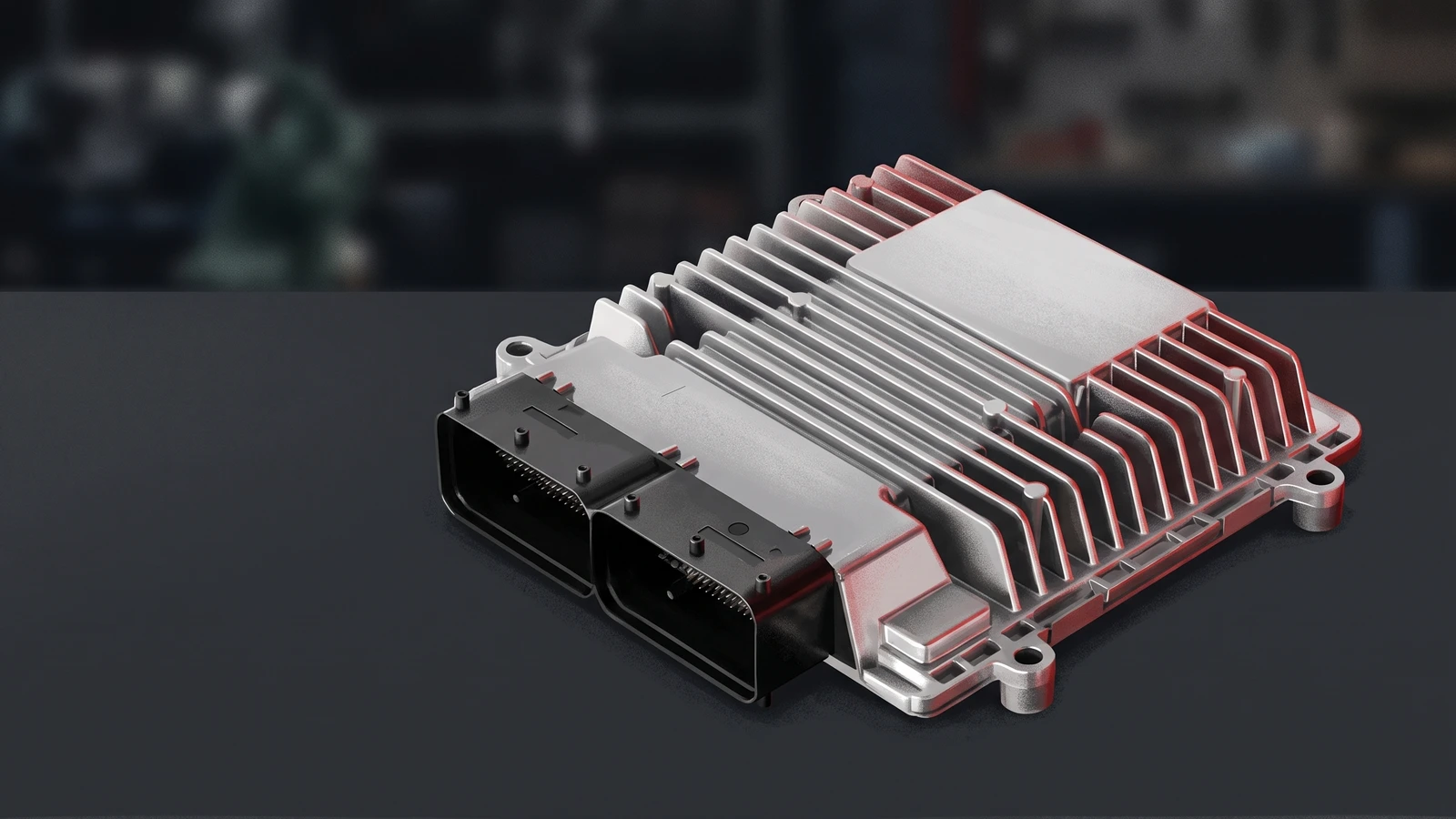
- ECU meaning: engine control unit or electronic control unit?
- What does an ECU do?
- ECU vs TCM vs BCM: three control units compared
- What an ECU remap actually changes
- How an ECU remap is carried out
- Remaps, warranties and insurance: what to declare
- Signs of a failing engine ECU, and where it goes for repair
- Quick answers on ECUs
- Final thoughts
ECU meaning: engine control unit or electronic control unit?
ECU is used in two ways, and both are correct. In its broad sense it means electronic control unit: any of the small computers that each run one system on the car. A modern vehicle carries dozens of them, and some carry more than a hundred — the ABS, the automatic gearbox, the airbags, the power steering, the locks and the lights all have their own.
In the narrow sense — the way garages, parts lists and tuners use it — ECU means the engine control unit. You will also see it called the ECM (engine control module) or PCM (powertrain control module), names different manufacturers use for the engine unit. When someone says a car needs its ECU looking at, or talks about remapping the ECU, this is the unit they mean.
Context usually tells you which sense applies. On this page, ECU means the engine unit unless we say otherwise.
What does an ECU do?
An engine ECU works in a constant loop: measure, compare, adjust. Sensors around the engine report what is happening, the ECU checks those readings against the maps in its software, and it drives the parts that deliver fuel, spark and boost to suit. The loop never stops while the engine is running.
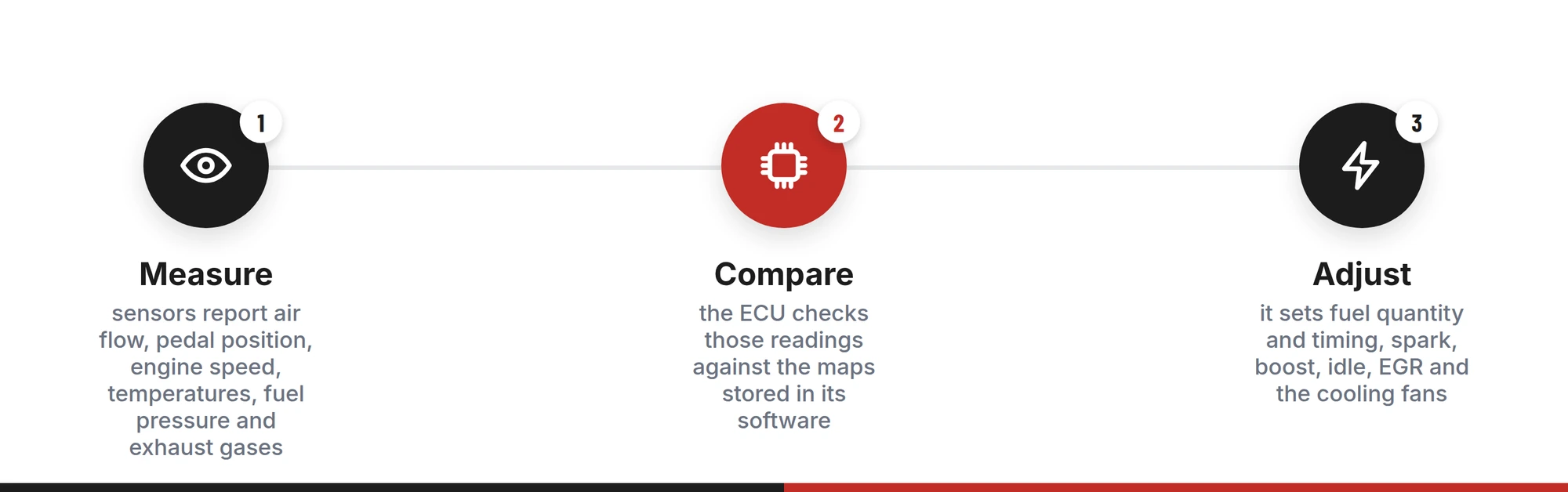
The inputs vary from engine to engine, but most engine ECUs listen to:
- Air: the mass air flow and intake air temperature sensors, which together tell it how much air is entering and how dense it is.
- Driver demand: the throttle or accelerator pedal position.
- Engine state: engine speed and coolant temperature.
- Fuel: the fuel rail pressure sensor.
- Exhaust: the oxygen and exhaust temperature sensors, which report how cleanly the engine is burning its fuel.
From those readings it sets the outputs: the quantity of fuel injected and the timing of each injection, the ignition timing on a petrol engine, turbo boost where there is a turbo, the idle speed, the EGR valve position and the cooling fans. If the exhaust sensors show the engine running rich (too much fuel) or lean (too little), the ECU trims the mixture to bring it back.
The factory maps behind all this are a compromise by design. They must suit every climate, altitude and grade of fuel a car might meet, satisfy the emissions rules and hold up over long service intervals, so they leave a margin rather than chasing the most power or torque the engine could make. That margin is the room a remap works in.
ECU vs TCM vs BCM: three control units compared
These three modules are confused more than any others, partly because all three are ECUs in the broad sense. Each one runs a different part of the car, and each gives itself away differently when it fails.
| ECU — engine control unit | TCM — transmission control module | BCM — body control module | |
|---|---|---|---|
| Runs | The engine: fuelling, ignition, boost and emissions | An automatic gearbox: which gear, when, and how firmly it engages | The body electrics: locking, lighting, wipers, windows and horn |
| Reads | Air flow and temperature, pedal position, engine speed, coolant temperature, fuel pressure and exhaust gases | Road and engine speed, load, pedal position, the selector lever and gearbox oil temperature | The switches and stalks you operate, door and boot signals, and the key |
| Other names | ECM, PCM | TCU or gearbox ECU; built into the gearbox on many dual-clutch and CVT designs | BCU, body computer, comfort module; SAM on Mercedes-Benz |
| Typical failure signs | Engine management light, rough running, lost power, limp mode or a no-start | Flashing selector display, harsh or delayed changes, limp mode, or a gear that will not engage | Faults spread across locks, lights and wipers that share nothing but the module; a key the car stops recognising |
| Touched by an engine remap? | Yes — this is the unit a remap rewrites | No | No |
| Read next | ECU remapping | What is a transmission control module? | What is a body control module? |
To place a fault, look at what it changes. How the engine pulls, idles or starts points at the engine side; how and when the gears arrive points at the TCM; something you switch or lock no longer obeying points at the BCM. Sensors, wiring and the mechanical parts each unit controls can imitate all three, so a diagnosis comes before a verdict.
Sinspeed repairs transmission control modules and body control modules by post, and remaps engine ECUs. Repairing a failed engine ECU is outside what we do; the section on failing ECUs below says where that work goes.
What an ECU remap actually changes
A remap replaces the calibration inside the engine ECU with a revised file. The hardware stays exactly as it was: the same ECU, the same sensors, the same injectors and the same turbo. What changes is the set of tables the ECU consults when it decides how much fuel, boost and ignition advance to give the engine at each speed and load.
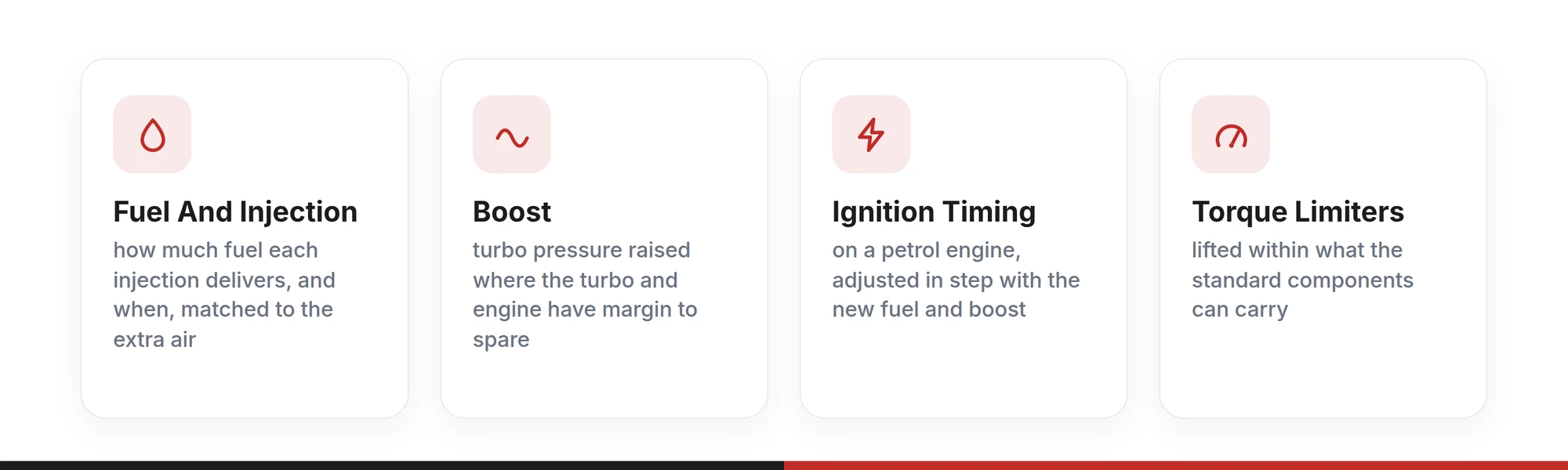
| Map or limit | What it controls | What a remap does with it |
|---|---|---|
| Fuel quantity and injection timing | How much fuel each injection delivers, and when | Revised to match the extra air and boost, within what the fuel system can deliver |
| Boost | Turbo pressure at each engine speed and load | Raised where the turbo and engine have margin to spare |
| Ignition timing (petrol) | The moment each spark fires | Adjusted in step with the new fuel and boost settings |
| Torque limiters | The ceiling the ECU puts on engine torque | Lifted within what the standard components can carry |
| Throttle response | How pedal position becomes a request for torque | Made more direct, so the engine answers the pedal sooner |
Just as much stays as it was. A road remap leaves the car’s emissions equipment fitted and working, and an engine remap does not rewrite the gearbox, brake or body modules. A Stage 1 map is software only, written for the car’s standard hardware, so the engine should still start, idle and drive normally day to day. Stage 2 and beyond belong to cars with supporting hardware changes, where the map is matched to those parts.
Remaps also differ in what they aim for. An economy remap favours low-down and mid-range torque, so the engine pulls a higher gear with less effort; a diesel remap uses the headroom most turbo-diesels carry, which owners who tow tend to notice first. We do not publish power or MPG gains, because they depend on the engine, its condition and how the car is driven.
How an ECU remap is carried out
Early engine ECUs had to be opened and physically altered to change their maps — chip tuning, as it was known. Most later ECUs can be read and rewritten through the car’s diagnostic (OBD) socket without leaving the car, which makes remapping far safer and simpler and put it within reach of everyday road cars. Some newer units are protected against tuning and have to come off the car to be read, which is why a remap sometimes involves the ECU itself travelling.
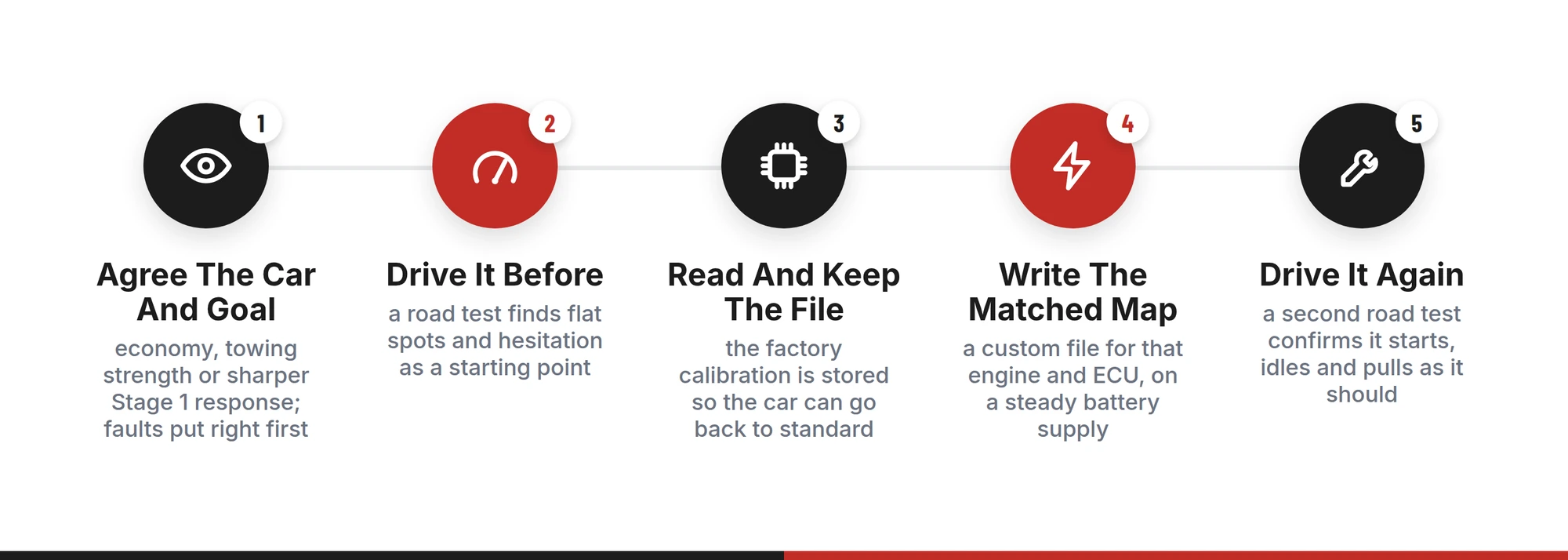
Either way, the job follows the same order:
- Agree the car and the goal
Make, model, engine, mileage and condition, and whether you want economy, towing strength or sharper Stage 1 response. An engine with a fault is put right first; no map can fix one.
- Drive it before anything changes
A road test through the gears finds flat spots and hesitation, so the result is judged against a known starting point.
- Read and keep the factory file
The original calibration comes off the ECU and is stored, so the car can go back to standard whenever you want.
- Write the matched map
A custom file for that make, model, engine and ECU is written while the battery supply is held steady, so a voltage dip cannot interrupt it.
- Drive it again
A second road test confirms the car starts, idles and pulls as it should on the new map.
That can happen at your home or workplace through our mobile ECU remapping service, or by sending the ECU to us where the unit has to come off.
Sinspeed · ECU remapping
Wondering what a remap would change on your car?Give us the make, model and engine, and a line on how the car is used. We will say which type of map suits it, whether anything needs attention first, and how the work would be done.
Factory file stored before any change · Map matched to your exact engine and ECU
Remaps, warranties and insurance: what to declare
A remap is a modification, and it should be treated like one. Tell your insurer before you drive the car remapped: an undeclared remap can lead to a refused claim or a cancelled policy, and the insurer may adjust the premium once it knows.
If the car is still under the manufacturer’s warranty, expect a remap to affect it — in most cases it will void the cover, so check the terms before booking rather than after. Restoring the factory file puts the standard map back; it is not a way to hide a modification from an insurer or a dealer, and we would not treat it as one.
The engine deserves the same honesty. A map pushed beyond what the engine and its components can hold can shorten its life and strain the parts around it, so worn components or an existing fault are dealt with before any map goes on. Extra torque finds weak points; it does not cure them.
Signs of a failing engine ECU, and where it goes for repair
An engine ECU has no moving parts, so when one fails the cause usually lies in its surroundings: water finding its way in, voltage spikes from the charging system or a badly handled jump start, and the constant heat and vibration of life near the engine. The signs include:
- The engine management light, sometimes with other warnings alongside it.
- An engine that cranks but will not fire, or will not start at all.
- Rough idling, misfires, hesitation or stalling.
- Lost power, or the car dropping into limp mode.
- Fuel consumption rising for no obvious reason.
- Higher emissions, which can mean an MOT fail.
Almost every one of those also has a sensor, wiring or mechanical cause. The ECU can only act on what its sensors tell it, so a failing sensor or a damaged wire makes a healthy ECU misbehave — and a failing ECU can pass for a bad injector or sensor in return. Stored fault codes and a proper diagnosis come before anyone condemns the unit.
Engine ECU repair is not a service Sinspeed offers. That work belongs to ecu-repairs.com, an independent specialist in engine ECU repair. A car with an engine ECU fault is also not one to remap until the fault is fixed.
Quick answers on ECUs
Is an ECU the same as an ECM?
In everyday use, yes. ECU (engine control unit) and ECM (engine control module) are two names for the unit that runs the engine, and PCM is a third that some makers use. The only confusion comes from the broader meaning of ECU — electronic control unit — which covers every control module on the car.
Can a car run without an ECU?
Not a modern one. The ECU decides how much fuel each injection delivers and, on a petrol engine, when each spark fires; without it, nothing tells the injectors or the ignition what to do, and the engine will not run. A car can sometimes keep going with a faulty ECU, often in limp mode, but never with none at all.
Can I fit an ECU from another car?
Not as a straight swap on most later cars. Many engine ECUs are coded to the vehicle they came from, and one taken from another car has to be recoded before it will work — a job that needs dealer-level diagnostic equipment and is not possible on every model. A swap is also no substitute for finding out why the original unit stopped working.
Is an ECU remap permanent?
It stays put: the revised calibration remains in the ECU until someone writes a different file to it or the ECU itself is replaced. It is also reversible. Your original file is read and kept before anything is written, so the standard map can go back on whenever you want, for a sale or any other reason.
Final thoughts
ECU is two terms in one: every electronic control unit on the car in the broad sense, and the engine control unit in the everyday one. The engine unit matters most to how the car drives, because its maps decide how the engine answers every press of the pedal.
Knowing that makes two things clearer. A remap changes those maps and nothing else, so what counts is how well the new file suits the particular car. And when the engine misbehaves, the ECU is one suspect among several — worth proving before it takes the blame.
Sinspeed · remaps matched to the car
Ready for a better map on your ECU?Name the car and the result you are after — economy, towing strength or sharper response. We will recommend the right map, confirm how it will be installed, and hold your factory calibration so standard is always one step away.
Mobile or mail-in installation · Aftercare and warranty behind every remap