
Summary: The Bosch 5.7 is the ABS/ESP pump control module — also called the ABS ECU, ABS module or ESP pump — fitted to many Audis, BMWs and other makes. When it fails, we remanufacture your original unit and return it plug and play, no coding required, with a lifetime warranty.
In this guide
- What is the Bosch 5.7 ABS/ESP pump module (and what it's also called)?
- Symptoms of a failing Bosch 5.7 ABS pump
- What causes Bosch 5.7 ABS/ESP failure?
- Can the Bosch 5.7 module be repaired or must it be replaced?
- Will I need programming, or do I keep my unit?
- Which vehicles use the Bosch 5.7 ABS pump?
- Bosch 5.7 part numbers
- How our repair service works
- FAQs
What is the Bosch 5.7 ABS/ESP pump module (and what it's also called)?
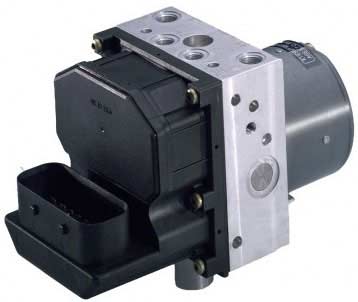
The Bosch 5.7 is the control module that runs your car’s anti-lock braking system (ABS) and, where the vehicle has traction and stability control, its electronic stability programme (ESP) as well. It is one of the most widely fitted ABS units ever made, which is why the same part turns up under a long list of different names. You will see it called the ABS pump, the ABS ECU, the ABS module, the ABS controller, the ESP module and the ESP pump — all the same component. On BMWs the stability system is badged DSC (Dynamic Stability Control), so a BMW owner may know it as the DSC module, but the hardware is the same Bosch 5.7.
Physically the unit is made up of three parts that cannot work without each other. The pump motor keeps the brake system pressurised so the ABS can react the instant it is needed. The hydraulic control unit (HCU) is the solid aluminium block of valves and channels that meters brake pressure to each wheel. The electronic control unit (ECU) is the brain: it reads the wheel-speed sensors and the brake-pressure sensor, decides what each wheel needs, and drives the valves and the pump to deliver it.
On a car fitted with ESP the ECU does more again. It compares the steering-angle and yaw (rotation) sensor signals to work out whether the car is going where the driver is pointing it. If it detects understeer or oversteer it brakes individual wheels on its own — without the driver touching the pedal — to bring the car back into line. That is why a fault in this one module can light up ABS, traction and stability warnings all at once.
Bosch introduced the 5.7 generation in the late 1990s and it went on to become one of the brand’s most successful ABS platforms, fitted across an enormous range of vehicles. It exists in several closely related variants — the 5.7, 5.7ASG, 5.7P and 5.7S among them — which differ in detail but share the same basic design and the same common failure points.
Symptoms of a failing Bosch 5.7 ABS pump
These units rarely fail cleanly. More often the warning signs come and go for weeks before the fault settles in for good, so it is worth acting on them early. The symptoms we see most often on a failing Bosch 5.7 are:
- ABS warning light on — constantly, or flickering on and off as the fault comes and goes.
- Traction or stability light on — the ESP or traction-control warning, or the DSC light on a BMW.
- Handbrake or brake warning light on, often alongside the ABS light.
- Steering warning light on — on some vehicles the same fault flags the steering or power-steering system.
- Speedometer not working, or reading erratically — the dashboard speed is taken from the wheel-speed signals that pass through the ABS module.
- Wheel-speed sensor fault codes — frequently stored even when the sensors themselves are in good order.
- No communication with the module — a diagnostic scan tool cannot talk to the unit at all.
- Brake-pressure sensor faults.
- Brakes juddering, or the pedal pulsing, when you are braking normally.
- The ABS pump motor running on — sometimes continuously, even with the ignition off and the key removed.
Because this is part of the braking system, none of these should be left to drift. A single failing module can switch off ABS and ESP together, which means the features that help you stop in an emergency or hold the road in the wet are exactly what you lose. If any of these warnings are showing, have the car diagnosed promptly.
What causes Bosch 5.7 ABS/ESP failure?
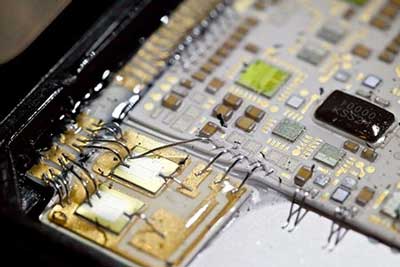
Most Bosch 5.7 failures are electronic rather than hydraulic, and they build up over years of use. The most common culprit is the fine internal connections between the unit’s plug and its circuit board: the bond wires and solder joints fatigue under constant heat cycling and vibration until one or more of them loses contact. Capacitors and resistors drift out of specification over time, and cracked solder joints produce exactly the intermittent, comes-and-goes faults owners describe.
The pump motor is the other common weak point. Worn brushes, windings burnt out by overheating, or an electrical short can all stop it generating pressure properly — and a pump that has started running on continuously is a classic warning that it is on its way out. The brake-pressure sensor on the HCU can fail too, leaving the system unable to regulate pressure correctly.
Where the unit is mounted on the car matters as much as the unit itself. On the Mercedes Sprinter, for example, the module sits close to the windscreen-washer filler and is prone to leaking fluid finding its way in. On the BMW 5 Series (E39) we see an above-average number of wheel-sensor complaints where the sensors are actually fine — the module has suffered from the heat and vibration of its mounting position instead.
This is the part many garages get wrong: not every “ABS fault” is the module. Faulty wheel-speed sensors, damaged wiring, poor power or earth connections and CAN-bus faults elsewhere in the car can all mimic a failed unit, so they need to be ruled out before the module is condemned. The stored fault codes point to the area at fault rather than naming the cause outright — chassis codes beginning with “C”, VAG codes such as 00287 (wheel sensor) or 00301 (pump motor), or BMW’s short codes like 34 (wheel sensor) and 15 (pump motor). We test the unit to confirm whether it is genuinely the module before any work is agreed.
Can the Bosch 5.7 module be repaired or must it be replaced?
Most main dealers and general garages will tell you the Bosch 5.7 has to be replaced. For them that is usually true — they are not equipped to repair a sealed electronic module at component level. A specialist remanufacturer is, and that changes the options considerably.
Replacement has real drawbacks. A brand-new unit can be expensive and, for older vehicles, increasingly hard to find. A second-hand unit from a salvage yard is a gamble — many have water damage and are not reliably repairable — and, like a new one, it is not married to your car. On top of the part itself, a replacement normally has to be coded to the vehicle before the system will work properly.
We repair your original unit instead. Our in-house electronic and hydraulic engineers work at circuit-board level, renewing the failed connections and components with new genuine OEM parts and reinforcing the points that fail in the first place — so the rebuilt module is brought back to meet and exceed the original specification, rather than being swapped for an identical new one that carries the same built-in weakness.
Every unit is then proven on our in-house Hardware-in-the-Loop (HIL) test rigs, which recreate the heat, vibration and electrical load the module sees in service. That way an intermittent fault shows itself on the bench, where we can put it right, instead of back on your driveway.
Will I need programming, or do I keep my unit?
You keep your own unit — and that is the single biggest advantage of repairing rather than replacing.
Because we rebuild the module that is already coded to your car, its vehicle marriage and configuration stay intact. It comes back as your module, repaired, so there is no programming or coding to do when you refit it: the Bosch 5.7 is returned fully plug and play. You bolt it back on, plug it in, and the car is ready to go.
A new replacement module, by contrast, almost always has to be programmed and coded to the vehicle with dealer-level equipment before it will function — an extra cost and an extra delay you avoid entirely by keeping your original. Where any calibration is needed, we carry it out before the unit leaves us, using dealer-level diagnostic tools, so what arrives back with you is ready to fit. Every remanufactured unit is covered by a lifetime warranty with no mileage limit.
Which vehicles use the Bosch 5.7 ABS pump?
The Bosch 5.7 is fitted across a very wide range of vehicles. We see it fail most often on Audis and BMWs, but it is just as much at home on Fords, Mercedes-Benz cars and vans, Volkswagens and many other makes — from the Alfa Romeo 156 and Fiat Stilo to the Jaguar X-Type, Peugeot 307, SEAT Ibiza, Skoda Superb, Toyota Avensis and Range Rover. The full list of vehicles known to use this unit is below.
| Vehicle | Vehicle | Vehicle | Vehicle | Vehicle |
|---|---|---|---|---|
| Alfa Romeo 156 | Alfa Romeo 166 | Audi A4 | Audi A6 | Audi A8 |
| Audi S8 | BMW 3 Series | BMW 325 | BMW 330 | BMW 5 Series |
| BMW 520 | BMW 523 | BMW 528 | BMW 535 | BMW 540 |
| BMW 7 Series | BMW 725 | BMW 728 | BMW 730 | BMW 735 |
| BMW 740 | BMW 745 | BMW 750 | BMW 760 | BMW B7 |
| BMW X5 | Fiat Stilo | Ford Mondeo | Iveco Daily | Jaguar X-Type |
| Mercedes 109 | Mercedes 111 | Mercedes 115 | Mercedes 119 (Vito) | Mercedes 122 (Vito) |
| Mercedes 616 (Sprinter) | Mercedes Viano | Mercedes Sprinter | Peugeot 307 | Range Rover |
| Seat Cordoba | Seat Ibiza | Skoda Superb | Toyota Avensis | Toyota Corolla |
| Toyota Corolla Verso | Volkswagen (VW) Passat | Volkswagen (VW) Polo | and more.. |
Not sure the Bosch 5.7 is the unit you have? The Bosch 8.0 and the Teves MK70 are different ABS pump generations that look similar and share many of the same symptoms. If yours might be one of those, see our Bosch 8.0 ABS/ESP pump module repair and Teves MK70 ABS pump repair services — or send us the part number from your unit and we will identify it for you.
Bosch 5.7 part numbers
Bosch and the vehicle manufacturers used a long list of part numbers for this module across its different applications. The numbers we have found associated with the Bosch 5.7 are listed below — checking yours against the list is the quickest way to confirm you are looking at the right unit.
| Bosch | OEM |
|---|---|
| 0265 224 011 | 6Q0614417 |
| 0265 224 012 | 6Q0614417B |
| 0265 224 013 | 6Q0614417D |
| 0265 224 085 | 6Q0614417E |
| 0265 224 086 | 6Q0614417A |
| 0265 225 005 | 6Q0614417F |
| 0265 225 006 | 6Q0614417A |
| 0265 225 059 | 6Q0614417F |
| 0265 225 133 | 6Q0698417 |
| 0265 225 135 | 4465789 |
| 0265 225 136 | 34516751189 |
| 0265 225 138 | 34516752276 |
| 0265 225 139 | 34516752737 |
| 0265 225 140 | 34516753867 |
| 0265 225 141 | 34516753642 |
| 0265 800 003 | 34516755739 |
| 0265 800 008 | 34516750841 |
| 0265 900 001 | 34516750382 |
| 0265 900 009 | 34511164851 |
| 0265 900 043 | 34516757593 |
| 0265 900 048 | 34516758969 |
| 0265 950 002 | 34516750349 |
| 0265 950 004 | 34516751501 |
| 0265 950 006 | 34516750844 |
| 0265 950 012 | 34516757594 |
| 0265 950 036 | 34516758970 |
| 0265 950 054 | 34516753643 |
| 0265 950 055 | 34516755740 |
| 0265 950 056 | 34516751192 |
| 0265 950 061 | 34516752738 |
| 0265 950 062 | 34516753868 |
| 0265 950 063 | 34516769536 |
| 0265 950 065 | 32306769860 |
| 0265 950 067 | SRB000282 |
| 0265 950 073 | 4E0614517C |
| 0265 950 076 | 4E0614517B |
| 0265 950 084 | 3U0614517 |
| 0265 950 087 | 3U0614517B |
| 0265 950 118 | 3U0614517D |
| 0265 950 120 | 3U0614517C |
| 0265 950 127 | 3U0614517E |
| 0265 950 130 | 7D0907379 |
| 0265 950 135 | 7D0907379A |
| 0265 950 135 | 7D0907379B |
| 0265 950 145 | 7D0907379C |
| 0265 950 149 | 7D0907379D |
| 0265 950 150 | 7D0907379F |
| 0265 950 159 | 7D0907389B |
| 0265 950 160 | 34511164849 |
| 0265 960 357 | 4465789 |
| 0273 004 573 | 71719822 |
| 0273 004 574 | 34516750349 |
| 0273 004 576 | 34516751501 |
| 0273 004 578 | 34516750844 |
| 0273 004 957 | 34516757594 |
| 1265 800 003 | 34516758970 |
| 1265 800 008 | 34516753643 |
| 1265 900 001 | 34516755740 |
| 1265 900 009 | 34516751192 |
| 1265 900 043 | 34516752738 |
| 1265 900 048 | 34516753868 |
| 1265 950 002 | 34516769536 |
| 1265 950 004 | 32306769860 |
| 1265 950 006 | 34516750349 |
| 1265 950 012 | 34516751501 |
| 1265 950 036 | 34516750844 |
| 1265 950 054 | 34516757594 |
| 1265 950 055 | 34516758970 |
| 1265 950 056 | 34516753643 |
| 1265 950 061 | 34516755740 |
| 1265 950 062 | 34516751192 |
| 1265 950 063 | 34516752738 |
| 1265 950 065 | 34516753868 |
| 1265 950 067 | 34516769536 |
| 1265 950 073 | 32306769860 |
| 1265 950 076 | 34516754407 |
| 1265 950 084 | 34516754509 |
| 1265 950 120 | 34516759564 |
| 1265 950 127 | 34516758783 |
| 1265 950 135 | 34516760961 |
| 1265 950 149 | 34516761782 |
| 1273 004 573 | 34516764447 |
| 1273 004 574 | 34516766846 |
| 1273 004 576 | 34516767834 |
| 1273 004 957 | 34516771232 |
| 0265 225 124 | 34516789320 |
| 34516789324 | |
| 8E0 614 517 B | |
| 4B0 614 517 B | |
| 8E0 614 517 L | |
| 8E0 614 517 N | |
| 4B0 614 517 J | |
| SRB000282 | |
| SRB000283 | |
| 4B0 614 517 S | |
| 4E0 614 517 C | |
| 4X432C405CA | |
| 4X432C405CB | |
| 4X432C405CC | |
| C2S35778 | |
| 5X432C405CA | |
| C2S39160 | |
| 34516756215 | |
| 34516761978 | |
| 34516765429 | |
| 34516757017 | |
| 34516759849 | |
| 34516756777 | |
| 34516755246 | |
| 34516752074 | |
| 34516762114 | |
| 1S712C405DA | |
| 1149168 | |
| 1197814 | |
| 2S712C405BA | |
| 1S712C405BC | |
| 1S712C405BD | |
| 1S712C405BE | |
| 1S712C405BB | |
| 1124751 | |
| 1127931 | |
| 1131729 | |
| 1142139 | |
| 1219695 | |
| 3S712C405BA | |
| 3S712C405CA | |
| 1225679 | |
| 1303858 | |
| 3S712C405CB | |
| 4541 A9 | |
| 9404541A98 | |
| 71734809 | |
| 71746405 | |
| 4454002011 | |
| 4405002051 | |
| 4405002050 | |
| 3S712C405BB | |
| 1225678 | |
| 3S712C405BC | |
| 1320552 | |
| 71732682 | |
| 71714735 | |
| 71719733 | |
| 440500F020 | |
| 440500F021 | |
| 4E0 614 517 R | |
| 4E0 614 517 BF | |
| 4E0 614 517 S | |
| 4E0 614 517 L | |
| 4E0 614 517 AD | |
| 4E0 614 517 BG | |
| 4405005080 | |
| 4405005063 | |
| 4405005081 | |
| 4E0 614 517 AN | |
| A 0014461089 | |
| 0004466789 | |
| 0004469189 | |
| A0004466789 | |
| A0004469189 | |
| A0014461089 | |
| 4E0 614 517 BJ | |
| 8E0 614 111 AQ | |
| 8E0 614 111 AR | |
| 8E0 998 375 K | |
| 42541757 | |
| 504034920 | |
| 6Q0 614 117 | |
| 6Q0 614 117 B | |
| 6Q0 614 117 D | |
| 6Q0 614 117 E | |
| 34511164849 | |
| 34516750346 | |
| 34516756341 | |
| 6Q0 614 417 | |
| 6Q0 614 417 B | |
| 6Q0 614 417 D | |
| 6Q0 614 417 E | |
| 0025401145 | |
| 0015409045 | |
| 0015409845 | |
| A0015409045 | |
| A0015409845 | |
| A0025401145 | |
| 34516751189 | |
| 34516752276 | |
| 34516752737 | |
| 34516753867 | |
| 34516753642 | |
| 34516755739 | |
| 34516750841 | |
| 34516750382 | |
| 34511164851 | |
| 34516757593 | |
| 34516758969 | |
| 34521165599 | |
| 34526752777 | |
| 34526753172 | |
| 34526755077 | |
| 34526756179 | |
| 34526756871 | |
| 34526758629 | |
| 34526755799 | |
| 34526754405 | |
| 34526753197 | |
| 34526755076 | |
| 34526752776 | |
| 34526752078 | |
| 34521165599 | |
| 34526752777 | |
| 34526753172 | |
| 34526755077 | |
| 34526756179 | |
| 34526756871 | |
| 34526758629 | |
| 34526755799 | |
| 34526754405 | |
| 34526753197 | |
| 34526755076 | |
| 34526752776 | |
| 34526752078 | |
| 34521165599 | |
| 34526754511 | |
| 34526758785 | |
| 34526759566 | |
| 34526760963 | |
| 34526761784 | |
| 34526764449 | |
| 34526766848 | |
| 34526767836 | |
| 34526771234 | |
| 34526789322 | |
| 34526766847 | |
| 34526789326 | |
| 4B0 998 375 | |
| SRB000100 | |
| SRB000270 | |
| SRB000271 | |
| SRB000272 | |
| SRB000273 | |
| SRB000272 | |
| 4E0 614 517 C | |
| 4E0 614 517 M | |
| 4E0 998 375 | |
| 8H0 998 375 C | |
| 4X432C405BA | |
| 4X432C405EA | |
| 4X432C405BB | |
| 4X432C405BC | |
| 5X432C405BA | |
| 6Q0 614 517 | |
| 6Q0 614 517 A | |
| 6Q0 614 517 D | |
| 6Q0 614 517 E | |
| 6Q0 614 517 K | |
| 2S712C405AA | |
| 2S712C405AC | |
| 1S712C405AJ | |
| 1S712C405AH | |
| 1S712C405AG | |
| 1S712C405AF | |
| 1S712C405AC | |
| 1S712C405AE | |
| 1S712C405AK | |
| 3S712C405AA | |
| 3S712C405AB | |
| 3S712C405AC | |
| 96 453 241 | |
| 96 484 353 | |
| 3S712C405BB | |
| 1225678 | |
| 1320552 | |
| 3S712C405BC | |
| 3S712C405BB | |
| 1225678 | |
| 4B0 614 517 M | |
| 4E0 614 517 M | |
| 4B0 614 517 BC | |
| 8E0 614 111 AQ | |
| 8E0 998 375 K | |
| 42541757 | |
| 7516011000 | |
| 7516011001 | |
| 7516011002 | |
| 7516011006 | |
| 7516011009 | |
| 7516011010 | |
| 7516011012 | |
| 7516011013 | |
| 7516011014 | |
| 7516011015 | |
| 7516011016 | |
| 7516011017 | |
| 7516011019 | |
| 7516011024 | |
| 7516011029 | |
| 7516011032 | |
| 7516011057 | |
| 7516011067 | |
| 7516011080 | |
| 7516011084 | |
| 7516011101 | |
| 7516011104 | |
| 7516011106 | |
| 7516011107 | |
| 7516011112 | |
| 7516011116 | |
| 7516011130 | |
| 7516011134 | |
| 7516011137 | |
| 7516011140 | |
| 7516011141 | |
| 7516011157 | |
| 4BO 614 517 G |
If your part number is not on the list, that does not necessarily mean we cannot help — the table is extensive but not exhaustive. Send us the number from your unit, or browse our full ABS pump and module repair category, and we will confirm whether it is one we cover.
How our repair service works
Our Bosch 5.7 repair is a mail-in, repair-and-return service. There is no need to bring the car anywhere — you send us the module and we return it ready to fit.
- Get in touch. Tell us your vehicle and what it is doing through our repair form, or contact us if you are not certain which unit you have, and we will confirm what to send.
- Remove and send your unit. Disconnect and remove the Bosch 5.7 module and post it to us — we will tell you exactly what we need and how to pack it safely.
- We test and diagnose. Your unit is bench-tested on our Hardware-in-the-Loop rigs to confirm whether the module itself is at fault, and we report what we find before any work goes ahead.
- We remanufacture. Our in-house engineers carry out the board-level repair, renewing the failed components with new genuine OEM parts and reinforcing the known weak points.
- We return it plug and play. The repaired module comes back coded to your car as it was, ready to bolt straight on, and covered by a lifetime warranty.
All of this is carried out in a cleanroom-standard, ESD-safe workshop by our in-house team of electronic and hydraulic engineers. If you would rather not handle the unit yourself, we can also arrange professional diagnosis and fitting — just ask when you get in touch.
FAQs
Can a Bosch 5.7 ABS pump really be repaired instead of replaced?
Yes. Dealers and general garages replace it because they are not set up for component-level work, but the unit can be rebuilt at circuit-board level. We repair your original module, which keeps its coding and avoids the programming a replacement would need.
Will I need to programme or code the unit after the repair?
No. Because we repair the module that is already married to your car, it is returned fully plug and play. You refit it as it is — there is no coding or programming to do. A new replacement unit, on the other hand, would normally have to be coded to the vehicle first.
My speedometer has stopped working — could it be the ABS pump?
Quite possibly. The dashboard speed reading is taken from the wheel-speed signals that pass through the ABS module, so a fault in the Bosch 5.7 commonly knocks out the speedometer as well as lighting the ABS warning. It is one of the most frequent symptoms we see on this unit.
Is it safe to drive with the ABS or DSC light on?
Your ordinary brakes still work — the system is designed so that a fault leaves you with normal braking rather than no braking. But you lose the anti-lock and stability assistance that help you stop and hold the road in an emergency or in the wet, so a lit ABS or DSC warning means a safety system is switched off. Treat it as a fault to put right promptly, and have the car diagnosed rather than driving on it.
What is the difference between the ABS pump, the ABS ECU and the ESP module?
On the Bosch 5.7 they are all the same part. The names describe the different jobs the one unit does — pumping brake fluid, controlling the system electronically, and managing stability and traction — but the hardware is a single module. BMW owners may also know it as the DSC module.
How do I know whether it is the module or a wheel-speed sensor?
You often cannot tell from the symptoms alone, because a failing module and a faulty sensor can store very similar codes. That is exactly why we bench-test the unit to confirm whether the module itself is at fault before any repair is agreed — so you are not paying to fix the wrong thing.
What do I need to send you?
Usually just the Bosch 5.7 module itself. When you get in touch we will confirm exactly what to include for your vehicle and how to pack it safely for posting.
Is the repaired unit guaranteed?
Yes. Every Bosch 5.7 we remanufacture is returned with a lifetime warranty with no mileage limit, ready to fit.
Final thoughts
A failing Bosch 5.7 is one of the more disruptive electronic faults a car can develop — it takes out your ABS, your stability control and often your speedometer in one go. The standard advice to fit a new module and have it coded is the slow and costly route, and on a salvage unit it is a gamble as well. Repairing your original is usually the better answer: the same unit, the same coding, the weak points designed out, and a lifetime warranty behind the work. If your car is showing the symptoms or codes on this page, send us the unit and we will get your braking system back to how it should be.