
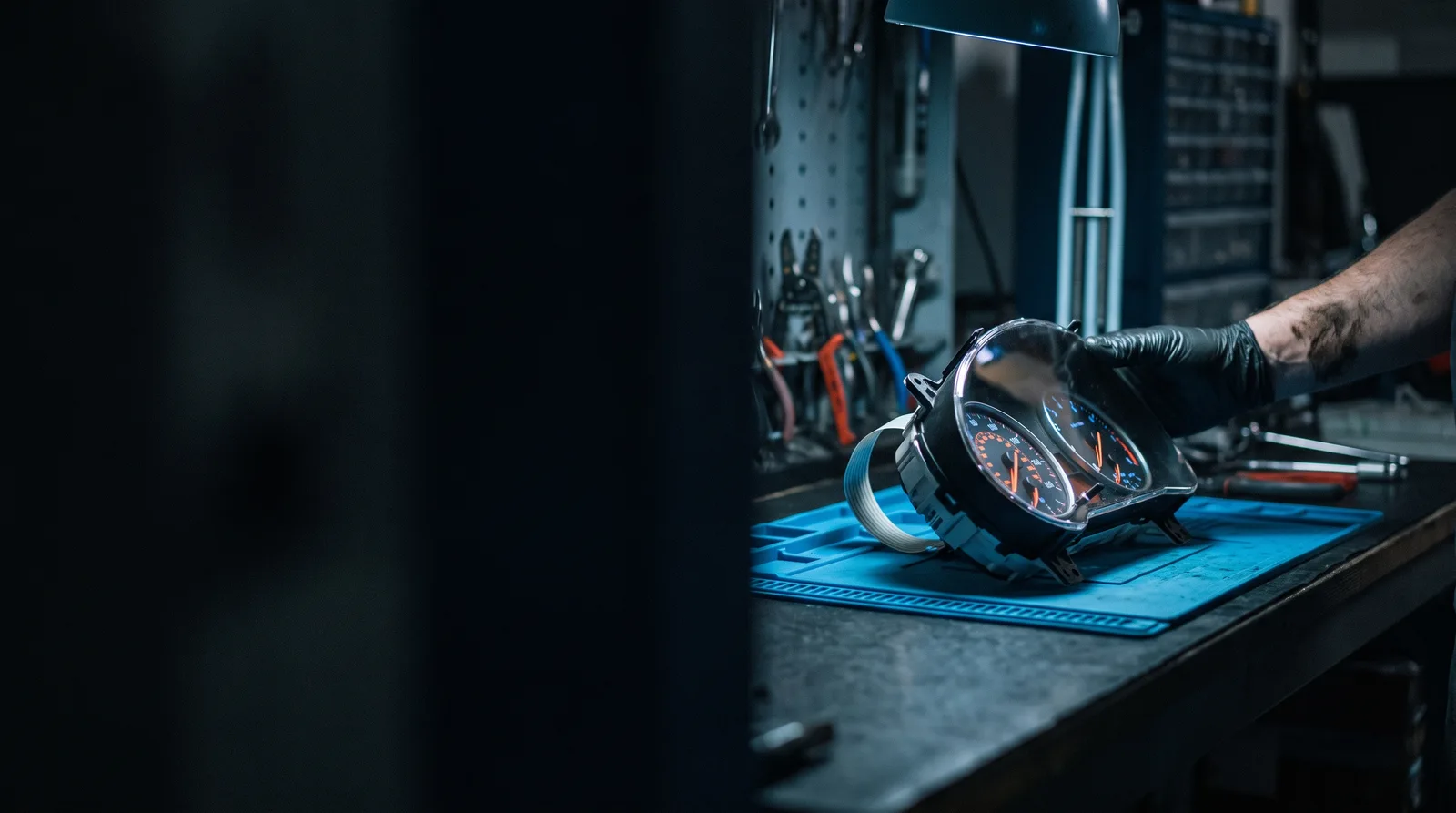
 In short
A blank dashboard, black spots across the LCD or a dead digital speedometer on a 2nd-generation Citroën C4 Picasso or Grand C4 Picasso is almost always a fault inside the instrument cluster itself. We diagnose the unit, confirm the fault on the bench and carry out a circuit-level repair by post — restoring the display while keeping your original mileage and security data, so there is no dealer recoding to pay for.
The digital cluster in these cars is a known weak point. When the screen goes patchy, dim or completely dark, the panel is repairable at board level — you do not need a new dealer cluster, and you do not need to lose the mileage recorded in your own unit. Send us the failing cluster and we return it working.
Symptoms of a failing C4 Picasso instrument cluster
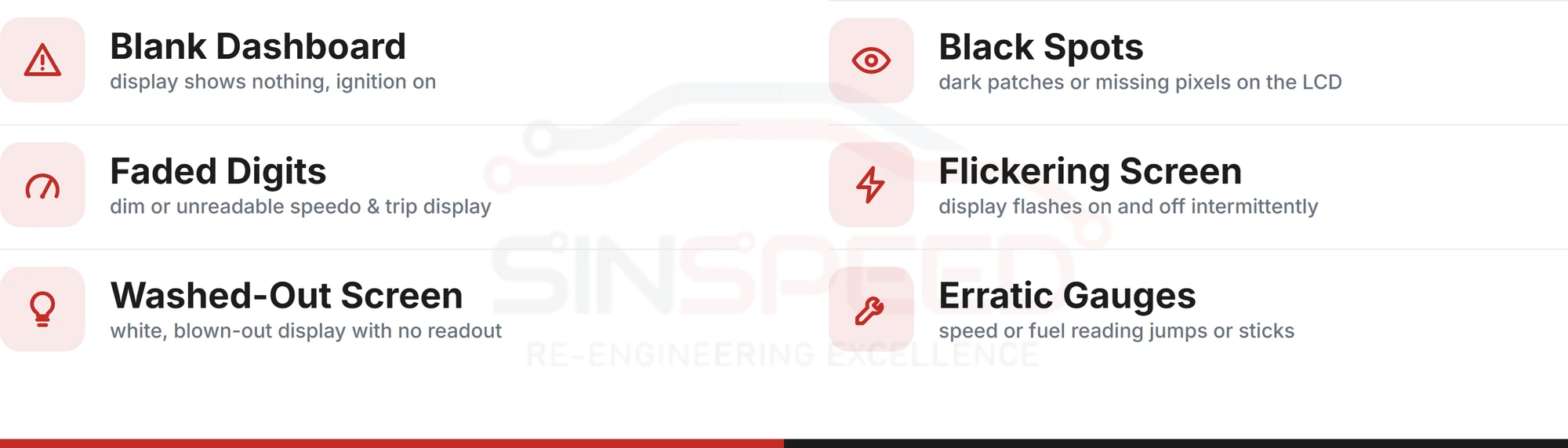
The single most common complaint we see on the 2nd-generation C4 Picasso is the one that brings most owners to us: the dashboard goes completely blank. You turn the key, the car starts and runs, but the digital display shows nothing — no speed, no fuel, no warning lights. That is a fault in the cluster, not in the engine or the wiring, and it is repairable.
Before a cluster fails outright it often warns you first. The faults we repair on these units include the full range below, and many owners see two or three of them together before the display gives up entirely.
- A completely blank or dead dashboard — the display shows nothing when the ignition is on.
- Black spots, dark patches or missing pixels spreading across the LCD.
- Faded, dim or unreadable digits on the speedometer or trip display.
- A flickering display, or a screen that flashes on and off intermittently.
- A white or washed-out screen with no usable readout.
- Erratic, frozen or wildly incorrect gauge readings — speed or fuel jumping or sticking.
- Warning lights or error messages that appear on the LCD and will not clear.
- An intermittent fault that comes and goes with temperature, then eventually becomes permanent.
If your cluster is showing any of these, the panel can be repaired rather than replaced. Send us the unit and we will test it, confirm the fault and put it right — you can start that with the repair form below.
Why the Gen-2 digital cluster fails
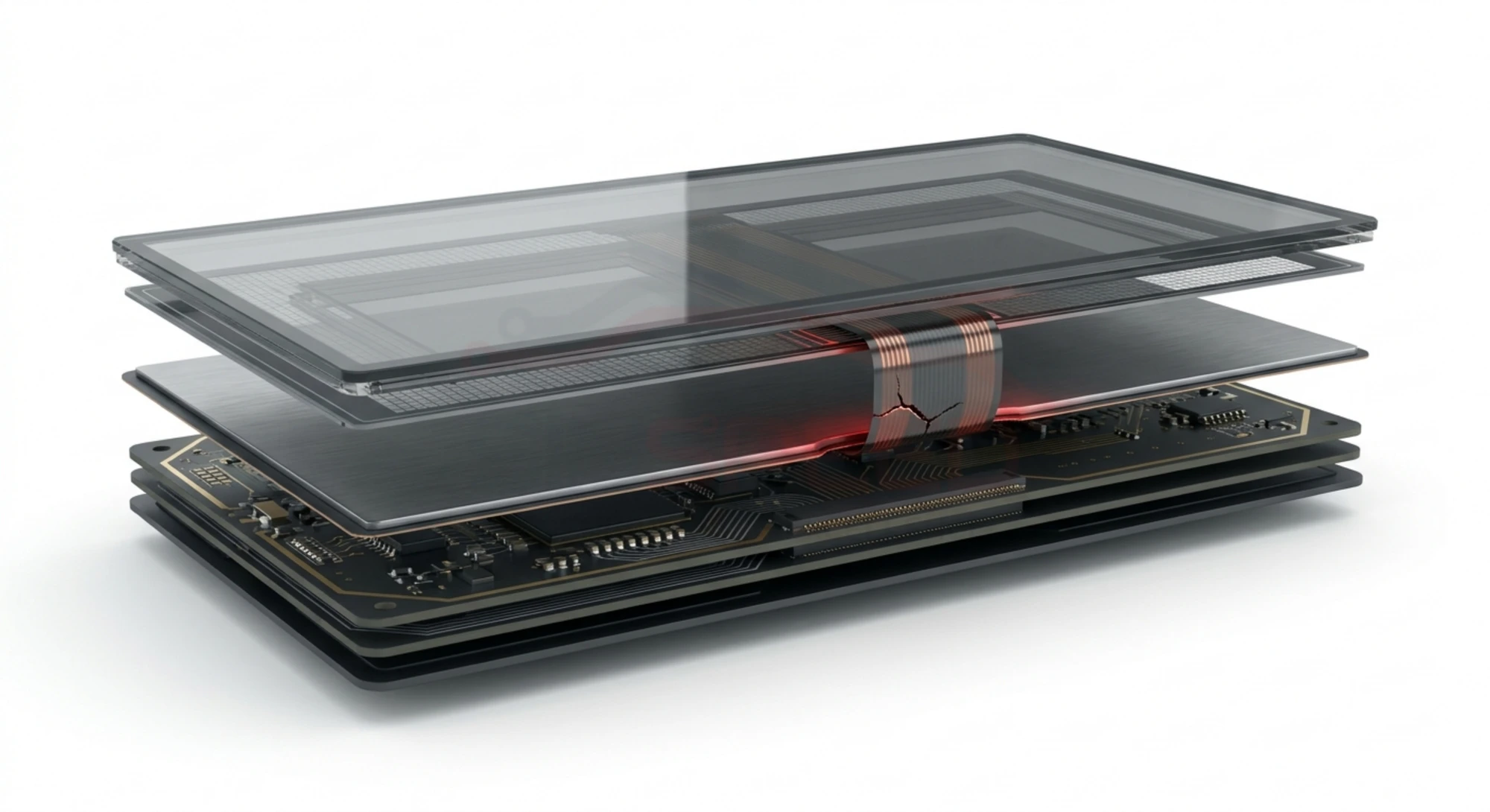
The 2nd-generation C4 Picasso and Grand C4 Picasso use a full-width digital LCD panel in place of the older analogue dials. It is a good display when it works, but the screen module and the fine ribbon connection that drives it are the part of the cluster that wears out. Years of heat cycling on the dashboard, vibration and the natural ageing of the display’s internal layers degrade the connection between the driver board and the LCD.
As that connection deteriorates, sections of the screen stop being driven correctly. That is what you see as black spots, missing pixels, a flickering image or dim digits. When the fault reaches the point where the display can no longer be driven at all, the dashboard goes blank. Because this is a physical, progressive fault in the display and its connection rather than a random electronic glitch, a general reset or software update will not fix it — the hardware itself needs repairing.
This is not a one-off. It is a recognised pattern across the Gen-2 cluster, which is exactly why a repair route exists at all — the failure is understood, so it can be corrected at source rather than papered over.
A real repair: the C4 Picasso with a completely blank dash
A recent job on the bench is a good example of how this fault presents and how we deal with it. A 2014 Citroën C4 Picasso arrived with a completely blank instrument cluster — the car started and drove normally, but the digital dashboard displayed nothing at all. The cluster carried Citroën part number 9808860580, one of the digital speedometer clusters fitted across the 2nd-generation range.
We powered the unit on our test rig, reproduced the blank-display fault exactly as the owner described it, and traced it to the cluster’s display circuit. Once the fault was confirmed on the bench — not assumed — we carried out the repair at board level and tested the panel again through its start-up and running states until the display drove correctly and consistently. The original mileage and coded data stayed on the owner’s own unit throughout; nothing was reprogrammed or reset.
That test-then-confirm-then-repair sequence is how we handle every cluster. We do not fit parts on a guess — we prove the fault first, then correct it, then prove the fix.
Sinspeed · mail-in repair
Send us the cluster rather than buying a used oneA used cluster brings someone else’s mileage and its own years of heat and vibration. Send us yours with the vehicle details and we repair the failed section at circuit level and return it programmed to your car.
Lifetime, unlimited-mileage warranty on all remanufactured parts · Mail-in, UK-wide · Tested on Hardware-in-the-Loop rigs before dispatch
How we diagnose, confirm and repair your cluster
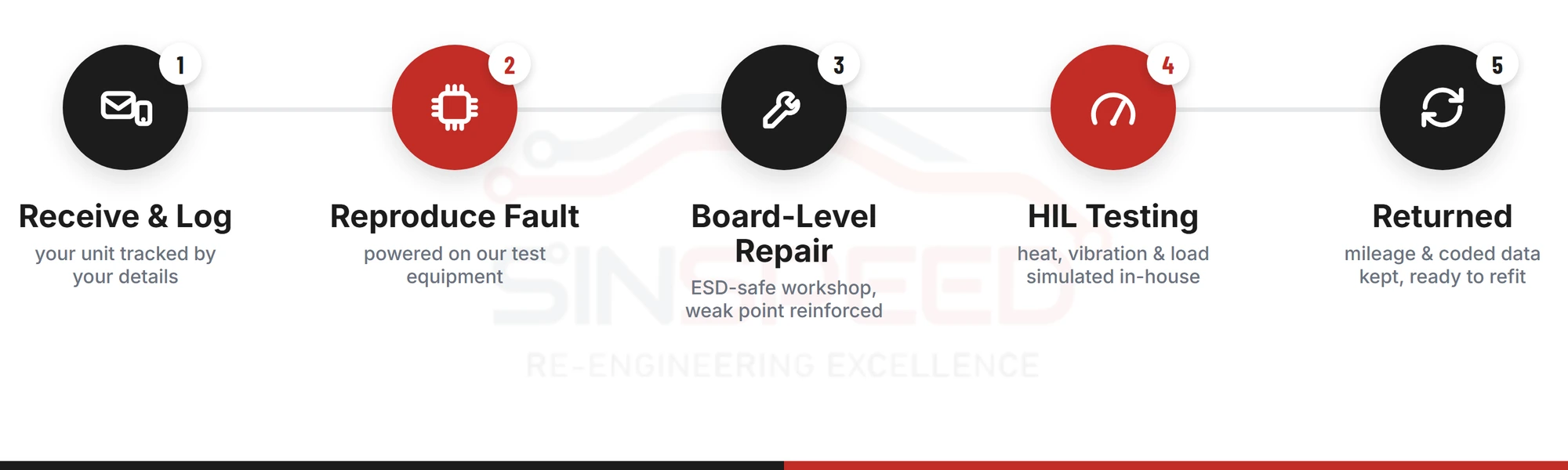
At Sinspeed we are a specialist automotive-electronics remanufacturer — we diagnose, test, repair and remanufacture vehicle electronic units, and instrument clusters are one of our core lines. Every C4 Picasso cluster follows the same disciplined process.
- We receive your cluster and log it against your details, so your own unit — and its stored mileage and security data — is the one that comes back to you.
- We power the unit on our test equipment and reproduce your fault, so the repair is based on the confirmed condition of the panel rather than an assumption.
- We carry out the repair at circuit-board level in an ESD-safe workshop — reinforcing the known weak point in the display circuit rather than simply swapping like for like.
- We test the cluster on bespoke in-house Hardware-in-the-Loop platforms that simulate real-world heat, vibration and load, driving the display through its full range before it leaves us.
- We return the repaired cluster ready to refit, with your mileage and coded data intact and, in most cases, no coding or programming required on your side.
The work is done by an in-house team of electronic engineers, technicians and diagnostic specialists carrying out board-level repair and calibration — not a screen swap done blind. Most of our remanufactured parts carry a lifetime, unlimited-mileage warranty, so the repair is backed once it is back in your car.
Which C4 Picasso clusters we cover
We repair the digital instrument clusters fitted to the 2nd-generation Citroën C4 Picasso and Grand C4 Picasso — the B78-platform cars from 2013 onward, including the 2013, 2016, 2017 and 2018 model years owners most often ask about. If your car has the full-width digital dashboard rather than the earlier analogue dials, it is the cluster we cover.
| Model | Generation / platform | Years | Example part number |
|---|---|---|---|
| Citroën C4 Picasso | 2nd generation (B78) | 2013 onward | 9808860580 |
| Citroën Grand C4 Picasso | 2nd generation (B78) | 2013 onward | Gen-2 cluster part-number family |
Part number 9808860580 is one of the digital speedometer clusters used across this range. The 2nd-generation cars use a family of closely related cluster part numbers, so if your unit carries a different number it is very likely still one we repair — the surest way to confirm is to send us the part number stamped on your cluster and we will check it against the range. If you are not certain which cluster your car has, tell us the model, year and the number on the unit through the repair form and we will confirm coverage before you send anything. You can also view options and order on our Citroën C4 Picasso (2013–2018) instrument cluster product page.
Repair or replace? Why a repair keeps your data
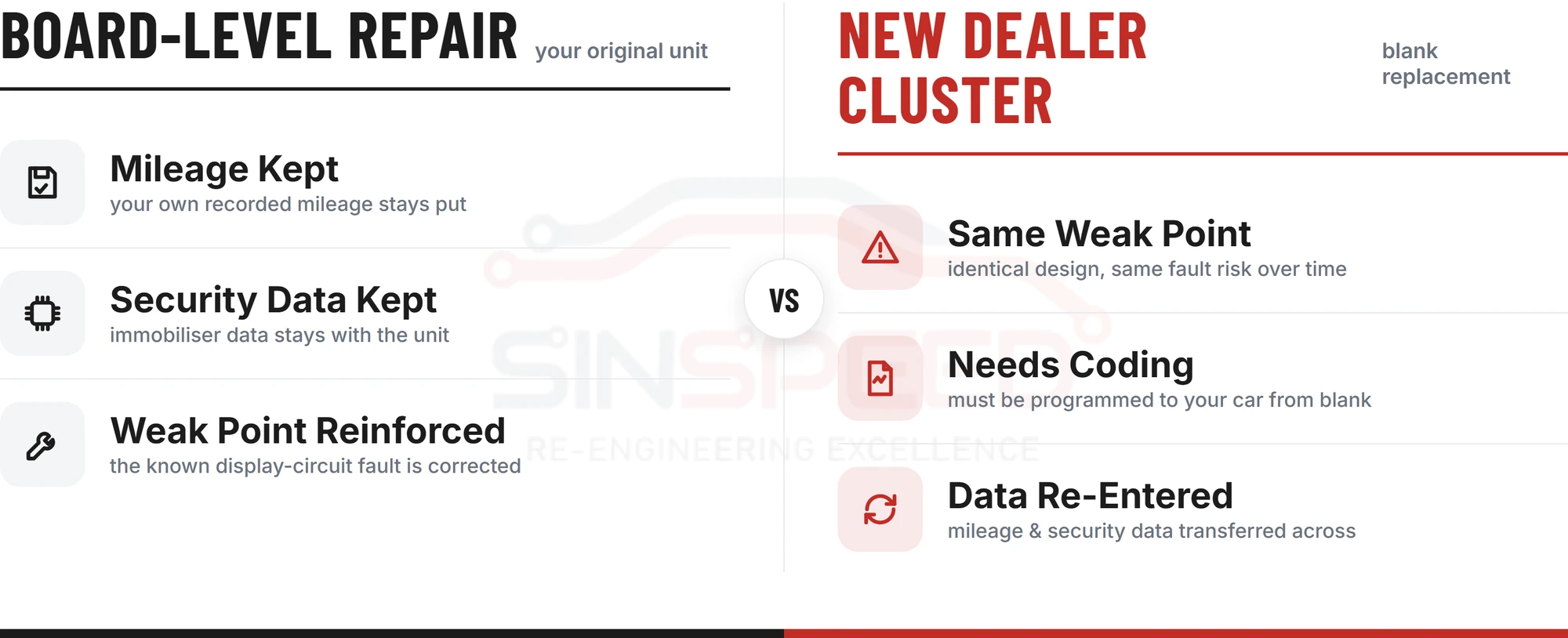
The obvious alternative to a repair is a new cluster from a main dealer. On the 2nd-generation C4 Picasso that route carries two costs most owners do not expect. First, a brand-new dealer cluster is the same design as the one that failed — it carries the same known weak point in the display circuit, so it can fail the same way in time. Our repair reinforces that weak point rather than fitting a like-for-like unit with the same flaw built in.
Second, a new cluster is blank. It has to be coded and programmed to your car, and your recorded mileage and security data have to be transferred across — work that has to be done with dealer-level equipment and is easy to get wrong. A repair sidesteps all of that. Because we work on your own original unit, your mileage stays exactly where it was, your immobiliser and coded data stay with the cluster, and in most cases the repaired unit goes straight back in with no recoding at all.
For the owner, the outcome is simple: the dashboard works again, the mileage on the car is still the mileage the car has genuinely done, and there is no separate coding job to arrange or pay for.
How the mail-in repair service works
This is a mail-in repair-and-return service. You remove the instrument cluster from your C4 Picasso — or have your garage remove it — and send the unit to us. We diagnose it, confirm the fault, carry out the repair and return the same unit to you, tested and ready to refit.
To get started, complete the repair form with your vehicle details, the cluster part number if you have it, and a description of the fault. We will confirm that your unit is one we cover and explain what happens next. If you would rather talk it through first — or you are a garage arranging a repair on a customer’s car — get in touch and we will advise on removal and what to send.
Start your C4 Picasso cluster repair on the repair form, or if you would rather ask a question first, get in touch before you send your unit.
A dead speedo, road safety and your MOT
A blank cluster is not only inconvenient — it is a safety and legal problem. With a dead digital dashboard you have no speedometer, no fuel or temperature reading and no way to see warning lights, so you cannot tell how fast you are going or whether the car is telling you something is wrong. Driving without a working speedometer makes it far harder to stay within speed limits and drive safely.
It also affects your MOT. A speedometer and the dashboard warning lights are checked as part of the test, so a cluster that will not display them can cause problems at MOT time. Getting the cluster repaired restores the readouts the car — and the test — expects to see, which is another reason not to leave a failing display until it goes fully blank.
C4 Picasso instrument cluster repair FAQs
What does a Citroën C4 Picasso instrument cluster repair cost?
The cost depends on the exact fault and the condition of your cluster, which is why we confirm it after testing rather than quoting a flat figure up front. A repair is designed to be a genuine alternative to a new dealer cluster — and it avoids the separate coding and programming a new cluster needs, because we work on your own original unit. Send your details through the repair form and we will confirm what your specific cluster needs.
Is there a DIY repair kit, and should I attempt the repair myself?
There are LCD screen kits sold for these clusters, and some people do attempt the swap themselves. The risk is that the fault is not always just the visible screen — the display circuit and its connection are involved too — so a screen-only swap can leave the fault unresolved, and the cluster is a delicate, static-sensitive assembly that is easy to damage further. We diagnose the actual fault first, then repair at board level and test the result, which is why we recommend sending the unit to us rather than guessing at a kit.
How long does the repair take?
Turnaround depends on the fault and our current workload, and we will give you a realistic timescale once we have received and tested your cluster. Because it is a mail-in service, the total time also includes sending the unit to us and back — ask us through the repair form or contact page and we will tell you where things stand for your job.
Which years and part numbers do you cover?
We cover the 2nd-generation Citroën C4 Picasso and Grand C4 Picasso (B78 platform) with the digital dashboard, from 2013 onward — including the 2013, 2016, 2017 and 2018 model years. Part number 9808860580 is one of the digital clusters in this range, and the Gen-2 cars use a family of related part numbers. If your unit carries a different number, send it to us to check — it is very likely still one we repair.
Will my mileage and security data be kept?
Yes. We repair your own original cluster, so your recorded mileage stays exactly as it is and your immobiliser and coded data stay with the unit. In most cases the repaired cluster goes straight back into your car with no recoding required — one of the main advantages of a repair over a new dealer cluster, which has to be coded and programmed from blank.
Sinspeed · mail-in repair
Not sure which unit has failed?Send us your fault codes and vehicle details and we will tell you which unit is at fault before you remove anything.
Cleanroom-standard, ESD-safe workshop · Circuit-level board repair by in-house engineers · Most units returned ready to fit