
Summary: Replacing one ABS wheel speed sensor at a UK independent garage typically costs about £65–£180 fitted, and £130–£350 once a diagnostic charge, a seized sensor or an awkward corner is added. The sensor is an inexpensive part that gets replaced, not repaired. The costly mistake is fitting one the car did not need: the same wheel-speed code can come from the ring, the bearing, the wiring or the ABS module itself, and when the module is at fault we repair it on our bench by post.
- How much does an ABS sensor replacement cost in the UK?
- What pushes a sensor job towards the top of the range
- Symptoms, likely causes, and when a new sensor will not fix it
- Repair or replace: what each part of the system needs
- When the ABS module goes to our bench
- Can you drive with a faulty ABS sensor, and will it fail the MOT?
- ABS sensor replacement questions
- Final thoughts
How much does an ABS sensor replacement cost in the UK?
For a single sensor on a mainstream car, published UK garage quotes for a straightforward swap sit between roughly £65 and £180, parts and labour together. Where the garage charges to diagnose the fault first, the old sensor is seized in the hub, or the corner needs more taken apart, £130 to £350 is the more realistic range.
The figures below are typical ranges drawn from published UK garage quotes and parts listings checked in September 2026. They show what you are likely to be asked to pay. They are not a quote for your car.
| What you are paying for | Typical UK figure | What sits behind it |
|---|---|---|
| Aftermarket sensor, part only | From about £12 to £40 on common cars | Many sensors look alike but are specific to the model and to the front or rear axle, so the part number decides the fit. |
| Genuine manufacturer sensor, part only | Can be over £150 | On some models the franchised part costs several times the aftermarket equivalent. |
| One sensor fitted, straightforward access | About £65–£180 | An independent garage’s parts and labour for one corner, with the old sensor coming out cleanly. |
| One sensor fitted, with diagnosis or a difficult removal | About £130–£350 | Adds a diagnostic charge, extra time on a seized sensor, or a corner that needs more dismantling. |
| Garage labour rate | Around £70 an hour outside the big cities, around £90 in London | A clean sensor swap is usually an hour to an hour and a half of that. |
The model moves the part price more than the labour. On the cars below, the part and the fitted total typically fall in these bands, with diagnosis included in the total.
| Vehicle | Typical sensor price (part only) | Typical total with labour and diagnosis |
|---|---|---|
| Ford Fiesta | £20–£40 | £130–£180 |
| VW Golf | £50–£60 | £130–£210 |
| BMW 3 Series | £60–£80 | £180–£250 |
| Land Rover Range Rover | £70–£90 | £190–£350 |
What pushes a sensor job towards the top of the range
Two quotes for the same corner of the same car can differ by more than a hundred pounds. The gap usually comes from one of these.
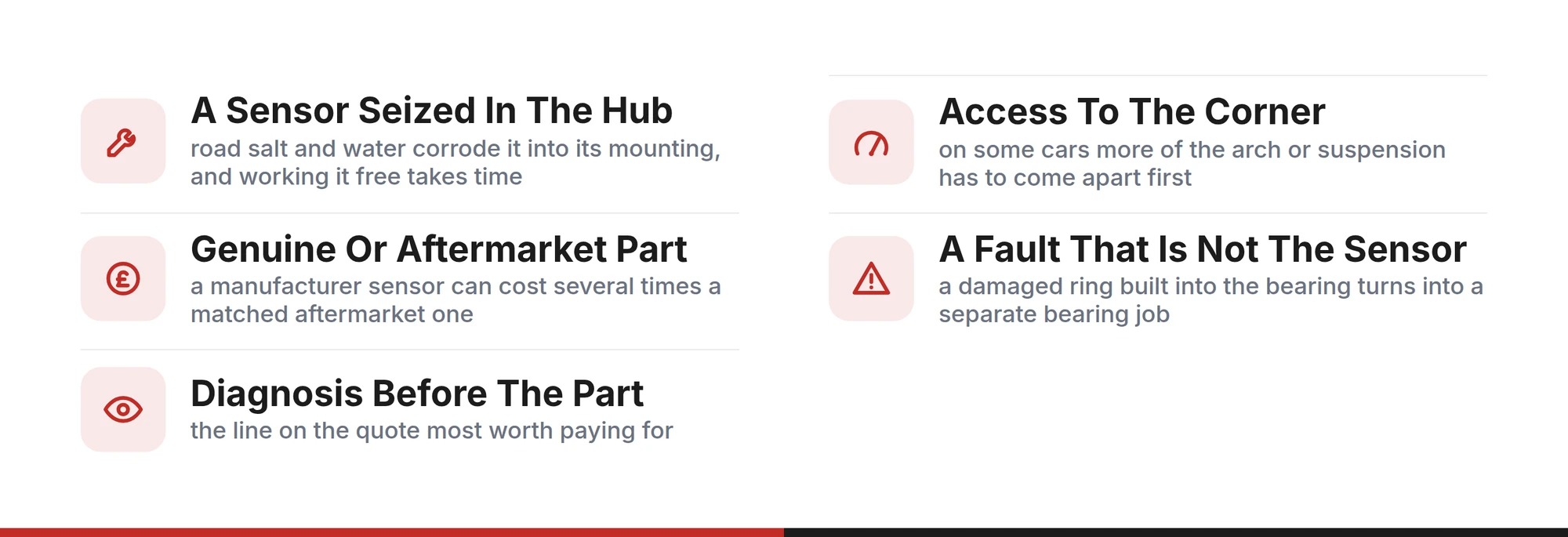
- A sensor seized in the hub. Road salt and water corrode the sensor into its mounting, and getting it out without damaging the hub takes time. A sensor that slides out and one that has to be worked free for an hour are billed very differently.
- Access to the corner. On some cars the sensor and its lead are easy to reach once the wheel is off. On others more of the arch, the suspension or the cable route has to come apart first.
- Genuine or aftermarket. Some garages fit only manufacturer parts, which lifts the part price. Others fit a quality aftermarket sensor matched by part number. Ask which one the quote includes.
- A fault that is not in the sensor at all. On many modern cars the ring the sensor reads is built into the wheel bearing, so a damaged ring turns into a bearing replacement, priced as a separate job. Our guide to ABS reluctor rings explains how ring damage shows itself.
- Diagnosis before the part. A garage that proves the corner and the cause before ordering anything will charge for that time. It is the line on the quote most worth paying for.
Symptoms, likely causes, and when a new sensor will not fix it
A new sensor cures a failed sensor and nothing else. Read across each row: what you are noticing, what it usually points to, and the situations in which fitting a sensor leaves the fault exactly where it was.
| What you notice | What it usually points to | A new sensor fixes it if… | Replacing the sensor will NOT fix it when… |
|---|---|---|---|
| ABS light on, usually with the traction control or ESP light | A lost wheel-speed signal from one corner | The code names one corner and the sensor itself has failed | The ring, bearing, cable or connector at that corner is the damaged part, or the ABS module is rejecting a good signal |
| A light that comes and goes with speed, rain or bumps | A physical problem at the wheel: the gap to the ring, the ring, the connector or the cable | The sensor body is cracked or its own lead is broken | Bearing play is moving the ring away from the sensor, or the ring itself has cracked or corroded |
| Fault code: wheel speed sensor implausible signal | One wheel’s reading disagrees with the other three | The original sensor is confirmed faulty | A new sensor is already fitted and the same code returns. The module’s handling of that signal is next in line |
| ABS pulsing through gentle stops on a dry road | The module believes a wheel is locking when it is not | Debris on the tip or a failing sensor is making one wheel look slower than it is | The ring is damaged, or the module has begun to judge a sound signal as faulty |
| An erratic speedometer or harsh automatic gear changes, with the ABS light | The wheel-speed data shared with the cluster and gearbox has become unreliable | One sensor has failed and the others are healthy | The module has stopped passing the data on, or more than one reading is affected |
| Sensor codes stored for more than one corner | A fault common to those corners | Rarely. It is unusual for two sensors to fail together | Almost always. The wiring those corners share, or the ABS module, is the likelier cause |
| Other modules report lost communication with the ABS unit | The ABS module has dropped off the car’s network | Never | Always. The module’s supply, its wiring or the unit itself is at fault. Our guide to ABS modules that stop communicating covers this |
| Red brake warning light with the ABS light, or a soft pedal | A fault in the hydraulic braking system | Not applicable | Always. Stop driving, and have the brakes inspected before the car is used again |
The implausible-signal code needs a closer look. We see it regularly on cars that arrive with a new sensor already fitted and the light still on. It means the module has compared that wheel’s signal with the other three and decided the signal cannot be right. A failed sensor produces that verdict. So do a damaged ring, a loose connector, and a module whose own circuit for that wheel has begun to fail.
Your garage settles which one it is with a scan tool before it orders any part. Our guide to how a wheel speed sensor fault is diagnosed sets out the sequence they follow.
Sinspeed · same code after a new sensor
New sensor fitted and the implausible-signal code is back?Tell us the vehicle, the code, the corner it names and what has been replaced so far. Our engineers will say whether the pattern fits the ABS module before your garage removes anything.
Electronic and hydraulic engineers in-house · Faults proved under simulated heat, vibration and load
Repair or replace: what each part of the system needs
Each part behind a wheel-speed fault has its own right answer. Only one of those answers is a repair on our bench.
| Part | Repair or replace | Who does it |
|---|---|---|
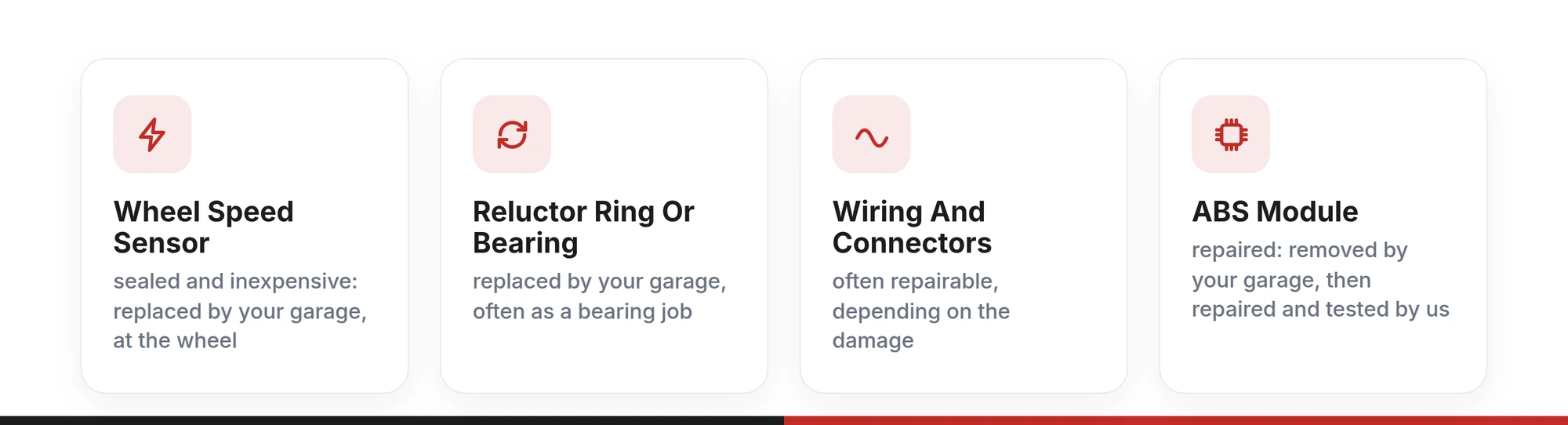
| Wheel speed sensor | Replace. It is a sealed, inexpensive part and not worth repairing | Your garage, at the wheel |
| Reluctor ring or wheel bearing | Replace | Your garage, often as a bearing job |
| Wiring and connectors between the wheel and the module | Often repairable, depending on the damage | Your garage or an auto electrician |
| ABS module (the control unit on the hydraulic block) | Repair | Removed by your garage, then repaired and tested by us |
The sensor is the simple case. It has no serviceable parts, so when one has genuinely failed, the right course is a new one of the correct type for that corner.
The module is the case that gets missed. It sits on the hydraulic unit in the engine bay, supplies power to active sensors and decides for itself whether each wheel’s signal is plausible. When the circuit that feeds or reads one wheel starts to fail, usually from engine-bay heat and damp, it logs a fault that a scan tool cannot tell apart from a dead sensor at that corner. A failing brake-pressure sensor inside the unit can light the ABS lamp as well. Either way, the code points at the wheel while the cause sits under the bonnet.
That module is what we repair. A new module from the manufacturer arrives without your vehicle’s coding, and repairing the unit already fitted keeps it. The makes and units we cover are listed under ABS unit repairs by make, and our guide to how an ABS module repair is priced explains what shapes the price of that work.
When the ABS module goes to our bench
Once the evidence points at the module, your garage removes the ABS unit and sends it to our workshop by tracked courier, and the car stays with them. Our electronic and hydraulic engineers diagnose it with dealer-level equipment and repair it in a cleanroom-standard, ESD-safe workshop.
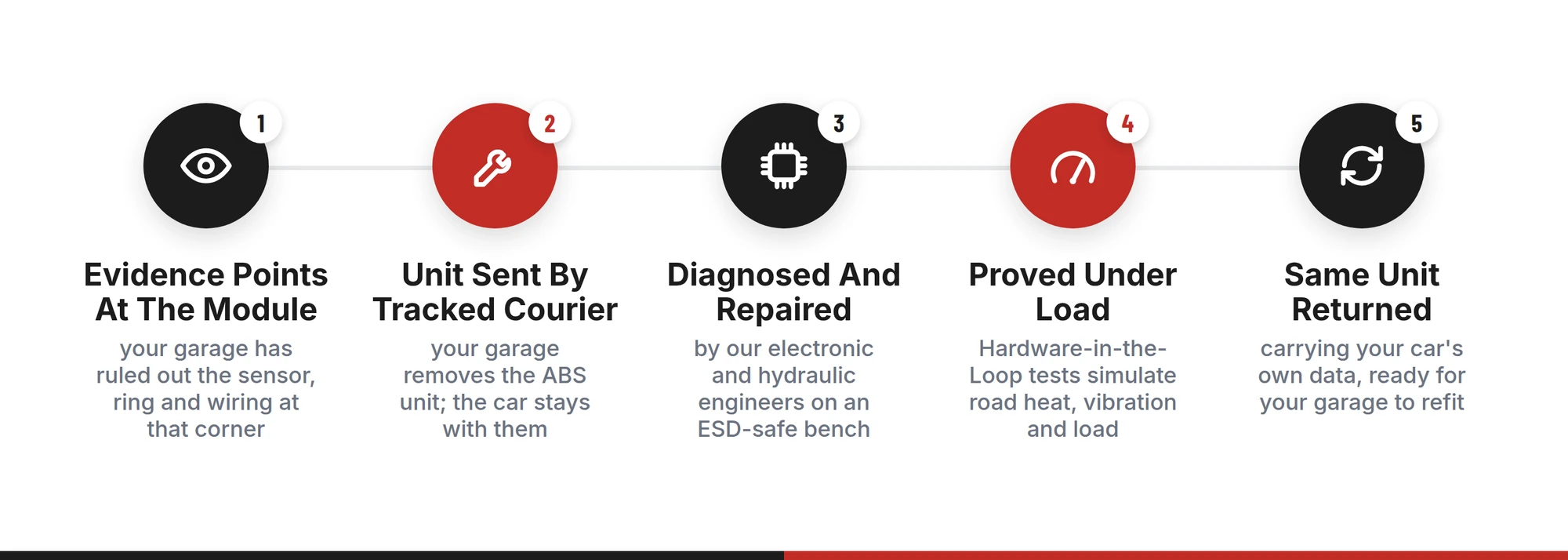
Before it leaves, the unit runs on our Hardware-in-the-Loop platforms, which simulate the heat, vibration and load it meets on the road. A fault that only shows when the module is warm and working is caught on the bench, not after refitting.
The same unit goes back, carrying your car’s own data, and many units refit with no coding. Refitting ends with a brake bleed and any calibration that model needs. Both are routine steps your garage completes when it fits the unit. Most remanufactured parts carry a lifetime, unlimited-mileage warranty.
Can you drive with a faulty ABS sensor, and will it fail the MOT?
A failed ABS sensor does not stop the car braking. Press the pedal and the brakes respond much as they would on a car built without ABS. What is missing is the anti-lock function, and on most cars traction control and stability control switch off with it.
That loss matters in the moments you cannot plan for. In an emergency stop, or on wet, icy or loose surfaces, a wheel can lock, and the car can slide or take longer to stop. Drive with that in mind, and book the diagnosis rather than leaving it.
Some combinations mean the car should not be driven at all. If the red brake warning light comes on with the ABS lamp, or the pedal turns soft or travels further than it should, the problem is in the hydraulic braking system rather than a sensor, and the car needs inspecting where it stands.
An ABS lamp that stays on after the start-up check fails the MOT as a major defect. Our guide to the ABS light and the MOT covers what the tester checks and why. Wiping the code the day before the test does not get round it: the system tests itself on every start and relights the lamp while the fault is still there.
ABS sensor replacement questions
How much does it cost to replace an ABS sensor in the UK?
For one sensor fitted at an independent garage, expect roughly £65 to £180 where the job is straightforward. Expect £130 to £350 once diagnosis, a seized sensor or difficult access is involved. The part alone runs from about £12 for an aftermarket sensor on a common car to over £150 for some genuine manufacturer parts. These are typical published figures, not a quote.
Why did replacing the ABS sensor not fix my ABS light?
Often, because the sensor was never the problem. The code only tells the garage which wheel’s signal failed its check. Behind that signal sit the ring the sensor reads, the bearing that holds the ring in place, the cable back to the module and the module itself. A fault in any of them looks the same on the scan tool. Once a correct new sensor is fitted and the code comes straight back, have the ABS module examined before anything else is bought.
How long does an ABS sensor replacement take?
Where the old sensor comes out cleanly, the job is usually an hour to an hour and a half of labour, and most garages finish it the same day. A sensor corroded into the hub can take considerably longer. Time spent diagnosing the fault first is charged on top.
Can an ABS sensor be repaired rather than replaced?
Not in any practical sense. A wheel speed sensor is a sealed part, so a failed one is replaced with the correct sensor for that corner. The wiring leading to it can often be repaired. The ABS module the sensors report to can be repaired too: we repair ABS modules by post and return the same unit.
Can the ABS module be repaired instead of replaced?
In most cases, yes. We repair the module on our bench, test it on Hardware-in-the-Loop platforms under simulated heat, vibration and load, and return the same unit with your vehicle’s coding still on it, so many units refit without programming. Severe physical or water damage can put a unit beyond repair, and we tell you before any work is agreed.
Sinspeed · ABS module bench repairs
Sensor ruled out? Have the ABS module checkedIf the sensor, ring and wiring at the named corner are sound and the light will not stay off, the module is the part left to look at. Your garage takes it off and couriers it over, and we return the same module repaired and proved under load.
ESD-safe, cleanroom-standard bench · Most remanufactured parts warrantied for life, unlimited mileage
Final thoughts
An ABS sensor is one of the cheaper parts on the braking system, which is exactly why it so often gets fitted on suspicion. When the code is right about the sensor, a garage replaces it in an afternoon and the job is done.
The expensive version is the second visit: a new sensor on, the lamp back on the first drive, and the question still open. Before paying for a sensor, ask what the code said, which corner it named and what was checked at that wheel. If a new one has already been fitted and failed to clear the lamp, the answer is no longer at the wheel, and the next part to look at is the module.