Sinspeed supplies the economy remap as a custom ECU remap built around your car’s specific engine and coded to it, set up to stretch each tank rather than chase headline power. The map lifts pulling power low in the rev range, so the engine needs less pedal to move off, climb and hold motorway speed. It suits drivers who cover real distance: high-mileage diesel commuters, anyone towing a caravan or horsebox, and vans that spend their working day loaded. The tune is road-legal and fitted through our mobile and mail-in service. Tell us the vehicle and how you drive it, and we will say plainly whether an economy map suits your car before you book.
What is an economy remap?
An economy remap is a rewrite of the software held on your car’s Engine Control Unit — the ECU — with fuel efficiency as the priority rather than outright power. Every modern petrol and diesel car leaves the factory with a single, conservative map that has to suit every market, every fuel grade and every owner, from the gentle motorway cruiser to the driver who never services the car. That built-in caution leaves genuine room to tailor the fuelling and timing to one specific engine.
An economy tune adjusts the fuel delivery, the ignition or injection timing, and the torque available lower in the rev range. The aim is to let the engine produce useful pulling power sooner, so it can hold a gear longer and turn fewer revolutions to do the same work. Small changes to how and when fuel is burned add up over a journey, because the engine spends less time working hard to get you moving.
Because the map is developed for your exact vehicle rather than lifted from an off-the-shelf template, the changes are matched to your engine and not to a whole model range. That distinction matters: a file written for an engine family is a compromise, whereas a map tailored to your specific car and engine reflects the vehicle in front of us.
How does an economy remap improve fuel economy?
Yes — a car can be tuned for better fuel economy, and the mechanism is honest and simple. Most real-world fuel is used accelerating and pulling away, not cruising at a steady speed. Every time you ask the engine to build speed, it has to move air and fuel to make torque, and the harder it has to work to make that torque, the more fuel it consumes doing it. An economy remap attacks that part of the equation directly.
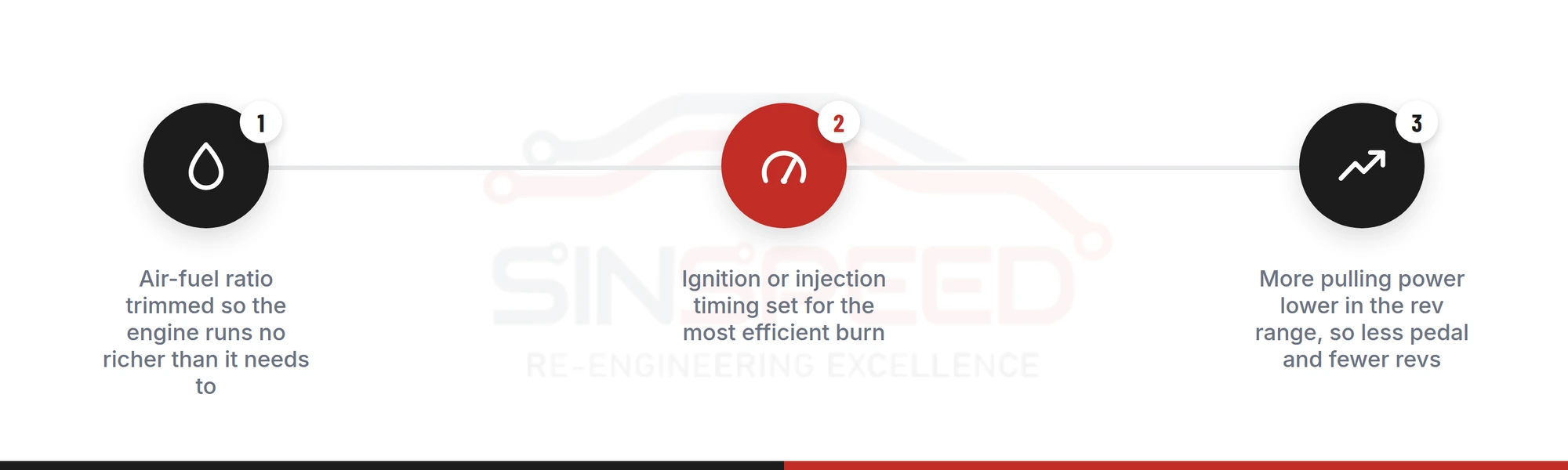
The change happens in three linked areas. First, fuelling: the map trims the air-fuel ratio so the engine is neither running richer than it needs to nor leaving usable efficiency on the table. Second, timing — the ignition point on a petrol engine, or the injection timing and duration on a diesel — is optimised so combustion happens at the most efficient moment for that engine rather than at a cautious factory default. Third, and most important for economy, the torque curve is reshaped so more pulling power arrives lower down the rev range. When strong torque is available at 1,500 to 2,000 rpm instead of only higher up, you no longer have to rev the engine hard or drop a gear to keep pace. You press the pedal less to climb a hill, join a motorway or move off from a junction — and less pedal, at lower revs, means less fuel for the same result.
Diesel engines respond particularly well, and it is worth understanding why. A diesel makes its power through the amount and timing of fuel injected rather than by throttling airflow, so it has a naturally broad, torque-rich character that an economy map can sharpen without stressing the engine. Modern common-rail diesels also inject fuel at very high pressure in precisely controlled bursts, which gives a well-developed map fine control over efficiency low in the rev range — exactly where a daily driver or a loaded tow car actually spends its time. That is why the strongest, most consistent economy gains tend to come from diesels.
Petrol engines can gain too, but the picture is more nuanced. A naturally aspirated petrol has less spare efficiency to unlock, so improvements are usually modest. Small turbocharged petrol units — the downsized 1.0 to 1.4-litre engines common on modern cars — sit somewhere in between: there is useful low-down torque to be found, which can genuinely help around town and on the motorway, but the gains rarely match a diesel’s. We will always tell you honestly where your specific engine sits on that scale before you commit.
The size of the gain depends on the engine, its condition and its service history, and above all on how you drive. We are honest about this: there is no fixed figure we can promise every car, and any tuner quoting a guaranteed number for every vehicle is guessing. A clogged air filter, tired injectors or a car that is overdue a service will all blunt the result. What we can say is that a properly matched economy map — developed for your specific engine and coded to your car — gives the engine the best possible chance of returning better MPG on the journeys you already make.
Sinspeed · ECU remapping
Talk to an engineer about what your engine will actually gainEvery map we write is built for the specific engine, its condition and how the vehicle is used — not pulled off a shelf. Tell us the vehicle and what you want from it and we will tell you what is realistic.
Mapped for your specific engine and its condition · Dealer-level diagnostic and programming tools · Mapped for your specific engine
Does a remapped car ever use more fuel?
It can — and understanding why is the key to getting real savings. The most common reason a remapped car returns worse economy is simple: the driver enjoys the extra response and drives harder. A performance-oriented map, or an economy map used with a heavier right foot, will burn more fuel, not less. The torque is there to be used; use it enthusiastically and any efficiency benefit disappears.
This is the single honest caveat every driver should hear before booking. An economy remap does not lower your fuel use on its own. It gives the engine the ability to do more with less, but that potential is only realised if you keep driving smoothly and let the extra low-down torque do the work at lower revs. Treat it as a performance upgrade and you will spend more at the pumps, not less.
Economy remap vs Stage 1: what is the difference?
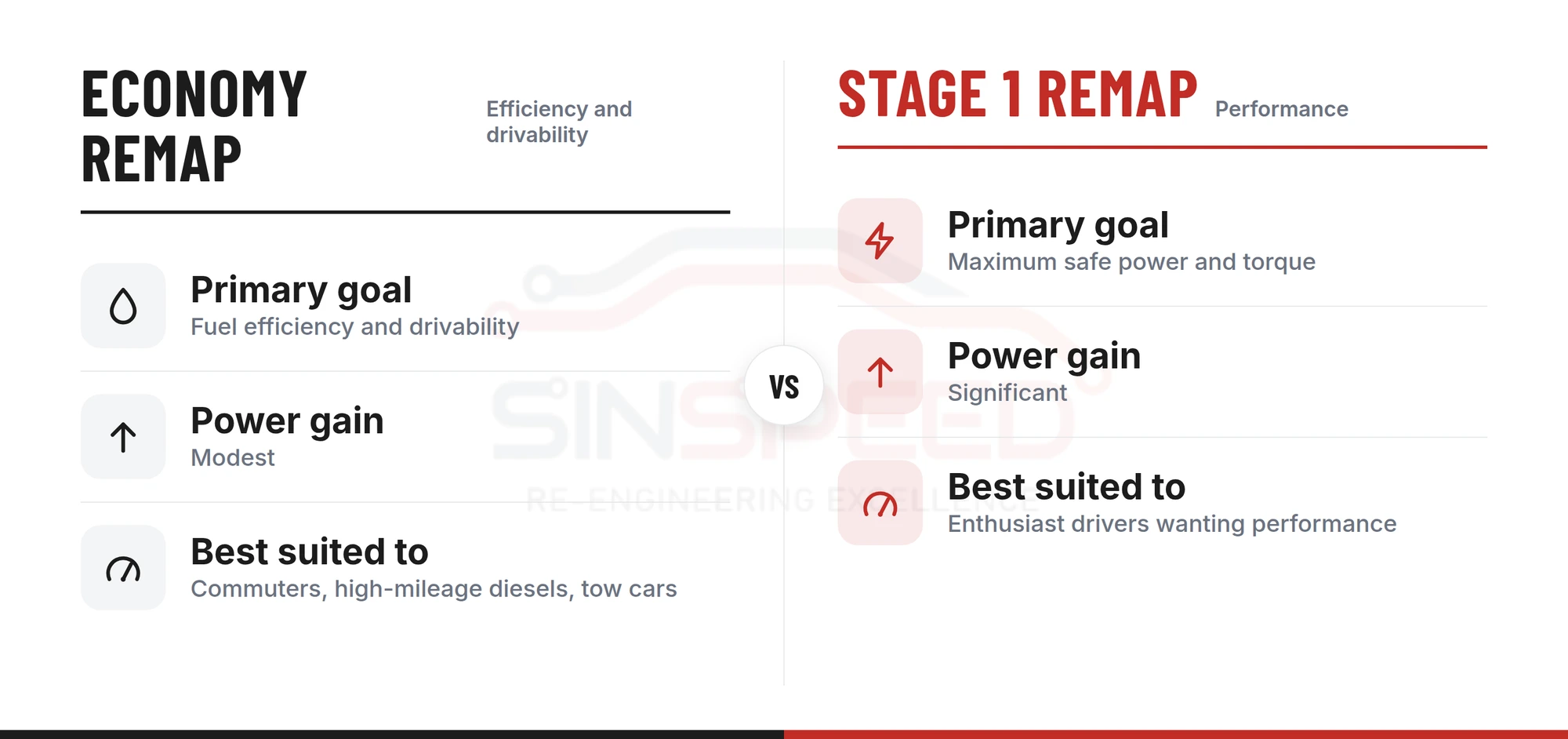
The two tunes start from the same process but chase different goals. A Stage 1 remap is a performance map: it extracts the most power and torque a standard engine can safely handle on its factory hardware, and fuel economy is a possible side effect rather than the aim. An economy remap keeps power gains modest and deliberately targets efficiency and drivability — usable torque low down, smoother delivery and sharper part-throttle response.
There is overlap. A mild economy map often adds a little power, and a sensibly driven Stage 1 car can sometimes return similar or better MPG than standard, because it too needs less throttle to cruise. The real difference is priority and calibration, as the table below shows.
| Aspect | Economy remap | Stage 1 (performance) remap |
|---|---|---|
| Primary goal | Fuel efficiency and drivability | Maximum safe power and torque |
| Power gain | Modest | Significant |
| Low-down torque | Raised, for relaxed cruising | Raised, for stronger acceleration |
| Throttle response | Sharper at part-throttle | Sharper throughout the range |
| Best suited to | Commuters, high-mileage diesels, tow cars | Enthusiast drivers wanting performance |
| Effect on MPG | Improved if driven smoothly | Can improve or worsen, depending on driving |
| Hardware needed | None — standard engine | None — standard engine |
In short, both are custom maps matched to the same vehicle; the economy version simply targets how much less fuel you can use rather than how much more power you can make.
Is an economy remap worth it, and who benefits most?
Whether an economy remap is worth it comes down to one thing more than any other: how you drive, and how far. The map changes what the engine is capable of, but you decide whether that capability is spent on saving fuel or on going faster. A driver who settles into the new low-down torque, changes up earlier and keeps revs low will see the benefit the map was built to deliver. A driver who treats the sharper response as an invitation to press on will not — and no honest tuner can change that. This is why we talk through your driving before recommending anything, rather than promising a number.
Distance matters just as much as style. An economy tune earns its keep through repetition: a small percentage improvement in MPG is barely noticeable on the odd short trip, but it compounds meaningfully across a high-mileage year of commuting. The more miles you cover at steady speeds, the more the map has to work with.
The vehicles that gain the most tend to be:
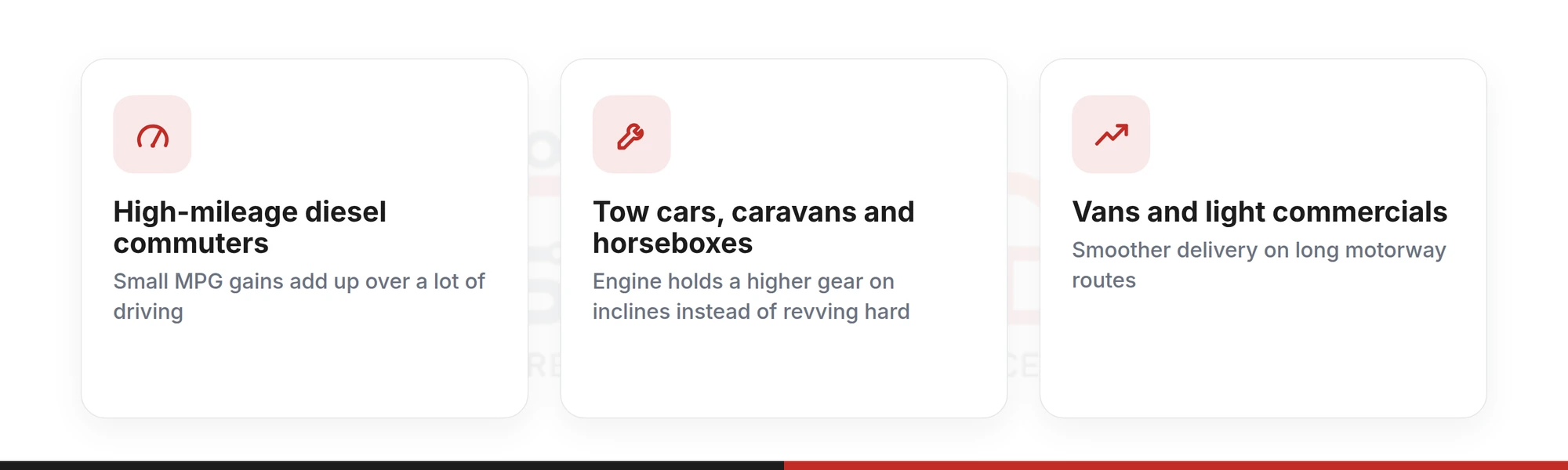
- High-mileage diesel commuters, where even a small percentage improvement in MPG adds up over a lot of driving, and where the engine spends most of its life in the low-rev band an economy map targets.
- Tow cars, caravans and horseboxes, where extra low-down torque means the engine labours less under load. Towing is where a good economy map really shows: the engine holds a higher gear on inclines instead of dropping down and revving hard, so it pulls the weight more calmly and burns less fuel doing it — and the drive is simply more relaxed.
- Vans and light commercials working long motorway routes, where smoother, more efficient delivery reduces driver fatigue as well as fuel use, and where the vehicle is often loaded and asking the engine to work.
Motorway and dual-carriageway drivers benefit for a similar reason: steady, sustained cruising is exactly the condition where reshaped torque and optimised fuelling let the engine hold speed with less effort. By contrast, for a car that only does short, low-mileage town trips from cold, or one driven hard for the fun of it, the case is weaker — the potential is there, but it is easily undone, and a cold engine on a two-mile school run never reaches the conditions where the map helps most.
We would rather tell you that honestly than sell a map that will not pay you back in the way you expect. If you are unsure whether your vehicle and driving style suit an economy tune, get in touch with the details and we will give you a straight answer before you commit to anything.
Is an economy remap legal, and what about insurance?
An economy remap is entirely road-legal in the UK. Remapping a standard engine for efficiency and drivability is a recognised, legitimate modification — you are optimising how the engine runs, not defeating any emissions or safety system. This page is about a clean, road-legal economy tune; it is not about emissions-equipment changes, which are a separate matter entirely.
There is one piece of good practice worth following: let your insurer know you have had the car remapped. Most modifications should be declared, and a quick call keeps your cover valid and avoids any dispute later. Beyond that, an economy remap leaves your car fully usable on the road exactly as it was before — just tuned to make better use of the fuel it burns.
Why choose Sinspeed for your economy remap
What separates a remap that delivers from one that disappoints is how well it is matched to your car and how it is fitted and supported. We do not flash a generic, off-the-shelf file downloaded for your engine family. Every economy remap we supply is a custom map matched to your exact make, model and engine, and coded to the car so it suits the vehicle in front of us rather than a whole model range.
Our role is to get the right map onto your car safely and to stand behind it. We guide you to the economy map that suits how and where you actually drive, handle the fitting properly through our mail-in and mobile service, and keep a copy of your original factory ECU file so the car can always be returned to standard if you ever want it — the change is reversible. Nothing is rushed, and the vehicle is checked before it goes back to you.
If a query comes up afterwards, you are dealing with the people who looked after your car, not an anonymous call centre, and our aftercare and support stay with you once the work is done. To get started, complete our repair and enquiry form with your make, model and engine, and we will confirm what is realistically achievable for your specific car.
Economy remap FAQs
Does an economy remap actually give better MPG?
It can, and it does for many drivers — but only if you let it. The remap raises low-down torque so the engine needs less throttle for the same journey, which lowers fuel use. Drive smoothly and you should see the benefit; drive harder to enjoy the extra response and any saving is cancelled out.
Does eco mode give you more MPG, and is it the same as an economy remap?
They are not the same. Eco mode is a factory driving setting that softens the throttle and shift points within the standard map. An economy remap rewrites the underlying ECU software itself, retuning fuelling, timing and torque delivery — a deeper, permanent change rather than a temporary setting.
What is the difference between a Stage 1 and an economy remap?
A Stage 1 remap targets the most power and torque the standard engine can safely make. An economy remap keeps power gains modest and prioritises efficiency and drivability — usable torque low down and smoother delivery, so you use less throttle day to day.
Does a remapped car use more fuel?
Only if it is mapped for performance or driven harder afterwards. A performance map, or an economy map used with an enthusiastic right foot, will use more fuel. An economy map driven smoothly is designed to do the opposite.
Is an economy remap legal in the UK?
Yes. Remapping a standard engine for economy and drivability is a legitimate, road-legal modification. You should, however, declare it to your insurer as you would any modification to the vehicle.
Which vehicles benefit most from an economy remap?
High-mileage diesels, tow cars and hard-working vans tend to gain the most, because they spend time under load where extra low-down torque reduces the effort — and the fuel — needed to do the work.
Sinspeed · ECU remapping
Find out what your engine will actually gainTell us the vehicle, its mileage and how you use it. We will tell you what a custom map can realistically deliver for that engine, and where the honest limits are.
Mapped for your specific engine and its condition · Dealer-level diagnostic and programming tools · Mapped for your specific engine