
 In short
On an Audi, P1649 is a communication fault — the engine side has lost the data-bus message it expects from the ABS controller, usually a failing ABS module or a wiring/earth fault. We diagnose the unit and remanufacture your original ABS pump and module, returning it ready to fit with a lifetime warranty.
What is the Audi P1649 ABS fault?
P1649 is a communication fault between your Audi’s engine management and its ABS controller. The VAG fault-code reference defines it as a powertrain data-bus fault — a missing message from the ABS controller — which means the engine side is no longer receiving the data it expects from the unit that runs your anti-lock brakes. It is not a fault with how hard you are braking; it is the two control units losing their conversation over the car’s data network.
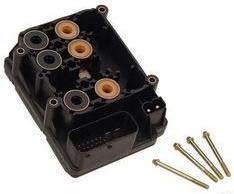
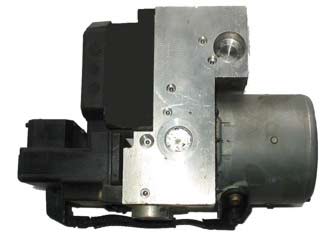
The ABS controller is the same part you may see called the ABS pump, the ABS module, the ABS ECU or, in VAG terms, the Brake Electronics (often labelled J104). On the Audi TT this is most commonly a Bosch ABS pump and controller, with the pump and the control module built together as one assembly. When that unit stops reporting to the rest of the car — or stops working altogether — P1649 is logged and the warning lights come on.
Because P1649 sits on the boundary between the engine ECU and the brake system, it points you at one of three things: the ABS module itself, the power and earth feeding it, or the data-bus wiring that carries its messages. It is the same code across much of the Audi and wider VAG range, which is why an Audi TT, an A4 and an S4 can all log it for the same underlying reason — the ABS controller has gone quiet.
Symptoms of P1649 on an Audi
P1649 usually announces itself on the dashboard before anything else, and because it sits in the braking system those warnings are worth acting on straight away rather than waiting to see if they clear. The signs we see most often are:
- ABS warning light on — steady, or coming and going as an intermittent fault settles in.
- ESP / traction-control warning light on, frequently alongside the ABS light rather than on its own.
- No communication with the ABS controller — a diagnostic tool cannot read the unit at all.
- Juddering or a pulsing feel through the brake pedal under braking.
- The fault returning after a clear, or appearing intermittently after the battery has been disconnected or replaced.
An intermittent P1649 — one that comes and goes — is still worth investigating rather than ignoring, because it tends to harden into a permanent fault over time. Once the code is stored, the safe assumption is that a braking safety system has dropped offline, so the car should be diagnosed promptly.
What causes P1649?
P1649 is a missing-message fault, so the cause is always something that has interrupted the ABS controller’s ability to report in. In practice that comes down to three culprits, and a proper diagnosis is about telling them apart rather than guessing.
The most common is the ABS module itself going bad. Audi and VW ABS pumps and control modules are well known for failing, and on these units the electronics inside the controller break down with age, heat and vibration until the module can no longer hold its place on the data bus. When that happens the unit may store its own internal faults, or simply stop responding — which is exactly what the engine side reports as P1649.
The second is a power, earth or wiring fault feeding the module. A poor earth, a corroded connector or a damaged section of the data-bus (CAN) wiring can starve the controller of a clean supply or break the signal path, so the unit drops off the network even though the module itself may be sound. Faults of this kind often appear after battery work, which disturbs the surrounding wiring and earths. The third, less common, is a fault stored within the Brake Electronics unit that knocks out its communication as a knock-on effect. Confirming which of these it is, on test, is the whole point of the diagnosis below.
Sinspeed · mail-in repair
Send us the ABS unit rather than replacing the whole assemblyFill in the repair form with your vehicle details and the fault codes your scanner is showing. Our engineers strip the module, repair the failed circuit or valve driver and test it on our in-house Hardware-in-the-Loop rigs before it goes back to you.
Lifetime, unlimited-mileage warranty on all remanufactured parts · Mail-in, UK-wide · Tested on Hardware-in-the-Loop rigs before dispatch
How P1649 is diagnosed (the checks)
Because P1649 is a communication fault rather than a single failed sensor, the job is to find where the message is being lost — in the module, in its power and earth, or in the data-bus wiring between the engine ECU and the ABS controller. You cannot tell which from the dashboard alone, which is why the unit is properly tested rather than condemned on the code. The table below summarises how the fault shows up across the common Audi platforms and the checks behind it.
| Affected Audi models / platform | Related / companion codes | Key diagnostic checks | Repair vs new unit |
|---|---|---|---|
| Audi TT — most commonly a Bosch ABS pump and controller | No fixed companion DTC; P1649 is logged on the engine side while the ABS controller (Brake Electronics, J104) may store its own fault(s); ABS and ESP lights on | Scan the Brake Electronics unit for stored faults; confirm the data-bus (CAN) link between the engine ECU and the ABS controller; check the module's power supply and earths | Remanufacture the original Bosch unit and reinforce the known weak point, rather than refit a like-for-like unit that can carry the same flaw |
| Audi A4 (B6) | Same missing-message pattern, frequently intermittent; pairs with codes stored inside the ABS controller and ABS/ESP warning lights | Confirm communication with the controller, then bench-test the module under load — intermittent comms most often trace back to the controller itself | Repairing your own unit keeps it coded to the car; a new or salvage unit may simply repeat the failure |
| Audi S4 / RS4 (B5) | P1649 with loss of communication to the controller, commonly alongside ABS/ESP warnings | Check earth points and battery-area wiring first, confirm the data-bus link, then test the module to separate a wiring fault from a failed unit | Many units are returned ready to fit with no coding; a reinforced repair addresses the cause rather than resetting the clock |
On the bench we recreate the conditions the unit sees in the car, so an intermittent P1649 that would otherwise reappear on your driveway shows itself where we can put it right. If you are not certain which ABS unit your Audi has, send us the details through our repair form and we will identify it — or browse our Audi ABS pump and module repair page to see the units we cover.
Can you drive with P1649?
Treat P1649 as a reason to stop driving on the car until it has been checked. When the ABS controller is offline the anti-lock and stability systems are not working, and you should take real caution because the ABS will not modulate the brakes the way it is designed to.
In some cases an Audi will feel normal to drive on ordinary roads with the fault present. But on many vehicles that combine ABS and traction control in one unit, the car can become noticeably unstable when the module is not working — and under heavy or emergency braking, with the ABS unable to do its job, braking performance is significantly affected. That is the moment the system matters most, and the moment you cannot rely on it.
Our advice is to drive only if you genuinely have to while the ABS or traction light is on, and to have the fault diagnosed without delay. We do not recommend resetting, recoding or attempting to repair an ABS unit yourself — this is a braking safety system, and the right course is to have the unit tested and put right properly.
Can P1649 be repaired, or does it need a new unit?
Most main dealers and general garages will tell you a P1649 means a new ABS unit. For them that is usually the only option, because they are not equipped to repair the controller at component level. A specialist remanufacturer is, and that changes the answer.
Replacing the unit carries real drawbacks. A new module is expensive and a salvage-yard unit is a gamble — it is the same common fault, so a used unit may be waiting to fail — and a replacement normally has to be coded to your car before the brakes will work correctly. Worse, a like-for-like unit brings back the very same design weakness that failed first time, so you can end up buying the same fault again.
We repair your original unit instead. The work is carried out at circuit-board level by our in-house electronic and hydraulic engineers, and rather than simply returning the failed part to standard we reinforce the known weak point so the fault that brought the unit to us is far less likely to return. Because we rebuild the module that is already married to your car, it keeps its coding — most units come back ready to fit with no programming required, and for many common Audi applications we hold remanufactured exchange units on the shelf to keep turnaround short.
Every unit is then proven on our in-house Hardware-in-the-Loop test rigs, which simulate the real-world heat, vibration and electrical load the module sees in service, and the repair is backed by a lifetime, unlimited-mileage warranty.
How our Audi ABS repair service works
Our Audi ABS repair is a mail-in, repair-and-return service — there is no need to bring the car anywhere. You send us the unit and we return it ready to fit, usually within 48 to 72 hours, though we will always tell you if that is going to vary.
- Get in touch. Tell us your vehicle and what it is doing through our repair form, or contact us if you are not sure which ABS unit you have, and we will confirm what to send.
- Remove and send your unit. Keep the control module attached to the pump and send both parts together — there is no extra charge for this — so we can test the pump and module as one complete assembly, exactly as they work on the car.
- We test and diagnose. Your unit is bench-tested to confirm whether the module, its wiring path or the controller itself is at fault, and we report what we find before any work goes ahead.
- We remanufacture. Our engineers carry out the board-level repair and reinforce the weak point that caused the failure, so you are not left with the same flaw that failed first time.
- We return it ready to fit. The repaired unit comes back coded to your car, plug-and-play with no programming needed in most cases, and covered by a lifetime warranty.
All of this is done in a cleanroom-standard, ESD-safe workshop using dealer-level diagnostic tools to test and calibrate the unit before it is dispatched. If you would like to see the wider range we cover, our ABS pump and module repair category lists the units we remanufacture across other makes and models.
FAQs
How do you fix a P1649 fault code?
P1649 is a lost-communication fault with the ABS controller, so fixing it means finding where the message is being lost — the module, its power and earth, or the data-bus wiring — and putting that right rather than just clearing the code. Where the ABS module itself has failed, we remanufacture your original unit at board level and reinforce the weak point, then return it tested and ready to fit. Because it is a braking safety system, we do not recommend resetting or recoding it yourself; have the unit tested and repaired properly.
What is the P1649 code on an Audi A4?
On an Audi A4 — and on the TT, S4 and other VAG models — P1649 means the same thing: the engine side has lost the expected data-bus message from the ABS controller (the Brake Electronics unit). It is most often a failing ABS module, but a poor earth or damaged data-bus wiring can produce it too, which is why the unit is tested rather than condemned on the code alone.
Can you drive with a P1649 fault?
You should treat it as a reason to stop and have the car checked. Your ordinary brakes will usually still work, but with the ABS controller offline the anti-lock and stability systems are not, so braking under heavy or emergency conditions is affected and some cars feel unstable. Drive only if you genuinely have to while the light is on, and have it diagnosed without delay.
Is P1649 the ABS pump or the ABS module?
On these Audis the pump and the control module are built together as one assembly, so P1649 points at that combined unit — specifically the control side that talks to the rest of the car. That is why we ask you to send the module still attached to the pump: it lets us test both halves together and confirm exactly where the fault lies.
Can P1649 be repaired, or does it need a new unit?
In most cases it can be repaired. A new unit is costly, usually needs coding to the car, and being like-for-like can carry the same weakness that failed first time. We repair your original unit at component level, reinforce the weak point and return it coded to your car with a lifetime warranty — so a replacement is rarely the only answer.
Sinspeed · mail-in repair
Not sure which unit has failed?Send us your fault codes and vehicle details and we will tell you which unit is at fault before you remove anything.
Cleanroom-standard, ESD-safe workshop · Circuit-level board repair by in-house engineers · Most units returned ready to fit