
Summary: A blocked GPF — the particulate filter on a petrol engine — usually shows itself first as an amber particulate filter or engine management light, then as flat acceleration, heavier fuel use and, if it is left, limp mode. Petrol filters burn their soot off mainly when you lift off the throttle at speed, so cars that live on short, slow journeys are the ones that clog. A completed regeneration clears soot; a filter carrying ash, or one that keeps blocking, needs its cause found and a professional off-car clean, which is the road-legal fix our team carries out.
- GPF, OPF or PPF: the part in one paragraph
- What are the symptoms of a blocked GPF?
- What does the petrol particulate filter warning light mean?
- Why do petrol particulate filters block?
- Can you clear a blocked GPF by driving?
- What a garage checks before deciding what the filter needs
- GPF cleaning: what works and what does not
- Is removing the GPF an option?
- Blocked GPF FAQs
- Final thoughts
GPF, OPF or PPF: the part in one paragraph
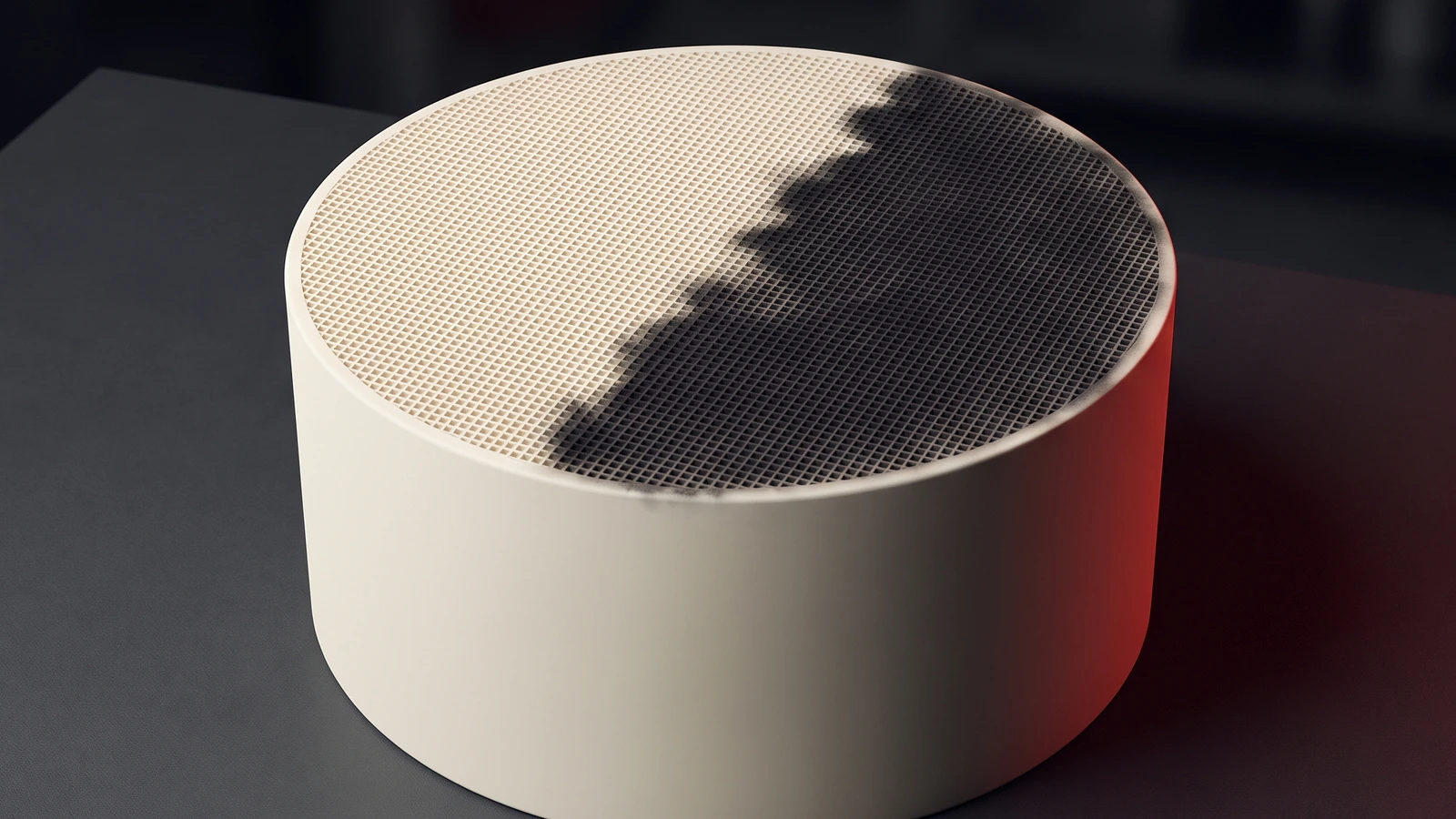
A gasoline particulate filter (GPF) — also called an OPF (Otto particulate filter) or PPF (petrol particulate filter) — is a ceramic honeycomb in the exhaust of a direct-injection petrol engine that traps the fine soot those engines produce and burns it off in place. It works on the same wall-flow principle as a diesel filter, with far less room for soot. If you are still establishing whether your car has one, our guide to whether your petrol car has a particulate filter covers what the part is and which cars carry it. This page starts where that one stops: the point at which the filter blocks.
The diesel version is explained in our guide to what a diesel particulate filter is and how it works. The two share a principle but not a cleaning strategy, and that difference is exactly why petrol filters block for their own reasons.
What are the symptoms of a blocked GPF?
The symptoms tend to arrive in a recognisable order, because the engine management reacts to a filling filter well before the driver can feel anything.
- Particulate filter lamp — amber, and often the only early sign
- Engine management light — joining the filter lamp as the fault progresses
- Flat acceleration — the engine feels strangled pulling away or climbing, because exhaust gas cannot leave freely
- Fuel consumption creeping up — with no change in how or where the car is driven
- Limp mode — power cut back by the ECU to protect the engine and the filter
- A lamp that keeps returning — the filter clears after a good run, then loads up again within days
The first two are information. The rest are consequences. A filter that has reached the stage of costing you power has usually been signalling for a while, and the easiest time to deal with it is while only the lamp is lit.
Two look-alikes are worth separating out. A flashing engine management light means a misfire, which is a different and more urgent fault — though, as later sections show, it is often the reason the filter is struggling in the first place. And a lit lamp does not prove the filter is full: a failing pressure sensor can report a blockage that is not there, which is why a garage checks the measurement before judging the filter.
What does the petrol particulate filter warning light mean?
An amber particulate filter lamp means the engine ECU has calculated that the filter is saturated with soot and needs to regenerate, and that normal driving has not been giving it the chance. Handbooks treat it as a request for a particular kind of drive, described below. At this stage it is a prompt, not yet a fault.
What turns it into a fault is persistence or company. If the lamp stays lit after a suitable drive, if the engine management light comes on alongside it, or if the car drops into limp mode, the ECU has stopped expecting the filter to recover on its own, and the stored codes need reading. On some makes the filter lamp flashes rather than glowing steadily once the load is severe; the handbook for your car tells you which behaviour it uses.
Not every car shows a symbol at all. On Peugeot and Citroën models an emissions-system problem is often reported as a text message, and our guide to the anti-pollution fault warning explains what that message covers — a particulate filter is only one of its possible causes.
Sinspeed · particulate filter diagnosis
Filter lamp back again within a week?Tell us the car, how it is normally used and what the dashboard is showing, along with any codes a scan has picked up. We will tell you whether it reads as a regeneration problem, an ash-loaded filter or a measurement fault that has nothing to do with the filter itself — and what the road-legal fix looks like.
Checked by our in-house diagnostic specialists · Dealer-level diagnostic tools
Why do petrol particulate filters block?
A diesel filter is emptied largely by adding heat: the ECU puts in extra fuel to push exhaust temperature up until the soot ignites. A petrol engine already runs a hot exhaust — roughly 300°C to 500°C in town and up to around 700°C at motorway speed — so temperature is rarely what it is missing. What it is missing is oxygen. A petrol engine runs at a chemically balanced mixture, which leaves very little spare oxygen in the exhaust to burn soot with.
The oxygen arrives when you lift off. On the overrun, in gear with your foot off the accelerator, fuel injection is cut and the engine pumps plain air through a hot exhaust, and that is when the filter clears. Where a car rarely offers that moment, the ECU can create one by adjusting ignition timing and running briefly lean. Either way, a petrol filter cleans itself in hot, oxygen-rich moments, and a car that never provides them fills up.
Its small capacity means that happens sooner than owners expect. A petrol filter holds far less soot than a diesel one, so a few weeks of unsuitable journeys is enough to load it. The usual causes are these.
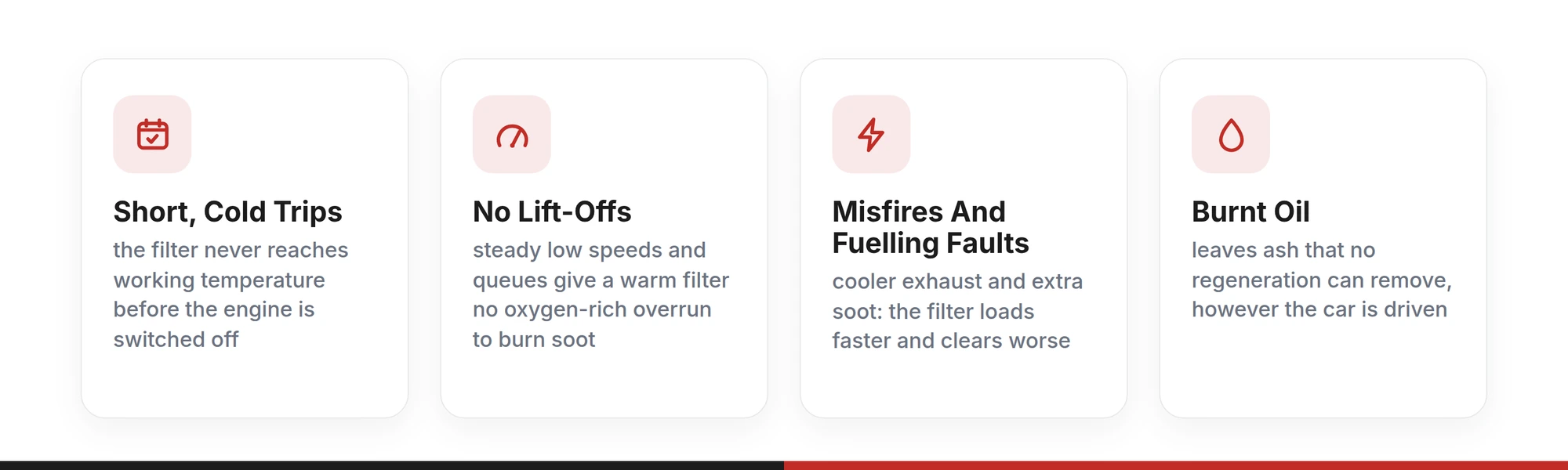
- Short, cold, slow journeys. The filter never reaches working temperature before the engine is switched off, and a crawl through town offers few lift-offs from any real speed.
- Driving that never coasts. Long spells at a steady low speed, or queuing traffic, keep the engine under load; a warm filter with no overrun phases still cannot burn what it holds.
- An engine that runs in bursts. Where the petrol engine is stopping and starting constantly, as it can in a hybrid, it may spend much of its running time below full temperature.
- Incomplete combustion. A misfire, a fuelling fault or injectors that are no longer delivering cleanly lower exhaust temperature and send more soot downstream at the same time, so the filter loads faster and regenerates worse.
- Oil reaching the combustion chamber. Burnt engine oil leaves ash, the non-combustible residue of its additives, and no regeneration can remove it. An engine that uses oil fills its filter with something no drive will shift.
- Regenerations cut short. Switching off partway through leaves the soot where it was, so each new attempt begins further behind.
- A measurement the ECU trusts. The filter’s load is judged from a differential pressure sensor across it and the ECU’s own soot model. A failing sensor, or a split or blocked sensor pipe, can call for regenerations that are not needed or miss a filter that really is full.
Most of these causes belong to the car rather than the filter, and that is the point to hold on to. A filter loaded by a misfire or by oil consumption will load again after any clean until the cause is put right.
Can you clear a blocked GPF by driving?
Often, yes — while only the amber lamp is lit and the car is driving normally. The drive that works is not a long, steady cruise. It is a fully warm engine given repeated lift-offs from speed, which is what manufacturer handbooks describe.
- Warm the engine through first. The regeneration needs the exhaust at operating temperature before any of the rest helps.
- Accelerate, then lift off completely. On a suitable road, hold around 50 mph or more, then take your foot right off the accelerator and let the car coast in gear for a few seconds.
- Repeat until the lamp goes out. It can take a while. A dual carriageway with roundabouts and junctions suits this well, because it builds the pattern in naturally.
- Follow your own handbook where it differs. Speeds and conditions vary by make, and the handbook is the authority for your car.
Do it only where it is safe and legal to vary your speed, and never by coasting in neutral: the fuel cut that makes the regeneration possible only happens with a gear engaged.
Stop trying, and have the codes read, if the lamp is still lit after a proper attempt, if it turns red or other warnings join it, if the engine management light is flashing, or if the car is in limp mode. A flashing engine light means a misfire, and driving hard on a misfire sends unburnt fuel into a hot exhaust — the last thing the filter needs.
Stopping it coming back
- Build a proper run into the routine. If the car mostly does short trips, a regular warm drive with some lift-offs from speed gives the filter what town use never will.
- Stick to the oil grade in the handbook. And treat rising oil consumption as a filter problem on its way.
- Get misfires and fuelling faults fixed promptly. Each one feeds the filter while lowering its ability to clear itself.
- Take a returning lamp seriously. Once in a while is the system working. Every few days is a fault.
What a garage checks before deciding what the filter needs
The lamp tells you the ECU’s conclusion. A proper diagnosis works backwards from it, because the right fix depends on whether the filter holds soot, holds ash, or is not really full at all.
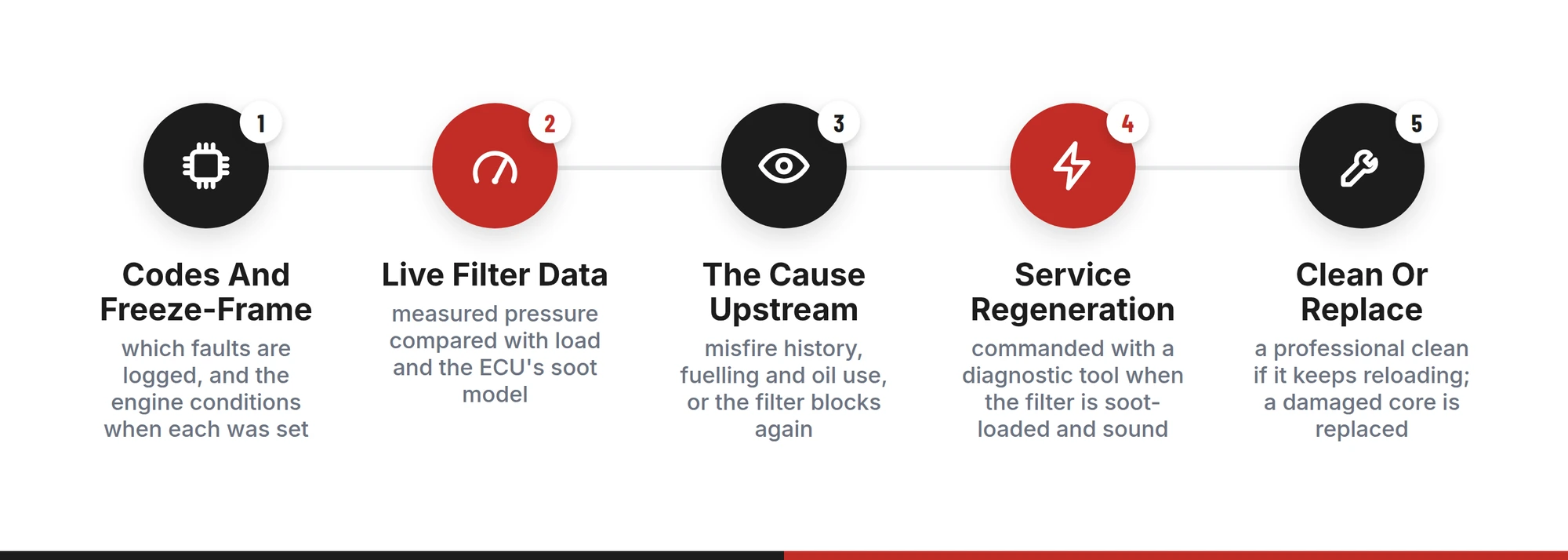
- Stored codes and freeze-frame data
Which faults are logged, and the engine conditions at the moment each one was set.
- Live filter data
The measured pressure across the filter is compared with engine speed and load, and with the soot load the ECU’s model believes is there. A reading that disagrees with itself points at the sensor or its pipes rather than the filter.
- The cause upstream
Misfire history, fuelling and oil consumption are checked, because a filter blocked by something upstream will block again.
- A service regeneration
Where the filter is soot-loaded and sound, a regeneration is commanded with a diagnostic tool under controlled conditions.
- Clean or replace
If a completed regeneration does not bring the reading back down, or the filter keeps reloading, it comes off for a professional clean. A damaged core is a replacement.
The codes most often seen on a blocked petrol filter are the generic particulate-filter set shared with diesels, although many makes add their own numbers and wording alongside them.
| Code | What it reports | What it usually points at |
|---|---|---|
| P2463 | Particulate filter soot accumulation | Soot building faster than the car is clearing it — usually journeys that never offer the conditions for regeneration |
| P2002 | Particulate filter efficiency below threshold, bank 1 | The filter is not performing as the ECU expects — incomplete regenerations, or a reading worth checking |
| P242F | Particulate filter restriction, ash accumulation | A restriction regeneration cannot lift — a clean, once the sensor side has been ruled out |
| P2452 / P2453 | Differential pressure sensor circuit, or signal out of range or implausible | The measurement rather than the filter — the sensor, its wiring or its pipes |
| P0300–P0304 | Random or cylinder-specific misfire detected | An upstream cause: unburnt fuel and lower exhaust temperature feeding the filter. Fix this first |
From the driver’s seat, a pressure sensor giving a falsely high reading cannot be told apart from a filter that genuinely is full: the lamp is the same and so is the loss of power. That is why no filter should be condemned, or even cleaned, on the strength of a code alone.
GPF cleaning: what works and what does not
“Cleaning” covers two very different things where petrol filters are concerned, and they are not interchangeable.
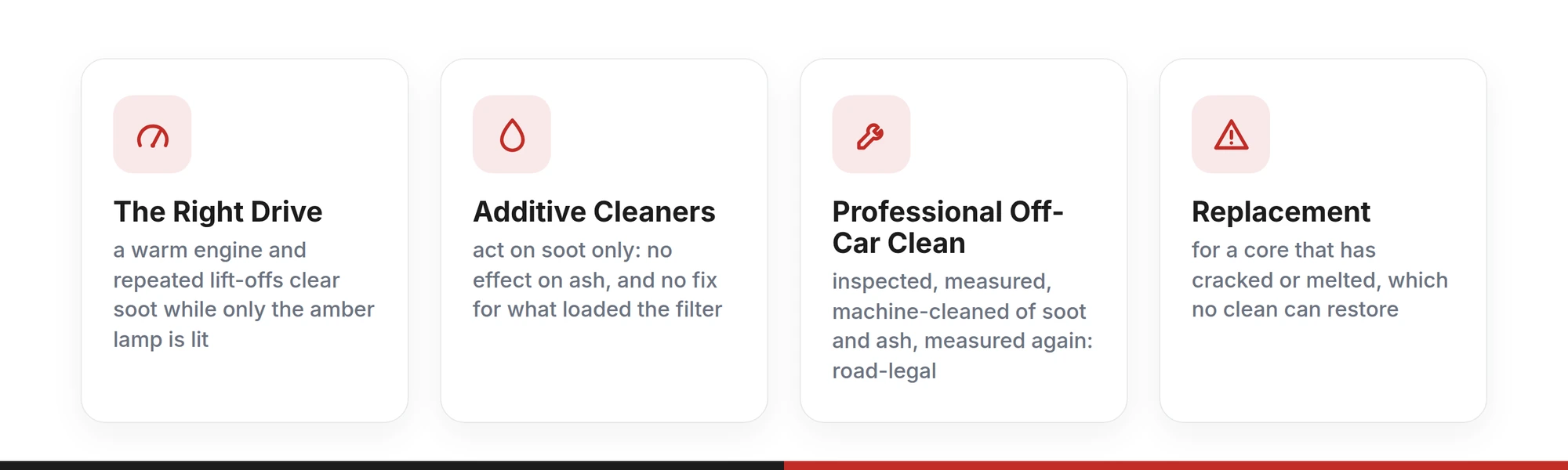
In-tank and on-car cleaners
Fuel additives and introduced-on-the-car cleaners are widely sold for petrol filters. They act on soot only. None of them can take ash out of the filter, and none addresses the misfire, fuelling fault or oil consumption that loaded it. For a filter that has already stopped regenerating, they are not a repair.
A professional off-car clean
A professional clean takes the filter off the vehicle — in our workshop, or removed by your own garage — so it can be inspected and physically cleaned rather than burned. The process follows the one set out on our particulate filter cleaning service page.
- Codes logged first
Stored and active faults are recorded before anything is disturbed.
- Inspected inside
An endoscope inspection looks for cracking or melting in the core, and the interior is photographed.
- Measured before
A back-pressure test records how restricted the filter is.
- Cleaned and dried
The filter goes through a two-way machine clean with a water-based solution, followed by thorough drying so that soot and ash both come out.
- Measured after
A second back-pressure test and internal inspection prove the result rather than assuming it.
- Refitted and reset
Once the filter is back on the car, the relevant ECU values are reset so the engine management knows it is working with a clean filter.
The inspection is there because cleaning has a ceiling. A core that has cracked, or melted where misfires dumped unburnt fuel into a hot exhaust, is finished, and the honest answer is a replacement filter. The diagnosis is there for the other limit: a clean restores the filter, but whatever filled it is still on the car until it is repaired.
Is removing the GPF an option?
The question comes up more as petrol filters become common, and for a car that is driven on the road the answer is short.
Using a vehicle on a UK road with its emissions equipment removed is an offence under the Road Vehicles (Construction and Use) Regulations. A car without the particulate filter it was built with fails its MOT, and the fine can reach £1,000 for a car or £2,500 for a light goods vehicle. Particulate filter removal is carried out for off-road and motorsport vehicles only — that work is listed in our DPF removals category. For any car used on the road, cleaning the original filter is the fix.
Everything else on this page — the drive, the service regeneration and the clean — is written for cars that stay on the road.
Blocked GPF FAQs
Can I keep driving with the GPF light on?
For a short while, if it is the amber lamp on its own and the car drives normally — and the right kind of drive is the thing most likely to clear it. Give the fully warm engine repeated lift-offs from around 50 mph in gear, as your handbook describes. If the lamp is still on afterwards, turns red, is joined by the engine management light, or the car loses power, stop relying on driving and have the codes read. Carrying on in limp mode will not clear the filter.
Will a forced regeneration fix a blocked GPF?
It fixes soot, provided the filter is sound and the cause is no longer active. A service regeneration commanded with a diagnostic tool burns off what the car could not, and on a filter loaded by short journeys that can be the whole repair. It does nothing for ash from burnt oil, it cannot correct a false pressure reading, and a filter that needs one every few weeks is telling you something upstream is wrong.
Do GPF cleaner additives work?
They act on soot only. An additive in the tank or a cleaner introduced on the car may help soot burn during a regeneration, but none removes ash, and none fixes the misfire, fuelling fault or oil consumption that loaded the filter. For a filter that has stopped regenerating, a professional off-car clean, inspected and back-pressure tested before and after, is the route that deals with both soot and ash.
Will a blocked GPF fail the MOT?
The MOT does not measure how loaded the filter is, but what comes with a blocked one can fail the test. Under the DVSA’s MOT inspection manual, an illuminated engine management light is a major defect, and an engine fault behind the blockage, such as a misfire, can fail the emissions test as well. A filter that has been removed fails on its own. Clearing the fault properly before the test is far simpler than dealing with the result.
Why does my GPF keep blocking when the car is fairly new?
Because use matters more than age. A new petrol car driven mostly on short, slow journeys can load its filter within weeks, since it never offers the hot, oxygen-rich lift-offs a petrol filter clears itself in. If the lamp keeps returning even after suitable drives, the cause is worth finding: a misfire, a fuelling fault, oil consumption, or a sensor reading the filter wrongly.
Sinspeed · petrol particulate filters
Petrol filter blocked and refusing to clear?Send us the vehicle, the codes and a picture of how the car is used. Our diagnostic specialists will work out whether it needs a service regeneration, a professional clean or a repair further up the engine first, and point you to the road-legal fix.
Specialist UK automotive-electronics team · Resets and calibration on dealer-level tools
Final thoughts
A petrol particulate filter asks for very little, but it asks for something specific: a hot exhaust and the burst of oxygen that arrives when you lift off at speed. Cars that get that as part of their normal week rarely see the lamp. Cars that live on short, slow trips do, and for them the first warning is a driving-pattern problem long before it is a mechanical one.
When it does turn mechanical — the lamp returning, power fading, codes stored — the order of work is what decides the outcome. Check that the reading is real, find whatever is filling the filter, and only then choose between a regeneration and a clean. A filter handled in that order usually goes back on the car and stays clear. One handled out of order tends to come back.