
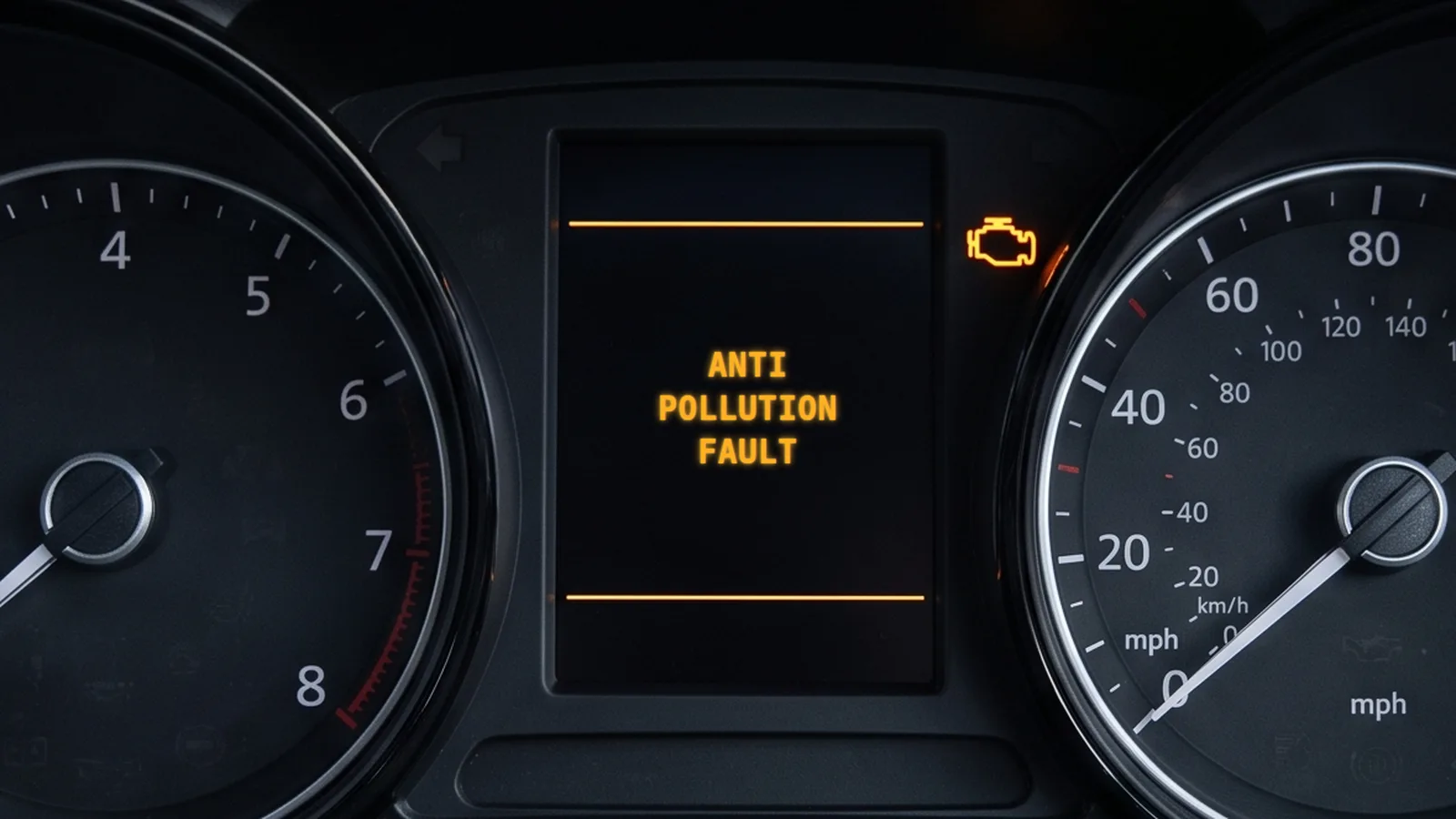
Summary: ‘Anti-Pollution System Faulty’, ‘Anti-Pollution Fault’ or ‘Check Anti-Pollution System’ is a dashboard warning used mainly by Peugeot, Citroen, DS and Renault. It is a general emissions and engine-management alert — the car has detected a fault somewhere in the system that keeps its emissions in check — and it often appears alongside the engine-management light and a drop into reduced-power mode. It does not name a single failed part: the cause can be anything from a lambda sensor to a mass air flow sensor, throttle body or EGR valve, so it needs the stored fault codes read to pin down. Where the cause turns out to be an electronic engine-management part such as the throttle body, that is our specialism — we diagnose, repair and remanufacture those units on a mail-in basis, backed by a lifetime warranty.
- What does the ‘Anti-Pollution System Faulty’ message mean?
- What does ‘Check anti-pollution system’ mean on a Renault?
- Is an anti-pollution fault serious? Can you keep driving?
- What causes an anti-pollution fault?
- Can you reset an anti-pollution fault?
- How is an anti-pollution fault diagnosed and fixed?
- Frequently Asked Questions
- Final thoughts
What does the ‘Anti-Pollution System Faulty’ message mean?
The message goes by a few names — “Anti-Pollution System Faulty”, “Anti-Pollution Fault” or “Check Anti-Pollution System” — and it is used mainly on French-built cars from Peugeot, Citroen, DS and Renault. It is the car’s plain-English label for an emissions-related problem: the engine-management system has spotted a fault in one of the parts that keep exhaust emissions within limits, and it has flagged it rather than carry on as if nothing were wrong.
“Anti-pollution” simply refers to the emissions-control side of the engine — the sensors, valves and after-treatment parts that keep combustion clean and the exhaust within legal limits. When the engine-management system sees a reading that falls outside what it expects from one of those parts, it logs a fault and warns you. On many cars the message shows together with the engine-management (EML) light, and the car may drop into reduced-power or “limp” mode to protect itself and cut emissions until the fault is dealt with. The warning is deliberately generic — it tells you the emissions system is unhappy, not which part is at fault.
What does ‘Check anti-pollution system’ mean on a Renault?
‘Check anti-pollution system’ is the message Renault shows when the engine-management system finds a fault in the parts that control exhaust emissions. It is a general warning, not a diagnosis: the cause can be a sensor, the throttle body, the EGR valve or, on a diesel, the DPF. Reading the stored fault codes is what names the part.
The wording is Renault’s own, but the warning underneath is the same umbrella alert that Peugeot and Citroen word as ‘Anti-Pollution System Faulty’. The engine-management system has seen a reading from the emissions side of the engine that it does not accept, stored a fault code against it and put the message on the display. It often arrives with the engine-management light, and the car may hold itself in reduced power until the fault is put right.
What sits behind the Renault message
The causes are the same systems listed further down this page. Sensors measure the air going in and the exhaust coming out; the throttle body meters the air the engine draws; the EGR valve returns a share of exhaust gas to the intake; and on a diesel the DPF traps soot. Each of them either changes how cleanly the engine burns its fuel or how accurately the system can measure what it is doing, and any one can raise the same text.
The message does not rank them, so the codes have to. When they lead to the throttle body, our guide to throttle body fault codes explains what each group of codes is reporting.
Does clearing it fix anything?
No more on a Renault than on any other car. A restart or a battery disconnect may clear a warning set off by a one-off event, and if that was all it was, it may stay away. If the fault is real, it returns, and clearing the codes before they are read throws away the evidence a diagnosis depends on. The reset section below covers this in full.
Dacia drivers and the zigzag lamp
Dacia and Renault models share one more signal worth knowing: the orange or red zigzag lamp, which belongs to those two makes rather than to cars in general. It does not report a fault of its own. It lights beside another lamp or message and tells you how urgently to treat it, and our guide to Dacia Sandero dashboard warning lights explains how to read the pair.
Where the codes do settle on the throttle body, the car does not need to come to us. You or your garage remove the unit and post it in; we repair it, test it and send it back.
Is an anti-pollution fault serious? Can you keep driving?
In most cases you can drive gently in the short term — an anti-pollution fault rarely leaves a car stranded, and if it is still running reasonably you will usually make it to a garage. It is not a warning to live with, though. While it is showing, performance and fuel economy suffer, and if the car has dropped into limp mode it will feel noticeably flat.
More importantly, if the underlying problem is a genuine emissions fault it will not clear itself, and the car will fail its MOT emissions test until it is put right. A fault that also causes a misfire can, over time, send extra heat and unburnt fuel through the catalytic converter and damage it — turning a smaller repair into a larger one. If the car is misfiring heavily, stalling, badly down on power or the engine-management light is flashing, treat that as a stronger signal and have it looked at promptly rather than driving on. The sensible course with any anti-pollution fault is to have the codes read sooner rather than later.
What causes an anti-pollution fault?
Because the message is a general emissions alert rather than a specific code, it has a wide range of possible causes. What they share is that each one disturbs how cleanly the engine burns fuel, or how accurately the system measures what it is doing. The common causes are:
- A faulty lambda (oxygen) sensor. This sensor measures the oxygen in the exhaust so the engine-management system can keep the fuel mixture correct. When it reads slowly or inaccurately, the mixture drifts and an emissions fault is logged — one of the most frequent triggers for this message.
- A dirty or faulty MAF (mass air flow) sensor. The MAF sensor measures how much air is entering the engine so the system knows how much fuel to add. Contaminated with oil or dust, or failing electronically, it under- or over-reads — and the mixture, and the emissions with it, go wrong.
- A throttle body fault. The throttle body controls the air the engine draws in and carries the sensors — and, on drive-by-wire cars, the motor — that report and set that airflow. Carbon build-up or an electronic fault here upsets the airflow and idle control and can trip the warning.
- An EGR valve problem. The exhaust gas recirculation (EGR) valve recirculates a measured amount of exhaust gas to lower emissions. When it sticks open or closed, or clogs with carbon, the emissions system notices and flags a fault.
- A blocked or faulty DPF (diesel particulate filter). On diesel cars a saturated or failing diesel particulate filter — or a fault in the sensors that monitor it — is a common trigger for the anti-pollution warning. The answer is a proper forced regeneration, professional DPF cleaning or diagnosis to get it flowing and reporting correctly again, not ignoring it.
- Ignition and misfire faults. Worn spark plugs, tired ignition coils or a partial misfire leave fuel unburnt, which pushes emissions up and readily sets off an anti-pollution warning.
- Fuel-system issues. Low fuel pressure, a tiring fuel pump, a blocked filter or dirty injectors leave the mixture wrong, and the emissions drift with it. Poor-quality or incorrect fuel can do the same.
- A deteriorating catalytic converter. As a cat ages or is poisoned by an upstream fault, it stops cleaning the exhaust effectively, and the system detects the higher emissions.
The important point is that “anti-pollution fault” is an umbrella, not a diagnosis. Two cars showing the identical message can have completely different parts at fault, which is why reading the stored fault codes and the live data — rather than replacing parts on a hunch — is the only reliable way to find the real cause.
Sinspeed · throttle body repair
Codes pointing at the throttle body?If the stored codes trace the warning back to the throttle body, there is no need to buy a complete new part. Take the unit off, or have your garage do it, and post it to us with the codes. We repair your existing throttle body, prove it on the bench and send it back for refitting.
Mail-order repair from our Epsom workshop · Most units returned ready to fit with no coding
Can you reset an anti-pollution fault?
A lot of searches ask how to reset or clear the message, and it is worth being straight about this. Turning the engine off and restarting, or disconnecting the battery, can clear the warning if it was triggered by a one-off transient event — a bad tank of fuel or a momentary glitch, for instance. If that really was all it was, it may not return.
But if the fault is real, clearing the light changes nothing about the underlying problem, and the warning will come back — often within a few miles. Wiping the codes before they have been read also throws away the very information a diagnosis needs. If the message keeps returning, the answer is not to keep resetting it but to have the stored codes read so the actual fault can be identified and fixed.
How is an anti-pollution fault diagnosed and fixed?
Proper diagnosis starts with reading the stored fault codes and the engine’s live data. The codes point to the system or sensor that is unhappy, and the live data — fuel trims, sensor readings, airflow figures — shows how the engine is actually behaving, which narrows a broad “anti-pollution” warning down to a specific part. From there the suspect component is tested directly rather than swapped on a guess: the lambda and MAF readings are checked, the throttle body and EGR valve are inspected, fuel pressure is measured and the ignition system is examined. Working through it in that order is what separates a targeted repair from a string of replaced parts.
Once the fault is pinned down, the repair is whatever the diagnosis points to. Some causes — spark plugs, a fuel pump, an ageing catalytic converter — are mechanical jobs for a local garage. Others are electronic, and that is our side of the work. We are UK automotive-electronics specialists who diagnose, repair and bench-test engine-management units, so when an anti-pollution fault traces back to the throttle body, we rebuild your existing unit rather than selling you a complete new part. Each remanufactured unit is bench-tested on our in-house Hardware-in-the-Loop rigs, which replicate the heat, vibration and electrical load it faces on the engine, and most come back ready to fit with no coding required. Our remanufactured parts carry a lifetime, unlimited-mileage warranty.
The service is mail-in: you send us the suspect unit and we repair and return it. If a diagnosis has already pointed at the throttle body or air flow sensor, complete our repair form with your vehicle and fault details to get started. If you are not yet sure which part is behind the warning, get in touch and we will help you work out the next step. Where the cause turns out to be something mechanical like the fuel supply or the catalytic converter, a local garage is the right port of call — but for the engine-management electronics, that is what we specialise in.
Frequently Asked Questions
What does ‘Check anti-pollution system’ mean on a Renault?
It is Renault’s wording for the same general emissions warning: the engine-management system has found a fault in one of the parts that keep exhaust emissions in check, and the message does not say which. It often comes with the engine-management light or reduced power. Have the stored codes read; they point to the system at fault, and the warning will return until that is put right.
What causes an anti-pollution fault?
It is a general emissions warning with many possible causes rather than one specific part. The usual culprits are a faulty lambda (oxygen) sensor, a dirty or failing MAF sensor, a throttle body or EGR valve fault, an ignition or misfire problem, a fuel-supply issue or a deteriorating catalytic converter. Reading the stored fault codes and live data is what identifies which one you have. On diesels, a blocked or failing DPF (or its sensors) is another common cause.
Is the check anti-pollution system warning serious?
You can usually drive gently in the short term, but it should not be left. Performance and fuel economy suffer, the car may drop into limp mode, and a genuine emissions fault will fail the MOT and can, over time, damage the catalytic converter. If the car is misfiring, stalling, badly down on power or the engine-management light is flashing, get it diagnosed promptly.
Can you reset an anti-pollution fault?
A restart or a battery disconnect can clear the message if it was a one-off transient event, and it may not return. But if the fault is real, resetting the light changes nothing and the warning will come back — usually within a few miles — while wiping the codes first throws away information a diagnosis needs. If it keeps returning, have the codes read rather than repeatedly clearing it.
What does ‘anti-pollution’ mean on a car?
It refers to the emissions-control side of the engine — the sensors, valves and after-treatment parts that keep combustion clean and the exhaust within legal limits. An ‘anti-pollution fault’ means the engine-management system has detected a reading outside what it expects from one of those parts. The term is used mainly by Peugeot, Citroen, DS and Renault.
Sinspeed · engine-management electronics
Not sure which part is behind the warning?Send us the fault codes with the make and model. Our engineers will tell you whether they point at an electronic unit we repair, such as the throttle body, or at a mechanical job better done by a local garage, before anything comes off the car.
Cleanroom-standard, ESD-safe workshop · In-house electronic engineers and diagnostic specialists
Final thoughts
Whatever badge is on the bonnet, the message makes the same kind of statement. ‘Anti-Pollution System Faulty’ on a Peugeot or Citroen and ‘Check anti-pollution system’ on a Renault both say that the emissions side of the engine has reported a reading it should not have, and neither says which part produced it.
That is why the code read comes first, not last. It turns an umbrella warning into a named system, and it is the difference between a single targeted repair and a run of parts bought in hope.