
Summary: A warning lamp on a Polo is only half an answer, because the ABS unit, the gearbox and the cluster sitting behind it are not the same parts on a 9N, a 6R and an AW. This page identifies your generation first, then gives every Polo dashboard symbol with a safe-to-drive verdict, and says plainly which lamps are reporting a failed electronic unit rather than a worn part or a low fluid.
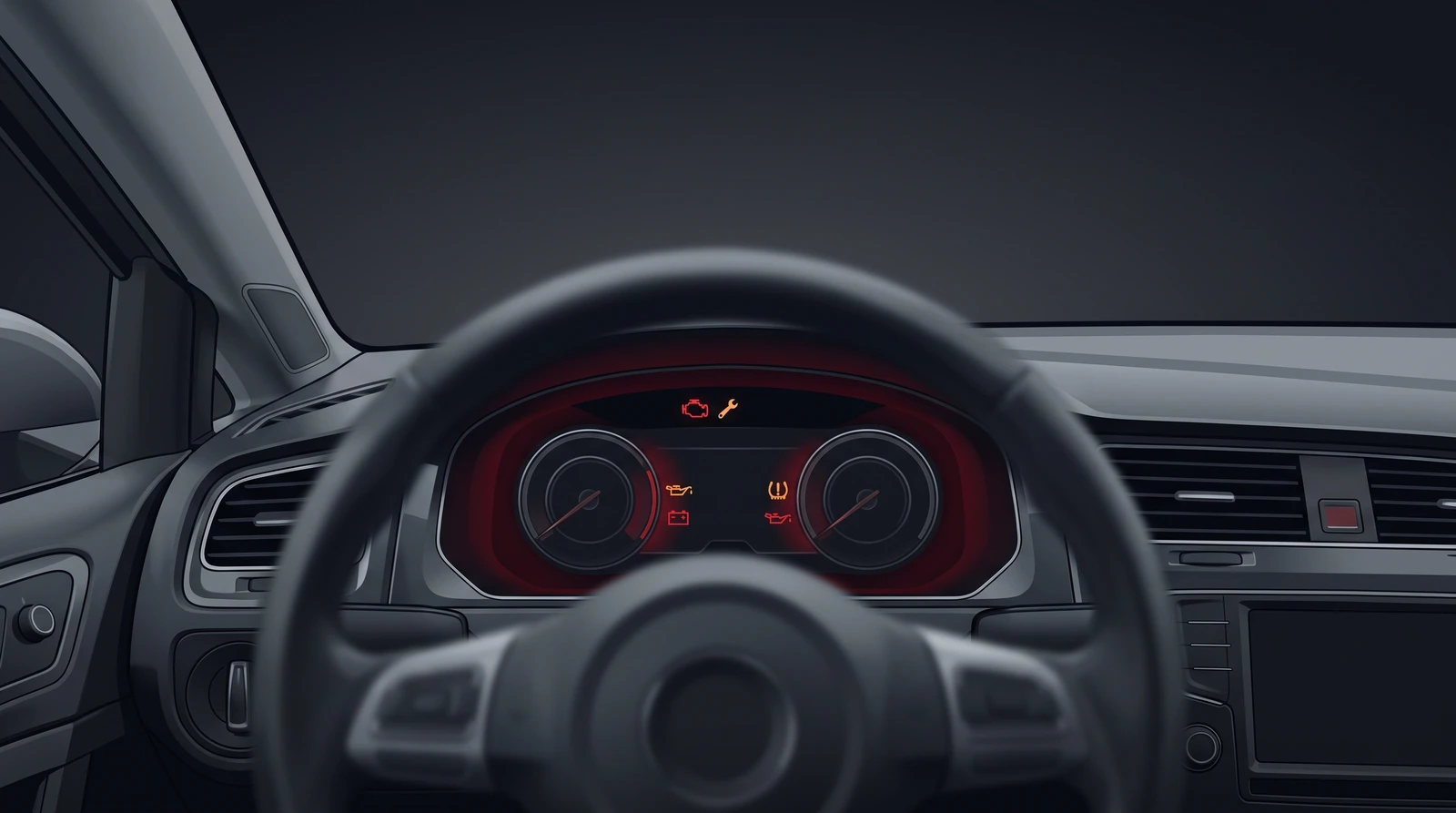
- Which Polo are you looking at, and why it decides the answer
- VW Polo warning lights and symbols: the full reference table
- EPC, the spanner and the yellow key: the three VW symbols that catch Polo owners out
- Polo Mk4 (9N and 9N3, 2002 to 2009): a short lamp list and an ageing cluster
- Polo Mk5 (6R and 6C, 2009 to 2017): the generation that fills the bench
- Polo Mk6 (AW, 2017 onwards): the dashboard that writes in words
- When the Polo’s dashboard is the fault and not the messenger
- The Polo lamps that point at a failed electronic unit
- What to do when a warning light comes on in your Polo
- VW Polo warning lights FAQs
- Final thoughts
Which Polo are you looking at, and why it decides the answer
The colour code behaves the same way on a Polo as on anything else — red means stop as soon as you safely can, amber means a fault has been stored and the car needs attention, green and white simply confirm that something is switched on — and our guide to common car warning lights sets that out in full. What the colour cannot tell you is which Polo you are sitting in, and on this model that is the question that changes the answer.
Three generations are on UK roads in numbers, and they are not three versions of one car. The instrument cluster, the ABS and stability unit and the gearbox behind the lamps all changed at the generation breaks, which is why a fault pattern that is genuinely common on one Polo does not exist on another.
- Polo Mk4 — body code 9N, and the 9N3 facelift (2002 to 2009). The simplest of the three electrically. Two analogue dials with a small monochrome display between them, a short list of lamps, and several systems a modern car takes for granted simply not fitted. Its faults are now largely age-related rather than design-related, and the cluster is the part that shows its age first.
- Polo Mk5 — body code 6R (2009 to 2014), facelifted as the 6C (2014 to 2017). The generation that fills workshop benches. This is where the Bosch 9-generation ABS and stability unit, the DSG gearbox on automatic cars and a busier instrument cluster all arrive together, and where a warning lamp is most likely to be pointing at a control unit rather than a sensor.
- Polo Mk6 — body code AW (2017 onwards). A larger car on newer architecture, with driver-assistance systems no earlier Polo has and, on higher trims, a fully digital instrument panel that writes warnings in words as well as showing an icon. The lamp set is much longer, and a good deal of it belongs to cameras and radar rather than to the engine or the brakes.
If you are not certain which you have, the date of first registration on the V5C settles it, and the dashboard confirms it: a small monochrome strip between two dials on a 9N, a larger multifunction display on a 6R or 6C, and a wide configurable digital panel available only on the AW. One trap worth knowing about is that Volkswagen enthusiasts, parts catalogues and repairers all number these cars differently — the same car turns up as a Polo Mk4, a Polo IV and a 9N depending on who wrote the listing, and as a Mk5, a Polo V or a 6R. They are the same cars under different labels, and matching the body code is the reliable way through it.
The consequence runs through everything below. Read the symbol correctly, then apply the wrong generation’s fault to it, and you can end up buying a part your Polo has never had fitted.
VW Polo warning lights and symbols: the full reference table
Two things about this table are worth saying before you use it. First, it is filtered to what a Polo actually carries. Marque-wide Volkswagen guides list air-suspension, adaptive-damper and rear-spoiler lamps that no Polo has ever been fitted with, which is a genuine obstacle when you are trying to match a shape you can see against a list you cannot. Second, the safe-to-drive answers are deliberately cautious: where a fault could reasonably be trivial or serious, the advice assumes serious.
Symbol shapes shift slightly across the generations and across trim levels, so treat this as the Polo set and check the handbook for anything unfamiliar. Where a lamp exists on only some Polos, the meaning column says so.
| Colour | Symbol | What it means on a Polo | Is it safe to drive? |
|---|---|---|---|
| Red |  Brake system — an exclamation mark inside a circle, with a curved bracket each side Brake system — an exclamation mark inside a circle, with a curved bracket each side | The handbrake is still applied, the brake fluid has fallen below minimum, or there is a fault in the braking system. | No, unless it goes out the moment the handbrake is fully released. If it stays lit, stop somewhere safe and arrange recovery. |
| Red | 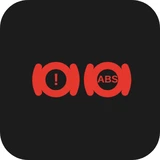 Brake system and ABS lit together — the circle-and-brackets alongside the letters ABS Brake system and ABS lit together — the circle-and-brackets alongside the letters ABS | The braking system and the anti-lock system are reporting at the same time. On a Polo this pairing can also follow a fault inside the ABS unit itself. | No. Brake gently, stop as soon as it is safe, and do not drive it to a garage. |
| Red |  Engine oil pressure — an oil can with a drip falling from the spout Engine oil pressure — an oil can with a drip falling from the spout | Oil pressure has fallen. This is the red lamp, not the amber low-level one further down this table. | No. Switch the engine off. Bearings are damaged in seconds without oil pressure, not in miles. |
| Red |  Engine coolant — a thermometer sitting in wavy lines Engine coolant — a thermometer sitting in wavy lines | The engine is too hot or the coolant level is too low: a leak, or a failed thermostat, water pump or radiator fan. | No. Stop, switch off and let it cool. Never open a hot expansion tank. |
| Red | 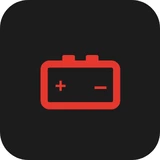 Vehicle charging system — a rectangular battery with a plus and a minus terminal Vehicle charging system — a rectangular battery with a plus and a minus terminal | The charging system is no longer replenishing the battery. Alternator, drive belt or wiring. | Only as far as somewhere safe. Everything is running on stored charge, and the car stops when it is gone. |
| Red |  Airbag and seat belt system — a seated figure facing a large inflated circle Airbag and seat belt system — a seated figure facing a large inflated circle | The restraint system has stored a fault. An airbag or a seatbelt pretensioner may not fire in a collision. | The car drives normally, but the protection you are relying on is not there, and it is an MOT defect. Have it read straight away. |
| Red | 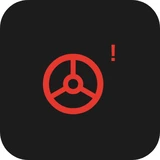 Power assisted steering — a steering wheel, usually with an exclamation mark beside it Power assisted steering — a steering wheel, usually with an exclamation mark beside it | Steering assistance has been cut. A Polo assists the steering with an electric motor, so there is no power steering fluid behind this lamp. | No. Assistance can disappear without notice, and the steering goes heavy at exactly the moment you need it. |
| Red | 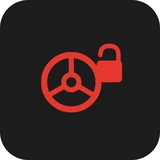 Steering column lock — a steering wheel with a padlock beside it Steering column lock — a steering wheel with a padlock beside it | A fault in the electronic steering column lock. Flashing normally means the lock has not released or has not confirmed its position. | No. This most often ends as a car that will not start rather than a car that is dangerous to drive, but it is a red lamp on a steering system and belongs to a workshop, not to a journey. |
| Red |  Ignition and immobiliser — a key outline, in red Ignition and immobiliser — a key outline, in red | A fault in the ignition or immobiliser circuit, rather than a key that has simply not been recognised. | If the engine has started, briefly. If it has not, the car is not going anywhere and needs the codes read. |
| Red | Gearbox temperature — a cog, or a gear-selector gate, in red | The DSG or automatic transmission is too hot. Volkswagen shows this one as a stop warning. | No. Pull over and let it cool rather than pressing on. |
| Red | 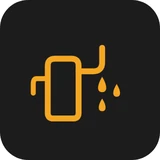 AdBlue — a fuel nozzle with AdBlue lettering beside it AdBlue — a fuel nozzle with AdBlue lettering beside it | The AdBlue tank is empty or nearly so. Only the later diesel Polos with an SCR exhaust system have this — look for a second, blue-capped filler beside the diesel filler. | Yes until it empties, and then not at all: the car will refuse to restart once the tank runs dry. Top it up before it gets there. |
| Red or amber |  Central warning — a triangle with an exclamation mark inside it Central warning — a triangle with an exclamation mark inside it | Volkswagen’s catch-all. The symbol carries no information on its own; the text written in the cluster beside it is the actual warning. | Read the message first and treat it as whatever it names. A red triangle means stop; an amber one means get it looked at. |
| Red | 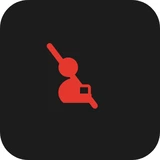 Seat belt reminder — a seated figure with a belt across the chest Seat belt reminder — a seated figure with a belt across the chest | A belt is unfastened, or something resting on a seat is being read as an occupant. | Not a fault. Belt up, or move the object. |
| Red |  Door, bonnet or boot open — a car outline with its panels standing open Door, bonnet or boot open — a car outline with its panels standing open | A closure is not properly latched. | No. Stop and shut it properly. |
| Amber |  Engine management — an engine block outline Engine management — an engine block outline | Steady: a stored powertrain or emissions fault. Flashing: an active misfire, which can destroy the catalytic converter in a short distance. | Steady, with the car driving normally: gently, and have the codes read within days. Flashing: stop. A malfunction indicator lamp that stays lit is also an MOT defect. |
| Amber |  EPC — the letters EPC EPC — the letters EPC | Electronic Power Control, a Volkswagen-group lamp for the drive-by-wire throttle system. On these cars it commonly reads at the throttle body, the accelerator pedal sensor or the brake light switch. | Only while the car is driving normally. If it has dropped into reduced power, keep the journey short and off fast roads. |
| Amber |  Emissions control — an exhaust pipe with wisps of smoke Emissions control — an exhaust pipe with wisps of smoke | An emissions-related fault, most often a sensor in the exhaust rather than a problem with the engine itself. | Yes, briefly. It will not clear itself, and an untreated emissions fault will find you again at the next MOT. |
| Amber |  ABS — the letters ABS inside a circle with a bracket each side ABS — the letters ABS inside a circle with a bracket each side | The ABS module has switched anti-lock braking off. Ordinary braking is unaffected. | Yes, with care, provided the red brake lamp is not lit as well. The wheels can lock in an emergency stop, so leave more room and brake earlier. It is also an MOT defect. |
| Amber |  ESP or traction control — a small car with wavy skid lines behind it ESP or traction control — a small car with wavy skid lines behind it | Flashing means the system is intervening and doing its job. Steady means it is switched off, or it has a fault. | Flashing on a wet or greasy road is normal. Steady on dry tarmac in ordinary driving means it is not protecting you — get it read. |
| Amber |  ESP OFF — the same car and skid lines with OFF beneath ESP OFF — the same car and skid lines with OFF beneath | Stability control has been switched off, usually deliberately with the button. | Yes, but switch it back on. If pressing the button changes nothing, treat it as a fault rather than a setting. |
| Amber |  Power steering, reduced — an amber steering wheel Power steering, reduced — an amber steering wheel | Assistance is reduced rather than absent: the system has derated itself, or it is asking to be calibrated after work on the steering. | With care, and not far. Reduced assistance can become no assistance without warning. |
| Amber |  Automatic gearbox — a cog with an exclamation mark, or a gear-selector gate Automatic gearbox — a cog with an exclamation mark, or a gear-selector gate | A fault in the DSG or automatic gearbox and its control electronics, which on these cars are built into the mechatronic unit inside the box. | Limited. The gearbox will often hold a single gear or refuse to select at all. Keep the journey short. |
| Amber |  DPF — a rectangular filter box with dots inside it (diesel) DPF — a rectangular filter box with dots inside it (diesel) | Steady: the particulate filter is loaded with soot and wants a regeneration. Flashing, or lit alongside other lamps: it has gone past that point. | Steady, yes — a sustained run at a steady motorway speed with the exhaust properly hot often completes a regeneration. Beyond that, get it seen before the car starts limiting itself. |
| Amber |  Glow plug or preheat — a coiled filament, like a flattened spring (diesel) Glow plug or preheat — a coiled filament, like a flattened spring (diesel) | Normal for a few seconds before a cold start. Lit or flashing while you are driving is a stored engine fault instead. | Yes, but have the codes read rather than waiting for it to clear. |
| Amber |  Engine oil level — an amber oil can with a drip Engine oil level — an amber oil can with a drip | The oil level is low. This is not the red oil-pressure lamp, and the two are confused constantly. | Yes, briefly. Check the level and top up before going any further. |
| Amber |  Tyre pressure monitoring — a horseshoe-shaped tyre cross-section with an exclamation mark inside Tyre pressure monitoring — a horseshoe-shaped tyre cross-section with an exclamation mark inside | A tyre is below pressure, or the system can no longer make sense of what it is reading. Many Polos use an indirect system that compares wheel speeds through the ABS sensors rather than a pressure sensor in each wheel, which is why it is reset through the car’s menu after you inflate. | Only as far as somewhere you can check all four pressures. Reduce speed and avoid hard braking until you have. |
| Amber |  Water in the diesel fuel filter — a fuel filter outline with droplets beneath it Water in the diesel fuel filter — a fuel filter outline with droplets beneath it | Water has collected in the fuel filter and needs draining. | Only briefly. Water reaching the injection system does expensive damage. |
| Amber |  Brake pad wear — a circle with dashes around its edge Brake pad wear — a circle with dashes around its edge | The wear sensor has reached the pads’ limit. | Yes, but book it now. The warning arrives with a margin left, and that margin is finite. |
| Amber |  Bulb and brake light monitoring — a headlamp outline with rays, carrying an exclamation mark Bulb and brake light monitoring — a headlamp outline with rays, carrying an exclamation mark | An exterior lamp is out, or the circuit driving it has failed. Volkswagen shows a separate warning specifically for the brake lights. | Yes, but a lamp that is out is an MOT failure and a hazard after dark, and a dead brake light is more serious than it sounds. |
| Amber |  Stop-start unavailable — the letter A inside a circular arrow Stop-start unavailable — the letter A inside a circular arrow | The stop-start system has taken itself out of use. On a Polo this is most often the battery no longer holding enough charge for it. | Yes. The engine simply stops shutting down at junctions. Have the battery and its current sensor checked. |
| Amber |  Driver assistance, Mk6 only — a car between two lane lines; a car with a bracket in front of it; a wing mirror with waves beside it Driver assistance, Mk6 only — a car between two lane lines; a car with a bracket in front of it; a wing mirror with waves beside it | Lane assist, front assist or blind-spot monitoring is unavailable. Amber most often means the camera or radar cannot see — ice, snow, road film, or something stuck to the windscreen in front of the camera. | Yes. The car drives normally and the assistance is simply not there, so do not rely on it until the lamp goes out. |
| Amber |  Service due — a plain spanner, usually with a service message in the display Service due — a plain spanner, usually with a service message in the display | A time or mileage interval has been reached. It is a reminder, not a fault, and it is reset at the service. | Yes. Do not confuse it with a fault lamp — see the section below. |
| Green, blue or white |      Side lights, dipped beam, indicators, main beam, front and rear fog lights, cruise control set, eco mode, heated rear screen Side lights, dipped beam, indicators, main beam, front and rear fog lights, cruise control set, eco mode, heated rear screen | The feature named is switched on and working. Blue is main beam; white is usually a comfort or convenience system. | Yes. These confirm something is active rather than warn of a fault. The rear fog light is the one to watch, because it dazzles the car behind. |
EPC, the spanner and the yellow key: the three VW symbols that catch Polo owners out
Most of the Polo’s lamps are the industry-standard set, and a driver moving from another make will recognise them. Three are Volkswagen’s own, and all three are routinely misread.
EPC. Electronic Power Control is not a second engine management lamp and it is not a service reminder. It covers the drive-by-wire throttle system — everything between your right foot and the throttle butterfly, plus the electronics that decide how much of that request the engine is allowed to act on. On a Polo the reads that come up most often are the throttle body, the accelerator pedal position sensor and the brake light switch, which the engine management uses to know when you have lifted off. An EPC lamp arriving at the same moment as the ABS and ESP lamps is a genuine pattern rather than a coincidence: the stability system asks the engine management to cut torque, so a fault on the braking side can be logged as a power-control fault. If the car has dropped into reduced power alongside it, that is the engine protecting itself and the journey should be short.
The spanner. A plain spanner, usually with a service message in the display, is a scheduled-service reminder. Nothing is broken and no code has been stored. It is worth knowing that on these cars the service interval data lives in the instrument cluster, which is why the reminder is reset through the dashboard rather than at the engine — and why a cluster that has been changed can show an interval that has nothing to do with when the car was last serviced. The lamp you should take seriously is the engine management or EPC symbol, not this one.
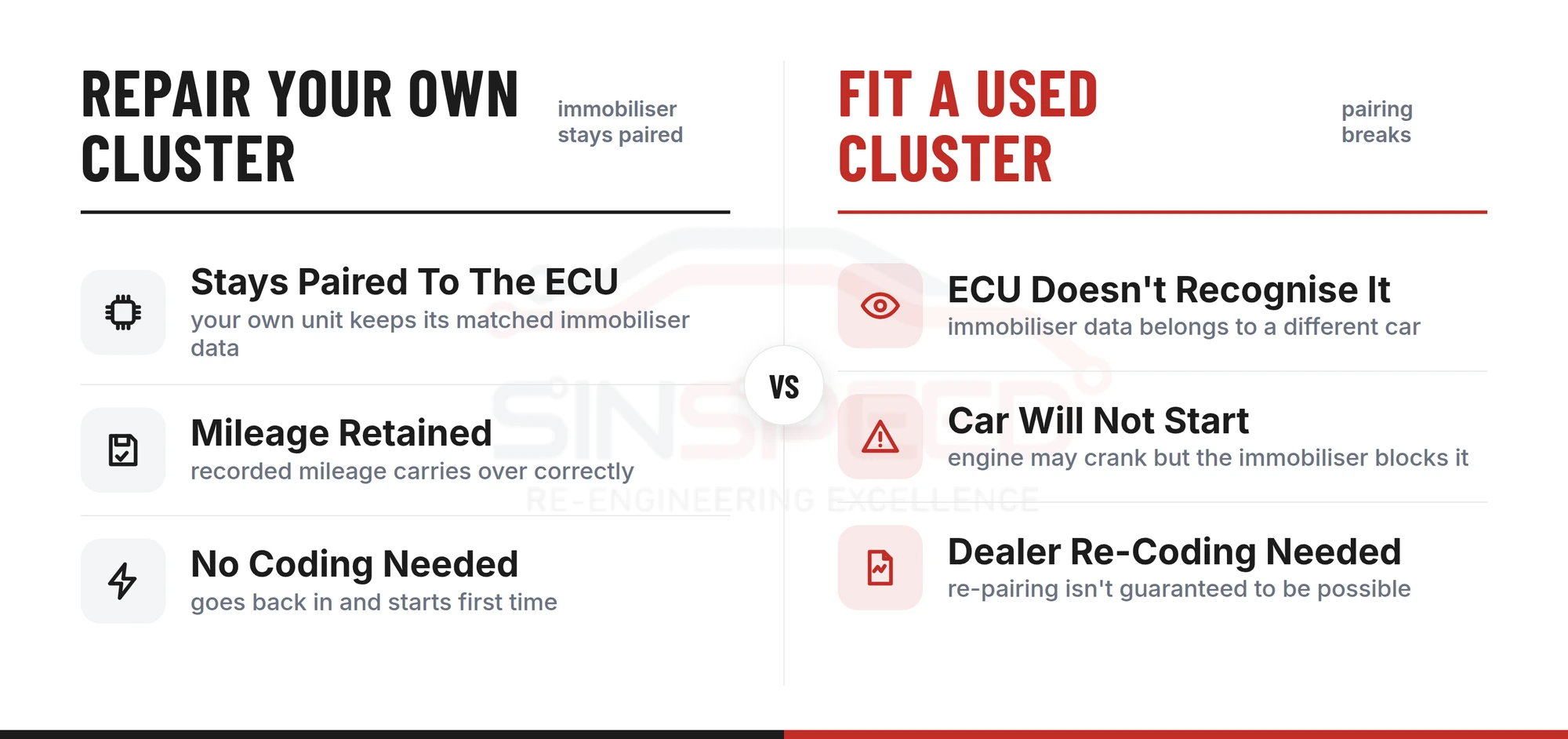
The yellow key. A yellow or amber key symbol is the immobiliser saying it cannot confirm the key. Sometimes the engine cranks and will not run; sometimes it starts and the lamp stays lit. Try the spare key before anything else, because that single step separates a failing key from a failing module. Worth understanding here: the immobiliser data on these cars is shared between the instrument cluster and the engine management, which is why a second-hand cluster taken out of another Polo will normally not start your car, however well it matches on part number. Repairing your own cluster keeps that pairing intact; buying somebody else’s breaks it.
Polo Mk4 (9N and 9N3, 2002 to 2009): a short lamp list and an ageing cluster
The 9N has the shortest lamp list of the three, which makes it the easiest to read and the easiest to misread — generic advice written for a modern car keeps offering it systems it was never built with. There is no lane assist, no front assist and no blind-spot monitoring, and tyre-pressure monitoring is not something you will find on most of these cars. If a symbol described elsewhere is simply not on your dashboard, that is usually specification rather than a failed bulb.
The steering lamp is the clearest example of the same trap. The Polo assists the steering with an electric motor rather than a belt-driven hydraulic pump, so there is no power steering fluid to check and no reservoir to find under the bonnet. Advice that tells you to top up the PAS fluid when the steering symbol appears was written for a different kind of car.
What does come with age on a 9N is the cluster. The monochrome display between the dials fades, loses segments or goes dark altogether, the backlighting fails in patches, and the trip and service information becomes unreadable. That is not a fault in whatever the display was trying to tell you about — it is the display, and it is repaired as a Polo Mk4 instrument cluster in its own right, with your mileage and immobiliser data kept where they are.
Polo Mk5 (6R and 6C, 2009 to 2017): the generation that fills the bench
If your Polo is a 6R or a 6C, a warning lamp is more likely to be pointing at a control unit than on either of the other generations. Four patterns account for most of it.
ABS and ESP lit together. Anti-lock braking and stability control share a hydraulic modulator and a control unit, which is why the two lamps so often arrive as a pair and why a fault in one takes the other with it. When both appear at once, and particularly when the ESP-OFF button changes nothing, suspect the unit before the wheel sensors. On this generation that unit is the Polo Mk5 Bosch 9 ABS pump, and it is repairable rather than a straight replacement.
The tyre-pressure lamp that is not about tyres. Because many Polos monitor pressure indirectly, by comparing how fast each wheel is turning through the ABS sensors, a wheel-speed or ABS fault can light the tyre-pressure symbol as well. If you have checked all four pressures, reset the system and the horseshoe comes back, look at the anti-lock system rather than buying valves.
The gearbox lamp on DSG cars. The transmission control electronics and the hydraulic control block are combined into one mechatronic assembly inside the gearbox, so a fault there presents as a gearbox problem and an electrical one at the same time: hesitant or jerky take-up, a refusal to select, limp mode in a single gear, and the gearbox symbol. Ours is listed as the Volkswagen Polo 2009 to 2016 DSG gearbox unit.
The cluster. The 6R and 6C carry a busier display than the 9N and it fails in its own right — missing segments, a screen that dims or disappears with temperature, backlighting that goes patchy. It is repaired as a Polo Mk5 instrument cluster, and the section below explains why it is worth ruling in or out early.
On the diesels, add the DPF and glow plug lamps to that list. Neither is an electronics fault in the sense the others are, and both are covered in the reference table above.
Polo Mk6 (AW, 2017 onwards): the dashboard that writes in words
The AW is where the generation rule earns its keep. It is a larger car on newer architecture with a longer lamp list, and the failure patterns described for a 6R should not be carried across to it. A Mk6 with the ABS and ESP lamps lit needs its codes read on their own merits.
Two practical differences follow. The first is that on cars with the digital instrument panel the symbol is only half the warning: the panel writes the fault in words alongside the icon, and the written message is the specific half. A generic amber triangle with a sentence beside it should be read as the sentence, not as the triangle. Note the wording down before it clears itself, because it is more useful to a diagnostic technician than any description of the shape.
The second is that a good share of the AW’s amber lamps belong to driver assistance rather than to the car’s mechanical systems. Front assist, lane assist and blind-spot monitoring all announce themselves when they are unavailable, and unavailable usually means a sensor that cannot see: ice or snow over the radar behind the badge, road film on the windscreen in front of the camera, or something stuck to the glass. That is not a failed unit, and it often clears once the car is clean and warm. It is worth being able to tell that apart from a stored fault, because they look similar and cost very different amounts to resolve.
Diesel AW Polos with an SCR exhaust also carry the AdBlue warning, which is a consumable rather than a fault — but one with teeth, because the car will refuse to restart once the tank has run dry. On the repair side, coverage of newer models and newer electronic systems is something we maintain a research and development capability specifically to keep up with, so a lamp on a recent Polo is not automatically a dealer-only job.
When the Polo’s dashboard is the fault and not the messenger
This is the one worth checking early, because a faulty instrument cluster makes every other lamp on this page untrustworthy. If the cluster is misreporting, you are not diagnosing the car — you are diagnosing the thing that is describing the car to you.
The symptoms are consistent across the generations:
- A display that is dead, dim, or comes and goes with temperature — often fine on a cold morning and gone once the car has warmed through, or the reverse.
- Missing segments, blank rows of pixels or characters that are half-drawn.
- Backlighting that has failed in patches, so part of the panel is readable and part is not.
- Needles that stick, sweep on their own, or read obviously wrong.
- Several unrelated warning lamps lit at once with no system actually reporting a fault behind them.
- A mileage reading that flickers, disappears, or shows dashes.
Any of those, and particularly the last two together, mean the cluster belongs at the top of the list rather than the bottom. Our Volkswagen Polo instrument cluster failure page goes through the fault in detail — what fails inside the unit, what the symptoms look like on each generation and how the repair is carried out. It is the right next stop if the description above matches what your dashboard is doing.
Two practical notes. The clusters are genuinely different parts across the generations, not variations on one design, which is why they are listed separately as the Mk4 and Mk5 units rather than as one Polo cluster. And repairing your own unit rather than fitting somebody else’s keeps your mileage and your immobiliser pairing intact, which is what allows most repaired clusters to go straight back in with no coding needed. The wider work is covered under instrument cluster repairs.
Sinspeed · Volkswagen Polo electronics
Cleared the light, and it was back within a week?A lamp that returns after the code has been cleared is telling you the condition never went away — and on a Polo that usually means the unit behind it, not the sensor in the wheel arch. Send us the generation, the stored codes and what the car is actually doing, and we will tell you which unit needs to come off before you take anything apart.
Trusted by the trade as well as private motorists — garages, main dealers and independent workshops nationwide · Mail-in, UK-wide
The Polo lamps that point at a failed electronic unit
Most warning lights on a Polo are a sensor, a fluid, a bulb or a service interval, and working through those first is the right order. A handful are different: they sit in front of a control unit with a recognised failure pattern on these cars, and no amount of checking levels will move them.
ABS and ESP
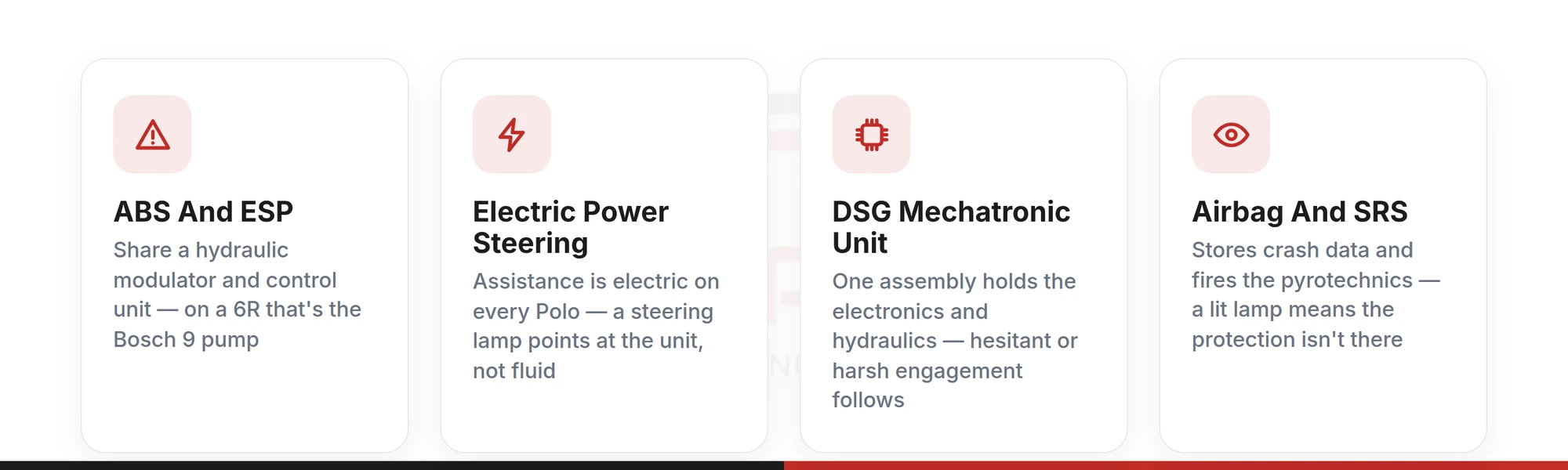
The two systems share a hydraulic modulator and a control unit, so a fault in one commonly lights both. The question that matters is whether the fault is in a wheel-speed sensor, which is a straightforward replacement, or inside the unit, which is not. The codes answer it. If they point at the unit, that unit is repaired at circuit level rather than replaced — on a Mk5 that is the Bosch 9 ABS pump, and the range is covered under ABS pump and module repairs. One line from the table bears repeating: an ABS lamp on its own leaves you with ordinary brakes; an ABS lamp with the red brake lamp does not.
Electric power steering
Because the assistance is electric, a steering lamp is never a fluid level and topping something up is not an option. Steering that is heavy from cold and normal once warm, assistance that fades in and out, or a wheel that goes heavy at one speed and not another all point at the electronics rather than the mechanical rack. Get the codes read, then talk to our engineers about which part of the assembly your Polo uses before anything is removed.
The gearbox lamp on a DSG
The mechatronic unit inside a DSG carries both the transmission control electronics and the hydraulic control block, so its failures read as a mixture of the two: the gearbox symbol lit, hesitant or harsh engagement, a refusal to select a gear, or limp mode holding one ratio. It is a repairable assembly, listed for these cars as the Polo 2009 to 2016 DSG gearbox unit.
The immobiliser
A yellow key means the immobiliser cannot confirm the key; a red one means a fault in the system itself. Try the spare key first. If both keys behave the same way, the fault is in the car rather than in your pocket, and the cluster-to-engine-management pairing described above is the reason a used replacement part rarely solves it.
Airbag and SRS
Restraint systems are handled differently, deliberately. An airbag control module stores crash data and fires pyrotechnic devices, so it is not a send-it-and-see job. If the airbag lamp is lit on your Polo, get in touch and we will tell you which module your car uses and what has to happen before it comes out. In the meantime, do not start probing connectors under the seats with the battery connected, and never treat the lamp as something to be switched off.
Engine management and EPC
Both lamps have too many possible causes to guess at, so the codes come first. The throttle body is a recurring cause on these cars and is repairable. Where diagnosis points at an internal failure of the engine ECU itself, that work belongs with the independent specialists at ecu-repairs.com, and a turbocharger fault — which often lights the same lamp alongside lost boost and a smoke complaint — belongs with our turbo specialists at turbo-repairs.com, our sister site for everything turbo. Sending the codes to the right specialist first is quicker than posting a unit to the wrong one.
The DPF and glow plug lamps
On a diesel Polo both of these are about combustion rather than electronics. The DPF lamp is a soot warning and escalates: steady means the filter wants a regeneration, and a sustained run at a steady motorway speed with the exhaust fully hot will often complete one. A filter that will not accept a regeneration needs cleaning properly rather than repeated attempts. A glow plug symbol that lights for a few seconds before a cold start is doing its job; one that stays lit or flashes while you drive is a stored engine fault wearing the wrong badge.
What to do when a warning light comes on in your Polo
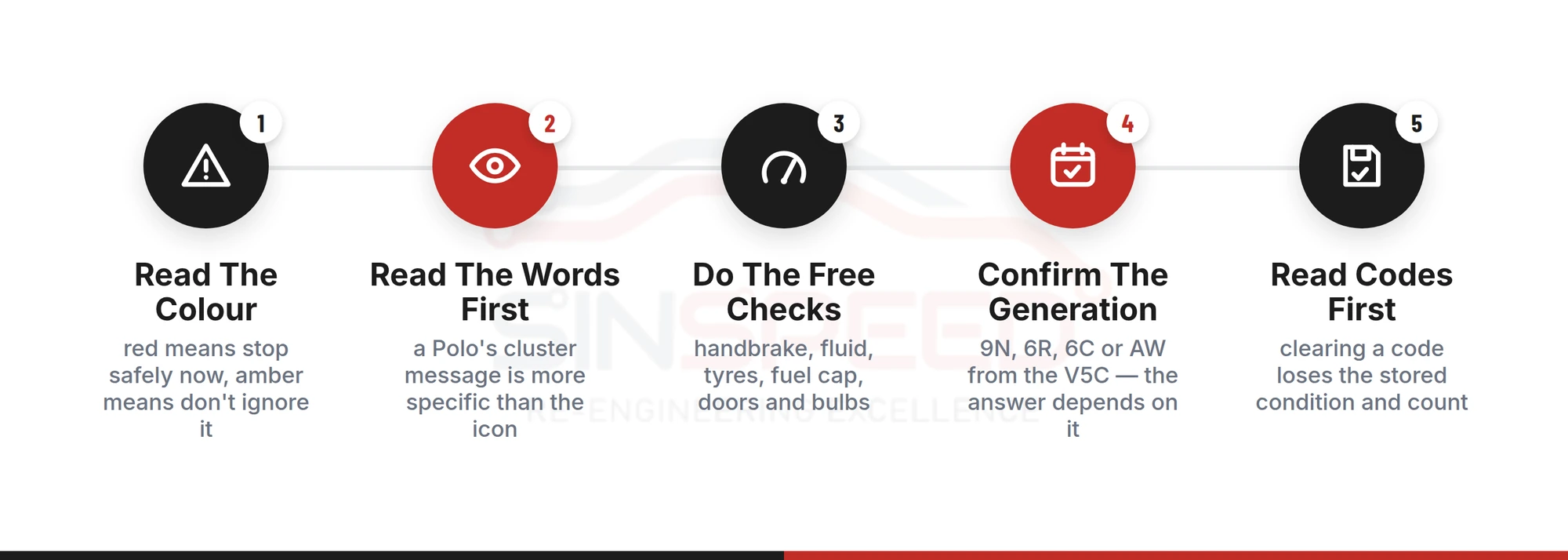
- Take the colour at face value. Red means find somewhere safe and stop. Amber means you have time to think, but not an unlimited amount of it.
- Read the words before the icon. A Polo with a message in the cluster is telling you something more specific than the symbol can. Write the text down exactly as it appears, because it will clear itself and you will not get it back.
- Do the checks that cost nothing. Handbrake fully off, fluid levels once the engine is cool, all four tyre pressures, fuel cap clicked shut, doors, bonnet and boot properly latched, and a walk round for a dead bulb. A fair share of amber lamps end right here.
- Establish the generation from the V5C. 9N, 6R, 6C or AW. Every answer on this page depends on it, and so does every answer you will find anywhere else.
- Have the codes read, and recorded, before anything is cleared. Clearing a code takes the stored conditions and the occurrence count with it. On an intermittent fault that record is the most valuable thing you have, and it cannot be recovered afterwards.
- Match the code to the generation, not to the badge. A Polo fault described online is only useful once you know which Polo it was found on. This is the step where a correct diagnosis and an expensive guess part company.
Two rules hold throughout. Never attempt a do-it-yourself repair on the braking or airbag systems, and never clear a safety lamp simply to stop it bothering you. And if the car you are working on is not a Polo, the method still applies — our Vauxhall Corsa warning lights guide is built the same way, generation first, for exactly the same reason.
VW Polo warning lights FAQs
What does the EPC light mean on a VW Polo?
EPC stands for Electronic Power Control, and it is Volkswagen’s lamp for the drive-by-wire throttle system — everything between the accelerator pedal and the throttle, plus the electronics deciding how much of that request the engine acts on. It is not a second engine management light and it is not a service reminder. On a Polo the causes that come up most often are the throttle body, the accelerator pedal position sensor and the brake light switch. An EPC lamp that arrives at the same moment as the ABS and ESP lamps is a real pattern rather than a coincidence, because the stability system asks the engine management to reduce torque and a fault on that side can be logged as a power-control fault. If the car has also dropped into reduced power, keep the journey short and get the codes read.
Which Polo have I got — 9N, 6R, 6C or AW?
The date of first registration on the V5C answers it. Roughly 2002 to 2009 is the Mk4, sold as the 9N and, after the 2005 facelift, the 9N3. From 2009 to 2014 it is the Mk5, body code 6R, facelifted as the 6C from 2014 to 2017. From 2017 onwards it is the Mk6, body code AW. The dashboard confirms it: a small monochrome strip between two dials on a 9N, a larger multifunction display on a 6R or 6C, and a wide configurable digital panel available only on the AW. Listings label these cars inconsistently, so the same car appears as a Polo Mk4, a Polo IV or a 9N depending on who wrote it — matching the body code is the reliable way through.
Can I drive my Polo with the ABS light on?
Yes, with care, provided the red brake warning lamp is not lit as well. Ordinary braking still works normally, but the ABS module has switched the anti-lock function off, so the wheels can lock under heavy braking and stopping distances lengthen on a wet or greasy surface. Leave more room, brake earlier, and have the codes read — an anti-lock lamp indicating a malfunction is also an MOT defect. If the red brake lamp is on alongside it, that is a different situation entirely: stop as soon as it is safe and arrange recovery rather than driving the car to a garage.
Why are the ABS and ESP lights on together on my VW Polo?
Because the two systems share a hydraulic modulator and a control unit, so a fault in one commonly takes the other with it. When they arrive as a pair, and particularly when pressing the ESP-OFF button changes nothing, the unit itself is more likely than a single wheel sensor. On a Mk5 Polo that unit is the Bosch 9-generation ABS and stability pump, and it is repaired at circuit level rather than replaced. The codes are what separate the two possibilities, so have them read and written down before any part is ordered.
Is the spanner symbol on a Polo a fault?
No. A plain spanner, usually shown with a service message in the display, is a scheduled-service reminder: nothing has failed and no fault code has been stored, and it is reset at the service. The service interval data is held in the instrument cluster on these cars, which is why it is reset through the dashboard rather than at the engine, and why a cluster that has been changed can display an interval that bears no relation to when the car was actually serviced. The symbols to take seriously are the engine management lamp and EPC, both of which mean a code has been stored.
My Polo’s dashboard display is dim, flickering or missing segments. Is that the cluster?
Almost certainly. A display that fades, goes dark, comes and goes with temperature, shows blank rows of pixels or half-drawn characters, or has backlighting that has failed in patches is a fault in the instrument cluster rather than in whatever the display was reporting on. The same applies to needles that stick or sweep on their own, a mileage reading that disappears, and several unrelated warning lamps lit with nothing behind them. It is worth ruling in or out early, because a cluster that is misreporting makes every other lamp on the dashboard unreliable. Repairing your own unit keeps your mileage and your immobiliser pairing intact, which is why most repaired clusters go straight back in without coding.
Will the airbag light fail my Polo’s MOT?
Yes. A lit airbag or SRS lamp means the restraint system has stored a fault, so an airbag or a seatbelt pretensioner may not fire in a collision — the car drives normally, but the protection you are relying on is not there. A lamp indicating a malfunction of the airbag and restraint system is a defect under the DVSA inspection manual, and so is a lamp that fails to illuminate during the ignition self-check, which rules out removing the bulb as a solution. Have it diagnosed rather than cleared.
The steering has gone heavy on my Polo and the steering wheel light is on. What is it?
A Polo assists the steering with an electric motor rather than a belt-driven hydraulic pump, so there is no power steering fluid to check or top up — advice telling you to do so was written for a different kind of car. A red steering symbol means assistance has been cut and the car should not be driven, because heavy steering arriving without warning is at its most dangerous in a corner or a manoeuvre. An amber one means assistance is reduced, or the system is asking to be calibrated after work on the steering. Either way the codes come first, because they distinguish a fault in the electronics from a fault elsewhere that has caused the system to derate itself.
Sinspeed · mail-in repair
Post the unit, keep the Polo on the driveThe car does not need to go anywhere. Remove the unit the codes point at, send it in, and it is stripped, repaired at board level and run on our own test rigs under simulated heat, vibration and load until it repeats the behaviour you described. If you are not certain which unit that is, describe the symptoms and we will confirm what to send.
Most remanufactured parts carry a lifetime, unlimited-mileage warranty · Many units go back ready to fit with no coding required
Final thoughts
Most cars hand you a warning lamp and leave you to work out what sits behind it. The Polo has an extra wrinkle: the component most likely to be misreporting is the component doing the reporting. A cluster with failing segments, a panel that dims and returns, or lamps lit for systems that are perfectly healthy sends owners chasing brakes, airbags and gearboxes that were never at fault — so when several unrelated lamps arrive together on a 9N or a 6R, the dashboard itself belongs on the list of suspects.
Everything else follows the order the table above is built around. Identify the Polo, match the symbol, then read the codes. And treat the safe-to-drive column as a floor rather than a ceiling: where a fault could be inconvenient or could be dangerous, this page has assumed dangerous, because the cost of being wrong in those two directions is not the same.
The one thing worth carrying away is that order. Generation, symbol, code — in that sequence, every time. Done the other way round, an hour of reading produces a confident answer about a part your Polo has never had fitted. Done properly, it usually finishes at a single unit, and on these cars that unit can often be opened, repaired and strengthened rather than thrown away.