
Summary: On a SensoDrive Citroen or Peugeot, P1795 is a gearbox information coherence fault: the gear-engagement count no longer agrees, usually because the gear actuator is wearing or has just been replaced. P1755 means the clutch actuator is out of position or stuck. Both actuators are electric units on the gearbox, and we test and repair your own by post, with no programming on refit and a lifetime warranty.
SensoDrive is an electronically controlled manual gearbox: an ordinary manual with an electric clutch actuator, an electric gear actuator (often called the gearbox actuator) and a gearbox ECU doing the work of the pedal and the lever. This page explains the codes those actuators log, how the faults feel, how to tell them from a worn clutch and how the repair works. Other makes are covered in our clutch and gear actuator repairs hub.
- The units: an electric clutch actuator and an electric gear actuator on the gearbox, both run by the gearbox ECU
- The codes: P1755 (clutch actuator position), P1795 (gearbox information coherence), P0744 (clutch actuator signal)
- What you notice: no gear, a “–” in the display, the wrong gear, a snowflake on the dash
- Models: Citroen C2 and C3, Peugeot 1007 and 207 with SensoDrive
- How it reaches us: by post once your garage has removed it, or through our fitting service
- At refit: no programming; calibration is part of fitting
- Cover: lifetime warranty on every actuator repair
- What do P1795 and P1755 mean on a Citroen or Peugeot?
- How a failing SensoDrive actuator shows from the driver’s seat
- Which Citroen and Peugeot models use SensoDrive?
- Why SensoDrive clutch and gear actuators fail
- Why an actuator fault feels like a worn clutch or a failing gearbox
- New, second-hand or your own actuator repaired: what changes at refit?
- How a SensoDrive actuator repair runs, from your garage to our bench
- P1795, P1755 and SensoDrive actuators: your questions answered
- Final thoughts
What do P1795 and P1755 mean on a Citroen or Peugeot?
On a SensoDrive Citroen or Peugeot, P1795 is logged as a gearbox information coherence fault. The gearbox keeps a count of gear engagements and disengagements, and when that counter information stops agreeing, it treats the gear actuator’s data as inconsistent. P1755 is more direct: the clutch actuator is in the wrong position, or stuck.
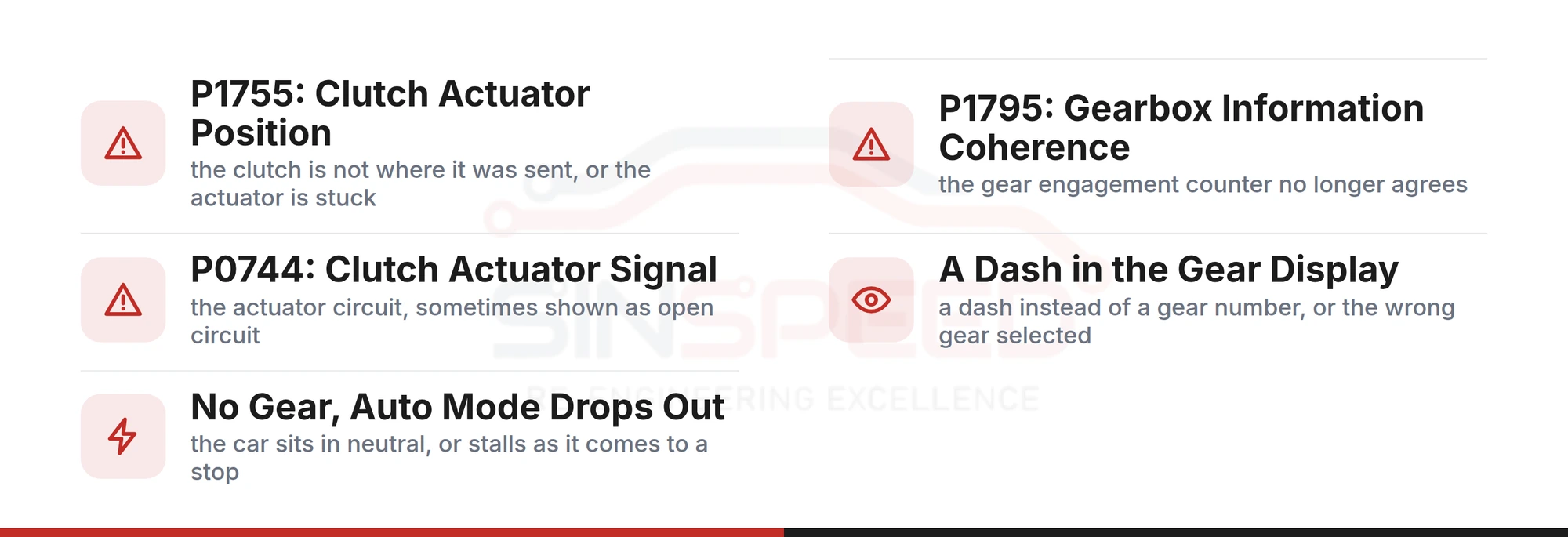
Either can leave the car refusing a gear, but they describe different halves of the system. P1755 is the clutch side failing to put the clutch where it was sent. P1795 is commonly logged as the gear actuator wears, and again after an actuator or the clutch has been replaced without the counter being brought back into line.
Treat a generic code list with care. P1 codes are set by each manufacturer, and general lookups give P1795 unrelated meanings, from an idle switch circuit to a sensor failure. On a SensoDrive car, it is the gearbox reporting.
| Code | What the scan tool reports | Where it usually points | First move |
|---|---|---|---|
| P1755 | Clutch actuator fault: incorrect position, or actuator stuck | The clutch actuator, with the supply voltage and its connector as the other suspects | Note whether it clears after a switch-off and a rest, then returns |
| P1795 | Gearbox information coherence: the engagement counter no longer agrees | A wearing gear actuator, or a new clutch or actuator fitted without the counter reset | If a part went in recently, confirm the post-fitting calibration was completed; if not, have the actuator tested |
| P0744 | Clutch actuator signal fault, sometimes shown as open circuit | The actuator’s circuit: the unit itself, or the wiring and connector to it | Prove the wiring and connector, then the unit |
Write down every stored code, not only these, exactly as the tool printed it.
How a failing SensoDrive actuator shows from the driver’s seat
The actuators do the work of the clutch pedal and the gear lever, so their faults show up as the gearbox misbehaving. These are the signs owners report:
- Gears will not select. The car sits in neutral or will not move off. With P1755 stored, this often clears once the engine has been off for a few minutes, then comes back.
- A dash where the gear should be. The display shows “–” instead of a gear number.
- The wrong gear. The gearbox selects a different gear from the one asked for.
- In and out of auto mode. The car drops out of automatic operation and back again on its own.
- Will not rev in reverse.
- A snowflake symbol on the dash.
- Stalling as the car stops. The engine dies at low speed, sometimes with the gearbox refusing to change as well.
The history matters as much as the list. A fault that began the week a clutch was fitted, one that follows a flat battery and one that comes and goes with a rest each point somewhere different, so put yours on the repair form. Our guide to clutch actuator fault symptoms covers the same signs on other automated manuals.
A gearbox that can drop to neutral or stall the engine at a junction is not one to trust in traffic. If yours is doing either, keep away from busy roads and junctions you need to clear quickly, and have the codes read before relying on the car again.
Which Citroen and Peugeot models use SensoDrive?
SensoDrive was offered as the semi-automatic option on several Citroen and Peugeot models. These are the cars listed against this repair:
| Make | Model |
|---|---|
| Citroen | C2, the VTR included |
| Citroen | C3 SensoDrive |
| Peugeot | 1007 |
| Peugeot | 207 |
The list is not complete, so a model missing from it is no reason to rule your car out. The label on the actuator settles it: numbers listed against this repair include 96 493 944 80, 96 625 689 80, 01 3981 000 036, 01 3981 009 001 and 3981000089. Photograph the label before the unit comes off and put the number on the form.
SensoDrive or EGS?
Other Citroen and Peugeot models, the C4 Picasso among them, use a different semi-automatic system, usually called EGS, which moves the clutch and gears with an electric pump and hydraulics rather than electric actuators. P1755 is logged on those cars too, but the hardware behind it is different, and this page covers SensoDrive. If yours is an EGS car, send us the codes and we will tell you which unit to look at. A Vauxhall with the equivalent system is covered on our Vauxhall Easytronic actuator repairs page.
Why SensoDrive clutch and gear actuators fail
Neither actuator gets a rest. In a conventional manual your foot and your hand share the work; on SensoDrive, two electric units on the gearbox do all of it, every time the car pulls away, changes gear or stops.
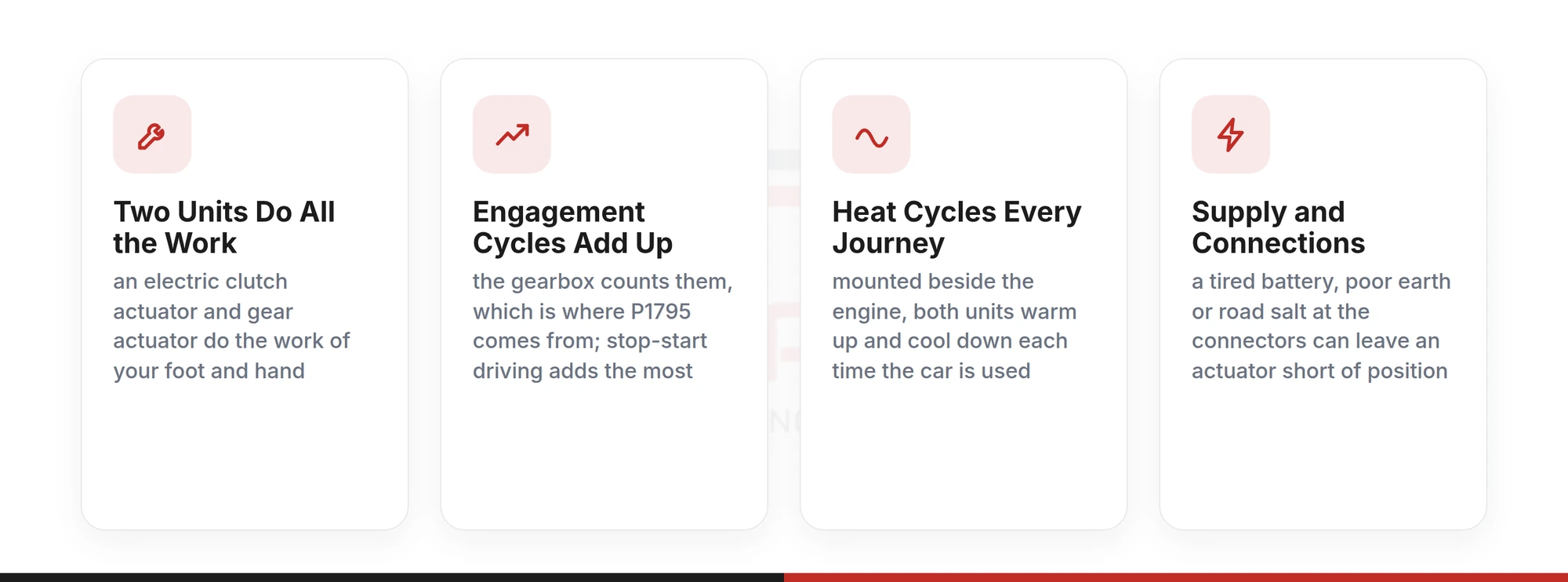
Engagement cycles add up. The gearbox counts them, which is where P1795 comes from. Stop-start town driving asks for far more clutch and gear movements per mile than a motorway run, and each one is wear on the unit making it.
Heat comes with the location. Mounted on the gearbox beside the engine, both units warm up and cool down on every journey. Faults that appear once the car is hot and vanish after it has stood fit that kind of cycling.
Supply voltage and clean connections. An electric actuator needs a steady supply to reach the right position at the right speed. A tired battery or a poor earth can leave it short just when it is working hardest, and water, road salt and grime reaching the connectors can corrupt the signals the gearbox ECU relies on. Both are quick to rule out before the unit comes off.
The clutch moves the target. As the clutch wears, the position the clutch actuator has to reach changes. The system compensates for a long time, until a wearing clutch and a wearing actuator together go beyond what it can correct.
Why an actuator fault feels like a worn clutch or a failing gearbox
Nobody sees an actuator fail. What the driver feels is the result: a clutch that bites late, a gear that will not go in, an engine that stalls as the car stops. Those are the same complaints a worn clutch or a damaged gearbox produces, which is how SensoDrive cars end up quoted for a clutch or a gearbox they did not need.
| What you notice | When the actuator is the cause | Other causes to rule out |
|---|---|---|
| Gears will not select, “–” in the display | The gear actuator not completing the engagement, often with P1795 stored | Supply voltage, or the wiring between the actuators and the gearbox ECU |
| Late bite, a slipping feel or harsh take-up | The clutch actuator placing the clutch in the wrong position, often with P1755 | A clutch worn beyond what the system can compensate for |
| Fault clears after a switch-off and a rest, then returns | A position fault that clears and recurs, the pattern reported with P1755 | A weak battery or a poor earth dragging the supply down |
| P1795 soon after a new clutch or actuator | The actuator’s data not agreeing with the gearbox’s stored count | The calibration and counter reset not completed at fitting |
| Engine stalls as the car comes to a stop | The clutch not being released in time as the car slows | Engine faults that cause stalling whatever the gearbox is doing |
A clutch that is genuinely finished will keep the faults coming whatever actuator is fitted, and older cars can have both problems at once. Testing the actuator on its own settles which side the fault sits on before anything else is replaced. If the codes point past the actuators to the gearbox ECU, send them to us and we will tell you plainly where the evidence leads.
Sinspeed · SensoDrive actuators
P1755 or P1795 on the scanner?Put every stored code on the repair form with the model, the registration and what the car does, then have your garage post the actuator to us. Not sure whether it is the clutch actuator, the gear actuator or both? Ask before anything comes off.
Each actuator run hot and loaded on our own test rigs before it is touched
New, second-hand or your own actuator repaired: what changes at refit?
Any of the three gets a SensoDrive car moving again. Where they differ is in what has to happen once the part is on the car, and how long it is covered.
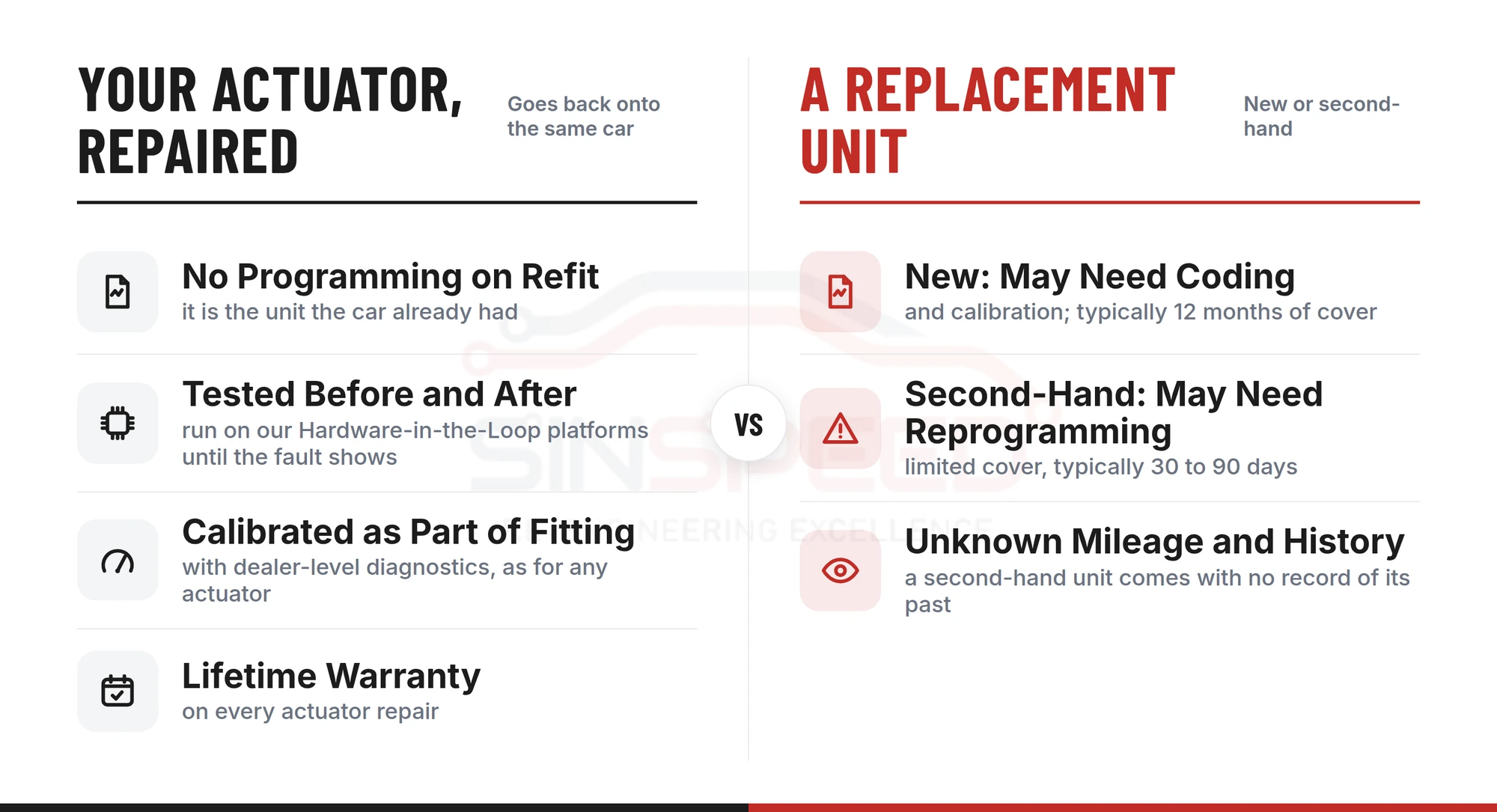
| Option | At refit | Warranty | What you know about it |
|---|---|---|---|
| New, from a dealer | May need coding and calibration | 12 months | New, but the same design as the unit that failed |
| Second-hand | May need reprogramming | Limited, typically 30 to 90 days | Unknown mileage and history |
| Your own, repaired by Sinspeed | No programming; calibrated as part of fitting | Lifetime | Tested before and after the repair |
Keeping your own unit is what removes the programming: it already belongs to the car, so it goes back as the same actuator that came off. The calibration after fitting is a different thing. It brings the gearbox’s stored values back into line with the clutch and actuator it is now working with, it is carried out with dealer-level diagnostics, and it is part of the job whichever unit goes on.
How a SensoDrive actuator repair runs, from your garage to our bench
We work on the unit alone, so the car never has to leave your garage.
- Book it in on the repair form
Give the model and registration, every stored code, what the car does and when, and anything fitted recently, a clutch especially. Add the number from the actuator label, then print the form and pack it with the unit.
- Your garage takes the actuator off
Removing and refitting a gearbox-mounted actuator is routine garage work. Ask them to protect the connector and pack the unit firmly. If you would rather not arrange it yourself, we also offer a fitting service.
- Put through its paces on our HIL platforms
Your actuator goes on our in-house Hardware-in-the-Loop platforms, which recreate the heat, vibration and electrical load of a running gearbox, and its movement and response are measured until the reported fault shows itself.
- Workshop repair, then the same tests again
Our electronic engineers carry out the repair in a cleanroom-standard, ESD-safe workshop. The unit is calibrated on dealer-level diagnostic equipment and runs the full test sequence again before it is cleared to return.
- Back on the gearbox it came from
Your garage refits the actuator and completes the post-fitting calibration with dealer-level diagnostics, including the engagement counter reset where P1795 was stored. Nothing needs programming, because the unit is the one the car already had.
Every SensoDrive clutch and gear actuator we repair carries our lifetime warranty.
P1795, P1755 and SensoDrive actuators: your questions answered
Final thoughts
P1795 and P1755 read like the gearbox is failing, but on SensoDrive cars the fault most commonly sits in the electric actuators on the outside of it. One code says the clutch is not where it was sent; the other says the gearbox no longer trusts its record of the gear side.
Read every code, rule out the battery and the connectors, and ask whether a clutch or actuator went in recently. If the actuator is still the suspect, the one already on your car is the one worth keeping: it comes back tested, refits with nothing to programme and carries a lifetime warranty.
Sinspeed · Citroen and Peugeot SensoDrive
Get the gears selecting again on your own actuatorFill in the repair form with every stored code and what the car is doing, then have your garage send us the clutch actuator, the gear actuator or both. Want a view on the codes first? Talk to us before anything is removed.
Measured on our test rigs before and after repair · Refits with nothing to programme · Lifetime warranty