
Summary: On a Mitsubishi Colt with the automated manual gearbox, P1710 and P1830 are the codes most often stored when the clutch actuator or the gear shift actuator is failing, usually with the car refusing a gear, sticking in neutral or dropping out of gear. We test and repair your own actuators by post at our workshop in Epsom; they refit plug and play with no re-coding and carry a lifetime warranty.
The Colt’s automated manual is a manual gearbox and clutch with no clutch pedal: a clutch actuator, a gear shift actuator and a gearbox ECU take over from the pedal and the lever. This page explains what P1710 and P1830 mean on this car, how a failing actuator behaves, how to tell the clutch side from the gear side and how the repair works. Other makes are covered in our clutch and gear actuator repairs hub.
- The units: a clutch actuator and a gear shift actuator on the gearbox, directed by the gearbox ECU
- The codes: P1710 and P1830, read together with the symptoms
- What you notice: no gear selected, stuck in neutral, slipping out of gear
- Both at once: it happens, so each actuator is tested on its own
- How it reaches us: your garage removes it and posts it to our Epsom workshop
- Refit and cover: plug and play, no re-coding, lifetime warranty
Which Colt gearbox uses clutch and gear actuators?
The actuators belong to the Colt’s automated manual gearbox, the version you can leave to change gear on its own or switch to manual at the press of a button. It is not a conventional automatic. Underneath sits a manual gearbox with an ordinary clutch, operated electrically instead of by a pedal.
Three parts run it. The clutch actuator engages and releases the clutch, the gear shift actuator selects the gears, and the gearbox ECU decides what both should do. Each actuator reports its position back to the ECU, which weighs that against road speed and other inputs to choose the gear, the moment to change and when to take up the drive.
P1710 and P1830 are reported on sixth-generation Colts with this gearbox, the CZ2 among them, with both the 1.3 and the 1.5 engine. If you are unsure which gearbox your car has, ask us before anything is removed.
What do P1710 and P1830 mean on a Colt?
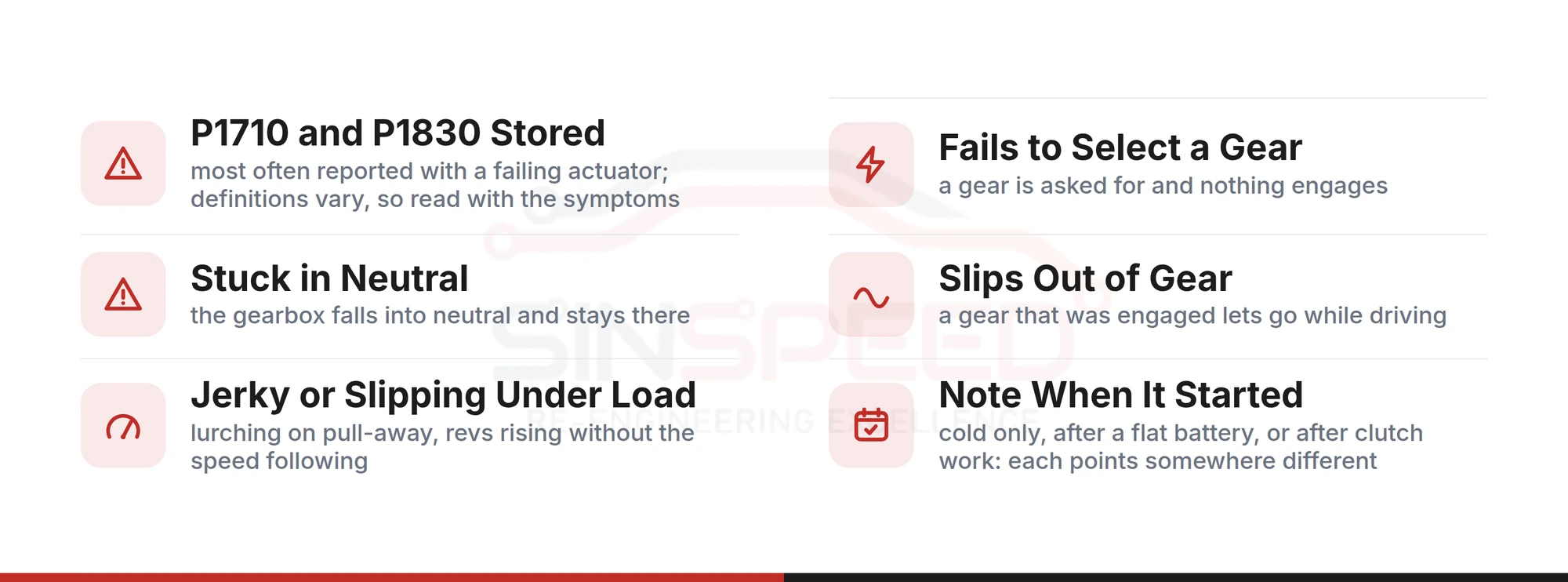
P1710 and P1830 are the codes Colt owners with the automated manual gearbox most often report alongside a failing clutch or gear actuator. Published definitions vary between sources, so we read them with the symptoms: no gear selection, sticking in neutral or dropping out of gear with either code stored points to the actuators.
The caution is needed because P1 codes are set by each manufacturer, and one number can mean different things on different vehicles. Generic code lists give P1710 to a transmission speed sensor or a hold-switch circuit, and P1830 to a transfer-case relay or a vehicle-speed coherence fault. A Mitsubishi document for a different model line reads P1710 as a vehicle speed signal fault. None of those matches what Colt owners describe.
| Code | What generic lookups say | What Colt owners report with it | First move |
|---|---|---|---|
| P1710 | A speed sensor, a speed signal or a hold-switch circuit, depending on the source | Gears that will not engage; the gearbox hanging in one gear, sometimes from cold; often stored with P1830 | Note whether it happens cold, hot or both, then have the actuators tested |
| P1830 | A transfer-case relay circuit or a vehicle-speed coherence fault, depending on the source | Gear changes refused and the car left in neutral, often with P1710 alongside | Check the battery and connectors, then have the actuators tested |
The pair together tells you more than either alone. Where both are stored and the car will not take a gear, the actuators are the first suspects. Write down every stored code exactly as the tool shows it, not only these two; our guide to clutch actuator fault codes covers the codes other automated manuals log.
What does a failing Colt actuator feel like?
Most owners meet an actuator fault as a gearbox that misbehaves, not as a code. These are the signs reported on Colts with this gearbox:
- Fails to select a gear. A gear is asked for and nothing engages, or the car will not move off.
- Stuck in neutral. The gearbox falls into neutral and stays there, at worst leaving the car immobile.
- Slips out of gear. A gear that was engaged lets go while you are driving.
- Jerky pull-away and changes. The car lurches as it moves off or as it shifts.
- Slipping under load. The revs rise without the speed following, typically uphill or accelerating hard.
- Hanging in a gear from cold. The gearbox sticks in one gear early in a journey, then recovers.
When the fault started matters as much as what it does. One that appears only from cold, one that began after a flat battery and one that followed clutch work each point somewhere different, so add that history to the repair form with the codes.
A gearbox that can let go of a gear on the move cannot be relied on in traffic. Until the codes have been read, avoid fast roads and junctions where you need to pull out quickly, or leave the car where it is.
Clutch actuator or gear actuator: which one has failed?
The two actuators split the work, so the symptoms lean one way or the other. They do not settle it, because a clutch that never fully releases also stops a gear from going in.
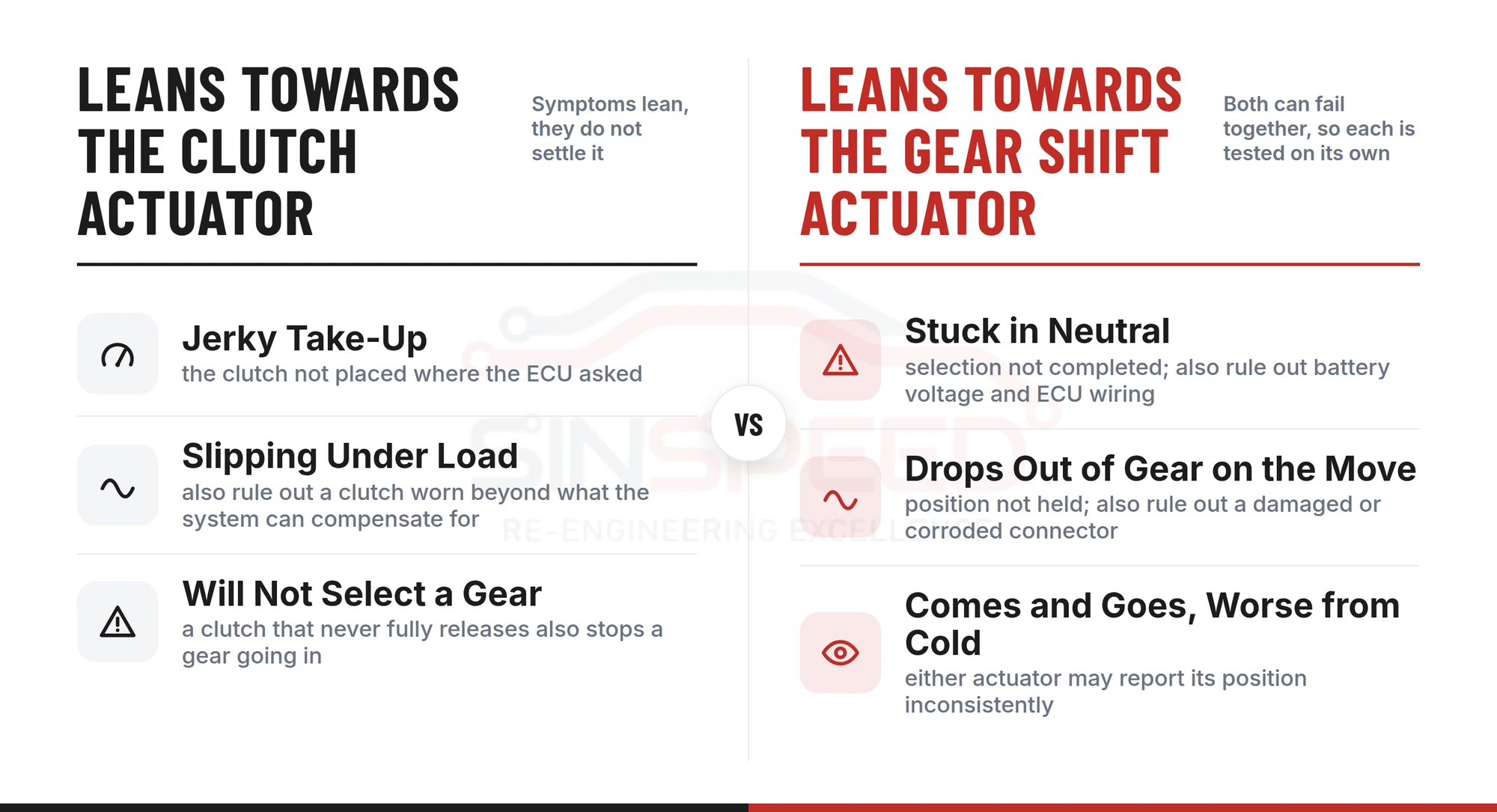
| What you notice | Leans towards | Also rule out |
|---|---|---|
| Jerky take-up, slipping under load | The clutch actuator not placing the clutch where the ECU asked | A clutch worn beyond what the system can compensate for |
| Will not select a gear, stuck in neutral | The gear shift actuator not completing the selection, or the clutch actuator not releasing | Battery voltage and the wiring to the gearbox ECU |
| Drops out of gear on the move | The gear shift actuator not holding its position | A damaged or corroded connector |
| Comes and goes, worse from cold | Either actuator reporting its position inconsistently | A weak battery or a poor earth |
Both can also be at fault. The two actuators have covered the same miles in the same conditions, and in some cases both have failed together. If the symptoms leave you unsure, send both: each is tested separately, and you hear which one was at fault, or whether both were, before any repair goes ahead.
Sinspeed · Colt automated manual
P1710 or P1830 stored and no gear?Put every code and a note of how the car behaves on the repair form, then have your garage post the actuator to our Epsom workshop. Undecided between the clutch actuator and the gear shift actuator? Ask us first.
Repaired by our own engineers in an ESD-safe, cleanroom-standard workshop
Why do Colt actuators fail?
Both actuators work every time the Colt moves off, changes gear or stops, with no driver input to share the load. These are the system-level causes that act on them.
Town driving multiplies the work. Stop-start journeys ask for far more clutch take-ups and gear changes per mile than a steady run, and each one is wear on the actuator making it.
Temperature swings beside the engine. Mounted on the gearbox, both units heat up and cool down on every journey. A fault that shows on a cold morning and fades once the car is warm fits that pattern.
The ECU only knows what the actuator tells it. The gearbox ECU acts on position information. If an actuator’s report drifts or drops out, the ECU can refuse a gear or fall back to neutral to protect the gearbox, which is why a degraded actuator feels so much like a failing gearbox.
Voltage, earths and connectors. An actuator needs a steady supply to reach position on time. A tired battery, a poor earth, or moisture and road salt at a connector can upset both the movement and the signals, and all three are quicker to check than removing a unit.
A wearing clutch shifts the goalposts. As the clutch wears, the point the clutch actuator has to reach moves. The system adapts for a long time, until clutch wear and actuator wear together take it past what it can correct.
That overlap is how Colts end up quoted for a gearbox or a clutch they did not need. Testing the actuators on their own settles it before anything else is replaced.
How we repair your Colt actuator by post
The repair is mail-order. Your garage looks after the car, and the actuator makes the journey to our workshop in Epsom.
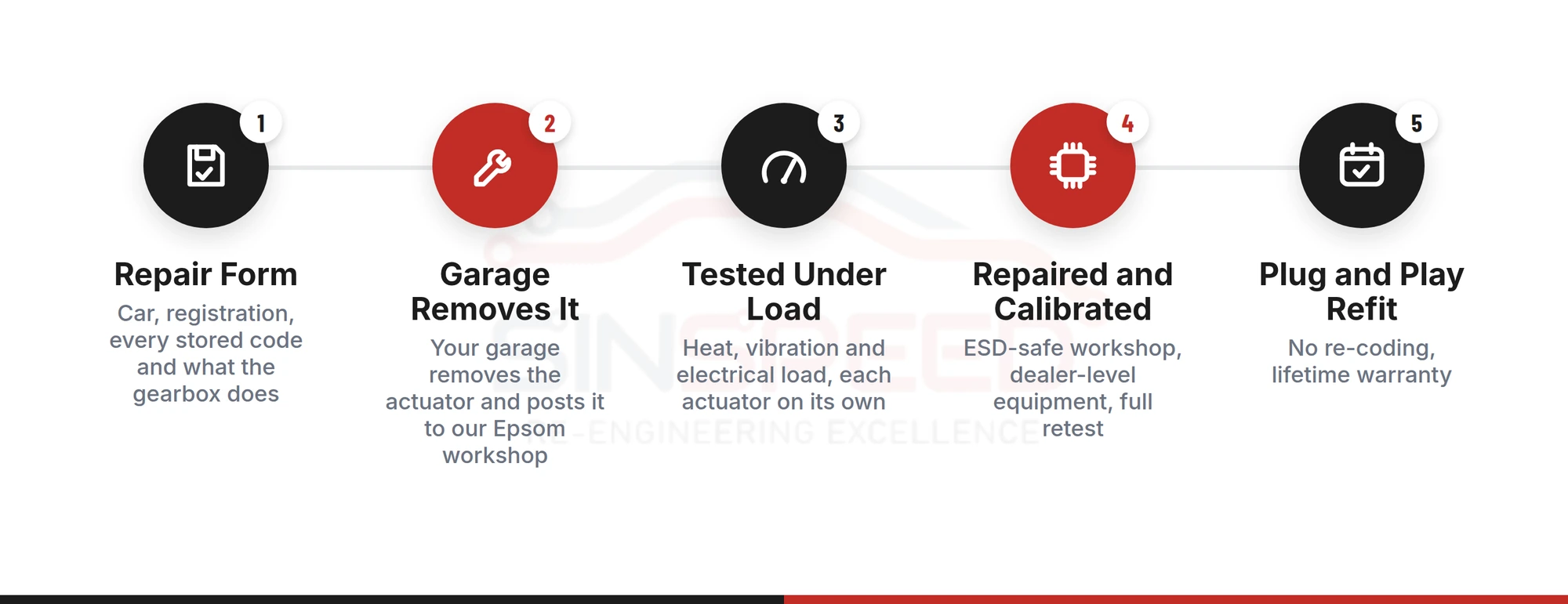
- Start with the repair form
List the car and registration, every stored code, what the gearbox does and when, and any clutch work done recently. Say whether you are sending the clutch actuator, the gear shift actuator or both, then print the form to go in the box.
- Removal by your garage
Taking an actuator off the gearbox and refitting it is routine work for a garage. Ask them to protect the connector, pack the unit firmly and post it to us.
- Tested as if it were still on the car
On our in-house Hardware-in-the-Loop platforms the actuator runs under the heat, vibration and electrical load of a working gearbox, while its movement and position reporting are measured until the reported fault shows itself.
- Repaired by our electronic engineers
The repair is carried out in an ESD-safe, cleanroom-standard workshop. The actuator is calibrated on dealer-level diagnostic equipment and runs the complete test sequence again before it is cleared to leave.
- Plug and play on refit
Your garage refits the actuator it removed. Because it is your Colt’s own unit, it needs no re-coding, and it is covered by our lifetime warranty.
Questions Colt owners ask
Final thoughts
P1710 and P1830 look alarming partly because the lookups disagree about them. On a Colt with the automated manual gearbox, the more useful reading is the one the car itself gives you: a gearbox that will not select, sticks in neutral or lets go of a gear, with those codes stored, is pointing at its actuators.
Rule out the battery and the connectors, think about whether the clutch has been touched recently, and test before replacing anything. If an actuator is at fault, the one already on the car is worth keeping: repaired, it goes back plug and play and is covered for life.
Sinspeed · Mitsubishi Colt actuators
Get your Colt choosing its gears againPut the codes and the symptoms on the repair form, then have your garage post the clutch actuator, the gear shift actuator or both to our Epsom workshop. Prefer to talk it through first? Message us before anything is removed.
Posted to our Epsom workshop · No re-coding on refit · Lifetime warranty