
Summary: Most 6-speed DSG gearbox problems on VW, Audi, SEAT and Škoda cars — jerky or harsh shifts, a flashing PRNDS display, a “Gearbox malfunction” warning, limp mode in a single gear — lead back to the gearbox ECU. On the wet-clutch DQ250 (gearbox code 02E) that ECU is the mechatronic unit: control electronics and hydraulic shift control built as one assembly inside the gearbox. It comes out at your garage with the gearbox left in the car, and we repair that same unit on the bench and send it back to be refitted.
- What does the DSG gearbox ECU do on a 6-speed DQ250?
- Which VW, Audi, SEAT and Škoda models use the 6-speed DQ250?
- What are the symptoms of a failing 6-speed DSG gearbox ECU?
- What does a “Gearbox malfunction” warning mean on a DSG?
- Why do 6-speed DSG gearboxes develop gearbox ECU faults?
- Why does a DSG gearbox ECU fault feel like worn clutches?
- VW Tiguan, Polo, Audi TT and other VW automatic gearbox problems
- How is a DQ250 mechatronic unit repaired?
- 6-speed DSG gearbox questions
- Final thoughts
What does the DSG gearbox ECU do on a 6-speed DQ250?
A DSG has two clutches and changes gear by handing drive from one to the other. Something has to decide when that handover happens and carry it out in a fraction of a second. On the DQ250 that job belongs to the mechatronic unit — which is what most people mean by the DSG ECU, or the Volkswagen DSG gearbox ECU.
It is two things in one housing. The electronic half reads road speed, engine load, throttle position and gearbox temperature, and decides which gear the car should be in. The hydraulic half turns that decision into oil pressure, which holds and releases both clutches and moves the selectors that engage each gear.
Because the two halves are built together and sit inside the gearbox casing, a fault in either one surfaces as a fault in the way the car drives. Nothing on the dashboard says “electronics”; the driver simply feels a gearbox that has stopped behaving.
The DQ250 is the wet-clutch DSG. Its clutch packs run in oil, and the mechatronic lives in that same environment, at that same temperature. That one detail explains a great deal about how this gearbox fails — and why its control faults so often pass for mechanical ones.
The unit also does a quieter job that matters at repair time. Over the car’s mileage it learns the gearbox it is fitted to — where each clutch starts to bite, how much pressure each change needs — and stores those values. Keep the original unit and you keep that learning.
Which VW, Audi, SEAT and Škoda models use the 6-speed DQ250?
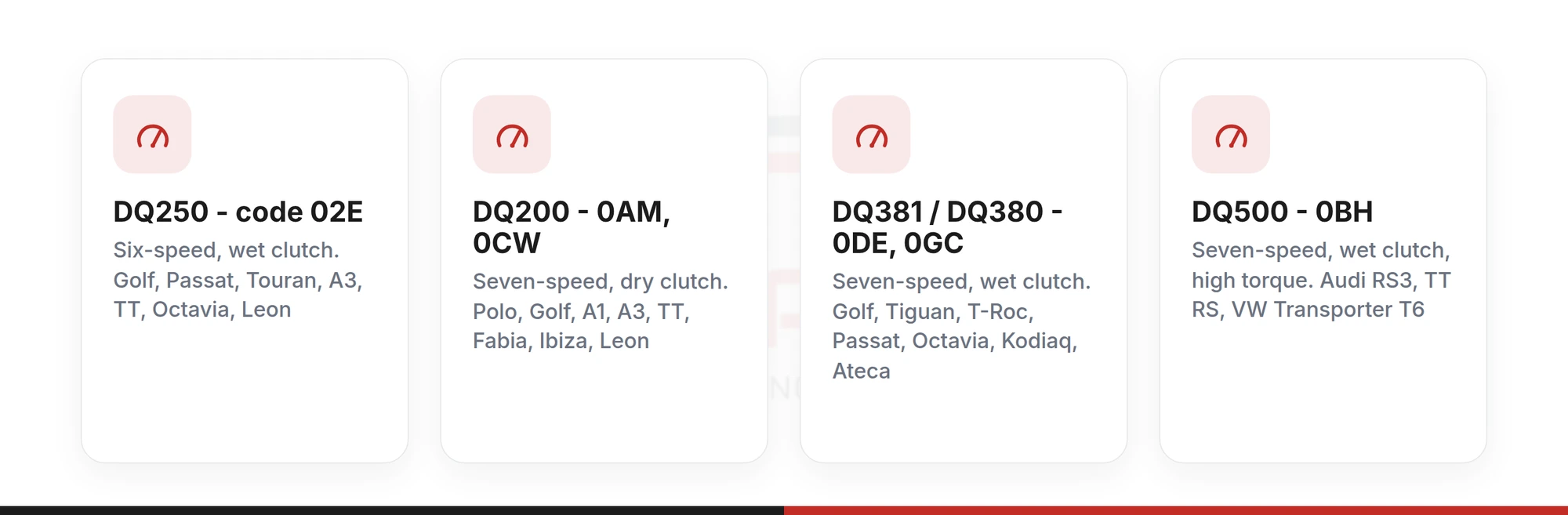
The Volkswagen Group fitted several DSGs under the same model names, chosen by engine, so the badge on the boot does not tell you which one you have. The DQ250 is the six-speed wet-clutch version, coded 02E. It appears in the VW Golf, Passat and Touran, the Audi A3 and TT, the Škoda Octavia and the SEAT Leon — and every one of those cars could also leave the factory with a different DSG behind a different engine.
| Gearbox | Gearbox code | Gears and clutches | Cars it appears in |
|---|---|---|---|
| DQ250 | 02E | Six-speed, wet clutch | Golf, Passat, Touran, A3, TT, Octavia, Leon |
| DQ200 | 0AM, 0CW | Seven-speed, dry clutch | Polo, Golf, A1, A3, TT, Fabia, Ibiza, Leon |
| DQ381 / DQ380 | 0DE, 0GC | Seven-speed, wet clutch | Golf, Tiguan, T-Roc, Passat, Octavia, Kodiaq, Ateca |
| DQ500 | 0BH | Seven-speed, wet clutch, high torque | Audi RS3, TT RS, VW Transporter T6 |
Counting the gears gives you a first answer: six forward gears behind a DSG badge points to the DQ250. It does not settle it on its own, because higher-output cars carry other variants. The gearbox code — in the car’s build data, or on the gearbox and the unit’s own label — is what confirms it. Send us that code with your enquiry and we will tell you which unit you are dealing with before anything is taken off the car.
What are the symptoms of a failing 6-speed DSG gearbox ECU?
A DQ250 with a failing mechatronic seldom stops dead without warning. It changes character first — gear changes that used to be invisible start to be felt — and the complaints then gather into a recognisable set.
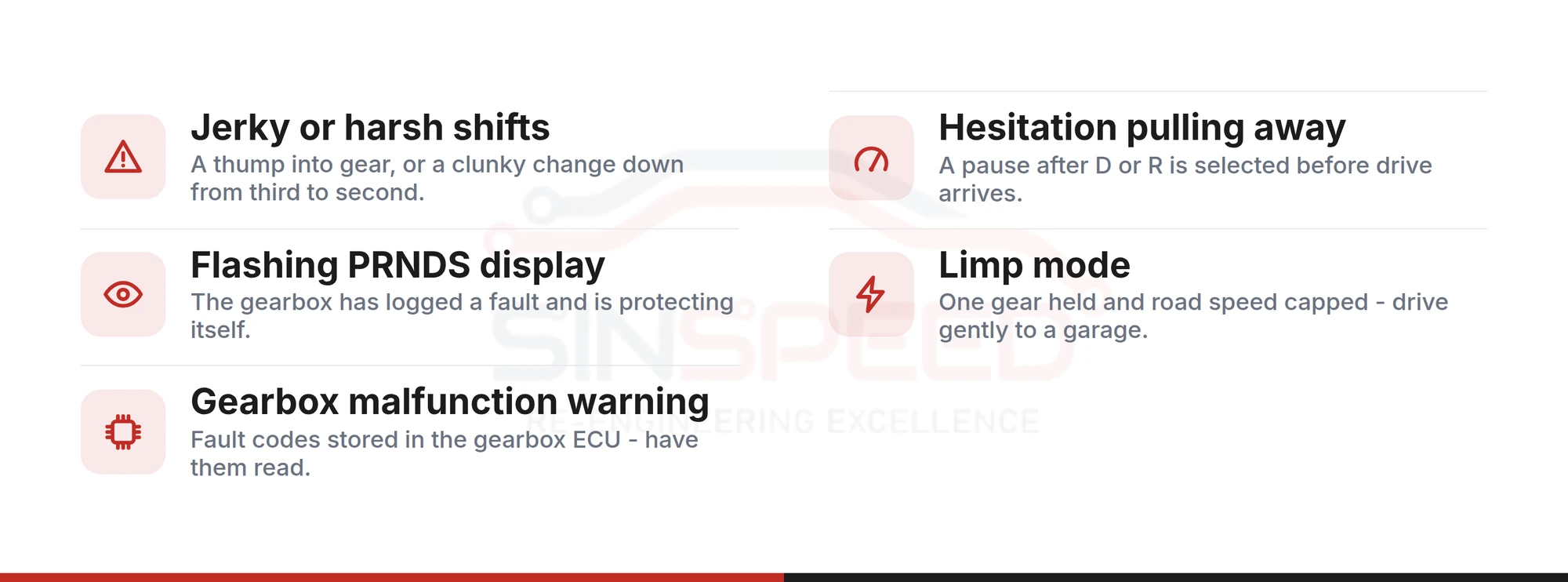
- Jerky or harsh shifts. A thump into gear, or a slam as the box changes down. The classic six-speed version is a clunky change from third to second and second to first, often with a judder in second.
- Hesitation pulling away. A pause of a second or more after D or R is selected before drive arrives, or a lazy, uneven take-up from a standstill.
- A flashing PRNDS display. The gear indicator in the instrument cluster flashes when the gearbox has logged a fault and is protecting itself.
- Limp mode. The box holds a single gear and caps road speed, so the car can be driven gently to a garage and no further.
- Missing gears. The odd-numbered or even-numbered gears disappear as a set, or reverse goes on its own.
- No drive. Drive drops out on the move, or the box will not leave park.
- A gearbox warning on the dash, with fault codes stored in the gearbox ECU.
Temperature is the clue owners most often miss. The DQ250’s electronics run at gearbox oil temperature and go through a full warm-up and cool-down on every journey, so its faults tend to be intermittent and heat-linked. A car that behaves from cold and turns awkward after a long motorway run is pointing at the unit. Write down when it happens — that pattern is evidence a later fault read cannot recover.
Limp mode exists to get you to a garage, not to be lived with. Expect the car to be slow and unpredictable pulling out of junctions and on to faster roads, and bear in mind that carrying on with the fault in place can damage more than the part that started it.
What does a “Gearbox malfunction” warning mean on a DSG?
A “Gearbox malfunction” message means the gearbox ECU has seen something outside its limits and stored a fault code. Sometimes the box carries on more or less normally; often it drops into a restricted mode at the same moment. Either way, a gearbox ECU malfunction warning is the point to have the codes read, not something to clear and forget.
On the DQ250, the codes that most often point at the mechatronic fall into a small group:
| Code | What it reports | What it suggests |
|---|---|---|
| P1815, P1820 | Pressure sensing inside the unit | The mechatronic can no longer measure the pressure it is controlling |
| P0746, P0776 | Pressure control | The unit’s command of clutch and shift pressure has gone out of range |
| P1604 | Control unit defective | The electronic half of the mechatronic itself |
Two cautions before any code is treated as a verdict. Low or degraded gearbox oil can set the same pressure codes as a failing unit, so have your garage confirm the level and condition first. And a code that clears and returns straight away is not old history — it is a live fault, found again the moment the unit checks.
A clean scan does not prove a healthy gearbox either. If the car is misbehaving with nothing stored, the symptoms and the conditions they appear in are still worth recording and sending to us. For codes on other gearbox families, our guide to mechatronic unit faults and symptoms works through them family by family.
Why do 6-speed DSG gearboxes develop gearbox ECU faults?
Few DQ250 units fail from a single event. They wear from where they sit and what they are asked to do, and three things account for most of it.
- Heat, every journey. The unit sits inside the gearbox and runs at its temperature — warming through each time the car is driven, cooling each time it is parked, and vibrated throughout. Age is really the count of those cycles, and it is why so many faults first appear with the gearbox hot.
- Oil condition and service history. On a wet-clutch gearbox the clutches run in oil, and the material they shed loads that oil over the miles. Tired, contaminated oil is harder on the hydraulic side of the unit, and on the DQ250 oil reaching the electronics is a common starting point for the faults that follow. A gearbox whose oil changes have been missed or stretched has been working its mechatronic harder than one serviced to the manufacturer’s schedule.
- How the car is used. Every pull-away, every creep forward in a queue and every gear change is work for the unit. Two cars on the same mileage can have asked very different things of it — one cruising on motorways, the other in stop-start traffic where the clutches are taken up and released over and over.
The common thread is control. Either the unit can no longer get the pressure it asks for, or it can no longer measure accurately what it got. Harsh changes, judder and limp mode follow from either one.
Why does a DSG gearbox ECU fault feel like worn clutches?
Slip, flare between gears and harsh take-up are what worn clutches feel like. They are also exactly what a mechatronic produces once it cannot judge what the gearbox is doing — which is why the first quote a DQ250 owner hears is so often for clutches, or for a gearbox.
The unit does not apply a fixed pressure and hope for the best. It commands a pressure, reads back what actually happened and corrects. Once the measuring side of that loop drifts, the unit is correcting against a wrong number, and clutches that may be in perfectly good order are applied too hard, too gently or at the wrong moment. From the driving seat, none of it feels electronic.
No road test separates the two. Codes narrow it a long way — pressure-sensing faults logged from inside the unit point firmly at the mechatronic — and a bench settles it, because the unit’s electrical and hydraulic behaviour is measured against known-good data instead of judged by feel. New clutches fitted behind a mechatronic that is misjudging pressure leave the cause in place, and the symptoms come back.
Sinspeed · DSG mechatronic repair
Find out whether it is the mechatronic before you pay for clutchesTell us the car, the gearbox code if you have it, the stored faults and the conditions the problem shows up in. We will tell you whether it reads as a mechatronic fault and exactly what your garage needs to take out.
Mail-in from anywhere in the UK · Most remanufactured parts carry a lifetime, unlimited-mileage warranty
VW Tiguan, Polo, Audi TT and other VW automatic gearbox problems
Most model-specific searches come down to one question: which gearbox is in this car? The answer decides which fault pattern you are actually looking at.
VW Tiguan gearbox problems
The Tiguan appears on the application list for the seven-speed wet DSG — the DQ381 or DQ380, codes 0DE and 0GC — rather than the six-speed DQ250. The faults known on that gearbox centre on how the unit senses clutch position, and they can show as a complete loss of drive or as a safe mode that limits revs and gear changes. Because engine choice decides the gearbox, confirm the code before leaning on any model-level advice, the Tiguan included.
VW Polo automatic gearbox problems
A Polo with a DSG is usually the seven-speed dry-clutch DQ200 — a different machine with its own fault pattern, covered in our guide to DQ200 gearbox problems.
Audi TT gearbox problems
The TT appears on the application lists for both the six-speed DQ250 and the seven-speed dry DQ200, while the TT RS uses the high-torque DQ500 (0BH). A TT with six gears and a wet-clutch box fits everything on this page; a seven-speed TT needs its gearbox code to say which one it is. All three are run by a mechatronic, and all three are units we repair.
VW automatic gearbox problems in general
Not every automatic VW or Audi is a transverse DSG. The larger longitudinal Audis — A4, A5, A6, Q5, S4 and S5 — use the seven-speed S tronic, and some models carry Multitronic or CVT transmissions. The symptoms overlap heavily: harsh or delayed changes, warning lights, limp mode, lost drive. Our VW and Audi DSG, Multitronic and CVT controller repairs page covers the control units across the range, and every unit of this kind we work on sits under our transmission control module repair services.
How is a DQ250 mechatronic unit repaired?
Only the mechatronic travels. It comes out of the gearbox casing at your garage, the gearbox and the car stay where they are, and the unit is posted to our workshop.
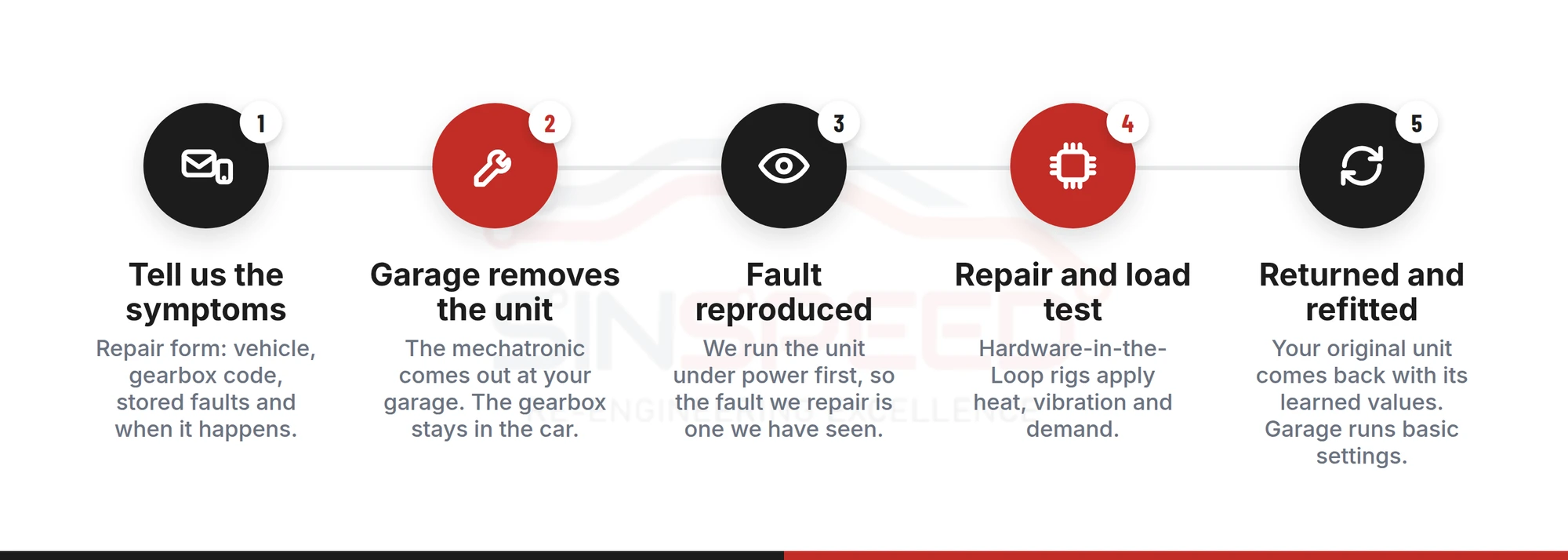
- Tell us what the car is doing
Complete the repair form with the vehicle, the gearbox code, the stored faults and when the problem appears. If the evidence points past the unit, we say so before you book the removal.
- The unit is sent in
Your garage packs and posts the mechatronic. Plan the removal and the refit as one booking around our turnaround, so the car is not left waiting twice.
- We reproduce the fault, then repair it
The unit is run under power before it is opened, so the fault we repair is one we have watched happen. The electronic and hydraulic halves are treated as one system, and the finished unit goes through our in-house Hardware-in-the-Loop rigs, which load it with the heat, vibration and demand it meets inside the gearbox.
- It returns with its own values
Being the same unit, it brings back the clutch bite points and pressure values it learned on your gearbox. A new mechatronic arrives blank and has to be programmed to the car.
Refitting completes the job. With the unit back in, the garage runs the gearbox’s basic settings and adaptations so unit and gearbox are matched again. That is a routine fitting step on any DSG mechatronic, new or repaired, it is part of the job, and we confirm what your car needs before the unit is dispatched.
- Unit: DQ250 (02E) mechatronic — the gearbox ECU and hydraulic control in one assembly
- Typical faults: pressure sensing and pressure control inside the unit, often heat- and oil-related
- What travels: the mechatronic only — the gearbox and the car stay with your garage
- Testing: fault reproduced first, then load-tested under simulated heat, vibration and demand
- Warranty: lifetime, unlimited-mileage on remanufactured parts
Where our work stops: worn clutch packs, damaged gears and internal gearbox rebuilds are mechanical gearbox work, and we do not carry them out. The mechatronic — the part behind most of the symptoms on this page — is what we repair, and if the codes or the bench point beyond it, you hear that from us first.
For the Golf specifically, the repair is also listed as our Volkswagen Golf DSG gearbox unit, which covers both the six-speed DQ250 and the seven-speed DQ200 in those cars.
6-speed DSG gearbox questions
Is the DSG gearbox ECU the same thing as the mechatronic unit?
On the 6-speed DQ250, yes. The gearbox ECU and the hydraulic control that carries out its decisions are built as one assembly — the mechatronic — which sits inside the gearbox casing. That is why it is repaired as one unit, and why a fault in its electronics can feel like a fault in the gearbox itself.
Can I keep driving with a flashing PRNDS or limp mode?
Only as far as a garage. Limp mode protects the gearbox by holding one gear and capping speed, which makes junctions and faster roads awkward. Driving on with the fault in place risks turning a unit repair into a bigger job, so have the codes read promptly.
Will a gearbox oil service fix a DQ250 fault?
It will not repair a mechatronic that has already degraded. It is still worth having the oil level and condition confirmed before anything is removed, because low or tired oil sets the same pressure codes as a failing unit — and on a wet-clutch gearbox, oil condition has a real bearing on how long the unit lasts. Which oil, and when, is for your garage to take from the manufacturer’s schedule.
Does the whole gearbox have to come out?
No. The gearbox stays in the car. Your garage takes the mechatronic out of the casing, posts it to us and refits it when it comes back. Where the unit sits changes the garage’s share of the job, not what we can do with the unit once it arrives.
Will the repaired mechatronic need coding?
No new coding, because it is your original unit and it keeps its software and learned values. After refitting, the garage runs the basic settings and adaptations that match unit and gearbox again — standard on any DSG mechatronic refit, and simply part of fitting the repaired unit.
How do I tell whether my car has the DQ250 or the DQ200?
Count the gears for a first guess: six points to the wet DQ250, while seven could be the dry DQ200 or one of the seven-speed wet gearboxes. The gearbox code confirms it — 02E is the DQ250, 0AM or 0CW the DQ200. It is in the car’s build data and on the unit’s label; send it with your enquiry and we will confirm which you have before any work starts.
Final thoughts
Two facts do most of the work on a 6-speed DSG: which gearbox is fitted, confirmed by its code rather than its badge, and which side of the control loop has given up. The car on its own cannot tell you the second, because a mechatronic that misjudges pressure drives exactly like a gearbox with tired clutches.
Codes, the pattern of when the fault appears and a bench test, taken in that order, remove most of the guesswork before anything is bought. And because these faults tend to start occasional and become constant, the intermittent stage is the best moment to act.
Sinspeed · mechatronic repair by post
Your DQ250 unit repaired — not swapped for a blank oneTell us the vehicle, the gearbox code and what the scanner is holding. If the mechatronic is behind it, your garage sends the unit and it comes back repaired, load-tested and still carrying what it learned on your gearbox.
Cleanroom-standard, ESD-safe workshop · Programmed and calibrated with dealer-level diagnostic tools · Lifetime, unlimited-mileage warranty