
 In short
The Vauxhall Corsa D ABS pump is one of the most common ABS failures in the UK. Every year, thousands of Corsa D owners discover the fault the hard way — the car veers sharply to the right under heavy braking with no warning light on the dashboard to warn them.
The cause is a known design flaw in the Bosch 8.0 hydraulic block fitted to all Corsa D models from 2006 to 2014. An internal valve fails, cutting hydraulic pressure to the near-side front (left front) calliper. No fluid reaches the calliper, the front left brake contributes nothing to the stop, and the car pulls hard toward oncoming traffic.
Replacing the unit with a new one from Vauxhall doesn’t solve the problem — new units carry the same design flaw. At Sinspeed we repair the fault and reinforce the known weak points, returning your unit with a lifetime unlimited-mileage warranty and no coding required.
Table of Contents
- The ABS Unit Fitted to the Vauxhall Corsa D
- The Primary Fault: No Fluid to the Front Left Calliper
- Other Faults and Symptoms
- How to Diagnose the Fault
- Why a New Unit Doesn’t Solve the Problem
- The Sinspeed Repair and Rebuild Service
- Is an Illuminated ABS Light an MOT Failure?
- FAQs
- Final Thoughts
The ABS Unit Fitted to the Vauxhall Corsa D
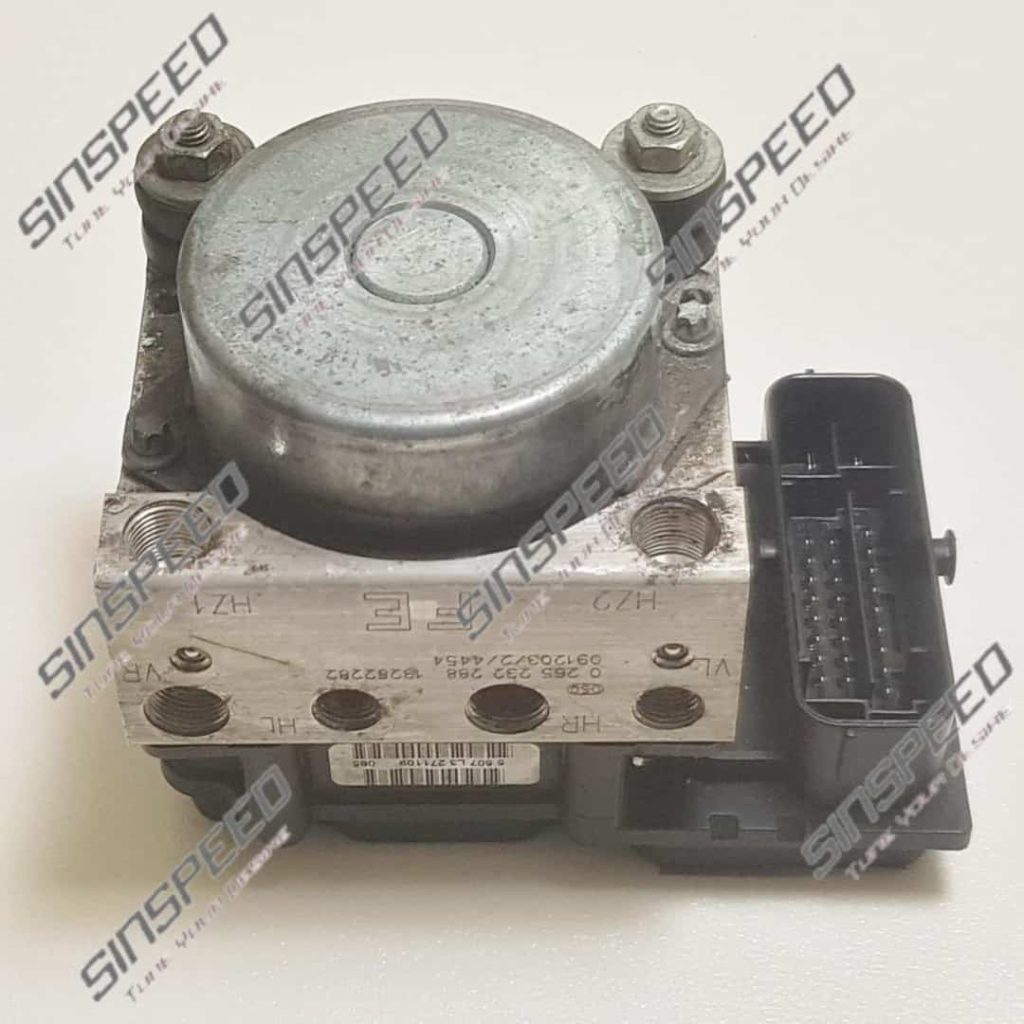
All Vauxhall Corsa D models built between 2006 and 2014 — across every engine size from the 1.0 ecoFLEX to the 1.6 VXR — are fitted with the Bosch 8.0 ABS unit. Depending on the trim level and specification, the unit is either the Bosch 8.0 without ESP (fitted to the majority of standard variants) or the Bosch 8.0 with ESP (fitted to higher-spec trims including the SXi, SE, and VXR).
| Unit | Fitted To | ESP? | Identifying Feature |
|---|---|---|---|
| Bosch 8.0 (no ESP) | Corsa D 2006–2014 — most variants | No | Part numbers often include suffix like ‘AQ’ or ‘FB’ |
| Bosch 8.0 (with ESP) | Corsa D 2006–2014 — higher-spec trims (SXi, SE, VXR) | Yes | Part numbers often include the suffix ‘AVT’; ESP/TC light on dash |
The ESP variant adds traction control and electronic stability functions on top of the standard ABS, but both variants share the same underlying hydraulic block design — and the same design weakness. The part numbers on your unit will help identify it: non-ESP units commonly carry the suffix AQ, AFA, FB or FE on the sticker. ESP-equipped units typically carry the suffix AVT.
For a full explanation of how the Bosch 8.0 unit works and what the three sub-assemblies inside it do, see our unit guide: Bosch 8.0 ABS Pump Faults & Repairs →
| Make | Model | Years | Engine Variants | ABS Unit |
|---|---|---|---|---|
| Vauxhall | Corsa D Hatchback (3-door) | 2006–2014 | 1.0 Twinport, 1.2 16v, 1.2 Twinport, 1.4 16v, 1.4 Twinport, 1.6 VXR, 1.3 CDTi, 1.7 CDTi | Bosch 8.0 |
| Vauxhall | Corsa D Hatchback (5-door) | 2006–2014 | 1.0 Twinport, 1.2 16v, 1.2 Twinport, 1.4 16v, 1.4 Twinport, 1.6 VXR, 1.3 CDTi, 1.7 CDTi | Bosch 8.0 |
| Vauxhall | Corsa D Van | 2006–2014 | 1.3 CDTi, 1.7 CDTi | Bosch 8.0 |
| Opel | Corsa D | 2006–2014 | All engine variants | Bosch 8.0 |
The Primary Fault: No Fluid to the Front Left Calliper
| ! SAFETY | This fault causes the vehicle to veer to the right under heavy braking. In the UK, this means pulling toward oncoming traffic. It can occur without any warning light on the dashboard. If you notice the car pulling under braking, do not ignore it — have it investigated immediately. |
The most common Corsa D ABS failure is not an electronic fault — it is a hydraulic one. Inside the ABS unit sits the hydraulic block: a precision-machined aluminium assembly containing the solenoid valves that control brake fluid pressure to each calliper independently. When the valves for the near-side front (left front) circuit fail or stick, fluid can no longer reach that calliper.
The result is that the front left brake contributes nothing during a stop. All braking effort falls to the other three wheels, and because the front right brake is still working hard while the left contributes nothing, the car pulls sharply to the right.
The critical detail that catches many owners and garages out: this fault rarely triggers a warning light. The ABS ECU does not always detect the hydraulic failure, so no fault code is stored and no amber warning light appears. The car brakes normally in routine driving. The fault only becomes apparent under heavier braking — often during an emergency stop, an MOT brake test, or when a mechanic notices uneven brake wear.
How garages can confirm this fault in 60 seconds
With the engine off and the brake fluid reservoir full, ask a mechanic to attempt to bleed each calliper in turn. If no fluid emerges from the near-side front bleed nipple despite a full reservoir and no visible external leaks, the ABS hydraulic block is the cause. The valve is stuck shut. No amount of bleeding, calliper replacement, or flexi hose replacement will fix this — the fault is inside the ABS unit.
The fault progresses if left unrepaired
In the early stages of the fault, brake imbalance may be mild and only apparent under hard braking. Over time, as the valve deteriorates further, the imbalance worsens. The front left calliper may begin to stick or bind in the opposite direction as residual pressure builds and cannot escape. In some cases, the wheel will eventually overheat. The pump motor can also be affected if the unit is left operating in a degraded state for extended periods.
Other Faults and Symptoms
While the hydraulic block valve fault is by far the most common Corsa D ABS failure, the Bosch 8.0 unit can fail in other ways. The table below covers all fault types we see at our workshop:
| Fault / Symptom | Warning Light? | Cause |
|---|---|---|
| No fluid to N/S/F (left front) calliper — vehicle pulls right under braking | No — often none at all | Internal valve fault in hydraulic block. Most common Corsa D fault. Part numbers often marked ‘AQ’ or ‘FB’. |
| No fluid to other callipers (O/S/F, rear) | Sometimes | Valve fault affecting different calliper circuit — less common but seen |
| ABS warning light on permanently | Yes — amber ABS light | ABS ECU fault, wheel speed sensor fault, or pump motor circuit fault (C1810) |
| No communication with ABS module (scanner shows U0121 or ‘no link’) | Yes — ABS + TC lights | Internal ECU failure — CAN communication lost |
| Brake pressure sensor fault (fault codes C0131 or similar) | Yes — ABS + ESP lights | Internal pressure sensor failure inside ECU (less common on Corsa D than on VAG / Ford MK60 units) |
| Pump motor running continuously / battery drain | Yes — ABS light | Internal relay or ECU fault commanding pump motor permanently |
The presence of warning lights does not necessarily indicate a more serious fault than their absence. As noted above, the most dangerous Corsa D ABS failure — the loss of fluid to the front left calliper — frequently produces no warning lights at all.
| Fault Code | Description | Likely Cause |
|---|---|---|
| No code stored | No fault codes present | Hydraulic block valve fault — most common Corsa D failure. No fluid from N/S/F bleed nipple. |
| C1810 | Pump Motor Circuit | Internal pump motor or relay fault inside ABS ECU |
| C0131 | Pressure Sensor Circuit Malfunction | Internal pressure sensor failure |
| U0121 | Lost Communication with ABS Module | Internal CAN transceiver failure in ABS ECU |
| C0035 | Wheel Speed Sensor Circuit – Front Left | External wheel speed sensor or wiring fault |
| C0040 | Wheel Speed Sensor Circuit – Front Right | External wheel speed sensor or wiring fault |
How to Diagnose the Fault
The Corsa D ABS fault is one of the more straightforward to confirm once you know what to look for. Work through these steps in order:
| Step | What to Do |
|---|---|
| 1. Check for warning lights | If there are no warning lights but the car pulls right under braking, the fault is almost certainly the hydraulic block valve — not the sensors or ECU. Do not be misled by an absence of lights into thinking the ABS is fine. |
| 2. Attempt to bleed all four brakes | Jack the car and attempt to bleed each calliper in turn. If you get no fluid from the near-side front (left front) bleed nipple despite a full reservoir and no visible leaks, the ABS block has a stuck or failed valve. This is diagnostic on its own. |
| 3. Scan with an ABS-capable tool | A generic OBD-II reader often cannot communicate with the Corsa D ABS module. Use Tech 2, Vauxhall-compatible scanners, or professional-grade tools (Autel, Launch). Note all fault codes before clearing anything. |
| 4. Check part number suffix | The part number sticker on the unit will show a suffix. Non-ESP units carry suffixes AQ, AFA, FB or FE. ESP units carry AVT. All variants are affected by the hydraulic block fault. Photograph the full part number before removing the unit. |
| 5. Do not replace callipers, pads, or flexi hoses | This fault is frequently misdiagnosed as a stuck calliper or kinked hose. If fluid is reaching the flexi hose but not exiting the bleed nipple, the ABS block is the cause — not the calliper. |
If scanning produces fault codes, cross-reference them against the fault table in Section 3. For no-communication faults (U0121 or similar), see our detailed guide: ABS Module No Communication Fault Diagnosis →
If the ABS light is on and you want to understand the reset process and what each fault code means: ABS Warning Light On? Causes, How to Reset & When You Can’t →
Why a New Unit Doesn’t Solve the Problem
The instinctive response to a faulty ABS unit is to replace it. For the Corsa D, this approach has a serious flaw: every new Bosch 8.0 unit supplied for the Corsa D contains the same hydraulic block design as the unit that failed. The valve configuration that caused the original failure is present in new units from the manufacturer.
This means fitting a new unit resolves the immediate problem but does not eliminate the risk of recurrence. The new unit carries the same design weakness and will, over time, be subject to the same failure mode. When it fails again, you face the same cost again — plus coding, plus labour.
| Option | Warranty & Coding | The Problem |
|---|---|---|
| New OEM unit from Vauxhall dealer | 1 year warranty. Coding required. | Contains the same hydraulic block design. The internal valve design flaw is present in new units too — repeat failure is a real risk. |
| Second-hand / scrapyard unit | 30–90 day warranty typically. Coding required. | Unknown history. Many scrapyard units were removed because they were developing the same fault. No meaningful warranty on a safety-critical component. |
| Sinspeed repair and rebuild service | Lifetime unlimited-mileage warranty. No coding required. | We repair the fault and reinforce known weak points — including upgrading components where appropriate — so the unit returns performing as it should, not just as it was. |
The case for having your original unit repaired and rebuilt is strong on every measure: warranty strength, turnaround time, and the elimination of the coding visit that a replacement unit always requires. Your original unit is already matched to your vehicle — it goes straight back in.
The Sinspeed Repair and Rebuild Service
Sinspeed has been repairing Vauxhall Corsa D ABS units since 2007. The Bosch 8.0 — in both its ESP and non-ESP variants — is one of the units we see most frequently, and our engineers know its failure modes inside and out.
When your Corsa D ABS unit arrives at our workshop, we:
- Test the unit on dedicated rigs that replicate real-world load and driving conditions — reproducing faults that bench testing alone would miss
- Identify the specific fault: hydraulic valve, pump motor, ECU circuit, pressure sensor, or communication failure
- Repair the fault and reinforce the known weak points in the Bosch 8.0 design, upgrading components to higher-rated specifications where appropriate
- Retest the unit after repair to confirm all faults are resolved and the unit performs correctly under load
- Return it to you ready to refit — plug straight back in, bleed the brakes, and drive away
No coding required. Because we are repairing your original unit — the one already matched to your vehicle — no dealer coding visit is needed on return. Your mechanic simply refits the unit and bleeds the system.
Lifetime unlimited-mileage warranty. Every Corsa D ABS repair at Sinspeed carries our lifetime warranty with no mileage cap and no hidden conditions. If the repair fails under normal use, we repair it again at no charge.
Typical turnaround: 2–3 working days from the date we receive your unit, returned via tracked courier.
To send your Corsa D ABS unit to us, you have three options:
- Have a question first? Call us on 0203 815 9441 or use our contact form and we’ll confirm coverage and answer any queries: Contact Us →
- Ready to send — pay after testing: Fill in our online repair form, print it off, pack it with your unit, and send it to us. We test first and contact you to confirm the fault before taking payment: Complete the Repair Form →
- Pay now and send: Select your vehicle year and pay in advance on our product page to get straight in the queue: Vauxhall Corsa D ABS Pump Repair — Pay Now →
| Suffix | OEM Part Number | Bosch Part Numbers | ESP? |
|---|---|---|---|
| AQ | 13236012 | 0265800422 / 0265231537 | No |
| AFA | 13378431 | 0265800983 / 0265232639 | No |
| FB | 13277812 | 0265800422 / 0265232238 | No |
| FB | 93192753 | 0265800422 / 0265232239 | No |
| FE | 13282282 | 0265800796 / 0265232288 | No |
| AVT | 13442015 | 0265952250 / 0265252688 | Yes |
Is an Illuminated ABS Light an MOT Failure?
Yes — for any Vauxhall Corsa D registered after 1 July 2003, an illuminated ABS warning light is an automatic MOT failure. The DVSA classifies it as a Major defect under the braking system category.
However, as noted throughout this guide, the most dangerous Corsa D ABS fault — the hydraulic block valve failure — often produces no warning light. A Corsa D with this fault can pass an MOT visual check without triggering a failure, yet be dangerous under heavy braking. The MOT brake efficiency test and a brake bleed test are the most reliable ways to identify the fault on a vehicle that shows no dashboard warnings.
For the full DVSA MOT rules and what to expect on test day: Is the ABS Light an MOT Fail? UK Rules Explained →
FAQs
My Corsa D pulls to the right when braking but there’s no ABS light. Could it still be the ABS pump?
Yes — and this is the most common presentation of the Corsa D fault. The hydraulic block failure does not always trigger a warning light. If the car pulls under braking and your mechanic cannot get fluid from the near-side front (left front) bleed nipple, the ABS unit is the cause.
Can I drive a Corsa D with this fault?
With caution, and only in the short term. The front left brake is contributing little or nothing to your braking effort. In routine driving at moderate speeds you may not notice much difference. In an emergency stop at speed, particularly in wet conditions, the vehicle can veer sharply to the right. This is dangerous and should be addressed promptly.
My mechanic has already replaced the calliper and flexi hose but the problem is still there. Why?
Because the fault is inside the ABS unit, not in the calliper or hose. This is an extremely common misdiagnosis. Fluid is not reaching the calliper because the ABS hydraulic block has a failed valve — no external brake component change will fix this. The ABS unit itself needs to be repaired.
Will the same fault happen again after repair?
Not if the repair addresses the root cause rather than just the symptom. At Sinspeed we repair the fault and reinforce the known weak points in the Bosch 8.0 design. This is why we back every repair with a lifetime warranty — we are confident the fault will not recur under normal use.
Does a Corsa D ABS repair require coding after refitting?
No. Because we are repairing your original unit, it retains its existing vehicle-matched configuration. Your mechanic simply refits the unit and bleeds the braking system. No diagnostic interface or dealer coding visit is required.
How long does the repair take?
Typically 2–3 working days from the date your unit arrives at our workshop. We contact you as soon as testing is complete and the unit is on its way back.
My part number isn’t in your list — can you still repair it?
Almost certainly yes. The part number table covers the most commonly seen numbers but is not exhaustive — we have repaired well over 200 distinct Corsa D ABS part numbers. If you’re unsure, call us on 0203 815 9441 with your part number and we’ll confirm within minutes.
What’s the difference between the Corsa D and Corsa E ABS fault?
The Corsa E (2014–2019) uses a different ABS unit and has a different primary failure mode — typically brakes that stick or bind after braking rather than the no-fluid-to-calliper fault seen on the D. We offer a separate repair service for the Corsa E.
Can you repair the Corsa D ABS pump if it has no communication?
Yes. No-communication faults on the Corsa D are repairable and are caused by internal ECU failure rather than external wiring in most cases. For a detailed explanation of how we diagnose and repair no-communication faults: ABS Module No Communication Fault Diagnosis →
Final Thoughts
The Vauxhall Corsa D ABS fault is well-documented, widespread, and entirely repairable. What makes it particularly important to address promptly is that the most dangerous version — the hydraulic block valve failure that removes braking force from the front left calliper — gives almost no warning. No light, no noise, no obvious symptom in everyday driving. It shows up when you need it least: in an emergency stop.
If your Corsa D is pulling to one side under braking, or your mechanic has found no fluid at the front left bleed nipple, the ABS unit needs attention. Replacing callipers, hoses, and pads will not cure it. Fitting a new unit from the dealer reintroduces the same design flaw at significant cost. The most cost-effective, reliable, and warranty-backed route is to have your original unit repaired and rebuilt by a specialist.
Sinspeed has been repairing Corsa D ABS units since 2007. Send your unit to us and we’ll have it back with you, fully repaired and tested, in 2–3 working days — backed by our lifetime, unlimited-mileage warranty.
- Have a question first? Contact us →
- Pay after testing: Fill in the Repair Form →
- Pay now and send: Vauxhall Corsa D ABS Pump Repair — Pay Now →
Browse all Vauxhall & Opel ABS repairs →
ABS warning light on? Full diagnosis guide →
Sinspeed · bench repair and return
A new Bosch 8.0 arrives with the same design flawThat is the difficulty with this particular fault: fitting a new or used unit puts the same hydraulic block back on the car, and the valve that starved your front left calliper is the same valve in the replacement. We repair the failure and reinforce the point it fails at, so the unit going back on your Corsa D is not the one that failed you. Send us the unit, or if you are not yet certain the ABS block is what is causing the pull, describe what the car does under braking and our engineers will tell you what to check first.
Repaired at component level and the known weak point reinforced, not swapped for a donor block · Bench-tested on in-house Hardware-in-the-Loop rigs that simulate real heat, vibration and load · Most remanufactured parts carry a lifetime, unlimited-mileage warranty and go back ready to fit with no coding required