
Summary:
If your ABS warning light has come on and stayed on, the ABS pump and module is one of the first places to look. It is the electro-hydraulic heart of your vehicle’s anti-lock braking system: it monitors four wheel-speed sensors hundreds of times per second and, the instant it detects a wheel approaching lock-up, modulates brake pressure on that wheel through a set of solenoid valves — keeping you in control even during an emergency stop on wet tarmac.
The unit itself contains three integrated sub-assemblies: the pump motor, the hydraulic control unit (HCU) with its solenoid valve block, and the ABS ECU. Failure in any one of these triggers the amber ABS warning light. The most commonly seen units in the UK — the Bosch 8.0 and ATE Teves MK60/MK70 — share well-documented failure modes: internal brake pressure sensor fault, pump motor circuit failure, and loss of CAN-bus communication.
When the module faults it shuts the anti-lock system down. Your normal brakes still stop the car, but ABS will not intervene in an emergency — and the vehicle will fail its MOT with the light on. This guide explains what the ABS pump does, what lives inside it, the signs it is failing, what actually causes those failures, and how a faulty unit is repaired. ABS pumps and modules are core work at Sinspeed: our in-house hydraulic and electronic engineers strip, test and remanufacture them at circuit-board level, for every make from Vauxhall and Ford to Audi, BMW and Mercedes.
If your ABS light is on or your brakes feel unresponsive, explore our ABS pump and module repair services or send us your unit for diagnosis — every repair carries a lifetime, unlimited-mileage warranty.
Table of Contents
- What Is an ABS Pump?
- The Three Sub-Assemblies Inside Every ABS Unit
- How the ABS System Works Step by Step
- ABS and Related Safety Systems (ESP, EBD, TCS)
- The Most Common ABS Units on UK Roads
- Warning Signs of a Failing ABS Pump or Module
- What Causes an ABS Pump or Module to Fail?
- Is It the Pump — or an ABS Sensor?
- Does the ABS Light Fail an MOT?
- How Sinspeed Remanufactures ABS Units
- FAQs
- Final Thoughts
What Is an ABS Pump?
The ABS pump — more accurately described as the ABS pump and module, or ABS hydraulic modulator — is the electro-hydraulic core of your vehicle’s anti-lock braking system. It sits between the brake master cylinder and the individual brake callipers, and its job is to independently control the hydraulic pressure delivered to each wheel the instant a lock-up is detected.
In normal driving it sits dormant. The moment you brake hard and a wheel begins to slow faster than the others — a sign it is about to lock — the unit springs into action, cycling brake pressure on that wheel many times per second to maintain traction without transferring full braking force to a locked wheel. The result is that you keep both braking efficiency and steering control, even in a panic stop on wet or icy tarmac.
ABS became a mandatory requirement on all new UK cars from 2004. Any vehicle registered from that point must have a fully operational ABS system to be road-legal and to pass its MOT. On vehicles registered before 2004, the presence of ABS is less common — but if it is fitted and faulty, it must still be repaired.
The Three Sub-Assemblies Inside Every ABS Unit
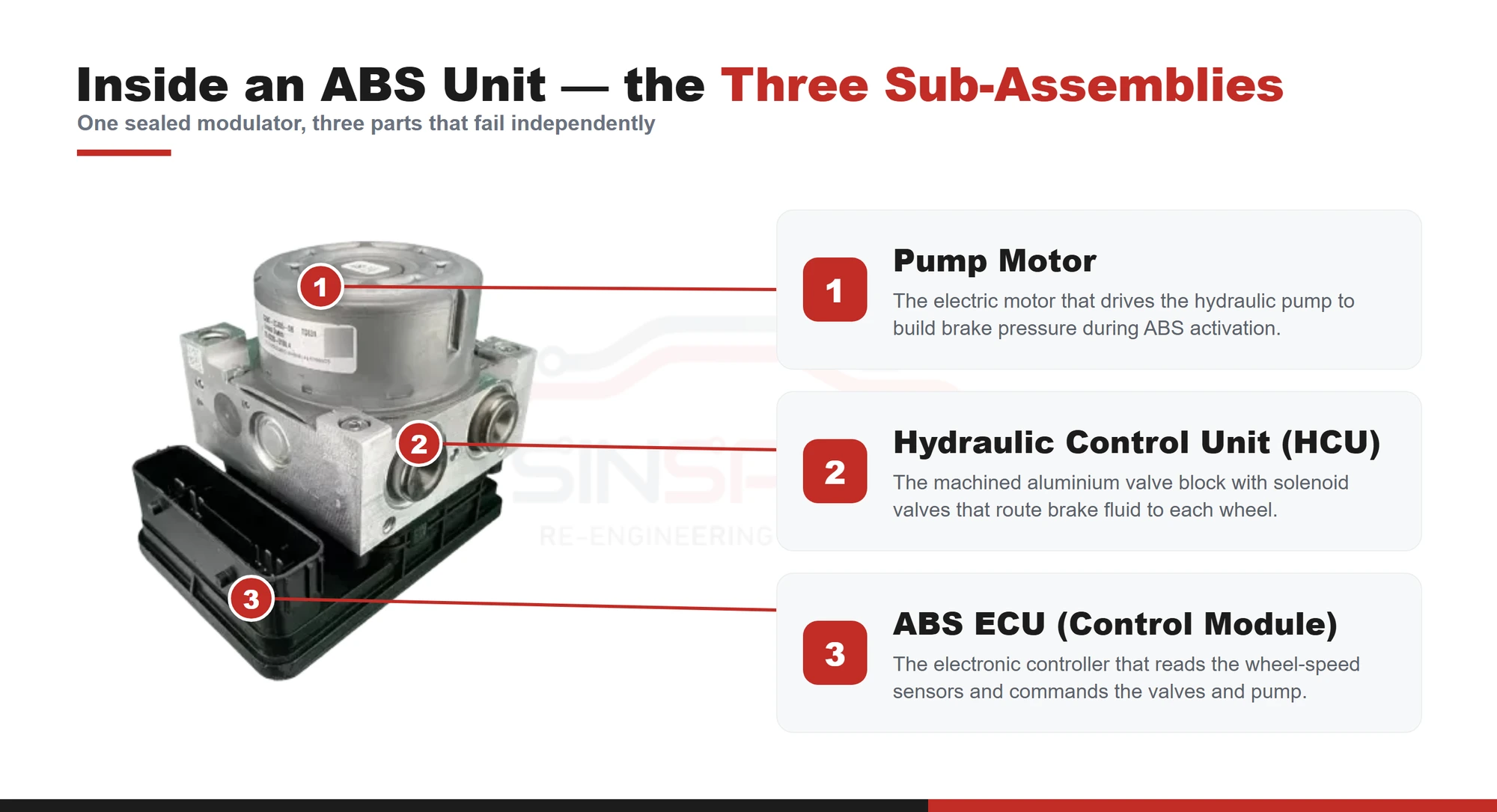
Although drivers and even mechanics sometimes talk loosely about ‘the ABS pump’, the unit fitted to your vehicle is far more than a pump alone. Every modern ABS unit integrates three distinct sub-assemblies into a single sealed housing:
The Pump Motor
A small electric motor that drives a piston or gear arrangement to restore hydraulic pressure to the brake lines after a solenoid valve has released it during an ABS event. The pump can cycle many times per second, which is the rapid pulsing sensation drivers feel through the brake pedal when ABS activates. Pump motor wear or burnout — often caused by age, voltage fluctuation, or running continuously due to an ECU relay fault — is one of the most common ABS failures we see.
The Hydraulic Control Unit (HCU)
The HCU is a precision-machined aluminium block that contains all of the solenoid valves — typically one inlet and one outlet valve per wheel, four wheels meaning eight valves in a standard four-channel system. Each valve can open, close, or partially restrict in milliseconds to independently modulate brake pressure on its assigned wheel. The internal channels of the HCU are narrow and precise; contaminated or degraded brake fluid can cause partial blockages or valve stiction that prevent correct modulation.
The ABS ECU (Electronic Control Unit / Control Module)
The ECU is the decision-making brain. It receives real-time rotational speed data from the wheel-speed sensors on all four wheels, processes it many times per second, and commands the solenoid valves and pump motor accordingly. The ECU also communicates with the vehicle’s broader CAN (Controller Area Network) bus — sharing data with the engine management system, stability control, and instrument cluster (including the speedometer). ECU failure modes include internal brake pressure sensor faults, corroded circuit board traces, damaged circuitry from heat cycling, and complete loss of CAN communication.
These three sub-assemblies are almost always sealed together in a single unit. This is why diagnosis and repair requires specialist knowledge and equipment — you cannot simply swap one sub-assembly in isolation without understanding how the failure of one affects the others.
How the ABS System Works Step by Step
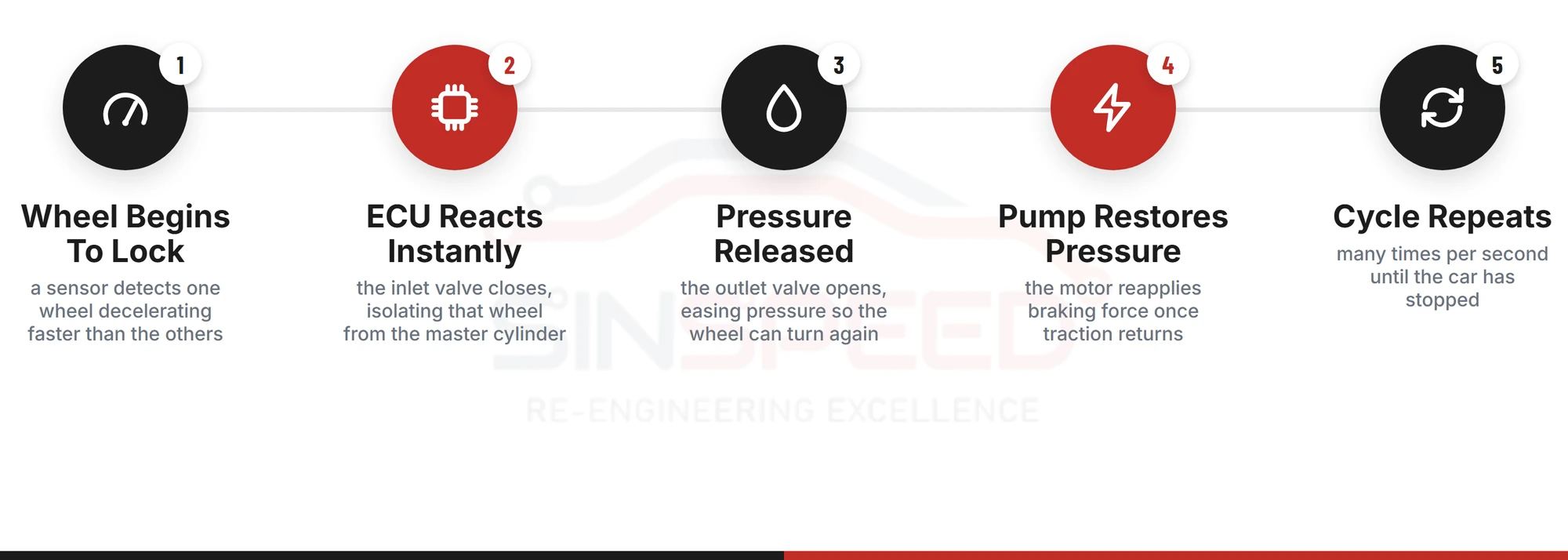
The following describes the sequence of events during a typical ABS activation:
- You apply the brakes forcefully. Hydraulic pressure from the master cylinder travels to all four callipers simultaneously.
- The four wheel-speed sensors (one at each wheel) continuously send rotational speed data to the ABS ECU. Normal braking causes all wheels to decelerate at a similar rate.
- One wheel begins decelerating significantly faster than the others — the tell-tale sign it is approaching lock-up. The ECU detects this within milliseconds.
- The ECU commands the inlet solenoid valve on that wheel to close, isolating it from the master cylinder so the driver pressing harder on the pedal cannot add more pressure to that wheel.
- If the wheel continues to decelerate, the ECU opens the outlet valve, releasing some brake pressure from that wheel into an accumulator.
- The wheel speeds up slightly (recovers traction). The ECU then closes the outlet valve and commands the pump motor to restore pressure, re-applying braking force to that wheel.
- This cycle — pressure reduction, hold, pressure restore — repeats many times per second for as long as a lock-up risk is detected. The driver feels this as the characteristic pulsing in the brake pedal.
- Once the vehicle has slowed sufficiently or the driver releases the pedal, the ECU returns all valves to their resting positions and the pump stops.
On loose surfaces like gravel or deep snow, the ABS may actually increase stopping distance compared to locked wheels, which can dig in and create a wedge effect. For this reason some vehicles fitted with off-road modes allow ABS to be reduced or disabled in specific conditions — but on tarmac and in wet conditions, ABS consistently shortens stopping distances and, critically, maintains steering control throughout.
ABS and Related Safety Systems (ESP, EBD, TCS)
The ABS pump and module does not work in isolation. Modern vehicles layer several safety systems on top of it, all using the same underlying hardware:
- Electronic Brakeforce Distribution (EBD): Automatically adjusts the split of braking force between front and rear axles depending on load, preventing the rear wheels from locking before the fronts under normal braking.
- Traction Control System (TCS): Uses the wheel-speed sensors and, in most implementations, the same ABS hydraulic unit to apply braking force to a wheel that is spinning during acceleration — restoring traction without the driver needing to lift off.
- Electronic Stability Programme (ESP / ESC): Combines ABS and TCS with yaw-rate and lateral acceleration sensors to detect and correct oversteer or understeer, applying braking force to individual wheels to bring the vehicle back in line. ESP became mandatory on all new EU-type-approved cars from 2014.
Because all of these systems share the ABS pump and its wheel-speed sensors, a single fault in the ABS module frequently triggers warning lights for two or more of them simultaneously. Seeing the ABS light and the traction control or ESP light on together is not a sign of multiple failures — it is usually one fault in the shared unit disabling everything that depends on it.
The Most Common ABS Units on UK Roads
Two manufacturers — Bosch and Continental (formerly ATE / Teves) — supply the vast majority of ABS units to vehicle manufacturers. Understanding which unit is fitted to your vehicle matters for diagnosis, because each generation has its own documented failure patterns:
| ABS Unit | Commonly Fitted To | Most Frequent Fault |
|---|---|---|
| Bosch 8.0 | VW, Audi, Seat, Skoda, Ford, Mazda, Volvo | Brake pressure sensor fault (code 01435) |
| ATE Teves MK70 | Ford, Mazda, Renault, Suzuki, Fiat, Peugeot, Citroën | Wheel sensor signal / no CAN communication |
| ATE Teves MK60 | VW Golf, BMW E46, Peugeot 206/207, Volvo S70/V70 | Brake pressure sensor / no communication (01130, 01276) |
| Bosch 5.3 / 5.7 | BMW, Mercedes, Volvo, Ford, Renault | No communication fault / ABS light on |
| Bosch 9.0 / MK100 | VW, Audi, Seat, Skoda, Ford, Mazda, Nissan, Opel, Renault, Vauxhall + more | Brake Booster Fault (C123EF0), Pump motor fault / CAN communication loss, Internal Valve Failure |
The Bosch 8.0 is particularly widespread across the VAG Group (Volkswagen, Audi, Seat, Skoda) and is notorious for internal brake pressure sensor failure — stored as fault code 01435 in VAG vehicles. The ATE Teves MK70 appears in a huge range of mass-market vehicles and most commonly fails with wheel-sensor communication faults or complete loss of CAN communication with the diagnostic scanner.
At Sinspeed, units from every generation in the table above arrive at our workshop daily. Part number identification is critical — the same vehicle model can be fitted with different ABS units across production years, and each has its own repair process.
Warning Signs of a Failing ABS Pump or Module
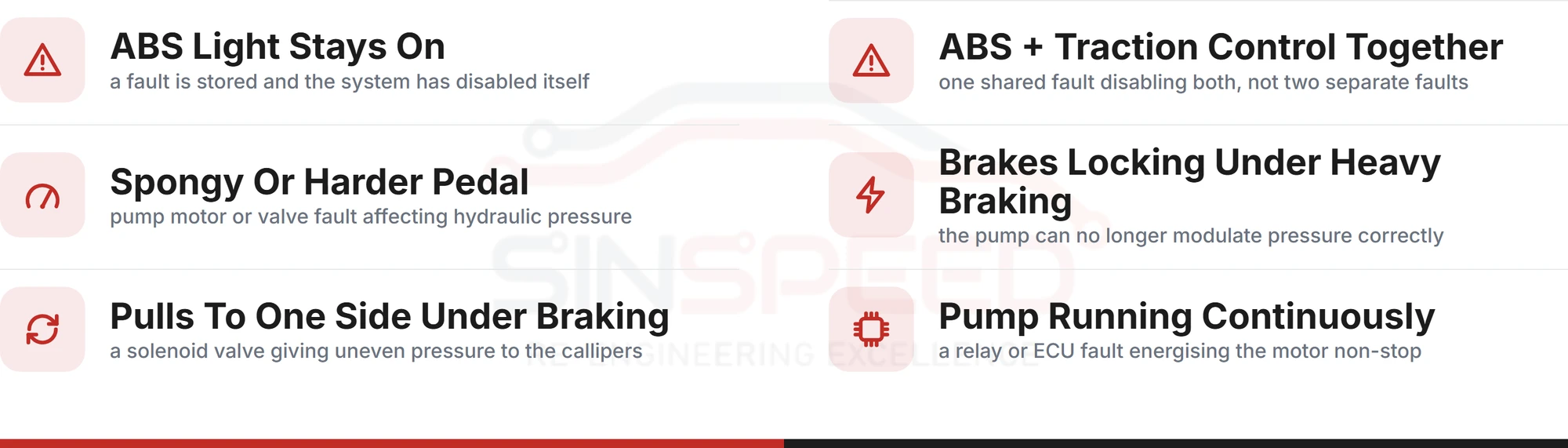
ABS pump failure rarely happens overnight. Faults typically develop gradually, with symptoms worsening as the unit degrades further. Here are the warning signs our engineers see most frequently:
| Symptom | What It Means | Urgency |
|---|---|---|
| ABS warning light stays on | Fault stored in the control module — system has disabled itself | Diagnose promptly |
| Both ABS + traction control lights on | Single fault affecting shared module/sensors — very common | Diagnose promptly |
| Brake pedal feels spongy or requires more effort | Pump motor or solenoid valve fault affecting hydraulic pressure | High — do not delay |
| ABS activates during normal, gentle braking | Corrupted sensor data or ECU fault causing false activation | High — check soon |
| Brakes locking up under heavy braking | Pump cannot modulate pressure — ABS has failed | Immediate |
| Vehicle pulls to one side under braking | Solenoid valve failure — uneven pressure to callipers | Immediate |
| Pump running continuously / battery drain | Internal relay or ECU fault — motor energised permanently | Immediate |
| Speedometer reading incorrectly or dropping to 0 | Wheel-speed sensor data feeding speedo has been corrupted | Diagnose promptly |
The ABS warning light is almost always the first sign, and it should never be dismissed as a minor issue. Once the control module stores a fault and disables the system, no amount of scanner resets will cure it unless the underlying fault is repaired. The light will always return.
Symptoms tell you the system has shut down, but not why it shut down — and the why is what decides whether a replacement unit will last. That is covered next. If you would rather go straight to the units and models we repair, they are listed on our ABS pump and module repair services page.
What Causes an ABS Pump or Module to Fail?
Almost every ABS fault we see traces back to one of six mechanisms. Knowing which one you are dealing with matters, because it also tells you whether the same failure is waiting to happen to whatever you fit next.
Solder-Joint Fatigue from Thermal Cycling
The ABS unit lives in the engine bay and cycles from cold start to full under-bonnet heat on every journey. The circuit board inside expands and contracts with it, and over enough cycles the solder joints — particularly the heavy-current joints feeding the pump motor and the valve solenoids — develop fatigue cracks. The result is an intermittent connection that logs as a motor-circuit or valve-circuit fault, often appearing and clearing with temperature for a long time before it fails for good.
Moisture Ingress and Corrosion
The multi-pin connector on top of the ABS unit is sealed, but seals harden and perish with age. Once moisture gets past one — or wicks in along the loom from a chafed outer sheath — it corrodes the connector pins and can track onto the circuit board itself. Corrosion on the board’s copper traces introduces resistance where there should be none, and on a unit switching solenoids in milliseconds that is enough to store a fault and disable the system. Corrosion is progressive, which is why it usually shows as an intermittent fault long before it becomes a permanent one.
Pump Motor Brush and Armature Wear
The pump motor is a DC motor running carbon brushes on a commutator. It only runs during ABS events, so on a healthy car it accumulates very little running time. But where a relay or ECU fault leaves the motor energised continuously, wear that should have taken the life of the vehicle happens in days — and the carbon dust the brushes shed can bridge commutator segments and short the armature. A pump you can hear running with the car sitting still, or a battery that keeps going flat overnight, points straight here.
Solenoid Valve Sticking in the HCU
The HCU’s solenoid valves move in precision bores with very fine clearances. Brake fluid is hygroscopic — it absorbs water from the atmosphere — and fluid left beyond its change interval carries both that moisture and the corrosion products and debris it creates. Those particles settle in the valve bores and the narrow galleries around them, and a valve that sticks even slightly can no longer modulate pressure properly.
This is one of the harder ABS faults to pin down, because there may be no electrical fault for the ECU to store at all: it commands the valve, the valve responds sluggishly, and you feel a soft pedal or a pull under braking while a scan shows nothing. Keeping to the manufacturer’s brake-fluid change interval is the single most effective thing an owner can do to prevent it.
Internal ECU Track and Pressure-Sensor Damage
The brake pressure sensor inside the ECU sits under constant thermal stress, and on the Bosch 8.0 it is the single best-known weak point — it stores fault code 01435 on VAG vehicles and takes the ABS offline permanently. No reset will clear it, because the sensor circuit itself has failed. Alongside it, the fine copper tracks on the board can lift or crack where heat cycling and vibration have worked on them, and the ECU’s internal supply circuitry degrades in the same environment.
Loss of CAN-Bus Communication
The ABS ECU is a node on the vehicle’s CAN bus, sharing wheel-speed data with the engine management, stability control and instrument cluster. When its internal CAN transceiver fails — or board damage reaches the communication circuitry — the unit stops answering the diagnostic scanner altogether. That is the classic ‘no communication with ABS module’ result, and it is the most common failure mode on ATE Teves MK70 units. It is frequently misread as a scanner problem or a wiring fault when the transceiver inside the module has failed.
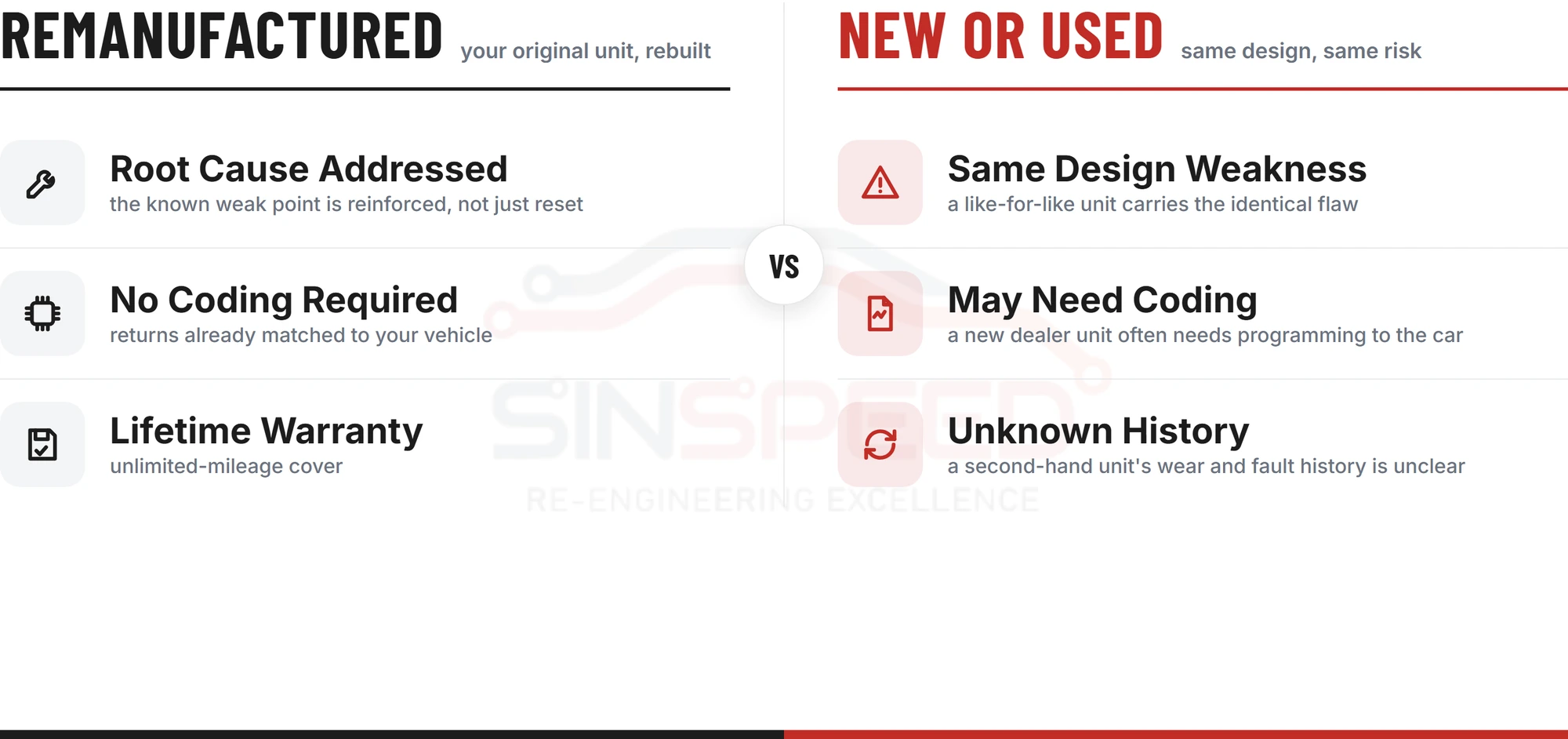
What almost all of these have in common is that they are design and environment related rather than anything the driver did wrong — a solder joint that was always going to fatigue, a seal that was always going to perish, a pressure sensor that was always the weak point of that generation. That matters when you decide what to do about a failed unit: a like-for-like new or second-hand module carries the same weakness and will, in time, go the same way. Remanufacture is the chance to address the cause — reinforcing the joints that crack, replacing the parts that wear, and clearing the corrosion path rather than just resetting the light.
Is It the Pump or an ABS Sensor?
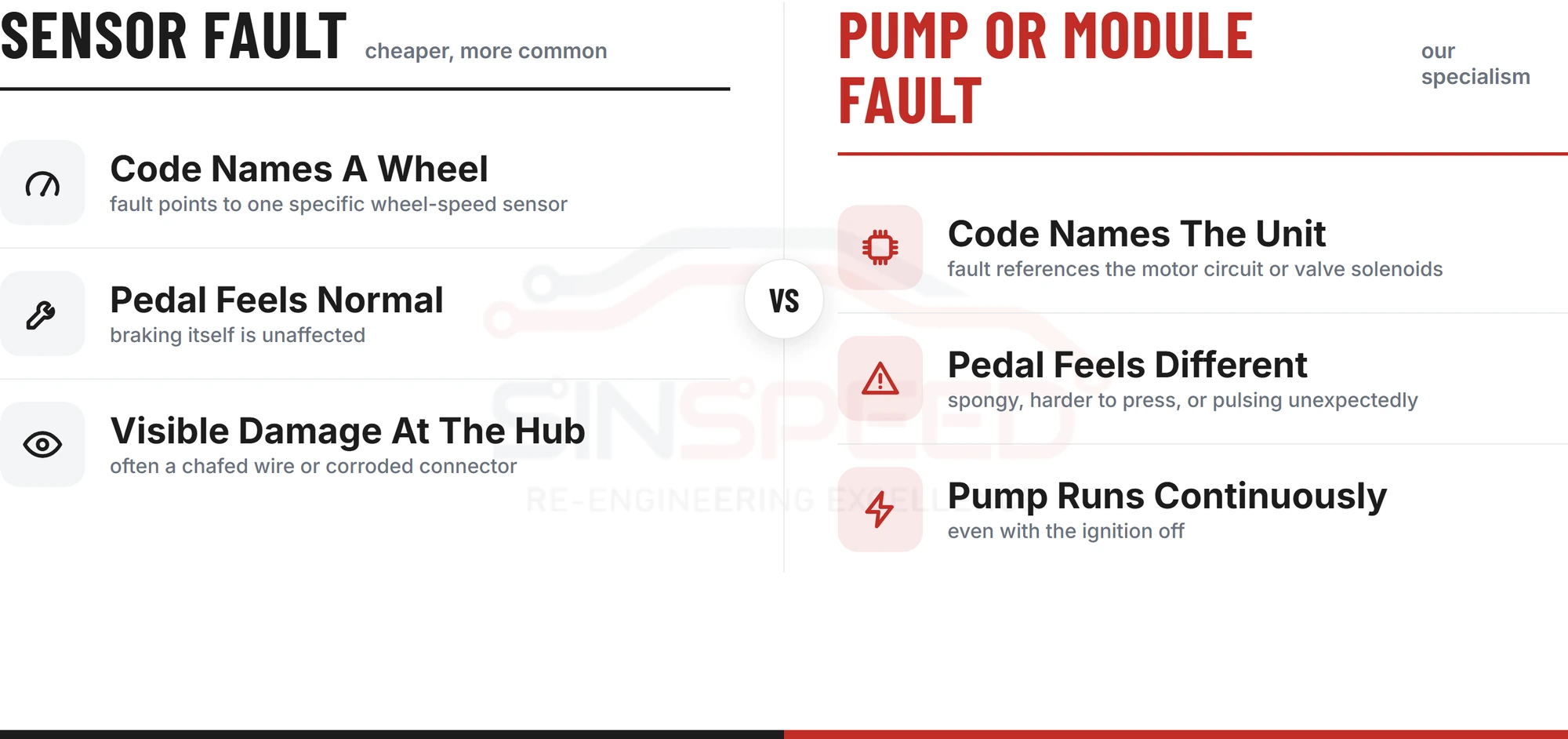
This is one of the most common — and most costly — points of confusion. Not every ABS warning light means the pump has failed. The four wheel-speed sensors themselves are far more common failure points and considerably cheaper to replace. Before drawing any conclusions, a proper diagnostic scan with a compatible professional scan tool (not a generic £30 OBD reader, which often cannot communicate with the ABS module at all) is essential.
| Indicator | Points to Sensor Fault | Points to Pump/Module Fault |
|---|---|---|
| Fault code content | References specific wheel position (e.g. ‘Left Rear WSS Signal’) | References hydraulic unit, motor circuit, or valve solenoids |
| Pedal feel | Unchanged | Spongy, harder to press, or pulsating under normal braking |
| Braking behaviour | ABS inactive but braking feels normal | Pulling to one side, locking, or inconsistent pressure |
| Pump behaviour | Normal (pump only runs during ABS events) | Pump running continuously, even with ignition off |
| Visual inspection | Damaged wiring, corroded connector at wheel hub | No visible damage at wheels — fault is inside the unit |
The critical rule: if your ABS light came on after a sensor was cleaned or replaced and the light still will not go out, the fault is almost certainly inside the pump or module — not the external sensor. This is something we see constantly: a garage replaces a wheel-speed sensor in good faith based on the fault code, the light returns within days, and the unit then comes to us. A proper ABS specialist will interpret fault codes in the context of live sensor data and physical inspection before any parts are replaced. Check out our guide on: How to Diagnose a Faulty Wheel Speed Sensor
Does the ABS Light Fail an MOT?
Yes — for any vehicle first registered after 1 July 2003, an illuminated ABS warning light is an automatic Major defect and an MOT failure. The DVSA classifies it as a braking system fault, regardless of whether normal braking feels fine to the driver. The system must self-test correctly at ignition start and the warning light must extinguish within a few seconds.
For the full DVSA rules, what the tester actually checks, and how to get your vehicle MOT-ready, read our dedicated post: Is the ABS Light an MOT Fail? UK Rules Explained →
How Sinspeed Remanufactures ABS Units
ABS pumps and modules are one of our core lines, not a sideline. What makes the unit demanding is that it is really three problems in one housing — a precision hydraulic block, a DC motor, and a circuit board — and it is rare for one workshop to be equipped for all three. Ours is: hydraulic and electronic engineers work the same unit, at circuit-board level, in a cleanroom-standard, ESD-safe workshop. We are not a general electronics repair shop that occasionally handles an ABS unit. This is what we do.
Our process is distinct from a standard repair in an important way: we do not just fix the reported fault and return the unit. We fully strip the unit, test every sub-assembly independently — the pump motor, the HCU valve block, and the ECU circuit board — replace all wear-prone components, and where a known design weakness exists in that unit generation, we address it permanently. That is why we can back every repair with a lifetime, unlimited-mileage warranty. No mileage cap. No time limit. If the repair fails under normal use, we repair it again at no cost.
Nothing goes back until it has been proved on our in-house Hardware-in-the-Loop rigs. For an ABS unit that means feeding the module four simulated wheel-speed signals and commanding it through full ABS cycles under load and heat — so the valve block, the pump motor and the ECU are all tested doing the job they will actually do on your car, rather than simply checked for continuity on a bench.
The service is mail-in from anywhere in the UK or internationally. Your mechanic removes the unit from the vehicle and sends it to us via tracked courier. We test, remanufacture, and return it — typically within 2–3 working days of receipt — ready to refit plug-and-play. Because we are remanufacturing your original unit rather than supplying a new dealer part, it comes back already matched to your vehicle with no coding required in the vast majority of cases — and unlike a second-hand scrapyard unit of unknown history, ours is fully stripped, tested and backed by a lifetime, unlimited-mileage warranty.
Explore our ABS Pump & Module Repair Services →
Send us your ABS unit for diagnosis and repair →
Frequently Asked Questions
What is an ABS pump?
An ABS pump — more accurately the ABS pump and module, or hydraulic modulator — is the electro-hydraulic core of your vehicle’s anti-lock braking system. Sitting between the brake master cylinder and the callipers, it independently controls the hydraulic pressure delivered to each wheel as that wheel approaches lock-up.
How does an ABS module work?
The ABS module reads the four wheel-speed sensors many times per second. The moment one wheel decelerates toward lock-up, it closes that wheel’s inlet valve, releases pressure through the outlet valve, then commands the pump to restore it — cycling rapidly to preserve both braking and steering control.
What is the difference between an ABS pump and an ABS module?
In everyday use the terms are often used interchangeably, but strictly speaking the ABS pump refers to the hydraulic pump motor sub-assembly, while the ABS module (or ABS ECU) is the electronic control unit that commands it. In practice, both are integrated into a single sealed unit — the ABS pump and module — which is what is sent to us for repair.
What causes an ABS pump to fail?
Six mechanisms account for almost all ABS failures: solder-joint fatigue caused by engine-bay heat cycling; moisture getting past a perished connector seal and corroding the pins or the circuit board; pump motor brush and armature wear, usually accelerated by a motor left running continuously; solenoid valves sticking in the HCU because of moisture and debris in old brake fluid; internal ECU track damage and brake pressure sensor failure; and loss of CAN-bus communication when the module’s transceiver fails. Almost all of them are design and environment related rather than anything the driver did wrong.
How long does an ABS pump last?
There is no fixed service life and the ABS pump is not a scheduled-replacement item — many last the life of the vehicle. Failure tracks heat cycling, moisture ingress and brake fluid condition far more closely than it tracks mileage, which is why two identical cars with the same mileage can have very different outcomes. Keeping to the manufacturer’s brake-fluid change interval is the most useful thing an owner can do to extend its life.
Can I drive with an ABS fault?
Your standard brakes will usually still function, but the anti-lock system will not engage during emergency braking. On wet or slippery roads this significantly increases the risk of wheel lock-up and loss of steering control. An illuminated ABS light is also an MOT failure. We strongly recommend getting the fault diagnosed and resolved promptly.
Why do the ABS and traction control lights come on together?
Because both systems share the same wheel-speed sensors and, in most vehicles, the same ABS hydraulic control unit and ECU. A single fault in any shared component disables both systems simultaneously, triggering both warning lights. It is almost never two separate faults.
What is fault code 01435 on a VW or Audi?
Fault code 01435 — Brake Pressure Sensor 1 — is one of the most common ABS faults on VAG-group vehicles fitted with the Bosch 8.0 unit. It indicates the internal brake pressure sensor within the ABS ECU has failed. This is a permanent electronic fault that cannot be cleared with a reset — the unit requires specialist remanufacture.
Does the ABS pump need coding after repair?
No, because we retain all coding data when rebuilding your original unit — it returns plug-and-play without needing a dealer coding visit. A new or second-hand replacement, by contrast, has to be coded to your car before the brakes will work correctly.
How long does an ABS pump remanufacture take?
Typically 2–3 working days from the date we receive your unit. We contact you as soon as testing and remanufacture is complete and the unit has been despatched back.
Can every ABS pump be repaired?
The vast majority can. The exception is catastrophic physical damage — such as a cracked hydraulic block from a collision impact — where the structural housing itself cannot be economically restored. In those cases we will tell you clearly and will not charge for a repair we cannot perform.
What is the Bosch 8.0 and why does it fail?
The Bosch 8.0 is one of the most widely used ABS units in Europe, fitted to millions of VAG-group, Ford, Mazda, and Volvo vehicles. Its most well-known failure mode is the internal brake pressure sensor — a small component within the ECU assembly that is subject to heat cycling stress. When it fails it stores fault code 01435 and disables the ABS. Sinspeed carries out a full remanufacture of this unit, addressing the root cause of failure permanently.
What is the ATE Teves MK70 and what goes wrong with it?
The ATE Teves MK70 (produced by Continental, formerly ATE) is found in a wide range of Ford, Mazda, Renault, Suzuki, Fiat, Peugeot, and Citroën models. Its most common failure modes are loss of wheel-speed sensor signal and loss of CAN communication — meaning diagnostic scanners cannot communicate with the ABS module at all. Both are repairable through specialist remanufacture.
How much does ABS pump repair cost?
Repair costs vary by vehicle and by the extent of the fault, so we do not quote a flat figure up front. Your unit is assessed when it reaches our workshop and we confirm the cost with you before any work is carried out. To get started, send us your vehicle and unit details through our repair form, or see the units we cover on our ABS pump and module repair services page.
Final Thoughts
The ABS pump and module is one of the most safety-critical components in your vehicle, and one of the most technically complex. Understanding what lives inside it — the pump motor, the HCU valve block, and the ABS ECU — and how the three work together helps explain why an amber light on your dashboard is never something to dismiss or attempt to mask with a scanner reset.
When the ABS warning light stays on, the system has detected a fault it cannot self-correct and has shut itself down. The most common causes — internal brake pressure sensor failure in Bosch 8.0 units, loss of CAN communication in ATE Teves MK70 units, pump motor burnout, cracked solder joints and corroded circuit boards — are all repairable. And because they are design weaknesses rather than accidents, remanufacture of your original unit is the option that addresses the reason it failed: faster than sourcing a new dealer part, more dependable than a second-hand unit of unknown history, and returned already matched to your vehicle.
At Sinspeed this is core work. Customers across the UK — and internationally — mail units directly to our workshop and have them returned, fully tested and remanufactured, in a matter of days. Every repair carries a lifetime, unlimited-mileage warranty with no hidden conditions.
Explore all ABS pump and module repair services →