
Summary: Most people reading this already have a figure in their head — a garage quote, a dealer price, or a number someone else remembers paying — and what they want to know is whether it is a fair one. Typical UK ranges are too wide to answer that on their own: ABS module repair typically runs £150 to £450, while a brand-new pump and module from the manufacturer typically costs £600 to £3,000. Our own rebuilds of the unit already on your car start from £150 +VAT. What none of those figures tells you is which one applies to your vehicle, because the price is set by which ABS unit you have, what has failed inside it, and how much of the total is the part rather than the labour and coding around it. This page takes those apart one at a time, then walks the mail-in process end to end so you know what you are committing to before you commit to it.
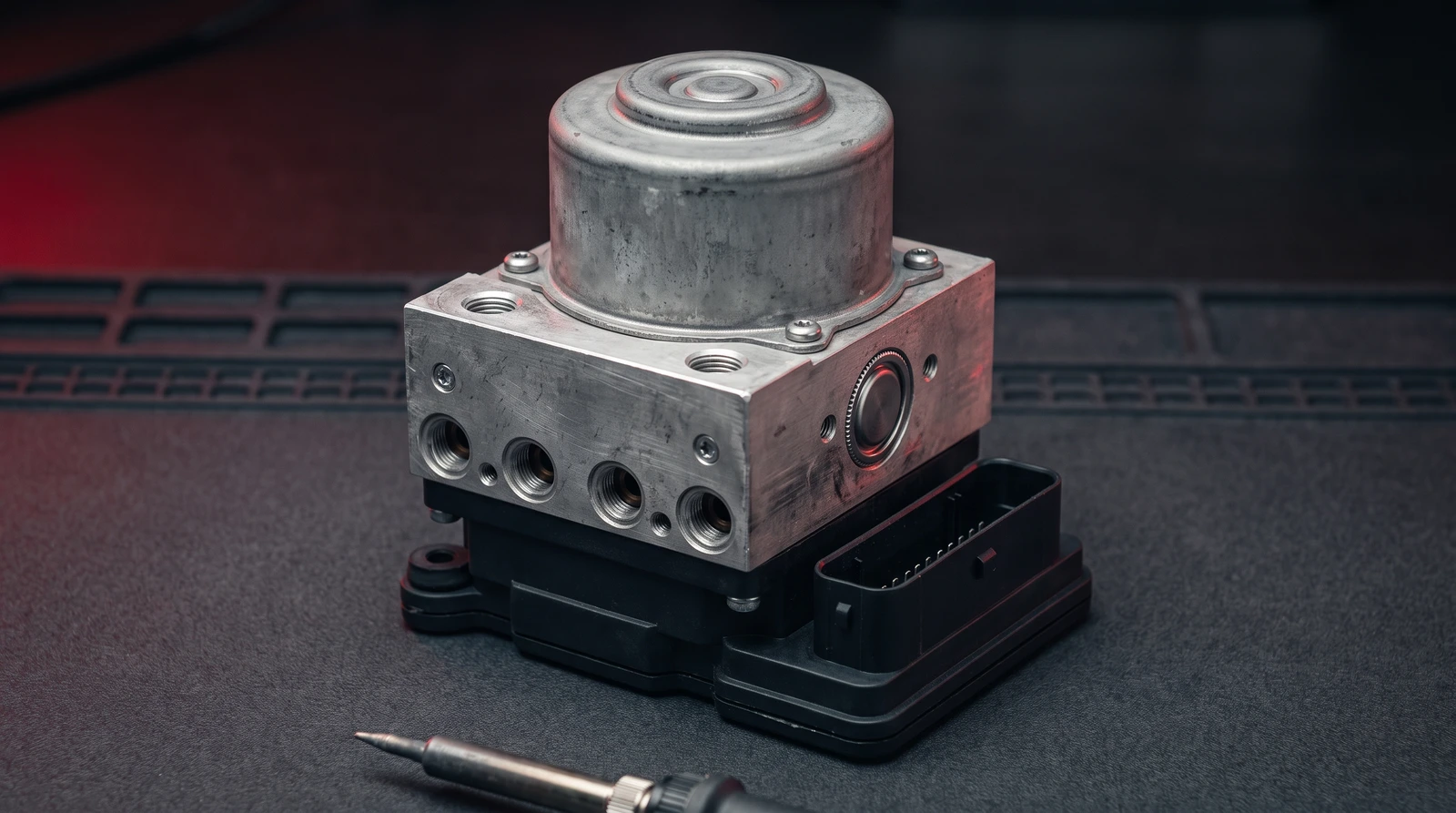
- What does an ABS pump or module repair cost in the UK?
- What is actually in the quote you have been given
- What drives the price of one ABS repair above another
- Rebuild, exchange, new or used: what each route gives you
- Why a new unit needs coding and a rebuild of your own usually does not
- Is it the pump, the module, or something cheaper?
- Can you drive with the ABS light on, and will it fail the MOT?
- What you actually do, and how long you are without the car
- What a suspiciously cheap quote usually means
- Older cars, obsolete units, and whether it is worth doing
- ABS pump and module repair cost FAQs
- Final thoughts
What does an ABS pump or module repair cost in the UK?
An ABS repair falls into one of four routes, and the route sets the band far more than the car does. Rebuilding the unit already fitted to your vehicle is the least expensive. A new unit from the manufacturer is the most. Everything else sits between the two.
Our own ABS pump and module rebuilds start from £150 +VAT, with the final figure depending on the unit and the fault inside it. Across the UK market, ABS module repair typically runs £150 to £450, and remanufactured exchange modules £400 to £800.
New parts are a different order of figure. A brand-new replacement ABS pump and module from the manufacturer typically costs £600 to £3,000.
Read that last paragraph twice, because those are part prices on their own. A part price is not a repair price. Fitting is extra, diagnosis is usually extra, and on most modern vehicles a new ABS unit arrives blank and has to be coded to the car before the braking systems will work with it — which is a separate line on the invoice and sometimes a separate visit.
So a quote for “ABS pump replacement” is not high or low on its own terms. It depends on which of the four routes it describes, and on how much of the four-part bill below it actually includes.
What is actually in the quote you have been given
Almost every ABS quote is four separate things added together, and garages differ enormously in how much of it they itemise. Knowing the four is what makes an unexplained total readable.
- Diagnosis. Reading the codes is quick; proving which component caused them is not. A proper ABS diagnosis means live data from the wheel speed sensors, a check of the pump motor circuit and its high-amperage fuse, and a look at brake fluid condition and battery voltage before anything is condemned. Where a garage charges a diagnostic hour, that is what it buys.
- The part. The figure everyone quotes and the one that varies most — anywhere from a rebuild of the unit you already own to a new assembly from the manufacturer.
- Labour to remove and refit. The unit sits in the engine bay with brake pipes screwed into it and a wiring connector on top. Taking it out opens the hydraulic circuit, so putting it back always ends in a brake bleed — and on many cars that bleed has to be driven by a scan tool, because air trapped inside the valve block will not come out with a pedal alone.
- Coding, calibration and the bleed itself. A new or used unit generally needs programming to the vehicle. A rebuild of your own unit generally does not. That single line is often the whole difference between two quotes that otherwise look alike.
Which of the four you pay for changes with the route you take, and that is most of the reason two quotes for what sounds like the same job can look nothing like each other. It is also why it is worth asking a garage to split a total rather than accepting it whole.
If the vocabulary is doing you no favours — pump, module, hydraulic block, ECU — those are parts of one assembly rather than separate items on the car, and we have a full explanation of what the pump and the module each do.
What drives the price of one ABS repair above another
Two cars with the same warning light can be quoted very differently, and the reasons are consistent enough to set out. This is the part of the subject that cost pages skip: they give you a range and leave you to guess where in it you sit.
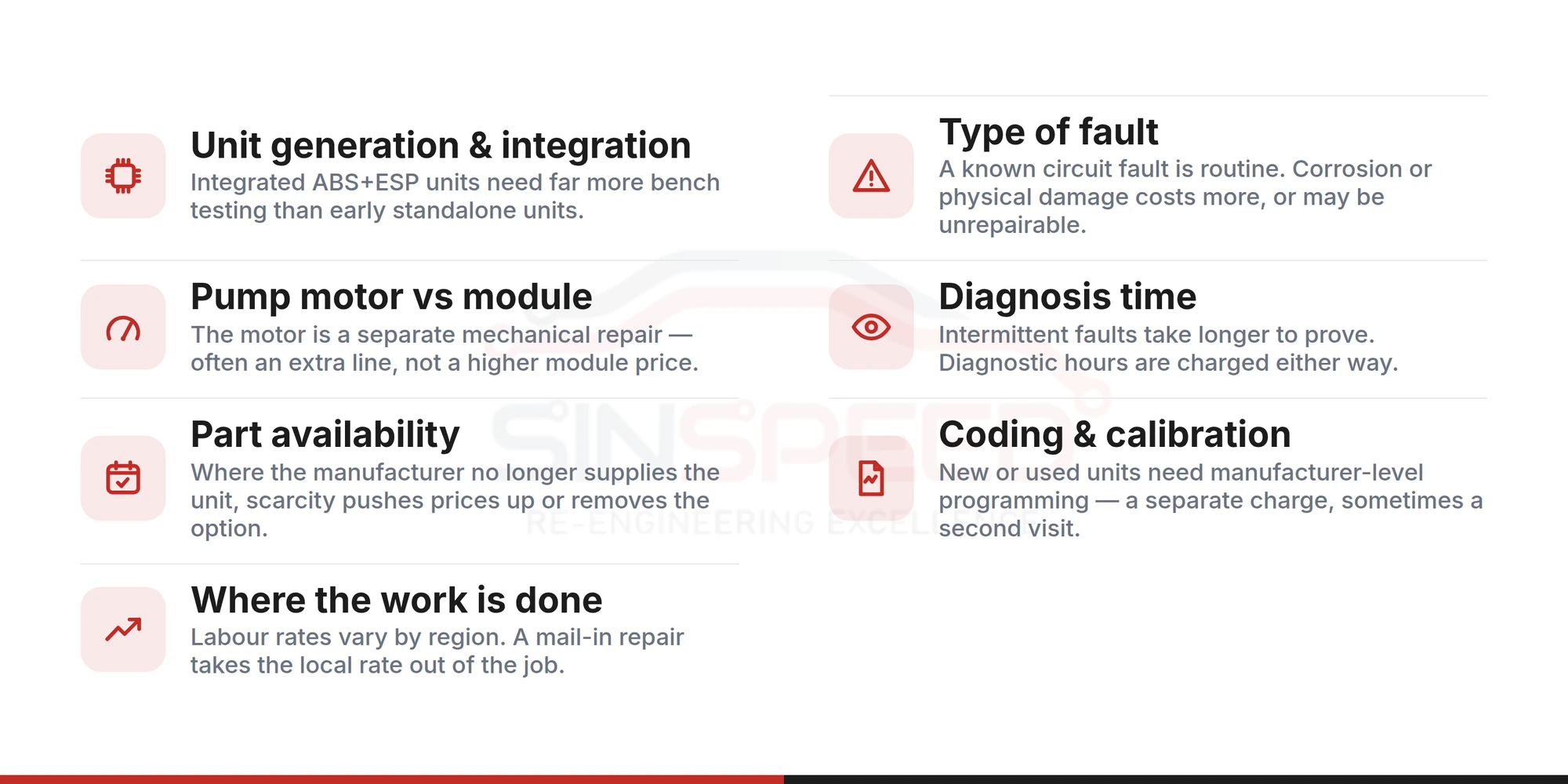
| What moves the price | Why it moves it | How it shows up on your quote |
|---|---|---|
| Which unit family your car uses | An early standalone ABS unit — a Bosch 5.3, an ATE Mk20 — has fewer solenoids, fewer driver circuits and far less to test than a later integrated ABS and ESP unit such as a Bosch 8.0 or an ATE Mk60. More channels means more bench testing before it can be signed off. | A higher rebuild price on newer or premium vehicles for the same named fault |
| Electronic, hydraulic or physical damage | A failed solenoid driver circuit is a known, repeatable board repair. A seized pump motor, a corroded valve block or a unit that has been crushed or submerged is different work, and some physical damage is not economically repairable at all. | A price confirmed only after testing, or a unit returned as beyond repair |
| Whether the pump motor itself has failed | The module is the electronic half and is repaired at circuit level. The motor is a mechanical item, and reconditioning or replacing it is separate work with its own parts cost. | An additional line rather than a higher module price |
| Diagnosis time | Intermittent faults, water-ingress damage and wiring problems all take longer to prove than a unit that fails consistently on the bench. Time is the commodity being sold. | Diagnostic hours, charged whether or not the unit turns out to be the fault |
| Part availability | Where the manufacturer still supplies the unit, replacement is at least an option. Where it does not, a replacement has to be found second-hand or not at all, and scarcity moves prices in one direction only. | Long lead times, dealer back-orders, or a quote that cannot be given |
| Coding and calibration | A new or used unit has to be programmed to the vehicle, and on some models the steering angle and yaw sensors need recalibrating afterwards. That is manufacturer-level tooling and manufacturer-level time. | A programming or setup charge, occasionally at a second garage |
| Where the work is done | Labour rates are not uniform across the country, and an hour on a diagnostic rig is not costed the same in the south east as it is in the Midlands. A mail-in repair takes the local rate out of the equation, which is part of why the figure you were quoted locally may not be the figure this job has to cost. | The same job, quoted differently a hundred miles away |
The first two rows account for most of the spread, and together they produce the conclusion the field never quite states: the fault matters more than the badge. A modest hatchback with an integrated ABS and ESP unit and a seized pump motor can be a bigger job than a premium saloon with a straightforward driver-circuit failure.
Rebuild, exchange, new or used: what each route gives you
There are only four things anyone can do with a failed ABS unit. Every quote you receive is one of them, whether or not it says so on the page.
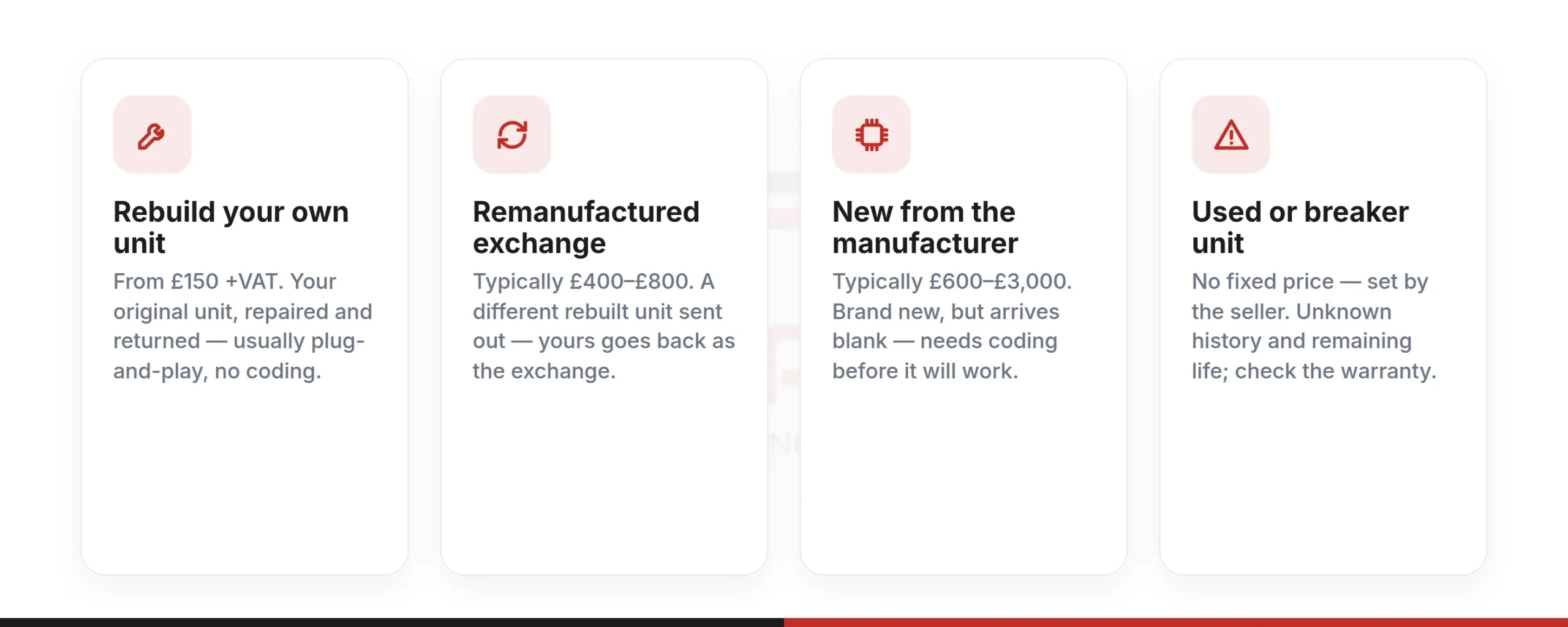
| Route | Published UK figures | What you get back | What to check before you commit |
|---|---|---|---|
| Rebuild your own unit | Sinspeed rebuilds start from £150 +VAT. Typical UK ABS module repair: £150–£450. | Your original unit, repaired at circuit level and returned. It keeps your vehicle’s own data, so on most cars it is a direct refit. | Whether the unit is tested under load before return, and what the warranty covers |
| Remanufactured exchange unit | Typically £400–£800. | A different unit, already rebuilt, sent out to you. Yours usually goes back as the exchange. | Whether it needs coding to your car, and what happens if your old unit turns out to be unrepairable |
| New from the manufacturer | Typically £600–£3,000 for a new pump and module. | A brand-new assembly, built to the original design — including the original design’s weak points. | Lead time, since new units are often on back-order, and whether programming is inside the price |
| Used or breaker unit | No reliable published range; priced by the seller and by scarcity. | A second-hand unit of unknown history and unknown remaining life. | Whether it is the exact part number, whether it will code to your car at all, and whether any warranty exists |
The rows are not simply cheapest to dearest, because they are not the same product. A rebuild returns the unit that is already matched to your car. An exchange unit gets you moving sooner if yours would take days on the bench, but it is somebody else’s part. A new unit is new, which sounds decisive until you consider that mass-produced ABS modules fail in recognised patterns — the same overloaded areas of the control board, the same water paths — and a new one carries the design that failed.
That is the case for rebuilding rather than replacing, and it is a mechanical argument rather than a financial one. When we strip an ABS module the known weak points are reinforced rather than merely restored, so what goes back on the car is not returned to the specification that failed. You can see the units and vehicles covered on the ABS pump and module repairs we handle.
Used units are the route with the least written about them and the most that can go wrong. Coding aside, a unit pulled from a scrapped car has already lived the life that killed yours, in the same weather, on the same roads.
Why a new unit needs coding and a rebuild of your own usually does not
This is the part of an ABS quote people most often discover after agreeing to it, so it is worth being plain about.
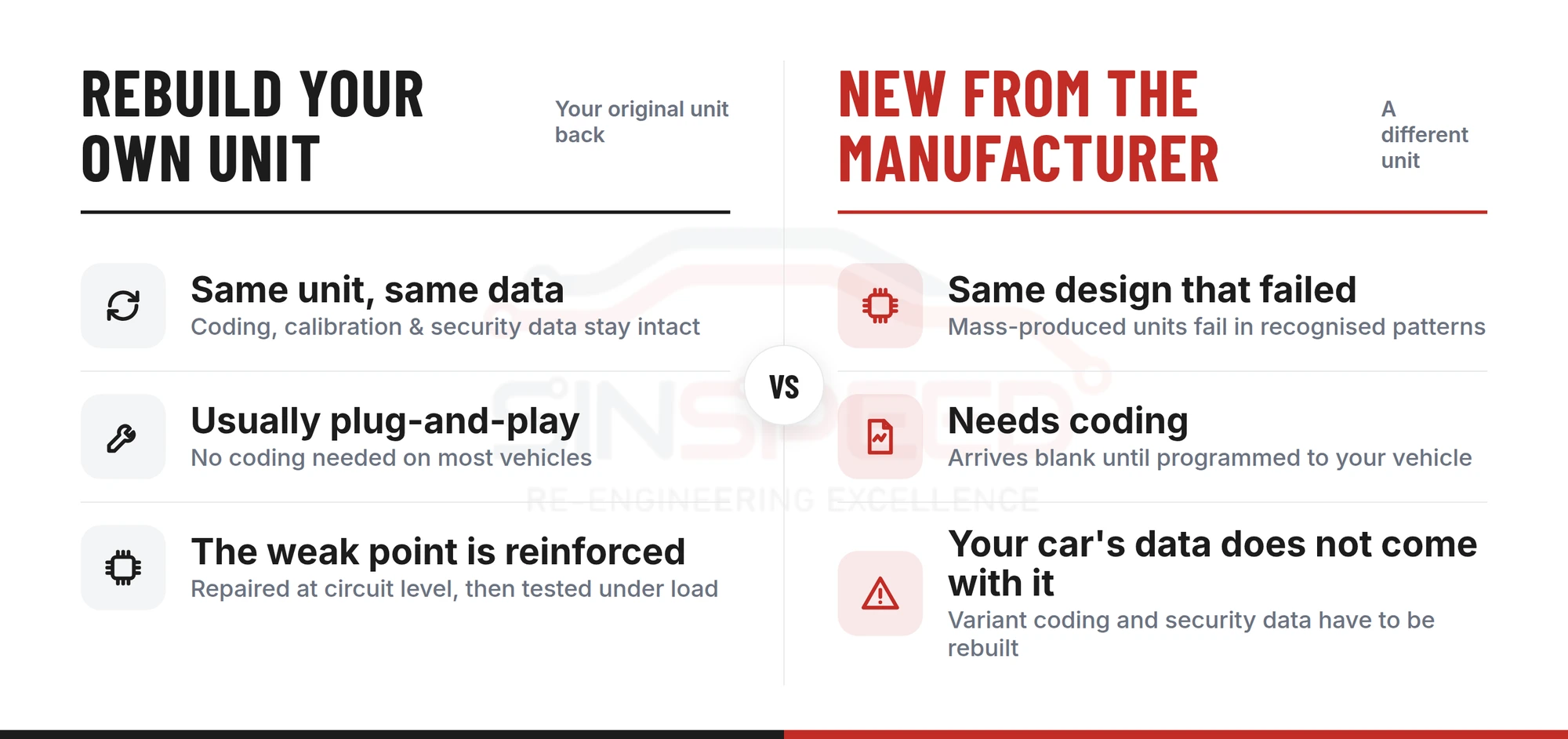
An ABS control module holds data belonging to your specific vehicle: the variant coding that tells it which model and options it is fitted to, calibration values for the steering angle and yaw sensors on cars with stability control, and on some vehicles security data paired to the rest of the electronics. A brand-new module arrives with none of it. Until it is programmed, the car can run with ABS, stability control and traction control disabled — which is precisely the state you were trying to get out of.
Programming one is not a generic OBD job either. It typically needs manufacturer-level software and, on many models, an online connection to the manufacturer to authorise the write. That is why the coding line can be a meaningful share of a replacement quote, and why some independent garages sub-contract it.
A rebuild reaches the same place by a different path. Because the unit that comes back is the unit that went out, the coding, calibration and security data never left your ownership, and on most cars it is a plug-and-play refit: fit it, bleed the brakes, and the system comes up as it was. Most rather than all is deliberate — a handful of models want a calibration routine after any ABS work, usually a steering angle sensor reset, which is a scan-tool job rather than a programming session.
If a supplier tells you a replacement will not need coding, ask specifically whether they mean a rebuild of your own unit or a different unit sent out to you. The answer changes what happens on your driveway.
Is it the pump, the module, or something cheaper?
An ABS warning light means the system has found a fault and switched itself off. It does not say which component is at fault, and several of the possibilities cost a fraction of an ABS unit repair. Eliminating those first is the single most effective thing you can do about the cost of this job.
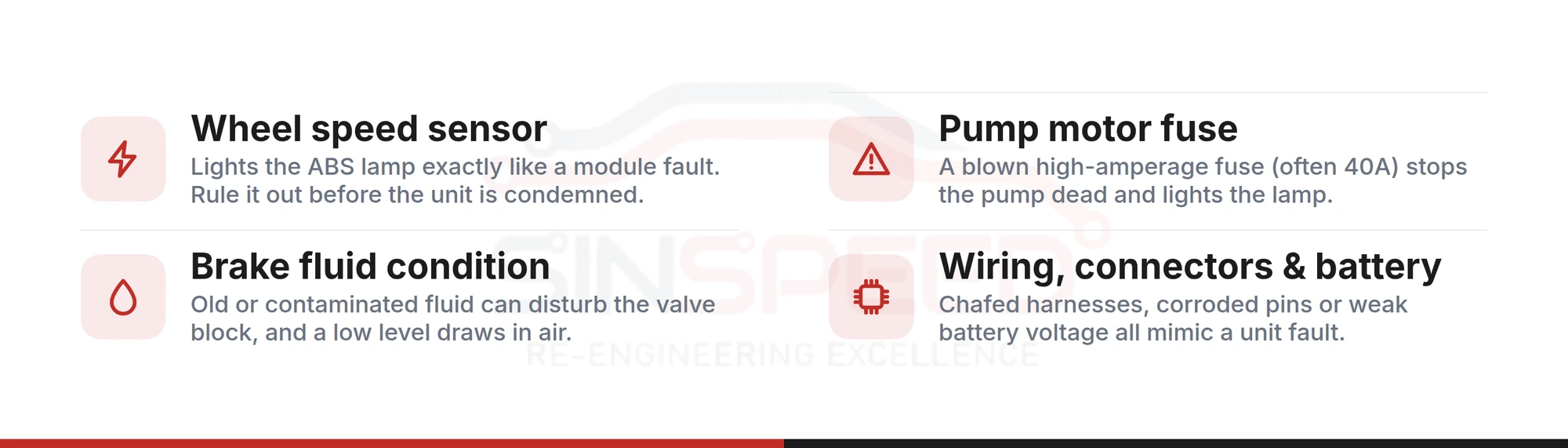
The most common of them is a wheel speed sensor. One failed sensor — or a damaged reluctor ring behind it, or a corroded connector — lights the ABS lamp exactly as a failed module does, and it is a far smaller job. It is the first thing worth ruling out, and we have a separate guide to what a wheel speed sensor costs to replace if the codes point that way. If that is what your car has, you do not need us.
Three more inexpensive causes are worth checking before the unit is condemned:
- The pump motor fuse. ABS pump motors draw heavy current and are protected by a high-amperage fuse, often 40A and often in a separate box from the main fuse panel. A blown one stops the pump dead and lights the lamp.
- Low or contaminated brake fluid. The valve block contains very fine passages. Old fluid that has absorbed moisture, or debris carried from degrading brake lines, can disturb its operation, and a low level can draw air into the circuit.
- Wiring, connectors and battery voltage. Chafed harnesses near the wheels, corroded pins at the module connector, and a battery too weak to hold voltage while cranking will all produce ABS faults with nothing wrong inside the unit.
Once those are gone, the remaining question is pump or module. As a working guide: a unit that is completely silent at ignition on, or that trips its fuse, points at the motor side. A unit that runs continuously, or that stores internal faults naming the control unit itself, points at the module. Braking that has gone soft or uneven at one corner, or a caliper that will not release, points at the hydraulic block. In practice all three are diagnosed together, because they are bolted into one assembly and the module drives the other two.
Can you drive with the ABS light on, and will it fail the MOT?
Take the MOT question first, because it is unambiguous. An illuminated ABS warning lamp is an MOT failure. Dashboard warning lamps are checked as part of the inspection, and a lamp lit for a stored fault is recorded as a defect. There is no version of this where the light stays on and the car passes.
The driving question deserves a more careful answer than it usually gets. With the ABS light on, your ordinary brakes still work — the hydraulic circuit is intact and the pedal still stops the car. What you have lost is the anti-lock function itself. Under hard braking, or on a wet, icy or loose surface, the wheels can lock, and a locked wheel cannot be steered. Stopping distances lengthen and the car becomes less predictable at exactly the moment predictability matters. Where ABS and stability control share one unit, traction and stability control usually go off with it.
So the honest position is this: an ABS fault is not a reason to abandon the car at the roadside, but it is a fault to have fixed promptly rather than one to live with. And there are cases where it should not be driven at all — if the red brake warning light is on alongside the ABS lamp, if the pedal has gone long or soft, if the brakes are binding or pulling to one side, or if fluid is leaking. Those are ordinary braking faults rather than ABS faults, and they call for recovery rather than a drive to the garage.
One thing the lamp is not is a nuisance to be switched off. Clearing the code repairs nothing: the module runs its self-test at the next ignition cycle, finds the same fault and lights the lamp again. Where a reset is a genuine part of the job — after a repair, for instance — we cover what resetting the ABS light does and does not do separately.
Sinspeed · mail-in ABS repair
Get a figure for your unit, not a range
Send us the vehicle details, the part number stamped on the ABS unit and the fault codes your garage read. We will tell you what your unit needs and what the rebuild costs before you take anything off the car.
Circuit-level board repair by in-house engineers · Tested on Hardware-in-the-Loop platforms before dispatch · Mail-in from anywhere in the UK
What you actually do, and how long you are without the car
The question underneath the price question is usually not “what does it cost” but “what do I have to do, and how long am I off the road”. Here is the whole of it.
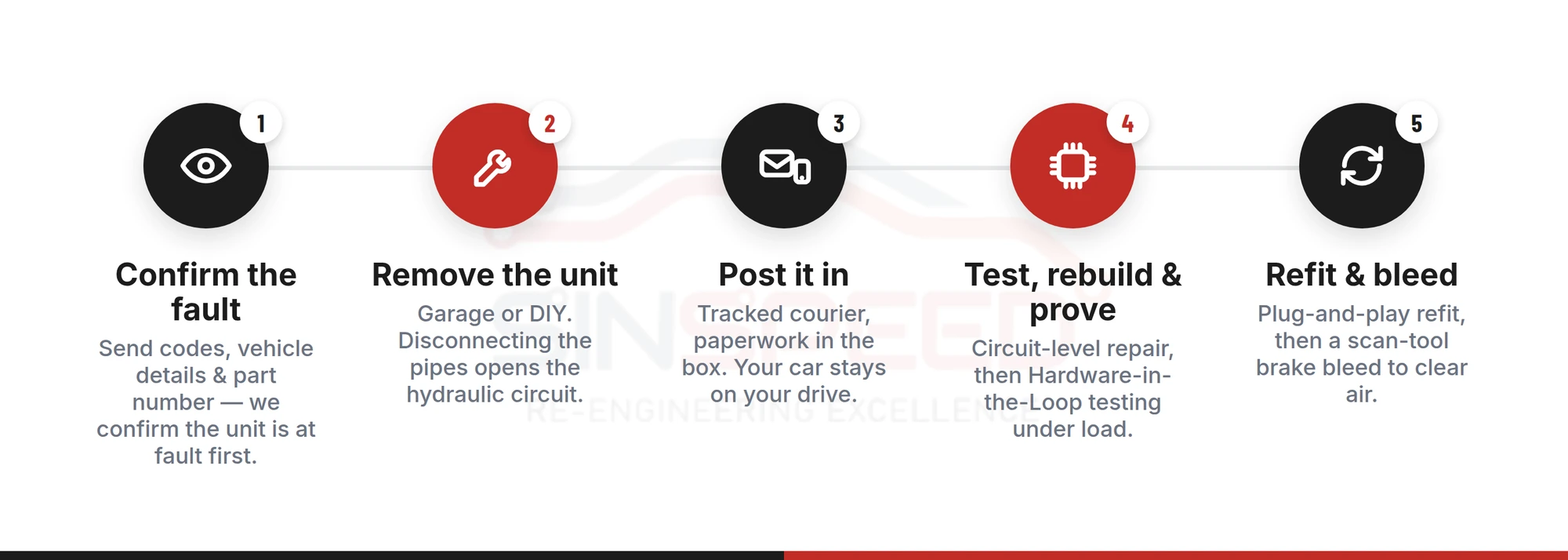
- Confirm what has failed before anything comes off
Have the codes read and the cheap causes above eliminated. Send us those codes, the vehicle details and the part number on the unit, and we will confirm whether the unit is the fault and what the rebuild involves. This is the step that prevents a wasted removal.
- Remove the unit
Most customers have their garage do this; some do it themselves. It means disconnecting the wiring plug and unscrewing the brake pipes, so the hydraulic circuit is opened and fluid will be lost. On many cars the ECU half can be separated from the hydraulic block and sent alone — ask us first, because on some units it cannot be split without the right tooling, and a poor reseal is a leak path in a braking system.
- Post it in
Package it properly and send it by tracked courier with your paperwork in the box. Your vehicle stays where it is, on your drive or on the garage’s ramp, for the whole workshop stage. Nothing is towed and nothing is booked in.
- We test, rebuild and prove it
The unit is stripped and tested in a cleanroom-standard, ESD-safe workshop by our own electronic and hydraulic engineers. The fault is repaired at circuit level and the known weak points reinforced, then the unit goes onto a Hardware-in-the-Loop platform that simulates real heat, vibration and load, so it is proved working under conditions rather than at rest on a bench. Many units are turned round in 24 to 48 hours.
- Refit and bleed
It comes back as your unit, with your vehicle’s own data intact, and on most vehicles goes straight back on with no coding. The job that must be done properly is the brake bleed: the circuit was opened, and on many cars the ABS pump has to be cycled with a scan tool to clear air from the valve block. Do not skip it, and do not accept the car back without it.
Realistically the time off the road is the postage each way plus the workshop time, which for most people is a few days rather than a fortnight. If the car is your only transport, the practical move is to have the unit taken off on a day you can manage without it and refitted when it arrives back, rather than leaving the car in pieces while it is away.
What a suspiciously cheap quote usually means
Prices below the ranges on this page exist, and some are perfectly legitimate. Several are not, and they have recognisable shapes.
- A used unit described as a repair. A breaker’s unit fitted and coded is a real service, but it is not a repair and should not be priced or warranted as one. Ask what is physically being done to the part currently on your car.
- A repair that is not a rebuild. These are genuinely different processes: swapping a small number of failed components returns the unit to the specification that failed, while a rebuild reworks the circuits and uses better-than-original parts where the design is weak. The first is quicker and cheaper. It is also likelier to come back.
- A code clear dressed up as a fix. If the light went out and nothing was replaced, nothing was repaired. It will return.
- No load testing. A module can pass a static bench check and fail as soon as it is hot, vibrating and switching current. If nobody can tell you how the unit was tested before it came back, it was probably powered up and looked at.
- Exclusions in the small print. Return carriage, programming, the brake bleed, VAT. A headline figure with three of those outside it is not the figure you will pay.
- A warranty you cannot read. Ask for the length, what it covers and what happens to the labour if the unit fails again. Ours is a lifetime, unlimited-mileage warranty on remanufactured parts, and it is written down.
The reverse case is worth stating too. A high quote is not automatically a wrong one: an integrated ABS and ESP unit with hydraulic damage genuinely is a bigger job than a driver-circuit repair on an early module. What makes any quote checkable is not the number but the itemisation behind it.
Older cars, obsolete units, and whether it is worth doing
On an older vehicle the comparison above can stop applying, because one of the columns is empty.
Manufacturers do not supply parts indefinitely. Some ABS units are no longer supplied by dealers at all, particularly for vehicles beyond roughly fifteen years old, and that new modules are frequently placed on back-order — as long as ten working days in some cases. Where the part number has been discontinued there is no new unit to buy at any price, and a breaker’s unit is the only alternative to repairing what you have. Some dealers also require the faulty unit to be surrendered in exchange when a new one is bought, which removes any residual value in the old one.
That is what makes the is-it-worth-it question less financial than it looks. The fixed part of the decision is that the car will not pass an MOT with the lamp lit, so on any vehicle you intend to keep on the road the work is not optional — only the route is. That takes “do nothing” off the list, which is usually the option people are really weighing.
What remains is a comparison only you can make, because it needs three numbers we do not have: what the car is worth to you, what the chosen route costs, and what else the vehicle is likely to need in the next year or two. A car that is otherwise sound and that you plan to keep is a different sum from one already on borrowed time. Worth noting too is that ABS units are not the only electronic assembly that reaches this decision point — much the same reasoning, and much the same process, applies to gearbox and clutch electronics, which we have written up in our guide to what a clutch actuator repair costs.
ABS pump and module repair cost FAQs
How much does an ABS pump or module repair cost in the UK?
Rebuilding the unit already on your car is the least expensive route: ours start from £150 +VAT, and ABS module repair across the UK market typically runs £150 to £450. A new unit from the manufacturer is the most expensive — a brand-new pump and module typically costs £600 to £3,000. Those are part prices. Removal, refitting, the brake bleed and, on a new unit, coding are charged on top.
Can an ABS module be repaired, or does it have to be replaced?
In most cases it can be repaired. ABS modules fail in recognised patterns — the same overloaded areas of the control board, the same water paths — and those are repairable at circuit level. What is not always repairable is severe physical damage, a badly corroded hydraulic block, or a unit that has been submerged. We test before confirming a price, so you find out which you have before committing to anything.
Will a repaired ABS module need coding to my car?
On most vehicles, no. A rebuild returns your own unit with its coding, calibration and security data intact, so it is a plug-and-play refit. A new or second-hand unit is different: that arrives without your vehicle’s data and has to be programmed, usually with manufacturer-level tooling. A small number of models want a steering angle sensor reset after any ABS work, which is a scan-tool job rather than programming.
How long does an ABS pump repair take, and how long is the car off the road?
Many units are turned round in 24 to 48 hours in the workshop, so the realistic figure is that plus the postage each way. The vehicle is only immobilised while the unit is out of it — it stays on your drive or on your garage’s ramp, and nothing is towed or booked in. If the car is your only transport, have the unit removed on a day you can manage without it.
Can I drive with the ABS warning light on?
Your ordinary brakes still work, but the anti-lock function is switched off, so under hard braking or on a wet or loose surface the wheels can lock — and a locked wheel cannot be steered. Treat it as a fault to fix promptly rather than one to live with, and remember the car will not pass an MOT with the lamp lit. If the red brake warning light is also on, the pedal is long or soft, or the brakes are binding, do not drive it at all.
Do I send the whole ABS unit or just the module?
Ask before you split anything. On many vehicles the ECU half can be separated from the hydraulic block and sent on its own, which is cheaper to post and quicker to handle. On others it cannot be split without the correct tooling, and a poor reseal is a leak path in a braking system. Tell us the part number and we will tell you which yours is.
Sinspeed · mail-in ABS repair
Not sure it is the unit at all?
Send us the fault codes and the vehicle details and we will tell you what we think has failed before you remove anything. If it turns out to be a sensor or a fuse, we will say so.
Lifetime, unlimited-mileage warranty on remanufactured parts · Most units returned ready to fit · Your vehicle never leaves your drive
Final thoughts
The decision in front of you is narrower than the price ranges make it look. There are only four things anyone can do with a failed ABS unit: rebuild the one already on the car, exchange it for somebody else’s rebuilt unit, buy a new one, or fit a used one. Diagnosis, removal, refitting and the brake bleed are common to all four, so they are not what makes two quotes differ.
That turns the question you arrived with into a better one. Rather than asking whether a figure is too high, ask which of the four routes it is for, whether the part and the labour are itemised separately, whether coding sits inside the total or outside it, and what the warranty actually says. A quote that can answer those is a quote you can check. A quote that cannot is just a number.
The one option not on the list is leaving it. The lamp stays lit, the anti-lock function stays off, and the car does not pass an MOT in that state. Which route you take is genuinely your choice, and on an older car it may come down to which routes still exist. Whether it gets fixed is not.