
Summary: A diesel particulate filter is built to burn its own soot away at temperature, and most DPF fault codes describe a way that process has stopped working — soot the exhaust never got hot enough to burn, ash that will not burn at any temperature, or a pressure sensor reporting a blockage that is not there. This page separates the three, takes the common codes in turn, and says what actually clears each one. The database further down maps thirteen DPF-related codes across Seat, Volkswagen, Skoda and Audi with the manufacturer’s own numbering alongside each.
- How a DPF cleans itself: passive, active and forced regeneration
- P2002 and P2003: the regeneration that never completes
- When cleaning is the answer instead
- P2452 and P2453: when the filter is not the problem
- P242F and P2463: soot burns, ash does not
- How to use the fault code database
- DPF removal: off-road and motorsport vehicles only
- The legal position in the UK
- DPF fault code FAQs
- Final thoughts
How a DPF cleans itself: passive, active and forced regeneration
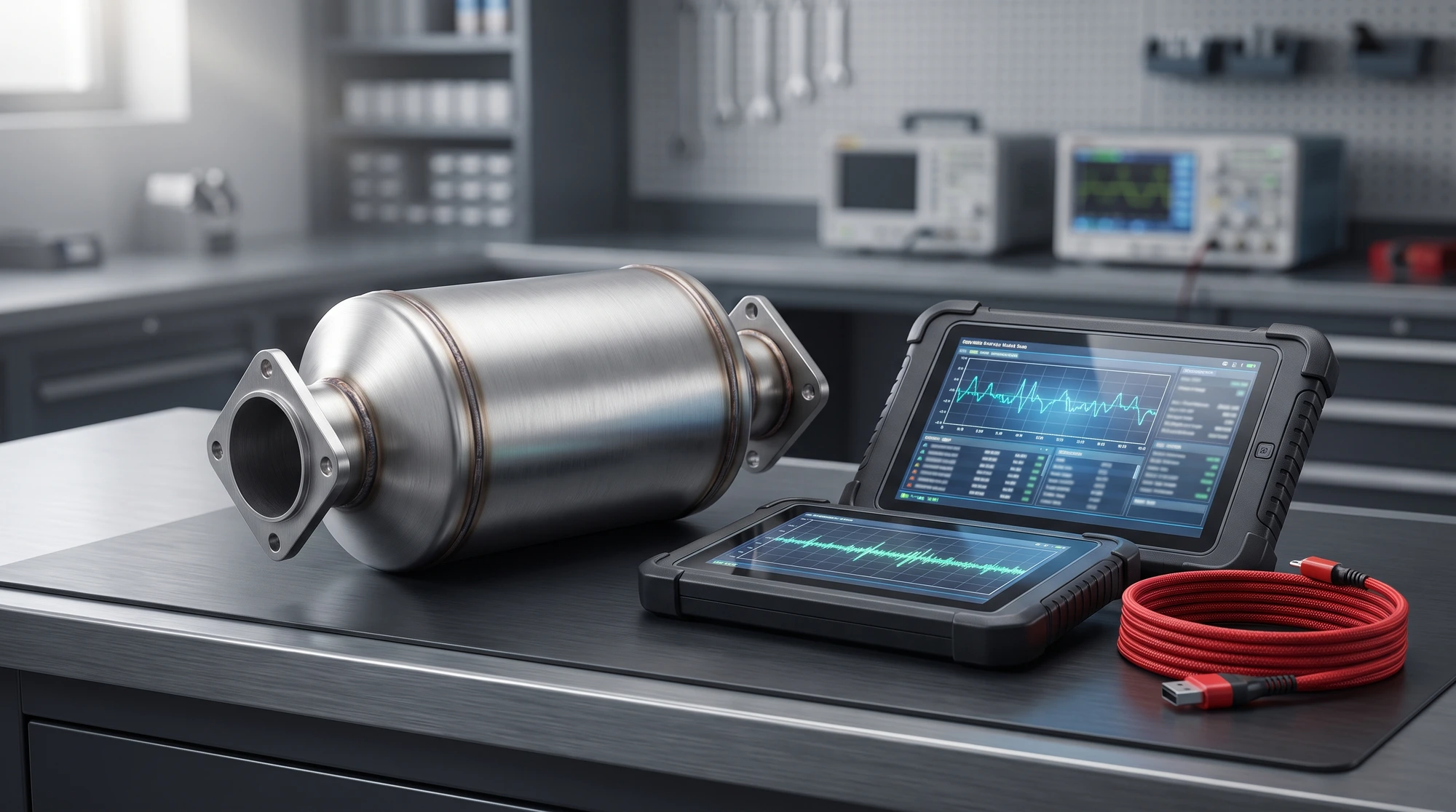
A diesel particulate filter sits in the exhaust and traps the soot the engine produces before it can leave the tailpipe. It holds a finite amount, so it is built to empty itself: at a high enough exhaust temperature the trapped soot burns away and leaves a far smaller quantity of ash behind. That process is called regeneration, and nearly every code on this page is describing a way it has stopped working. If you want the component explained first, start with what a diesel particulate filter is and how it works.
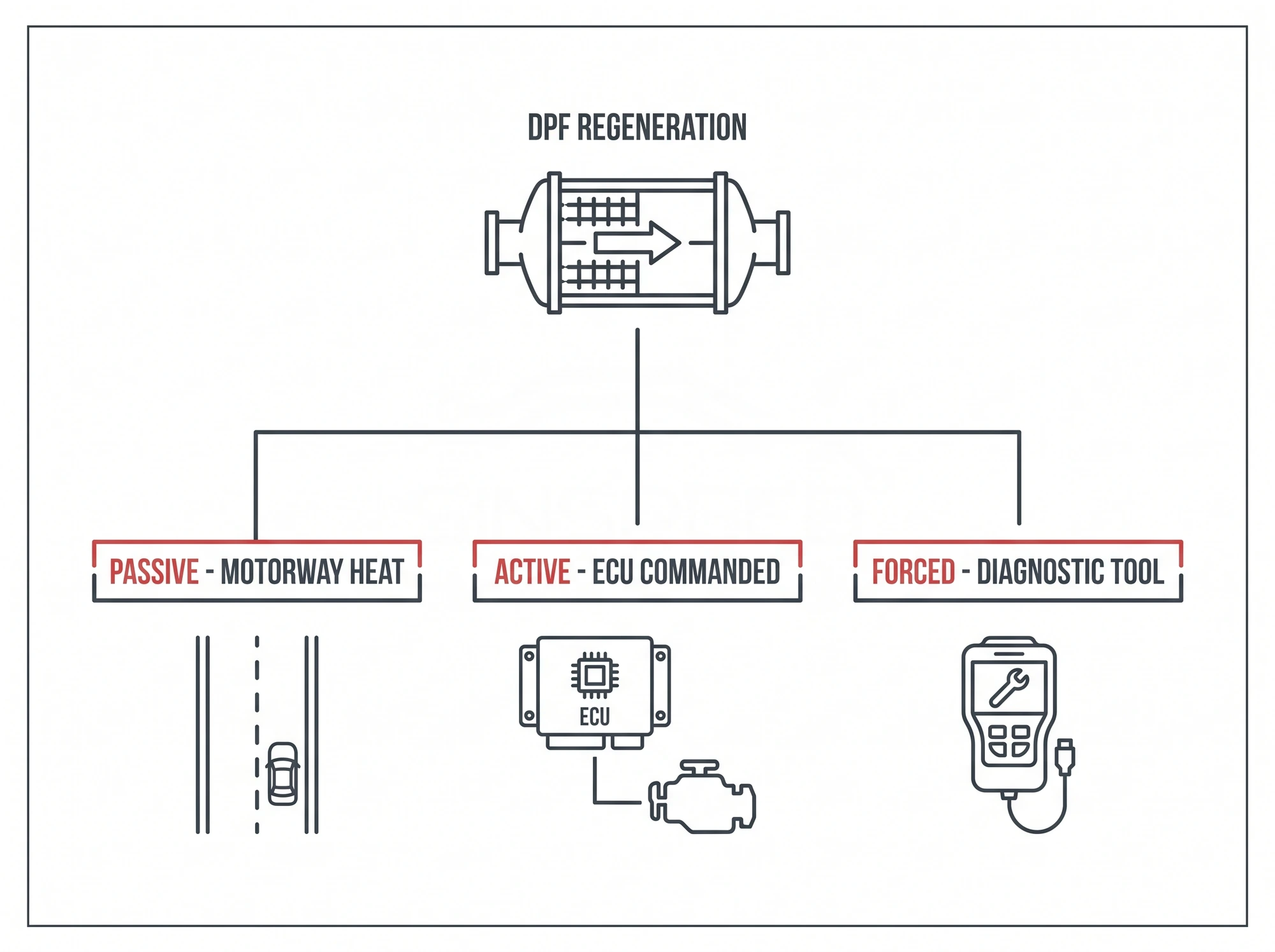
Heat is the entire mechanism. Surface temperatures inside the filter can exceed 600°C during a regeneration, which is the point at which soot converts to ash — some of it carried out with the exhaust gas, some of it retained in the core. There are three ways a car gets to that temperature.
Passive regeneration happens on its own, with no intervention and no announcement, on longer runs at sustained speed where the exhaust gas is already hot enough to burn soot as it arrives. A car used mainly for motorway work may never need anything else.
Active regeneration is deliberate. When the calculated soot load reaches a threshold, the engine ECU raises exhaust temperature on purpose — typically by injecting extra fuel late in the combustion cycle — to force a burn the driving conditions were never going to produce. It is not silent while it happens: idle speed often rises, the cooling fan runs harder, there is a hot smell, and fuel consumption climbs for the few minutes it lasts. The engine has to keep running for the cycle to finish.
Forced regeneration, also called a service regen, is the one a garage commands with a diagnostic tool when the vehicle can no longer complete an active regeneration by itself. The car is held at controlled conditions while the tool runs the cycle through. It is a recovery step rather than routine maintenance, and there is a limit to how often it can be used — which the next section deals with.
What decides when any of this happens is a differential pressure sensor plumbed across the filter. It measures the difference in exhaust pressure before and after the filter, and the ECU uses that reading, alongside its own soot-load model, to judge how full the filter is and when to start a regeneration. Keep that sensor in mind: two of the codes on this page belong to it rather than to the filter.
- Warning lights — the DPF lamp, or engine management, or both
- Loss of power — poor throttle response, slow pick-up, or a drop into limp mode
- Fuel consumption rising for no obvious reason
- Hard starting, rough running, or the engine cutting out
- Regeneration attempts on almost every journey — the idle rising and the fan running, repeatedly
P2002 and P2003: the regeneration that never completes
P2002 is particulate trap efficiency below threshold, bank 1. P2003 is the same complaint reported on bank 2 of an engine that has two. Efficiency below threshold means the ECU has compared how the filter ought to be performing against what its sensors report, and found it falling short. On its own it is not a statement that the filter is full.
The most common cause is short-distance driving. A car used for a few miles at a time, in traffic, or left idling, never holds exhaust temperature long enough for a regeneration to run to completion — so soot accumulates faster than it is burned away, and measured efficiency falls.
Interrupted regenerations do the same thing faster. An active regeneration stopped part-way — the engine switched off at the shops, a journey that ends mid-cycle — aborts, and the soot load carries over. The next attempt starts from a higher number than the last one did.
There are also conditions the ECU insists on before it will attempt one at all. Enough fuel in the tank, the engine at operating temperature, and no conflicting faults stored are the usual ones, which is why a car carrying an unrelated warning light can quietly stop trying to regenerate altogether.
And some faults make a successful regeneration impossible however the car is driven. An air leak in the exhaust upstream of the filter makes the pressure readings fluctuate and can set these codes by itself. A sticking EGR valve, a failing turbo or an injector delivering more fuel than it should all push soot production beyond what the filter can process. Fuel with a high sulphur content contributes as well.
What a driver can usefully do, while the warning is still amber and the vehicle is driving normally, is give the car the conditions it needs: a sustained run at motorway speed, at engine speeds high enough to hold exhaust temperature up, following whatever the handbook specifies for that vehicle. Once the lamp turns red, additional warnings appear, or the car drops into limp mode, that window has closed and driving further will not recover it.
Repeated forced regenerations are not a substitute either. Each one takes the filter above 600°C, and running that cycle over and over inside a short period puts thermal stress through a substrate that was not designed to absorb it, with cracking the eventual result. A forced regen that holds for a fortnight and then fails again is evidence that something other than soot is wrong — not a reason to book another.
When cleaning is the answer instead
Regeneration only ever deals with soot. Once a filter has reached the point where regeneration can no longer recover it, cleaning is the road-legal route, and it works on a different principle entirely: the filter comes off the vehicle and is cleaned on a machine, so the contents are physically flushed out rather than burned away. That includes ash, which no amount of heat will touch. For any vehicle used on the road, our DPF cleaning service is the option that applies.
Two honest limits on it. Cleaning cannot restore a filter whose substrate has cracked or partially melted — usually the legacy of repeated over-temperature regenerations, or of an engine fault putting raw fuel into the exhaust. A damaged core is a replacement, not a clean, and anyone telling you otherwise is selling you a clean twice.
The second is that cleaning does not address the reason the filter blocked. If the cause was a leaking injector, an EGR fault, a boost leak or simply the way the car is used, a cleaned filter fills again on the same schedule as the original. Establishing the cause before the clean is what makes the clean last.
P2452 and P2453: when the filter is not the problem
These two are the reason a page about blocked filters has to start by asking whether the filter is blocked at all. P2452 is a differential pressure sensor circuit fault — an electrical malfunction in the sensor or its wiring. P2453 is an implausible signal: the ECU is receiving a reading it cannot reconcile with everything else it knows about the engine.
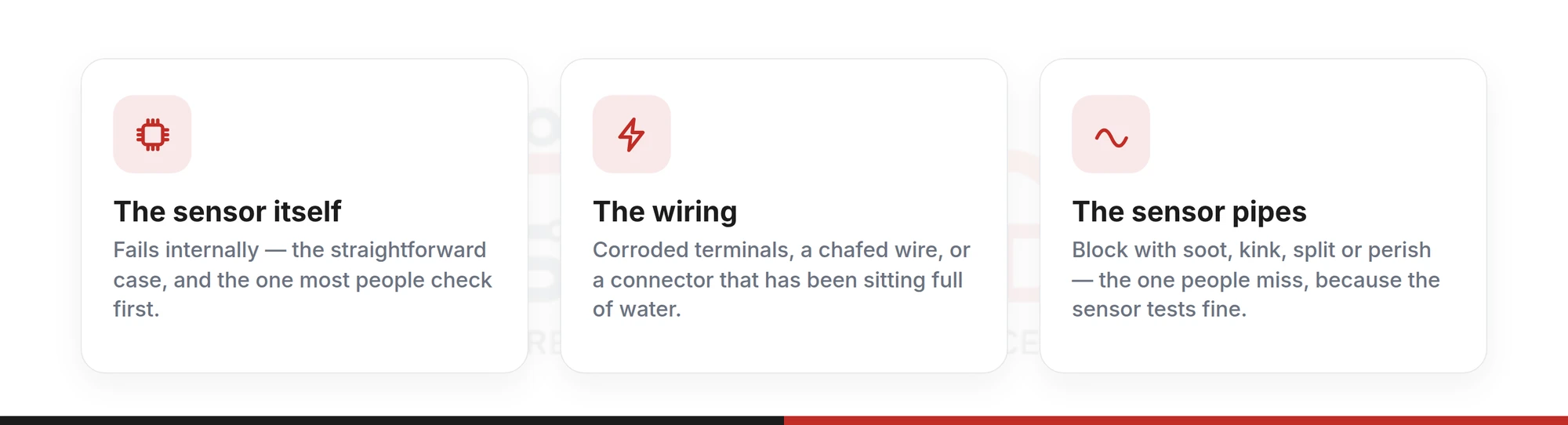
Neither code says the filter is full. Both say the measurement cannot be trusted, and that is a repair on the sensor side rather than work on the filter.
Three things account for most of them. The sensor itself fails. The wiring fails — corroded terminals, a chafed wire, a connector that has been sitting full of water. Or the pair of small pipes running from the sensor to the exhaust either side of the filter block with soot, kink, split or perish with age. That last one is the one people miss, because the sensor tests fine and the fault is in the plumbing.
A false reading is expensive in both directions. Read high, and the car believes the filter is blocked when it is not: it triggers regenerations it does not need, burning fuel and putting heat through a filter that was perfectly healthy. Read low, and the ECU never asks for a regeneration at all — so the filter genuinely fills while the dashboard reports nothing, and the first the driver knows about it is limp mode.
The check is live data rather than guesswork. With the engine stopped, the sensor should read essentially nothing; one showing a pressure difference across a filter with no gas flowing through it is telling you about itself. With the engine running, the reading should rise cleanly with load and settle back afterwards. And the pipes should be taken off and inspected before any conclusion is drawn about the filter behind them.
P242F and P2463: soot burns, ash does not
These two sit side by side in every code list and describe different problems with different answers. P2463 is excessive soot accumulation. P242F is a restriction attributed to ash accumulation. The difference between those two words is the most useful thing on this page.
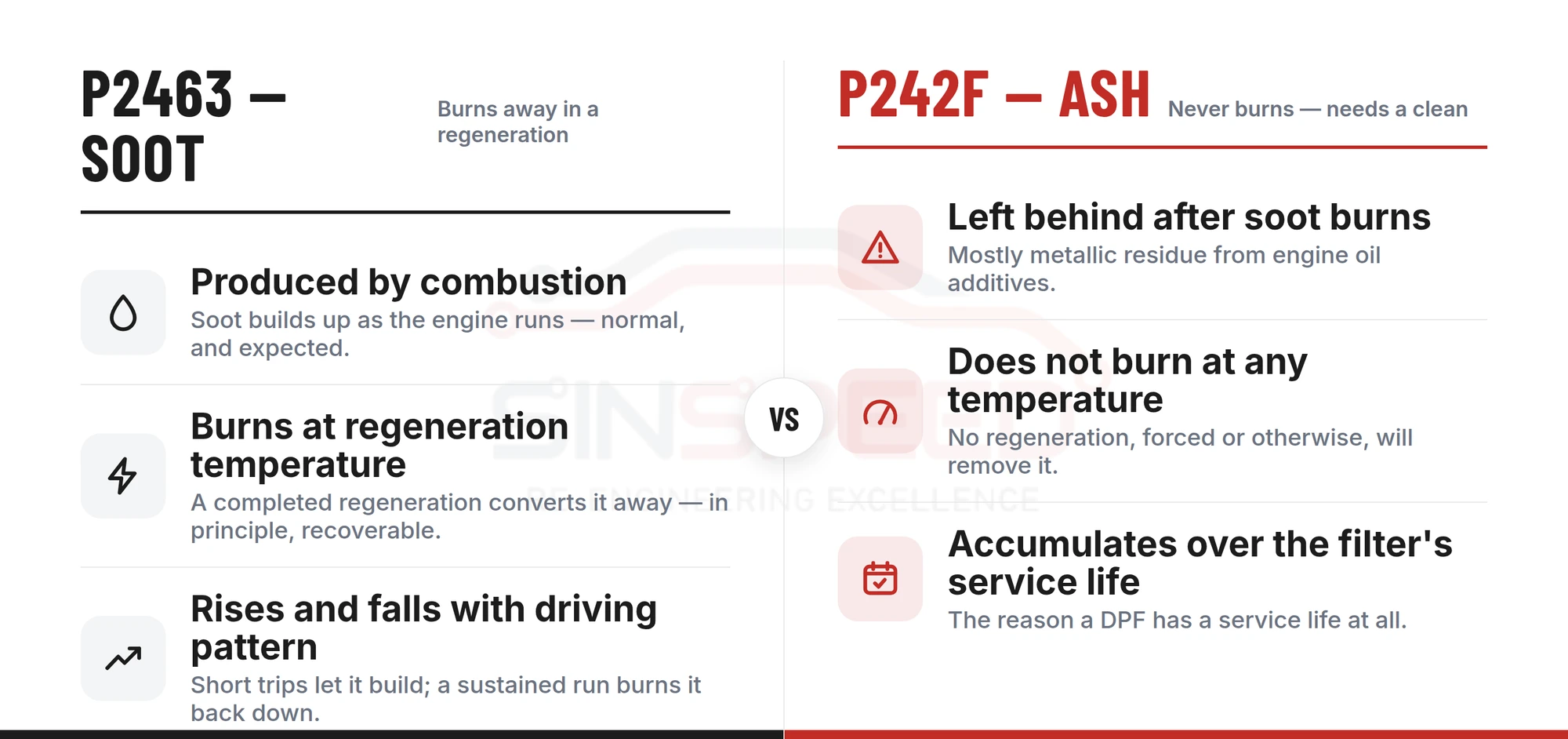
Soot is what the engine has just produced, and it is what regeneration exists to remove. A P2463 on a filter that is otherwise sound is, in principle, recoverable: complete a regeneration and the soot goes.
Ash is what remains after the soot has burned. Much of it is metallic residue originating in engine oil additives, it does not burn at any temperature a regeneration can reach, and it never leaves the filter on its own. It accumulates steadily over the filter’s life, which is the reason a DPF has a service life at all. That is what makes P242F a different class of problem. It is the ECU reporting that repeated regenerations have not brought the differential pressure back down, because whatever is causing the restriction cannot be burned away. A forced regeneration that clears P2463 will not clear P242F, and running one anyway achieves nothing except thermal stress.
So the two codes ask two different questions. P2463 asks whether the car can still complete a regeneration. P242F asks whether the filter can still be cleaned, or has reached the end of its service life.
The practical test: if a properly completed regeneration clears the fault and it stays away, you had a soot problem and a driving pattern to change. If the code returns within days, or never cleared in the first place, you have either ash in the filter or a measurement you should not have believed.
One caveat worth being straight about, because it is where money gets wasted. P242F is not always genuinely ash. The same code is set by a defective pressure sensor, by blocked sensor pipes, by an active regeneration system that has stopped working, and by heavy or repeated use of fuel additives, which leave residue of their own. That is why the sensor side gets checked before a filter is condemned — the section above this one is not an aside, it is the step before it.
How to use the fault code database
The table below lists thirteen DPF-related fault codes and maps each one across Seat, Volkswagen, Skoda and Audi, with the manufacturer’s own long-form number set against the OBD code.
Both numbers are there because a generic code reader and a VAG-specific diagnostic tool describe the same fault differently. One prints P2452; the other prints a five-digit number. Searching for one will not find the other, and an owner holding only the manufacturer’s number can spend a long time getting nowhere with it.
The P2-series codes covered above — P2002, P2003, P242F, P2452, P2453 and P2463 — are standardised, so they carry the same meaning whatever badge is on the bonnet. The P14xx and P1901 numbers in the table are manufacturer-specific and belong to these vehicles.
Two things to do with it. Find your code and read across to your make. Then record every code stored, not just the first one that came up — the combination changes the meaning. A pressure-sensor code sitting alongside a soot code says something quite different from a soot code on its own.
| Make | DTC Fault Code | DTC Description |
|---|---|---|
| Seat | 18884/P2452/009298 | – Diesel Particle Filter Differential Pressure Sensor: Elect. Malfunction |
| VW | 18884/P2452/009298 | – Diesel Particle Filter Differential Pressure Sensor: Elect. Malfunction |
| Skoda | 18884/P2452/009298 | – Diesel Particle Filter Differential Pressure Sensor: Elect. Malfunction |
| Audi | 18884/P2452/009298 | – Diesel Particle Filter Differential Pressure Sensor: Elect. Malfunction |
| Seat | 18885/P2453/009299 | – Diesel Particle Filter Differential Pressure Sensor: Implausible Signal |
| VW | 18885/P2453/009299 | – Diesel Particle Filter Differential Pressure Sensor: Implausible Signal |
| Skoda | 18885/P2453/009299 | – Diesel Particle Filter Differential Pressure Sensor: Implausible Signal |
| Audi | 18885/P2453/009299 | – Diesel Particle Filter Differential Pressure Sensor: Implausible Signal |
| Seat | P242F/009263 | – Diesel Particulate Filter (Bank 1): Restricted/Clogged |
| VW | P242F/009263 | – Diesel Particulate Filter (Bank 1): Restricted/Clogged |
| Skoda | P242F/009263 | – Diesel Particulate Filter (Bank 1): Restricted/Clogged |
| Audi | P242F/009263 | – Diesel Particulate Filter (Bank 1): Restricted/Clogged |
| Seat | 18895/P2463/009315 | – Diesel Particle Filter: Excessive Soot Accumulation |
| VW | 18895/P2463/009315 | – Diesel Particle Filter: Excessive Soot Accumulation |
| Skoda | 18895/P2463/009315 | – Diesel Particle Filter: Excessive Soot Accumulation |
| Audi | 18895/P2463/009315 | – Diesel Particle Filter: Excessive Soot Accumulation |
| Seat | 18434/P2002/008194 | – Particle Filter Bank 1: Malfunction |
| VW | 18434/P2002/008194 | – Particle Filter Bank 1: Malfunction |
| Skoda | 18434/P2002/008194 | – Particle Filter Bank 1: Malfunction |
| Audi | 18434/P2002/008194 | – Particle Filter Bank 1: Malfunction |
| Peugeot 307 2.0 HDI | P1429 | - Diesel Particulate Filter Pressure |
| Peugeot 307 2.0 HDI | P1400 | - DPFE circuit Low input |
| Peugeot 307 2.0 HDI | P1401 | - DPFE circuit High input |
| Peugeot 307 2.0 HDI | P1405 | - DPFE sensor upstream Hose off or plugged |
| Nissan | P1435 | - DPF Re-generation (CRNT) |
| Nissan | P1436 | - DPF Re-generation (CRNT) |
| Vauxhall Zafira 1.9 CDTI | P1901 | - Particulate filter pressure sensor error |
| Vauxhall Combo 1.3 CDTi | P1901 | - Particulate filter pressure sensor error |
| Nissan Navara 2.5 DCi | P2002 | - Particle Filter Bank 1: Malfunction |
| Honda Accord 2.2 DTEC | P2002 | - Particle Filter Bank 1: Malfunction |
| Vauxhall Insignia 2.0 CDTi | P2002 | - Particle Filter Bank 1: Malfunction |
| Mercedes Sprinter 311 CDI | P242F | - Diesel Particular Filter Restriction |
| Mercedes Sprinter 315 CDI | P242F | - Diesel Particular Filter Restriction |
| Mazda 5 2.0 TD | P242F | - Diesel Particular Filter Restriction |
| Mazda 6 2.0 TD | P242F | - Diesel Particular Filter Restriction |
| Ford Focus 1.6 TDCI | P2452 | - Particulate Matter Trap Differential Pressure Sensor Circuit |
| Vauxhall Zafira 1.9 CDTI | P2452 | - Particulate Matter Trap Differential Pressure Sensor Circuit |
| Peugeot 307 2.0 HDI | P1429 | - Diesel Particulate Filter Pressure |
| Peugeot | P1400 | - DPFE circuit Low input |
| Peugeot | P1401 | - DPFE circuit High input |
| Peugeot | P1405 | - DPFE sensor upstream Hose off or plugged |
| Alfa Romeo | P2002 | - Particle Filter Bank 1: Malfunction |
| Alfa Romeo | P2003 | - Particulate Trap Efficiency Below Threshold |
| Alfa Romeo | P242F | - Diesel Particular Filter Restriction |
| Alfa Romeo | P2452 | - Particulate Matter Trap Differential Pressure Sensor Circuit |
| Alfa Romeo | P2453 | - Diesel Particle Filter Differential Pressure Sensor: Implausible Signal |
| Alfa Romeo | P2463 | - Diesel Particle Filter: Excessive Soot Accumulation |
| BMW | P2002 | - Particle Filter Bank 1: Malfunction |
| BMW | P2003 | - Particulate Trap Efficiency Below Threshold |
| BMW | P242F | - Diesel Particular Filter Restriction |
| BMW | P2452 | - Particulate Matter Trap Differential Pressure Sensor Circuit |
| BMW | P2453 | - Diesel Particle Filter Differential Pressure Sensor: Implausible Signal |
| BMW | P2463 | - Diesel Particle Filter: Excessive Soot Accumulation |
| Chevrolet | P2002 | - Particle Filter Bank 1: Malfunction |
| Chevrolet | P2003 | - Particulate Trap Efficiency Below Threshold |
| Chevrolet | P242F | - Diesel Particular Filter Restriction |
| Chevrolet | P2452 | - Particulate Matter Trap Differential Pressure Sensor Circuit |
| Chevrolet | P2453 | - Diesel Particle Filter Differential Pressure Sensor: Implausible Signal |
| Chevrolet | P2463 | - Diesel Particle Filter: Excessive Soot Accumulation |
| Chrysler | P2002 | - Particle Filter Bank 1: Malfunction |
| Chrysler | P2003 | - Particulate Trap Efficiency Below Threshold |
| Chrysler | P242F | - Diesel Particular Filter Restriction |
| Chrysler | P2452 | - Particulate Matter Trap Differential Pressure Sensor Circuit |
| Chrysler | P2453 | - Diesel Particle Filter Differential Pressure Sensor: Implausible Signal |
| Chrysler | P2463 | - Diesel Particle Filter: Excessive Soot Accumulation |
| Citroen | P2002 | - Particle Filter Bank 1: Malfunction |
| Citroen | P2003 | - Particulate Trap Efficiency Below Threshold |
| Citroen | P242F | - Diesel Particular Filter Restriction |
| Citroen | P2452 | - Particulate Matter Trap Differential Pressure Sensor Circuit |
| Citroen | P2453 | - Diesel Particle Filter Differential Pressure Sensor: Implausible Signal |
| Citroen | P2463 | - Diesel Particle Filter: Excessive Soot Accumulation |
| Dodge | P2002 | - Particle Filter Bank 1: Malfunction |
| Dodge | P2003 | - Particulate Trap Efficiency Below Threshold |
| Dodge | P242F | - Diesel Particular Filter Restriction |
| Dodge | P2452 | - Particulate Matter Trap Differential Pressure Sensor Circuit |
| Dodge | P2453 | - Diesel Particle Filter Differential Pressure Sensor: Implausible Signal |
| Dodge | P2463 | - Diesel Particle Filter: Excessive Soot Accumulation |
| Fiat | P2002 | - Particle Filter Bank 1: Malfunction |
| Fiat | P2003 | - Particulate Trap Efficiency Below Threshold |
| Fiat | P242F | - Diesel Particular Filter Restriction |
| Fiat | P2452 | - Particulate Matter Trap Differential Pressure Sensor Circuit |
| Fiat | P2453 | - Diesel Particle Filter Differential Pressure Sensor: Implausible Signal |
| Fiat | P2463 | - Diesel Particle Filter: Excessive Soot Accumulation |
| Ford | P2002 | - Particle Filter Bank 1: Malfunction |
| Ford | P2003 | - Particulate Trap Efficiency Below Threshold |
| Ford | P242F | - Diesel Particular Filter Restriction |
| Ford | P2452 | - Particulate Matter Trap Differential Pressure Sensor Circuit |
| Ford | P2453 | - Diesel Particle Filter Differential Pressure Sensor: Implausible Signal |
| Ford | P2463 | - Diesel Particle Filter: Excessive Soot Accumulation |
| Honda | P2002 | - Particle Filter Bank 1: Malfunction |
| Honda | P2003 | - Particulate Trap Efficiency Below Threshold |
| Honda | P242F | - Diesel Particular Filter Restriction |
| Honda | P2452 | - Particulate Matter Trap Differential Pressure Sensor Circuit |
| Honda | P2453 | - Diesel Particle Filter Differential Pressure Sensor: Implausible Signal |
| Honda | P2463 | - Diesel Particle Filter: Excessive Soot Accumulation |
| Hyundai | P2002 | - Particle Filter Bank 1: Malfunction |
| Hyundai | P2003 | - Particulate Trap Efficiency Below Threshold |
| Hyundai | P242F | - Diesel Particular Filter Restriction |
| Hyundai | P2452 | - Particulate Matter Trap Differential Pressure Sensor Circuit |
| Hyundai | P2453 | - Diesel Particle Filter Differential Pressure Sensor: Implausible Signal |
| Hyundai | P2463 | - Diesel Particle Filter: Excessive Soot Accumulation |
| Iveco | P2002 | - Particle Filter Bank 1: Malfunction |
| Iveco | P2003 | - Particulate Trap Efficiency Below Threshold |
| Iveco | P242F | - Diesel Particular Filter Restriction |
| Iveco | P2452 | - Particulate Matter Trap Differential Pressure Sensor Circuit |
| Iveco | P2453 | - Diesel Particle Filter Differential Pressure Sensor: Implausible Signal |
| Iveco | P2463 | - Diesel Particle Filter: Excessive Soot Accumulation |
| Jaguar | P2002 | - Particle Filter Bank 1: Malfunction |
| Jaguar | P2003 | - Particulate Trap Efficiency Below Threshold |
| Jaguar | P242F | - Diesel Particular Filter Restriction |
| Jaguar | P2452 | - Particulate Matter Trap Differential Pressure Sensor Circuit |
| Jaguar | P2453 | - Diesel Particle Filter Differential Pressure Sensor: Implausible Signal |
| Jaguar | P2463 | - Diesel Particle Filter: Excessive Soot Accumulation |
| Kia | P2002 | - Particle Filter Bank 1: Malfunction |
| Kia | P2003 | - Particulate Trap Efficiency Below Threshold |
| Kia | P242F | - Diesel Particular Filter Restriction |
| Kia | P2452 | - Particulate Matter Trap Differential Pressure Sensor Circuit |
| Kia | P2453 | - Diesel Particle Filter Differential Pressure Sensor: Implausible Signal |
| Kia | P2463 | - Diesel Particle Filter: Excessive Soot Accumulation |
| Lancia | P2002 | - Particle Filter Bank 1: Malfunction |
| Lancia | P2003 | - Particulate Trap Efficiency Below Threshold |
| Lancia | P242F | - Diesel Particular Filter Restriction |
| Lancia | P2452 | - Particulate Matter Trap Differential Pressure Sensor Circuit |
| Lancia | P2453 | - Diesel Particle Filter Differential Pressure Sensor: Implausible Signal |
| Lancia | P2463 | - Diesel Particle Filter: Excessive Soot Accumulation |
| Land Rover | P2002 | - Particle Filter Bank 1: Malfunction |
| Land Rover | P2003 | - Particulate Trap Efficiency Below Threshold |
| Land Rover | P242F | - Diesel Particular Filter Restriction |
| Land Rover | P2452 | - Particulate Matter Trap Differential Pressure Sensor Circuit |
| Land Rover | P2453 | - Diesel Particle Filter Differential Pressure Sensor: Implausible Signal |
| Land Rover | P2463 | - Diesel Particle Filter: Excessive Soot Accumulation |
| Mazda | P2002 | - Particle Filter Bank 1: Malfunction |
| Mazda | P2003 | - Particulate Trap Efficiency Below Threshold |
| Mazda | P242F | - Diesel Particular Filter Restriction |
| Mazda | P2452 | - Particulate Matter Trap Differential Pressure Sensor Circuit |
| Mazda | P2453 | - Diesel Particle Filter Differential Pressure Sensor: Implausible Signal |
| Mazda | P2463 | - Diesel Particle Filter: Excessive Soot Accumulation |
| Mercedes | P2002 | - Particle Filter Bank 1: Malfunction |
| Mercedes | P2003 | - Particulate Trap Efficiency Below Threshold |
| Mercedes | P242F | - Diesel Particular Filter Restriction |
| Mercedes | P2452 | - Particulate Matter Trap Differential Pressure Sensor Circuit |
| Mercedes | P2453 | - Diesel Particle Filter Differential Pressure Sensor: Implausible Signal |
| Mercedes | P2463 | - Diesel Particle Filter: Excessive Soot Accumulation |
| Mini | P2002 | - Particle Filter Bank 1: Malfunction |
| Mini | P2003 | - Particulate Trap Efficiency Below Threshold |
| Mini | P242F | - Diesel Particular Filter Restriction |
| Mini | P2452 | - Particulate Matter Trap Differential Pressure Sensor Circuit |
| Mini | P2453 | - Diesel Particle Filter Differential Pressure Sensor: Implausible Signal |
| Mini | P2463 | - Diesel Particle Filter: Excessive Soot Accumulation |
| Mitsubishi | P2002 | - Particle Filter Bank 1: Malfunction |
| Mitsubishi | P2003 | - Particulate Trap Efficiency Below Threshold |
| Mitsubishi | P242F | - Diesel Particular Filter Restriction |
| Mitsubishi | P2452 | - Particulate Matter Trap Differential Pressure Sensor Circuit |
| Mitsubishi | P2453 | - Diesel Particle Filter Differential Pressure Sensor: Implausible Signal |
| Mitsubishi | P2463 | - Diesel Particle Filter: Excessive Soot Accumulation |
| Nissan | P2002 | - Particle Filter Bank 1: Malfunction |
| Nissan | P2003 | - Particulate Trap Efficiency Below Threshold |
| Nissan | P242F | - Diesel Particular Filter Restriction |
| Nissan | P2452 | - Particulate Matter Trap Differential Pressure Sensor Circuit |
| Nissan | P2453 | - Diesel Particle Filter Differential Pressure Sensor: Implausible Signal |
| Nissan | P2463 | - Diesel Particle Filter: Excessive Soot Accumulation |
| Opel | P2002 | - Particle Filter Bank 1: Malfunction |
| Opel | P2003 | - Particulate Trap Efficiency Below Threshold |
| Opel | P242F | - Diesel Particular Filter Restriction |
| Opel | P2452 | - Particulate Matter Trap Differential Pressure Sensor Circuit |
| Opel | P2453 | - Diesel Particle Filter Differential Pressure Sensor: Implausible Signal |
| Opel | P2463 | - Diesel Particle Filter: Excessive Soot Accumulation |
| Peugeot | P2002 | - Particle Filter Bank 1: Malfunction |
| Peugeot | P2003 | - Particulate Trap Efficiency Below Threshold |
| Peugeot | P242F | - Diesel Particular Filter Restriction |
| Peugeot | P2452 | - Particulate Matter Trap Differential Pressure Sensor Circuit |
| Peugeot | P2453 | - Diesel Particle Filter Differential Pressure Sensor: Implausible Signal |
| Peugeot | P2463 | - Diesel Particle Filter: Excessive Soot Accumulation |
| Porsche | P2002 | - Particle Filter Bank 1: Malfunction |
| Porsche | P2003 | - Particulate Trap Efficiency Below Threshold |
| Porsche | P242F | - Diesel Particular Filter Restriction |
| Porsche | P2452 | - Particulate Matter Trap Differential Pressure Sensor Circuit |
| Porsche | P2453 | - Diesel Particle Filter Differential Pressure Sensor: Implausible Signal |
| Porsche | P2463 | - Diesel Particle Filter: Excessive Soot Accumulation |
| Renault | P2002 | - Particle Filter Bank 1: Malfunction |
| Renault | P2003 | - Particulate Trap Efficiency Below Threshold |
| Renault | P242F | - Diesel Particular Filter Restriction |
| Renault | P2452 | - Particulate Matter Trap Differential Pressure Sensor Circuit |
| Renault | P2453 | - Diesel Particle Filter Differential Pressure Sensor: Implausible Signal |
| Renault | P2463 | - Diesel Particle Filter: Excessive Soot Accumulation |
| Saab | P2002 | - Particle Filter Bank 1: Malfunction |
| Saab | P2003 | - Particulate Trap Efficiency Below Threshold |
| Saab | P242F | - Diesel Particular Filter Restriction |
| Saab | P2452 | - Particulate Matter Trap Differential Pressure Sensor Circuit |
| Saab | P2453 | - Diesel Particle Filter Differential Pressure Sensor: Implausible Signal |
| Saab | P2463 | - Diesel Particle Filter: Excessive Soot Accumulation |
| Subaru | P2002 | - Particle Filter Bank 1: Malfunction |
| Subaru | P2003 | - Particulate Trap Efficiency Below Threshold |
| Subaru | P242F | - Diesel Particular Filter Restriction |
| Subaru | P2452 | - Particulate Matter Trap Differential Pressure Sensor Circuit |
| Subaru | P2453 | - Diesel Particle Filter Differential Pressure Sensor: Implausible Signal |
| Subaru | P2463 | - Diesel Particle Filter: Excessive Soot Accumulation |
| Suzuki | P2002 | - Particle Filter Bank 1: Malfunction |
| Suzuki | P2003 | - Particulate Trap Efficiency Below Threshold |
| Suzuki | P242F | - Diesel Particular Filter Restriction |
| Suzuki | P2452 | - Particulate Matter Trap Differential Pressure Sensor Circuit |
| Suzuki | P2453 | - Diesel Particle Filter Differential Pressure Sensor: Implausible Signal |
| Suzuki | P2463 | - Diesel Particle Filter: Excessive Soot Accumulation |
| Audi | P2002 | - Particle Filter Bank 1: Malfunction |
| Audi | P2003 | - Particulate Trap Efficiency Below Threshold |
| Audi | P242F | - Diesel Particular Filter Restriction |
| Audi | P2452 | - Particulate Matter Trap Differential Pressure Sensor Circuit |
| Audi | P2453 | - Diesel Particle Filter Differential Pressure Sensor: Implausible Signal |
| Audi | P2463 | - Diesel Particle Filter: Excessive Soot Accumulation |
| Volvo | P2002 | - Particle Filter Bank 1: Malfunction |
| Volvo | P2003 | - Particulate Trap Efficiency Below Threshold |
| Volvo | P242F | - Diesel Particular Filter Restriction |
| Volvo | P2452 | - Particulate Matter Trap Differential Pressure Sensor Circuit |
| Volvo | P2453 | - Diesel Particle Filter Differential Pressure Sensor: Implausible Signal |
| Volvo | P2463 | - Diesel Particle Filter: Excessive Soot Accumulation |
| Vauxhall | P2002 | - Particle Filter Bank 1: Malfunction |
| Vauxhall | P2003 | - Particulate Trap Efficiency Below Threshold |
| Vauxhall | P242F | - Diesel Particular Filter Restriction |
| Vauxhall | P2452 | - Particulate Matter Trap Differential Pressure Sensor Circuit |
| Vauxhall | P2453 | - Diesel Particle Filter Differential Pressure Sensor: Implausible Signal |
| Vauxhall | P2463 | - Diesel Particle Filter: Excessive Soot Accumulation |
| Seat | P2002 | - Particle Filter Bank 1: Malfunction |
| Seat | P2003 | - Particulate Trap Efficiency Below Threshold |
| Seat | P242F | - Diesel Particular Filter Restriction |
| Seat | P2452 | - Particulate Matter Trap Differential Pressure Sensor Circuit |
| Seat | P2453 | - Diesel Particle Filter Differential Pressure Sensor: Implausible Signal |
| Seat | P2463 | - Diesel Particle Filter: Excessive Soot Accumulation |
| Skoda | P2002 | - Particle Filter Bank 1: Malfunction |
| Skoda | P2003 | - Particulate Trap Efficiency Below Threshold |
| Skoda | P242F | - Diesel Particular Filter Restriction |
| Skoda | P2452 | - Particulate Matter Trap Differential Pressure Sensor Circuit |
| Skoda | P2453 | - Diesel Particle Filter Differential Pressure Sensor: Implausible Signal |
| Skoda | P2463 | - Diesel Particle Filter: Excessive Soot Accumulation |
| Volkswagen (VW) | P2002 | - Particle Filter Bank 1: Malfunction |
| Volkswagen (VW) | P2003 | - Particulate Trap Efficiency Below Threshold |
| Volkswagen (VW) | P242F | - Diesel Particular Filter Restriction |
| Volkswagen (VW) | P2452 | - Particulate Matter Trap Differential Pressure Sensor Circuit |
| Volkswagen (VW) | P2453 | - Diesel Particle Filter Differential Pressure Sensor: Implausible Signal |
| Volkswagen (VW) | P2463 | - Diesel Particle Filter: Excessive Soot Accumulation |
Sinspeed · DPF diagnosis and repair
Not sure whether it is soot, ash or the sensor?
Send us the codes your tool printed, the vehicle, and what it is actually doing. Our diagnostic specialists will tell you which of the three you are looking at, and what clears it, before anything is taken off the car.
Record every code, not just the first · The sensor side is checked before a filter is condemned
DPF removal: off-road and motorsport vehicles only
Removal is a different service with a narrow application, and it is worth describing accurately rather than vaguely. The filter’s internals are taken out and the engine management is recalibrated so that the ECU no longer expects a filter to be there.
The calibration half is not optional, and it is where most of the trouble comes from. A vehicle whose filter has been taken out without the software side being addressed properly stores faults, drops into limp mode and smokes — which is the single most common reason a car arrives here having had the work done somewhere else. Our smoke correction service exists for exactly that, and a worked example of what a full session involves is written up on our Volvo XC90 D5 removal session.
It is carried out for vehicles used away from the public road: motorsport, competition and off-road use. The full range is on the DPF removals category.
For any vehicle used on the road, the routes earlier on this page are the ones that apply — completing a regeneration while that is still possible, and cleaning the filter when it is not.
The legal position in the UK
Three facts, stated plainly, because vagueness on this subject helps nobody.
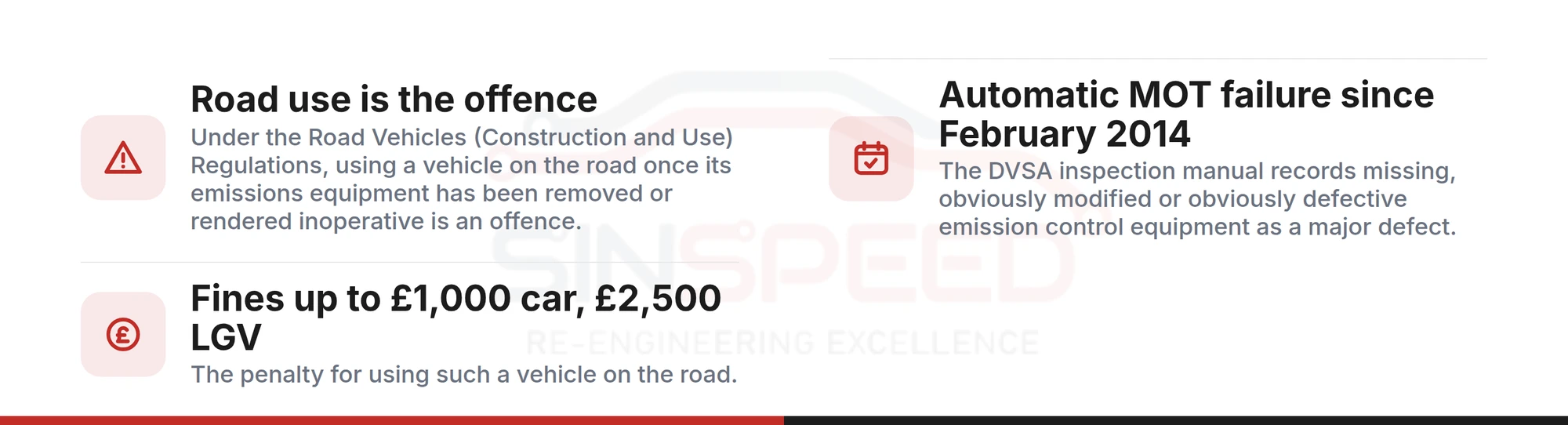
The offence attaches to road use rather than to the removal itself. Under the Road Vehicles (Construction and Use) Regulations it is an offence to use a vehicle on the road once its emissions equipment has been removed or rendered inoperative.
It has been an automatic MOT failure since February 2014. The test checks that the filter is still present on any vehicle originally fitted with one, and the DVSA inspection manual records emission control equipment that is missing, obviously modified or obviously defective as a major defect. It applies to vehicles first used on or after 1 September 2002.
Using such a vehicle on the road can carry a fine of up to £1,000 for a car and £2,500 for a light goods vehicle.
DPF removal is carried out for off-road and motorsport vehicles only. For a road-going vehicle, cleaning the filter is the road-legal route, and it is the one we will point you towards.
DPF fault code FAQs
Is it illegal to remove a DPF in the UK?
The offence attaches to using the vehicle on the road, not to the removal itself. Under the Road Vehicles (Construction and Use) Regulations it is an offence to use a vehicle on the road once its emissions equipment has been removed or rendered inoperative, and a missing filter has been an automatic MOT failure since February 2014 on any vehicle originally fitted with one. Using such a vehicle on the road can carry a fine of up to £1,000 for a car and £2,500 for a light goods vehicle. That is why removal is carried out for off-road and motorsport vehicles only, and why cleaning is the route for a road car.
Will a forced regeneration clear P242F?
No, not if the code is genuinely reporting ash. Regeneration works by burning soot, and ash does not burn at any temperature a regeneration reaches — so the restriction is still there when the cycle finishes and the differential pressure never comes back down. What a forced regen will do is put the filter through another cycle above 600°C, which is thermal stress with nothing to show for it. Where P242F has actually been set by a faulty pressure sensor, blocked sensor pipes or a regeneration system that has stopped working, the answer is that fault rather than a regen either.
Can P2452 or P2453 be caused by something other than a blocked filter?
They are usually caused by something other than a blocked filter. Both codes are about the differential pressure sensor and the reading it produces, not about how full the filter is. The common causes are the sensor itself, corroded or damaged wiring in its circuit, and the small pipes running from the sensor to the exhaust becoming blocked with soot, kinked, split or perished. An exhaust leak upstream will also unsettle the reading. A filter can be perfectly serviceable and still be reported as blocked because the measurement is wrong.
How do I complete a DPF regeneration myself?
While the warning is still amber and the vehicle is driving normally, give the car the conditions an active regeneration needs: a sustained run at motorway speed, at engine speeds high enough to keep exhaust temperature up, following whatever your handbook specifies. Do not switch the engine off part-way through — an aborted cycle carries the soot load over to the next attempt. If the lamp has turned red, other warnings have appeared, or the car has dropped into limp mode, that window has passed and driving further will not recover it. At that point it needs a diagnostic tool, not a longer journey.
My DPF light went out on its own. Is the problem fixed?
It means a regeneration completed, which is the system working as designed. Whether the problem is fixed depends on how often it happens. A light that appears occasionally on a car used for short journeys, and clears after a longer run, is telling you about a driving pattern. A light that returns every week or two is telling you something else: the filter is filling faster than it should, or a regeneration is being triggered by a reading that is wrong. Have the codes read while they are still stored rather than waiting for limp mode.
Sinspeed · DPF diagnosis and repair
Been told your DPF needs replacing?
Tell us the codes, the vehicle and the history, and we will tell you whether you are looking at a regeneration problem, an ash-loaded filter or a sensor fault — including when the honest answer is that the filter is not the part at fault.
In-house diagnostic specialists · Cleaning is the route we recommend for any road-going vehicle
Final thoughts
Every route on this page turns on one physical question, and it is worth carrying away on its own: can what is inside the filter be burned, or not?
Soot can. That is what regeneration exists for, and where the car is still capable of completing one, the answer is usually a change in how it is driven rather than a repair at all. Ash cannot, at any temperature a regeneration reaches. That is why a filter at the end of its ash life reads as a restriction no amount of heat will lift, and why the answer there is a physical clean rather than another forced regen.
And sometimes there is nothing in the filter at all. A pressure sensor with a sooted pipe reports a blockage that does not exist, and a filter gets condemned on the strength of a measurement rather than a fault. That is the cheapest thing on this page to check and the most expensive one to get wrong.
Which is the order to work in. Prove the measurement first. Then establish whether it is soot or ash. Only then decide what the filter needs.