
ESP stands for Electronic Stability Program — a safety system that steps in the instant your car starts to skid, braking individual wheels and trimming engine power to keep you on your intended line. Depending on the manufacturer it may be badged ESC, DSC, VSC or VSA, but it does the same job, and it is built on your car’s ABS system. When an ESP fault traces back to the ABS/ESP control module or pump, remanufacturing that unit — rather than fitting a costly new one — is our specialism.
On this page
- What is ESP on a car?
- How does ESP work?
- Should I drive with ESP on or off?
- Is it safe to drive with the ESP light on?
- What causes the ESP light to come on?
- How much does it cost to fix an ESP fault?
- Frequently Asked Questions
What is ESP on a car?
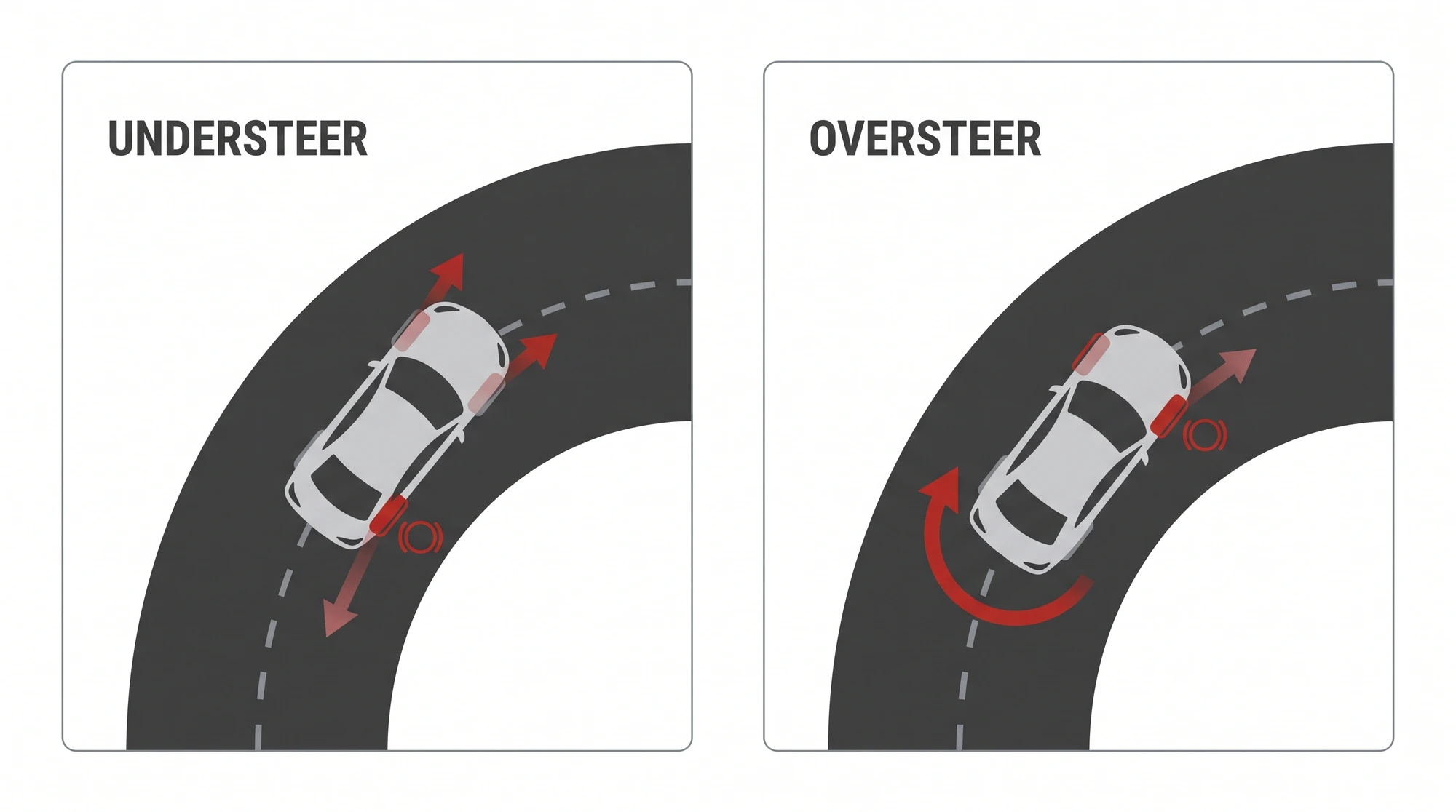
ESP stands for Electronic Stability Program — a computer-controlled safety system that steps in the instant your car begins to lose grip and slide. Depending on who built your vehicle, the same technology is badged differently: ESC (Electronic Stability Control), DSC (Dynamic Stability Control) on BMW, VSC on Toyota, or VSA on Honda. The name changes but the job does not. It sits quietly in the background whenever you drive, and it only acts when it senses the car is no longer going where you are steering it.
When you take a corner too quickly or hit a slippery patch, the car can begin to understeer — where the front washes wide of your line — or oversteer, where the back steps out. ESP detects that slide within milliseconds and responds automatically, braking one or more individual wheels and, where needed, cutting engine power to pull the car back onto the course you intended. It cannot rewrite the laws of physics, but it has been shown to prevent a large share of skid-related loss-of-control accidents, which is why it became a legal requirement on all new cars sold in the UK and EU in 2014.
How does ESP work?
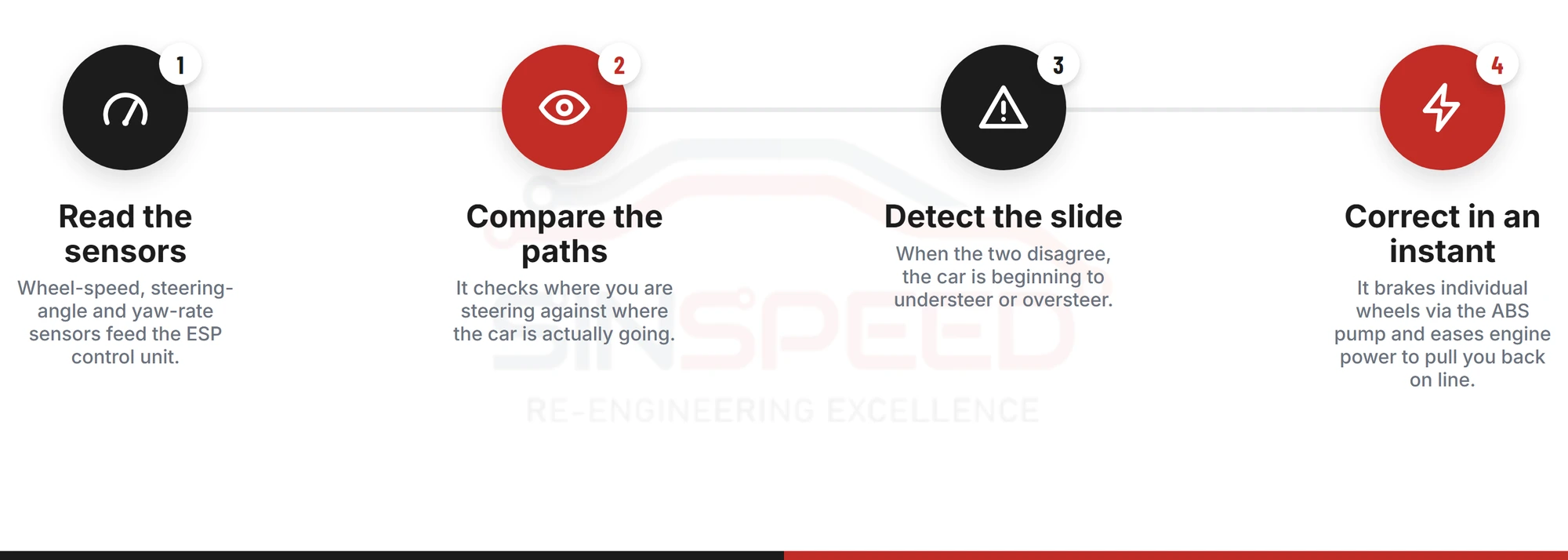
ESP is built on top of your car’s ABS (anti-lock braking system) and shares much of its hardware. To judge whether the car is doing what the driver wants, the ESP control unit reads three key inputs. The wheel-speed sensors at each wheel — the same ones ABS uses — tell it how fast each wheel is turning. A steering-angle sensor tells it where you are pointing the front wheels. And a yaw-rate sensor measures how much the car is actually rotating around its vertical axis. Put simply, the system constantly compares where you are steering with where the car is genuinely going.
When those two things disagree — you are steering into a bend, but the car is starting to slide straight on — ESP acts through the ABS pump, braking individual wheels to swing the car back into line, and it can ask the engine to ease off the power at the same time. All of this happens far faster than any driver could react.
This is why a flashing ESP light while you are driving is a good sign, not a fault. It means the system has detected a slippery surface and is actively working to keep you stable. A steady ESP light that stays on is a different matter: it usually means the system has found a fault and switched itself off, so it is no longer protecting you until the problem is put right.
Should I drive with ESP on or off?
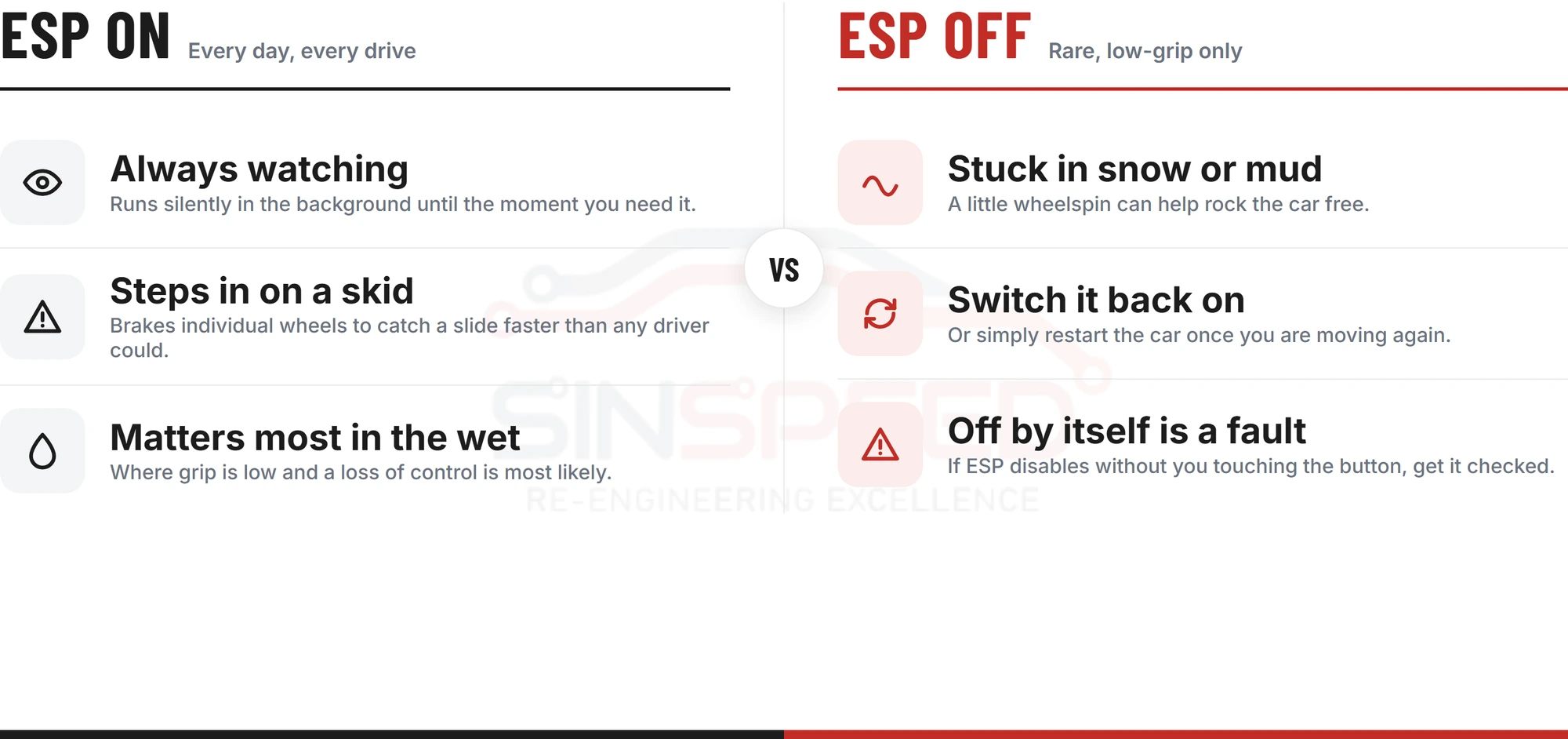
For everyday driving, the answer is straightforward: leave ESP on. It is one of the most effective safety systems fitted to a modern car, and it works away in the background without you noticing until the moment you need it. There is rarely a good reason to switch it off on the road.
The ESP-off button exists for a narrow set of situations where a little wheelspin actually helps — rocking the car free when it is stuck in snow, mud or soft sand, for example, where ESP’s instinct to cut power would work against you. Even then, switch it back on, or simply restart the car (which usually resets it), as soon as you are moving again. If you find ESP has turned itself off without you touching the button, that points to a fault rather than a setting.
Is it safe to drive with the ESP light on?
If the ESP warning light is on and staying on, the car will usually still drive and brake normally — but you have lost the stability safety net that would step in during a skid. In dry conditions on a familiar road that may feel like no difference at all. In the wet, in the cold, or in an emergency swerve, it could matter a great deal. For that reason it is not a warning to ignore: have it diagnosed rather than leaving it.
Pay particular attention if the ABS warning light has come on at the same time. Because ESP is built on the ABS system and shares its sensors, a single fault can affect both — and that combination means two safety systems are down at once. Treat it as more urgent and get the car checked promptly.
What causes the ESP light to come on?
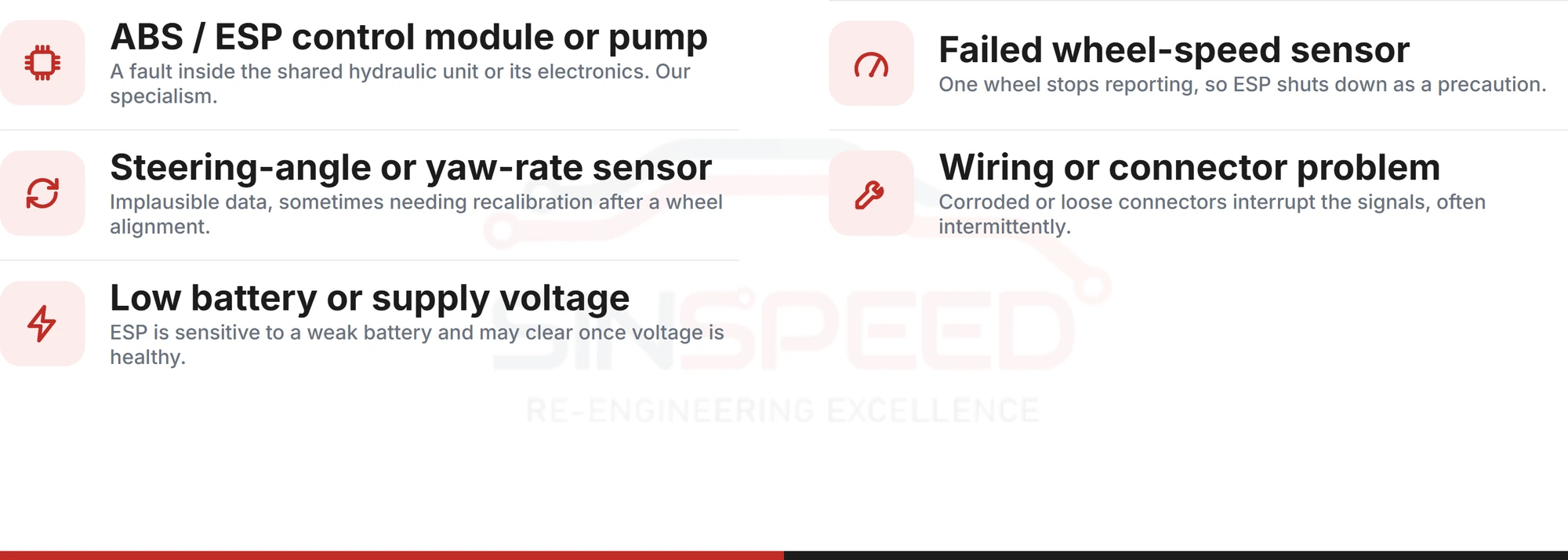
A steady ESP light can be triggered anywhere along the chain of sensors, wiring and control hardware the system depends on. The most common causes, grouped by the part of the system responsible, are:
- A faulty ABS/ESP control module or pump. ESP works through the same hydraulic unit and control module as your ABS, so a fault inside that unit — its electronics or the pump itself — will disable ESP and bring on the warning light. This is one of the more common underlying causes, and it is the area we specialise in.
- A failed wheel-speed sensor. Each wheel has a sensor feeding speed data to the system. If one stops reading correctly, the control unit no longer has the information it needs and shuts ESP down as a precaution.
- A steering-angle or yaw-rate sensor fault. These tell the system where you are steering and how the car is actually moving. If either sends implausible or missing data — sometimes after work such as a wheel alignment, when the steering-angle sensor needs recalibrating — ESP will flag a fault.
- Wiring or connector problems. Corroded, damaged or loose connectors between the sensors and the control unit can interrupt the signals and trip the light, often intermittently, which can make the fault frustrating to pin down.
- Low battery or supply voltage. ESP is sensitive to a weak or failing battery; low voltage can bring the light on, and it may clear once the electrical supply is healthy again.
Because so many different parts can produce the same warning, the first job is always a proper diagnostic scan to read the stored fault codes and identify which part of the system is actually at fault. Replacing sensors on a guess is how an ESP fault gets expensive without ever getting fixed.
Where the fault traces back to the ABS/ESP control module or pump, that is our wheelhouse. We are UK automotive-electronics remanufacturers, and the ABS/ESP unit is one of our core lines — you can see the full range on our ABS pumps and ECUs page. Rather than fitting a costly new dealer unit, we remanufacture your existing module: every unit is tested on our in-house Hardware-in-the-Loop rigs, which replicate the heat, vibration and electrical load it faces on the car, and most come back ready to fit and covered by a lifetime, unlimited-mileage warranty. The service is mail-in — you send us the unit and we repair and return it.
If a scan has already pointed at the ABS/ESP module, complete our repair form with your vehicle and fault details to get started. If you are not yet sure which part is behind your ESP light, get in touch and we will help you work out the next step. Where the cause turns out to be a wheel-speed sensor, the wiring or the battery, a local garage or auto electrician is the right port of call — but for the ABS/ESP control unit itself, that is exactly what we do.
How much does it cost to fix an ESP fault?
There is no single price for fixing an ESP fault, because the cost depends entirely on what has failed — and anyone quoting a flat figure before the car has been scanned is guessing. A single wheel-speed sensor is a modest job; a full ABS/ESP control module is a larger one. This is why diagnosis comes first: identifying the real cause is what stops you paying to replace parts that were never the problem.
Where the fault is the ABS/ESP control module, remanufacturing your existing unit is normally far cheaper than a new dealer part, and it keeps your vehicle’s original coding intact. We quote against your specific unit and fault rather than offering a generic price.
Frequently Asked Questions
Is it safe to drive with the ESP light on?
The car will usually still drive and brake, but with the ESP light on steadily you have lost the stability system that steps in during a skid — so you are without that safety net in the wet or an emergency manoeuvre. It is safe enough to reach a garage in normal conditions, but have it diagnosed rather than leaving it, and treat it as more urgent if the ABS light has come on too.
Should I drive with ESP on or off?
Keep ESP on for all normal driving — it is a proven safety system that only acts when the car starts to slide. The off switch is only for narrow low-grip situations, such as rocking the car free from snow or mud, where a little wheelspin helps. Switch it back on, or simply restart the car, as soon as you are moving again.
What causes the ESP light to come on?
A steady ESP light is usually caused by a faulty ABS/ESP control module or pump, a failed wheel-speed sensor, a steering-angle or yaw-rate sensor fault, a wiring or connector problem, or low battery voltage. Because several parts can trigger the same light, a diagnostic scan is needed to identify which one before anything is replaced.
How much does it cost to fix ESP?
It depends entirely on the cause, so there is no single price — a wheel-speed sensor is modest, while an ABS/ESP control module is more. This is why diagnosis comes first. Where the fault is the ABS/ESP module, remanufacturing your existing unit is normally far cheaper than a new dealer part, and we quote against your specific unit.