
Summary: P0101 is precise about one thing and silent about everything else. It says the engine ECU has compared the mass air flow sensor’s reading with what the engine ought to be breathing at that speed and load, and decided the figure is not believable — a signal that is present but wrong, rather than one that has gone missing. What sets the code is a measurement. What clears it is a cause, and a genuinely dead sensor is only one of several honest candidates. The rest of this page closes that gap in order: what the sensor is actually reporting, whether the air it measures is the air the engine receives, and which of those two the fuel trims say is wrong. Where the trail ends at a throttle body or an air mass meter, that bench work is ours. Where it ends at a split intake boot, it is not, and we will say so.
- What a P0101 fault code actually means
- How a mass air flow sensor measures air, and why a dirty one reads low
- What a P0101 feels like from the driving seat
- What causes a P0101 code
- Dirty sensor or intake leak? What the fuel trims settle
- How a P0101 is diagnosed properly, in order
- P0101 on a diesel: the airflow reading is doing a different job
- When the fault is the wiring, the connector or the module
- When P0101 is not the only code in the scan
- Can you keep driving with a P0101?
- Cleaning the sensor, and what fixes a P0101 when cleaning does not
- P0101 FAQs
- Final thoughts
What a P0101 fault code actually means
P0101’s full title is Mass or Volume Air Flow “A” Circuit Range/Performance, and the useful half is the second one. Range and performance means the ECU has a signal in front of it and does not accept it. It cross-checks the airflow figure against engine speed, throttle angle, manifold pressure where a sensor is fitted, and its own model of what that engine should be drawing in — and the two disagree by more than the tolerance allows, for long enough to count.
That is a different complaint from the codes either side of it. P0100 is the circuit itself. P0102 and P0103 are a voltage stuck below or above the sensible window. P0104 is a signal that keeps dropping out. Those are electrical faults. P0101 is a judgement about plausibility, which is exactly why it can be set by a sensor that is working perfectly: if the air it measures is not the air the engine receives, the disagreement is genuine and the sensor is innocent.
The “A” identifies the first airflow sensor. Most cars have one; engines with two separate intake tracts can carry a second, which stores its own codes. P0101 is a generic OBD-II code, so it means the same thing on any make, and a manufacturer scan tool will often print its own number alongside it — the same fault wearing a different label.
Sorting P0101 from its neighbours is worth doing before anything is unbolted, because the neighbours point at different work.
| Code | What the ECU is complaining about | What that usually points to |
|---|---|---|
| P0100 | The airflow circuit itself — a general fault with it. | Wiring, the connector, or a sensor no longer producing a usable signal. |
| P0101 | Range and performance — a signal is present, and it is not plausible. | A drifted or contaminated sensor, or unmetered air making a good sensor look wrong. |
| P0102 / P0103 | Circuit low, and circuit high — the voltage sits outside the expected window. | An open, a short to earth or a short to voltage; a failed sensor; a severely restricted intake. |
| P0104 | Circuit intermittent — the signal comes and goes. | A connector or loom fault far more often than a sensor. |
| P0171 / P0174 | System too lean — the ECU has been adding fuel to correct the mixture and has run out of authority. | A sensor under-reading, or unmetered air after it. The classic companion to P0101. |
| P0121 / P2135 | Throttle position range and performance, and disagreement between the two throttle position tracks. | The throttle body rather than the airflow sensor — a different part in the same air path. |
How a mass air flow sensor measures air, and why a dirty one reads low
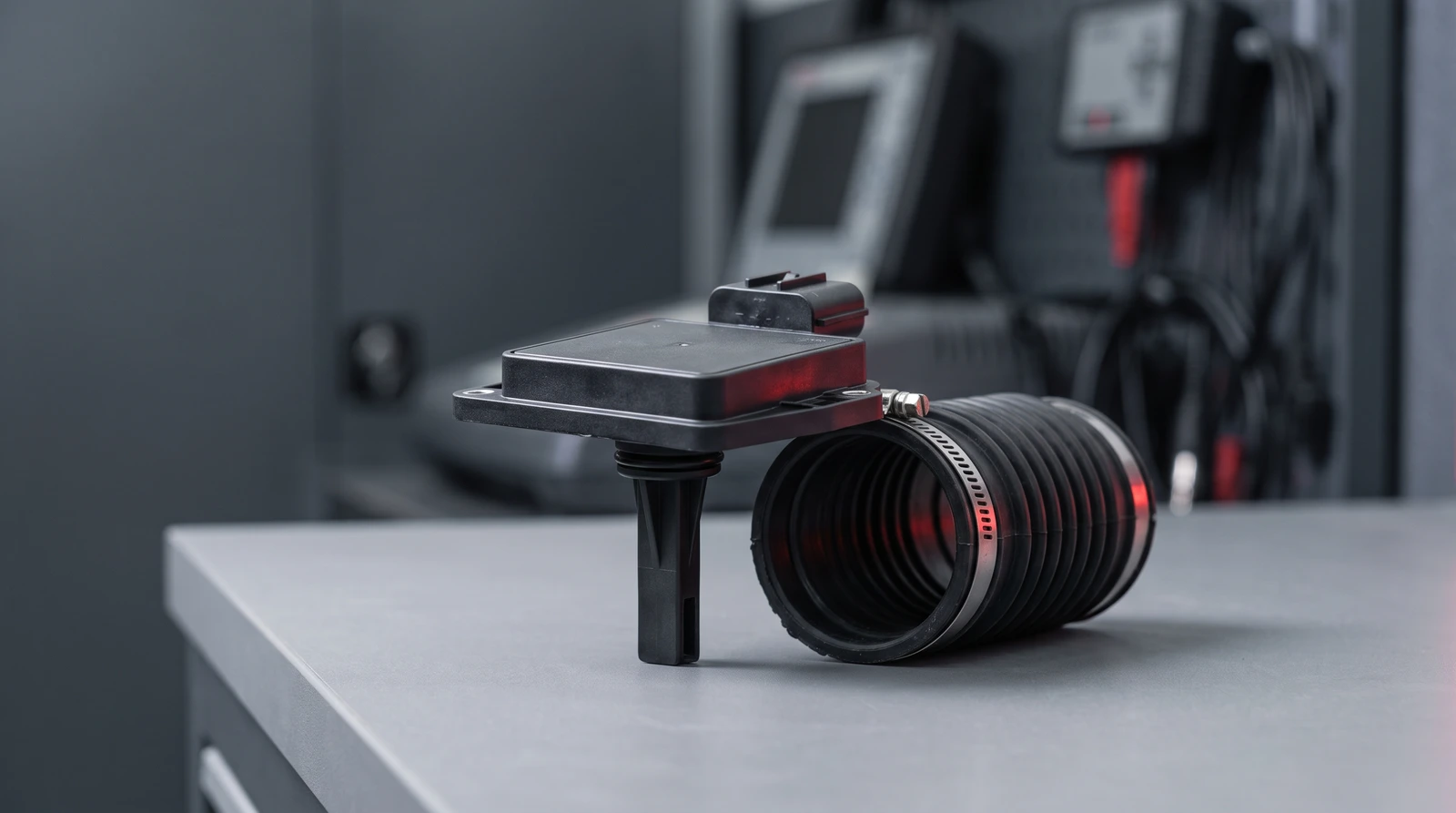
Almost every mass air flow sensor on a modern car works the same way, and the principle explains most of what goes wrong with one. A tiny element — a platinum wire on older designs, a printed film on newer ones — sits in a measuring duct inside the sensor housing and is held electrically at a fixed temperature above the incoming air. Air flowing past carries heat away from it. The circuit measures how much current it takes to hold that element at temperature, and that current tracks the mass of air going by, which is precisely what the ECU needs: fuel is metered against the mass of oxygen available, not the volume of air.
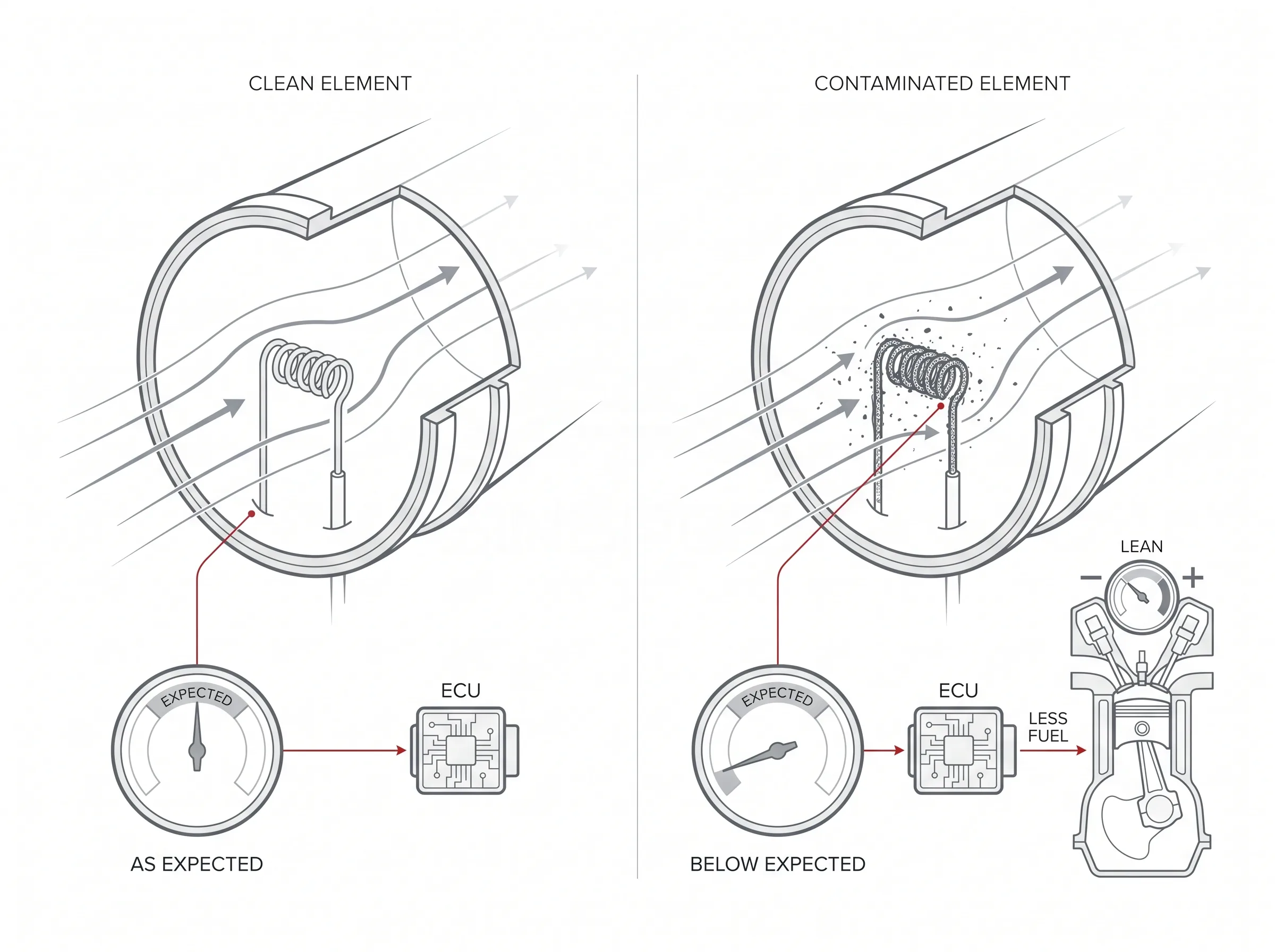
Now the part that decides your diagnosis. A film of oil mist, dust or filter fibre on the element insulates it. Insulated, it sheds heat more slowly, so it needs less current to stay hot, so the sensor reports less air than is really passing. Contamination characteristically makes a mass air flow sensor under-read. The ECU obliges by injecting less fuel than the engine needs, the mixture runs lean, the fuel trims climb positive to compensate, and on a great many cars a lean-mixture code stores alongside the P0101.
Over-reading happens too, and it looks nothing like the above: over-fuelling, a smell of unburnt petrol, black smoke under load and economy falling away. That direction usually comes from a damaged element, a poorly made replacement sensor, or something disturbing the flow pattern across the element — a collapsed intake duct, a damaged flow straightener, or a sensing element fitted into a housing it was never calibrated for. Knowing which way your sensor is out is far more useful than knowing that it is out.
One more thing about that housing. The calibration belongs to the sensor and its duct together rather than to the element alone, which is why the wrong part in the right-looking bore reads wrong from the moment it is fitted. And because the ECU rejects an implausible figure rather than acting on it, most engines fall back to a substitute airflow value worked out from throttle angle, engine speed and manifold pressure. That substitute is why the car still drives. It is also why it drives flat.
What a P0101 feels like from the driving seat
Because the airflow figure sets the fuelling, a wrong one shows up in how the engine idles, pulls and drinks.
- The engine management light — usually the first sign, and the reason most people have the codes read at all.
- A rough or hunting idle — the engine shakes or surges at a standstill, and can stall as you come to a stop.
- Hesitation on acceleration — a flat spot or stumble as you open the throttle, because the fuelling is not tracking the air arriving.
- A clear loss of power, most obvious under load: up a hill, fully loaded, or overtaking.
- Poor economy, with black smoke if the sensor is over-reading and the engine is being over-fuelled.
- Limp mode — the ECU deliberately holds revs and power down until the fault is dealt with.
- Odd shifts on an automatic — harsh or hunting changes, because shift scheduling runs on calculated engine load and load is derived from the airflow figure.
One pattern is worth recognising. A contaminated sensor often behaves acceptably at idle and badly under load, because a proportional under-read matters little when the engine wants a trickle of air and a great deal when it wants all of it. There is also an old workshop pointer: unplug the sensor and the car drives better, because the ECU stops listening to a bad figure and uses its substitute instead. That is a pointer rather than a proof, it will set further codes, and it is not a way to keep driving.
What causes a P0101 code
P0101 is tied to the mass air flow sensor, but the sensor is not always the part at fault. The reading can leave its window because the sensor is genuinely misreading, or because something else is disturbing the air the engine draws in. The honest list:
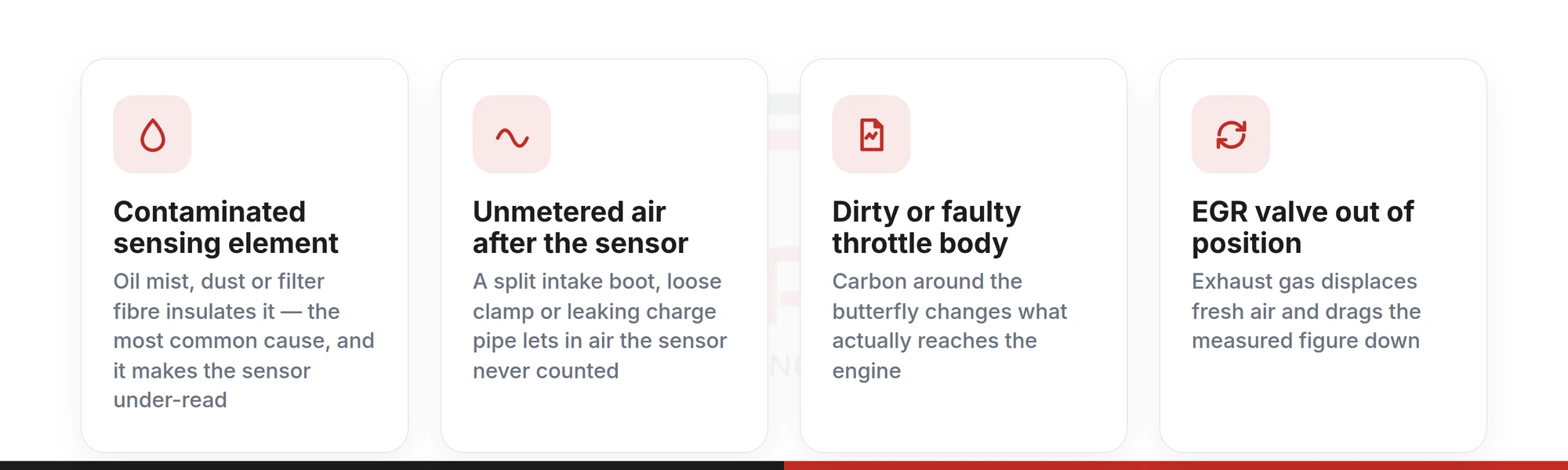
- A contaminated sensing element — by a distance the most common cause. Oil mist from the crankcase breather, dust past a poorly seated filter, and the oil carried off an over-oiled performance air filter are the three usual sources.
- A genuinely failed sensor. The element or its electronics degrade, and cleaning will not rescue one that has failed electrically.
- Unmetered air after the sensor — a split intake boot, a loose clamp, a perished breather hose, a leaking manifold gasket, or on a turbocharged engine a split charge pipe or a weeping intercooler joint. The engine gets air the sensor never counted.
- A restriction before it — a heavily blocked air filter, an airbox lid left proud after a service, or a collapsed intake duct.
- A dirty or faulty throttle body. Carbon around the butterfly and in the bore changes what actually reaches the engine and upsets idle control, and an electronic throttle fault can push the measured airflow out of its window. Where the scan carries throttle codes as well, work through the codes the throttle body sets in its own right before condemning the airflow sensor.
- An EGR valve that is not where the ECU thinks it is — exhaust gas dumped into the intake displaces fresh air and drags the measured figure down. Common, and commonly missed; the diesel section below explains why.
- Wiring, connector and earth faults — corrosion on the pins, a chafed core near the airbox, or a poor earth shifting the whole signal.
- Rarely, the control module, misreading a signal that is actually fine.
Fitting a new sensor on a guess is the classic P0101 mistake. Plenty of people buy one, fit it and watch the code return inside a week, because the cause was a split boot, a coked throttle body or a filter that was never properly seated. The reading gets checked before anything is changed.
Dirty sensor or intake leak? What the fuel trims settle
This is the fork the whole page turns on, and there is a test that settles it without removing a single bolt: read the fuel trims.
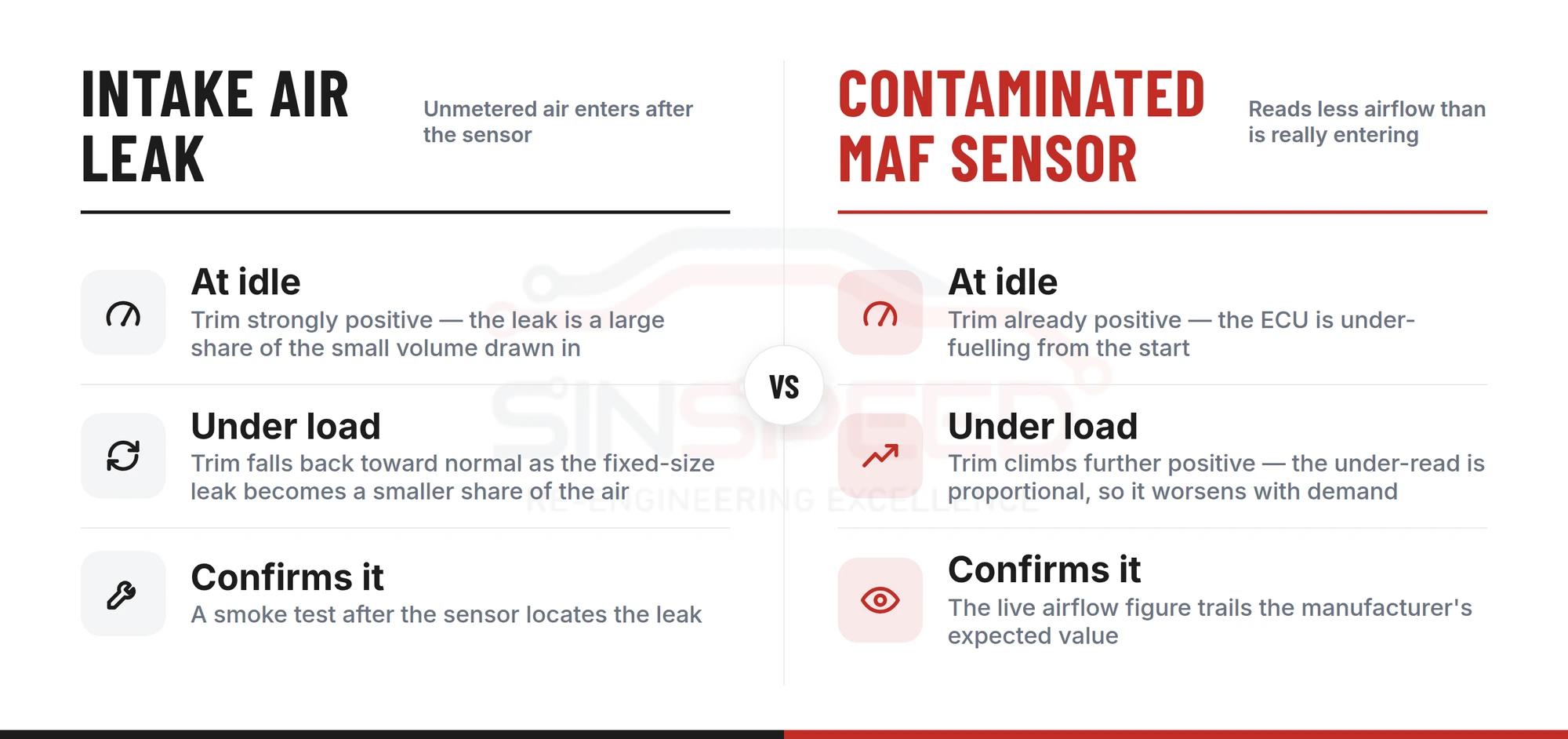
Short-term fuel trim is the correction the ECU is applying at that moment to bring the mixture back to target. Long-term fuel trim is the correction it has learned and settled on. Positive numbers mean it is adding fuel because it is seeing lean. Read both at a warm idle, then again at a steady cruise, and compare the two conditions.
Strongly positive at idle and falling back towards normal as airflow rises is the signature of unmetered air. A fixed-size leak is a large share of the small volume an engine breathes at idle and an insignificant share of what it breathes under load, so the correction shrinks as the throttle opens.
Positive at idle and getting worse as load rises is the signature of a sensor that is under-reporting. That error is proportional rather than fixed, so the more air the engine asks for, the more fuel goes missing.
Trims sitting near zero with a P0101 stored say the disagreement is intermittent, or that it only appears in a condition you were not in when you looked. The freeze-frame data recorded at the moment the code set tells you which condition to go back to.
That lean picture is also why so many people arrive here holding two codes rather than one, and it is worth reading P0171 and what positive fuel trims are telling you alongside this page. The two codes describe a single fault from opposite ends — the airflow measurement, and its consequence at the mixture — and which of them is the parent is precisely what the trim pattern above decides. Once the trims have pointed at a leak, a smoke test finds it. Once they have pointed at the sensor, the live airflow figure confirms it.
Sinspeed · automotive electronics
Not sure whether the fault is the sensor or the air path?
Send us the codes exactly as your scan tool prints them, with the vehicle details, the fuel trim figures if you have them, and what the car is doing. We will tell you what they point at — including when the answer is a garage job rather than anything we repair.
Mail-in repair and return · Your vehicle stays where it is — only the unit travels
How a P0101 is diagnosed properly, in order
Diagnosing a P0101 is a process of proving things rather than swapping them. Cheapest and most conclusive first.
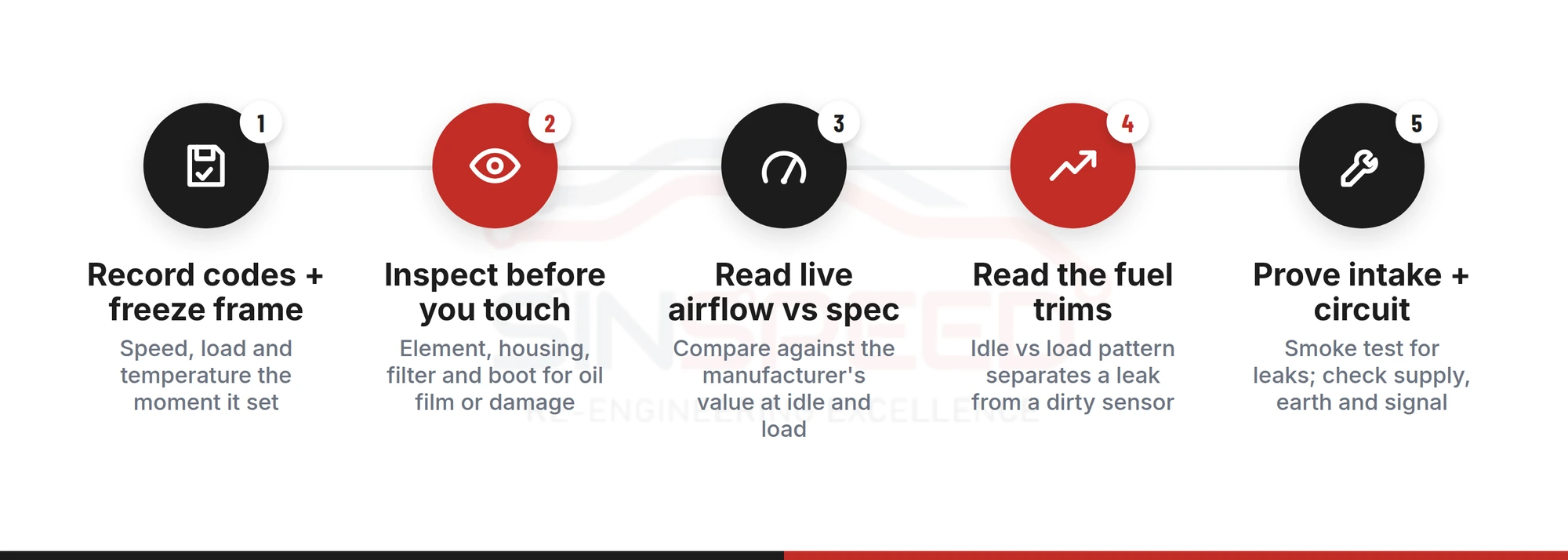
- Record every code with its freeze frame
Not just the P0101. Engine speed, load, coolant temperature and road speed at the moment it set tell you whether this happens cold, hot, at idle or under load — and that decides where to look.
- Look before you touch
The element, the inside of the housing, the filter, and the boot between sensor and throttle. An oil film on the element, debris in the duct, an airbox lid sitting proud or a boot that has obviously been off all name themselves.
- Read the live airflow figure against the manufacturer’s value
For that engine, at a stated idle speed and under load — not against a number lifted from a general discussion thread, because the expected figure scales with engine size and design. Watch it respond as the throttle opens: a reading that lags, flat-tops or wanders is the sensor’s own behaviour.
- Read the fuel trims at idle and at load
The test in the section above. This is the step that separates a dirty sensor from a leak, and skipping it is how new sensors end up on cars that never needed one.
- Prove the intake
A smoke test after the sensor finds unmetered air a visual check misses — behind the manifold, at a breather union, or in charge pipework on a turbocharged engine.
- Test the circuit, not just the part
Supply, earth and signal at the connector, with a wiggle test running against live data. A poor earth moves the whole signal and mimics a drifted sensor exactly.
P0101 on a diesel: the airflow reading is doing a different job
A petrol engine throttles its air and meters fuel to match, so the mass air flow reading sets the fuelling directly. A diesel runs unthrottled and always lean; the injected quantity comes from driver demand and the engine’s own maps. Its airflow sensor is there mainly to verify exhaust gas recirculation and to limit smoke — when the ECU commands the EGR valve open, it expects the measured fresh airflow to drop by a known amount, and the gap between the two is its evidence that gas is flowing.
Which means a diesel P0101 and an EGR fault are the same conversation from opposite ends. A valve stuck part-open pulls the measured fresh airflow down and can set an airflow range fault with a perfectly good sensor, while a sensor that under-reads makes the ECU believe recirculation is happening when it is not. If your scan carries both, read a stuck EGR valve and the codes it sets before anyone orders an airflow sensor.
The symptoms differ as well. Diesels tend to present a P0101 as a flat, gutless feel under load, black smoke and a drop into limp mode rather than the lumpy petrol idle. And where the complaint is really smoke, cutting out or a hard start rather than a measured-air disagreement, the fault usually sits on the fuelling side entirely — a separate family, taken apart on fuel pump and EDC faults on a diesel.
When the fault is the wiring, the connector or the module
The sensor’s circuit is short and unglamorous — a supply, an earth and a signal wire back to the engine ECU — and all three can produce a P0101 with a healthy sensor on the end of them.
Corroded pins and water in the connector are the commonest findings, helped by the plug sitting high in the engine bay where it collects everything the front of the car throws at it. After that, a core rubbed through where the loom crosses the airbox or a bracket, and a poor earth — which does not break the signal but shifts all of it, so the figure is wrong by a consistent amount and looks exactly like a drifted sensor.
Three states are worth keeping apart, because they need different work. An implausible signal is a P0101. No usable signal at all is the circuit codes above it. And a module that has stopped replying to the scan tool is neither — those are the U-codes, and while one is present no stored P-code is worth acting on, which is what a module that has stopped answering the scan tool is about.
An input fault inside the engine control unit is genuinely rare and belongs at the end of the list, once the connector, the loom and the earth have been proven good rather than assumed good. If the diagnosis does land there, that is engine ECU repair — work carried out by the independent specialists at ecu-repairs.com rather than by us.
When P0101 is not the only code in the scan
A P0101 rarely arrives alone, and the order the codes sit in matters more than how many of them there are.
Airflow is an input to almost everything, so a wrong figure sets consequences downstream: mixture codes, misfire codes, and eventually catalyst efficiency codes on a car that has been over-fuelling for a while. In that arrangement the airflow fault is the parent. Repair it, clear the lot, drive the car properly and rescan — then judge what genuinely returns, rather than chasing five codes at once.
Automatics deserve a note of their own. Shift scheduling and torque converter lockup are calculated from engine load, and load comes from the airflow figure, so an implausible reading can give harsh or hunting changes that feel like a gearbox fault and are not. A stored P0700 is a different animal altogether: it is the gearbox controller asking the engine ECU to light the lamp, which means a second module is holding a code of its own behind it. What a stored P0700 actually means is worth reading before the two faults get treated as one.
On an automated manual there is a symptom overlap rather than a shared cause, and it catches people out. Hesitation pulling away is a classic P0101 complaint and equally a classic sign of a tired clutch actuator. The discriminator is where the hesitation sits: at the moment of engagement points at the actuator, while a stumble once you are moving and asking for throttle points at the fuelling. If it is the first, start instead with hesitation that comes from the clutch actuator instead.
Can you keep driving with a P0101?
In most cases a P0101 will not leave the car undriveable, and with mild symptoms a short journey to a garage is reasonable. It is not a code to live with.
Running on the wrong mixture has consequences in both directions. Persistent over-fuelling fouls the plugs, washes oil from the bore walls and loads the catalytic converter. Persistent lean running under load makes the ECU pull ignition timing and, on a turbocharged engine, boost — which is what that flat feeling actually is. If the car is in limp mode, stalling, or badly down on power, treat that as the stronger signal and stop pressing on.
There is an MOT point as well. An engine management light illuminated for a stored fault is a major defect at test, so a P0101 left alone will fail the car regardless of how well it drives.
Cleaning the sensor, and what fixes a P0101 when cleaning does not
Because a contaminated element is the most common cause, a careful clean is a reasonable first move, and it is the one job on this page most owners can do themselves. Four rules separate fixing it from finishing it off.
- Use a purpose-made mass air flow cleaner and nothing else. Brake cleaner, carburettor cleaner, petrol and contact cleaner all attack the element.
- Never touch the element — not with a cloth, a cotton bud or a brush. It is a hair-fine wire or a printed film, and contact ends it.
- Spray, do not scrub. Short bursts down the duct from the correct end, letting the solvent lift the film off.
- Let it dry completely before refitting, and reconnect it with the ignition off.
On a genuinely dirty sensor that alone can clear the code. It is worth accepting that a clean occasionally finishes off a marginal sensor rather than saving it — the element was already degraded, and the clean revealed it rather than caused it.
If the code comes back, cleaning has not fixed it, and this is where guessing starts to get expensive. A P0101 that survives a clean means the sensor has genuinely failed, the circuit is at fault, or the cause was never the sensor at all — an intake leak, the throttle body, the EGR valve or a restriction elsewhere. Each of those has a different owner. The intake, the filter and the pipework are ordinary garage work, and a plain bolt-in airflow sensor that has genuinely failed is a part to fit rather than a unit to repair.
Where the trail ends at the electronic engine-management hardware — throttle body repair and remanufacture, or an air mass meter built into a unit rather than sold as a loose sensor — that is our bench. We are a UK automotive-electronics remanufacturer: we test the unit you send, find the actual fault and repair it at circuit level, rather than supplying a replacement that carries the same design weakness. Units are proven on in-house Hardware-in-the-Loop rigs that recreate the heat, vibration and electrical load they meet on the engine, most come back ready to fit with no coding required, and they carry a lifetime, unlimited-mileage warranty.
The service is mail-in, so the vehicle stays where it is and only the unit travels. If your diagnosis has already landed on a unit, the repair form is the quickest route. If it has not, tell us what the scan says and we will tell you whether it is ours.
P0101 FAQs
How do I tell whether it is the MAF sensor or an intake leak?
Compare the fuel trims at a warm idle with the same figures at a steady cruise. A leak is a fixed size, so it is a big share of the small volume the engine breathes at idle and a trivial share under load — the correction shrinks as the throttle opens. A sensor that is under-reading errs proportionally, so the correction gets worse under load, not better. Once the trims have pointed one way, a smoke test or the live airflow figure confirms it.
Can I clean the mass air flow sensor myself, and will that fix P0101?
Yes, and often it does, because a contaminated element is the commonest cause. Use a purpose-made mass air flow cleaner, never brake cleaner or a cloth, never touch the element, and let it dry fully before refitting. It is also worth checking the air filter and the pipework between the sensor and the throttle while you are there. If the code returns after that, cleaning is not the answer and the fault needs proper diagnosis.
I fitted a new MAF sensor and P0101 came back — why?
Almost always because the sensor was never the cause. The usual findings are unmetered air getting in after it — a split intake boot, a perished breather hose, a leaking charge pipe on a turbo — or a coked throttle body, a restricted filter or an EGR valve not sitting where the ECU thinks it is. A wrong or poorly made replacement does it too, because the calibration belongs to the sensor and its housing together.
Can I still drive with a P0101 code?
Usually yes in the short term, if the symptoms are mild, but it is not a code to leave. The engine is running on the wrong mixture: over-fuelling fouls plugs and loads the catalytic converter, while lean running under load makes the ECU pull timing and boost. If the car is in limp mode, stalling or badly down on power, have it diagnosed promptly rather than driving on.
Can a faulty oxygen sensor cause a P0101?
Not directly. P0101 is specifically about the airflow signal being implausible, so it is the mass air flow circuit that sets it, not the oxygen sensor. A failing lambda sensor tends to log its own codes or push the mixture codes instead. The two do feed the same fuelling calculation, though, so have the whole scan read rather than judging one sensor in isolation.
Sinspeed · automotive electronics
If the trail has ended at a unit rather than a hose
Most of what sets a P0101 lives on the car and belongs to a garage. The electronic units in that air path do not — they come to the bench, get repaired at circuit level and go back. Tell us what your scan says and we will tell you which side of that line you are on.
Cleanroom-standard, ESD-safe workshop · Circuit-level board repair by in-house engineers
Final thoughts
P0101 is one code, and it is unusually exact about what it saw: a number that did not add up. It says nothing whatever about why. Everything difficult about this fault lives in that gap, and everything expensive about it comes from jumping the gap in one move — buying the part the code appears to name, and hoping.
Crossing it properly is not complicated. Establish which way the reading is out. Establish whether the air being measured is the air the engine actually gets. Let the fuel trims arbitrate between those two, and check the connector before condemning anything on the end of it. By the time that is done, the code has usually stopped being a mystery and started being a job with an obvious owner.
More often than not that owner is a garage with a smoke machine and an hour, rather than us. We would rather say so than let a split intake boot arrive in the post as an airflow sensor.