
Summary: Two completely different gearboxes wear the same PowerShift badge. The wet 6DCT450 — Ford’s MPS6, and the gearbox in a long list of Volvos — runs its clutches in oil and controls them through a mechatronic valve body full of pressure-control solenoids. The dry 6DCT250, the DPS6, has no oil bath and no valve body at all: its control module drives the gear selectors with electric motors. Which one is in your car decides what has failed, what the failed part is even called, and what can be repaired rather than replaced.
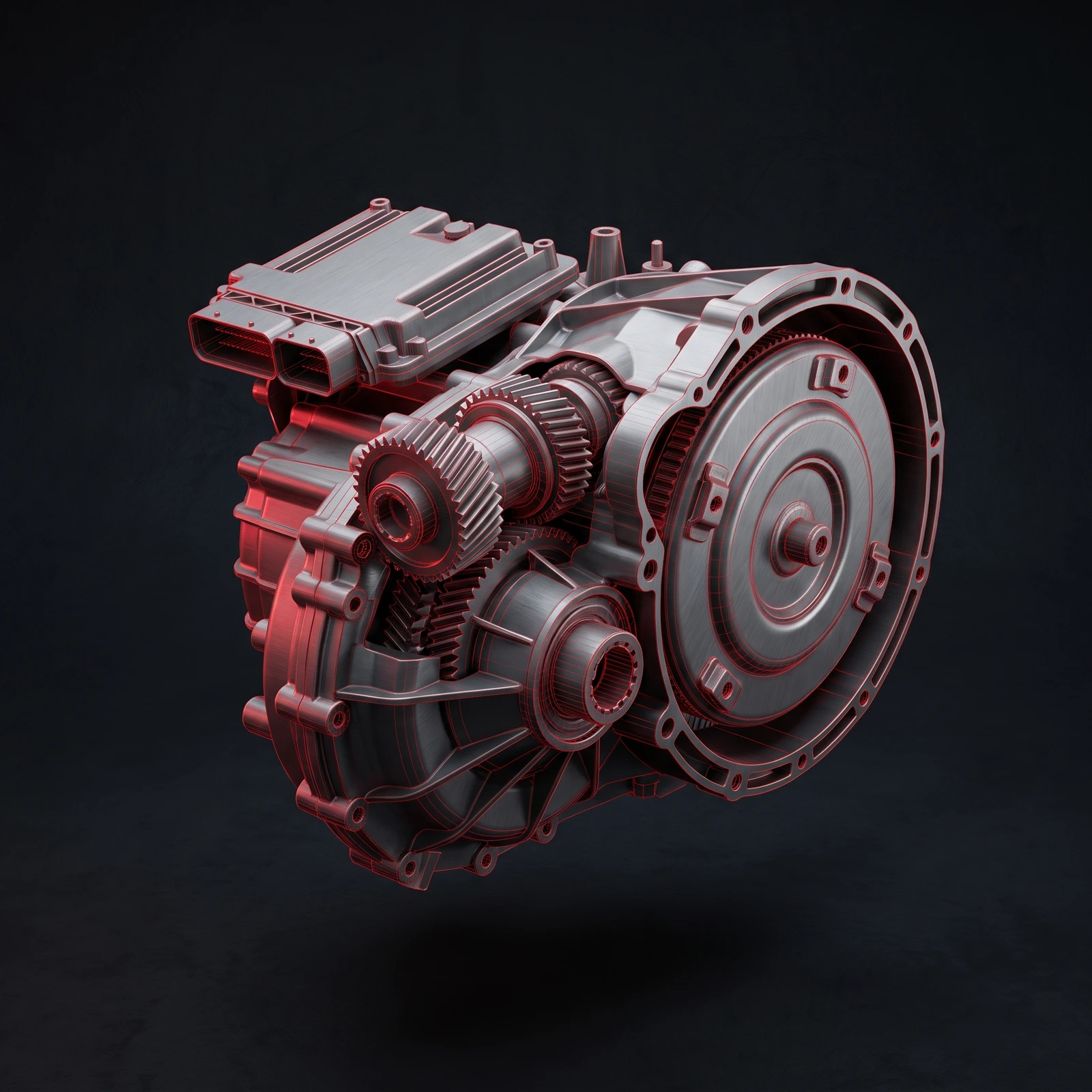
Start from the badge and you will reach the wrong answer. PowerShift is a family name Ford put on two Getrag dual-clutch gearboxes that share almost nothing where a repair is concerned — the clutches, the way gears are selected, the failure modes and the repairable part are all different. Everything below is split that way.
- Which PowerShift is in your car? Model by model
- What are the symptoms of Ford PowerShift problems?
- Wet 6DCT450 (MPS6): what fails in the mechatronic valve body
- Mechatronic unit, valve body or TCM — one assembly, three names
- Dry 6DCT250 (DPS6): a control module with motors, not a valve body
- Volvo Powershift is the same 6DCT450
- Did Ford fix the PowerShift, and which gearbox were the class actions about?
- Can you keep driving with a PowerShift fault?
- How a PowerShift mechatronic or TCM is repaired
- Ford PowerShift problems: FAQs
- Final thoughts
Which PowerShift is in your car? Model by model
Ford used the PowerShift name across two Getrag gearboxes with different type numbers, and the type number is what matters.
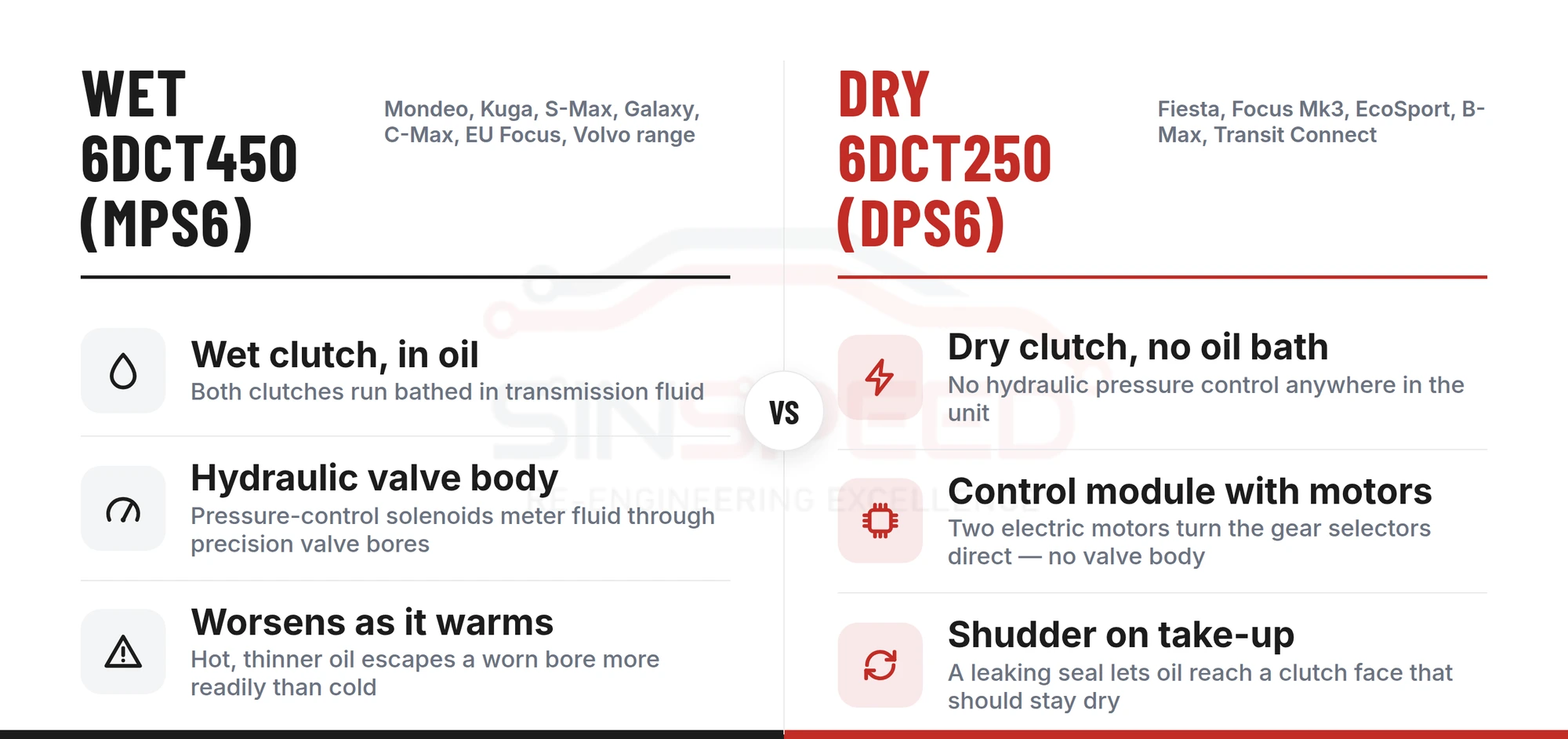
The 6DCT450, sold by Ford as the MPS6, is the wet unit. Its two clutches run in transmission fluid and everything is controlled hydraulically, through a mechatronic valve body — an aluminium casting full of precision valve bores, carrying the pressure-control solenoids and the electronic control unit. It went into the larger, torquier cars.
The 6DCT250, sold as the DPS6, is the dry unit. There is no oil bath and no hydraulic control of anything: its control module carries two brushless electric motors that turn the gear selector drums directly. It went into the smaller cars.
Find your model below before you read anything else here.
| Model | Which PowerShift | What typically fails | What we repair |
|---|---|---|---|
| Ford Mondeo Mk4 and Mk5 | Wet — 6DCT450 (MPS6). Later Mk5 cars use the related 6DCT451, Ford’s MPS6i | Pressure-control solenoids sticking; wear in the valve bores; control-board faults | The mechatronic valve body and its control electronics |
| Ford Kuga Mk1 and Mk2 | Wet — 6DCT450 (MPS6) | Debris in hot fluid jamming solenoids; gears dropping out; limp mode once warm | The mechatronic valve body and its control electronics |
| Ford S-Max, Galaxy, C-Max | Wet — 6DCT450 (MPS6) | As Mondeo and Kuga: solenoid sticking and valve-bore wear | The mechatronic valve body and its control electronics |
| Ford Focus | Either. European higher-torque cars took the wet 6DCT450; the global Mk3 took the dry 6DCT250 | Depends entirely on which unit it is | Identify the gearbox first — the two repairs have nothing in common |
| Ford Edge (European diesel) | Wet — 6DCT450 (MPS6) | Solenoid and valve-body wear | The mechatronic valve body and its control electronics |
| Ford Fiesta Mk7, EcoSport, B-Max, Ka+, Fusion, Transit and Tourneo Connect, Transit Courier | Dry — 6DCT250 (DPS6) | Input-shaft seal leaking onto dry clutch faces; clutch wear and overheating; the control module itself; clutch actuator motors | The transmission control module, including its actuator drive circuits |
| Volvo C30, C70, S40, V50, V40, S60, V60, S80, V70, XC60, XC70 | Wet — 6DCT450, badged Volvo Powershift | The same mechatronic faults as the Ford cars | The mechatronic valve body and its control electronics |
| Chrysler Sebring and 200, Dodge Avenger and Journey | Wet — 6DCT450 | The same mechatronic faults | The mechatronic valve body and its control electronics |
| Renault Clio IV, Captur, Megane III; Dacia Duster; Mercedes Citan | Dry — 6DCT250, badged EDC and known as the DC4 | Dry-clutch wear; control-module faults | The transmission control module and its actuator drive circuits |
Two notes on that table. The Focus is the one model you cannot settle from the badge, so the gearbox itself has to be identified before anything comes off the car. And the 6DCT450 and the 6DCT451 belong to the same Getrag PowerShift design family, with closely related hydraulic control architecture — but they carry separate part numbers and parts do not simply swap between them.
What are the symptoms of Ford PowerShift problems?
PowerShift faults show up in how the car pulls away and changes gear, not in how the engine runs. Both gearboxes produce a similar-looking set of complaints:
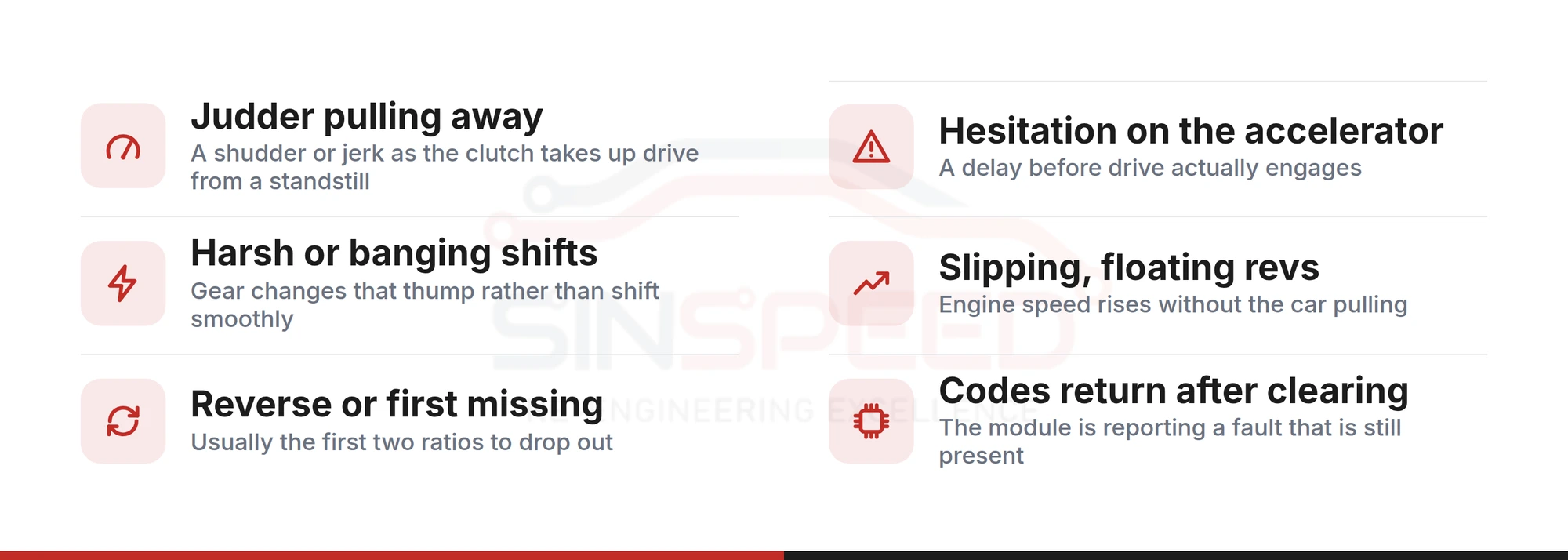
- Shuddering or juddering as the car moves off from a standstill.
- Hesitation, or a delay before the drive engages when you press the accelerator.
- Harsh, jerky or banging gear changes.
- Slipping — engine speed rising without the car pulling, sometimes described as a floating rev counter.
- Missing gears. Reverse and first are usually the first to go.
- Limp mode, a transmission malfunction message, or a gearbox warning lamp on the dashboard.
- Stored transmission fault codes that return after being cleared.
Two things separate the two gearboxes. On the wet 6DCT450, the fault very often gets worse as the fluid warms up, because it is a hydraulic pressure problem — hot, thinner oil escapes past a worn valve bore more readily than cold oil does, so a car that drives acceptably for the first few miles and deteriorates afterwards is pointing at the mechatronic. On the dry 6DCT250, the signature is a shudder specifically on take-up in first and second, which is oil where a clutch face is supposed to be dry.
A code that comes straight back after clearing is not a scan-tool problem. It is the module reporting a condition that is still present, and transmission control module fault codes sets out what the common ones mean. If you are working from the dashboard rather than a scan tool, our Ford Kuga warning lights and Ford Focus warning lights guides show which lamp carries a transmission fault on each car.
Wet 6DCT450 (MPS6): what fails in the mechatronic valve body
This is the half of the subject most PowerShift articles leave out, and it is where the majority of wet-box work actually lands.
The 6DCT450 engages both clutches and selects all six gears hydraulically. Fluid pressure is metered by pressure-control solenoids mounted on the mechatronic valve body, and the valves those solenoids operate slide in machined bores in an aluminium casting to clearances measured in microns. The whole arrangement depends on the oil staying clean.
It does not stay clean by itself. Ordinary internal wear — clutch friction material, gear wear, and on these gearboxes the plastic shift-fork guides — sheds debris into the fluid. That debris circulates, blocks the internal filter and reaches the valve body, and from there it becomes a chain reaction: a contaminated bore wears, a worn bore leaks pressure, lost pressure makes the control unit work the solenoids harder, and the extra work generates more heat and more wear.
What that looks like on the bench:
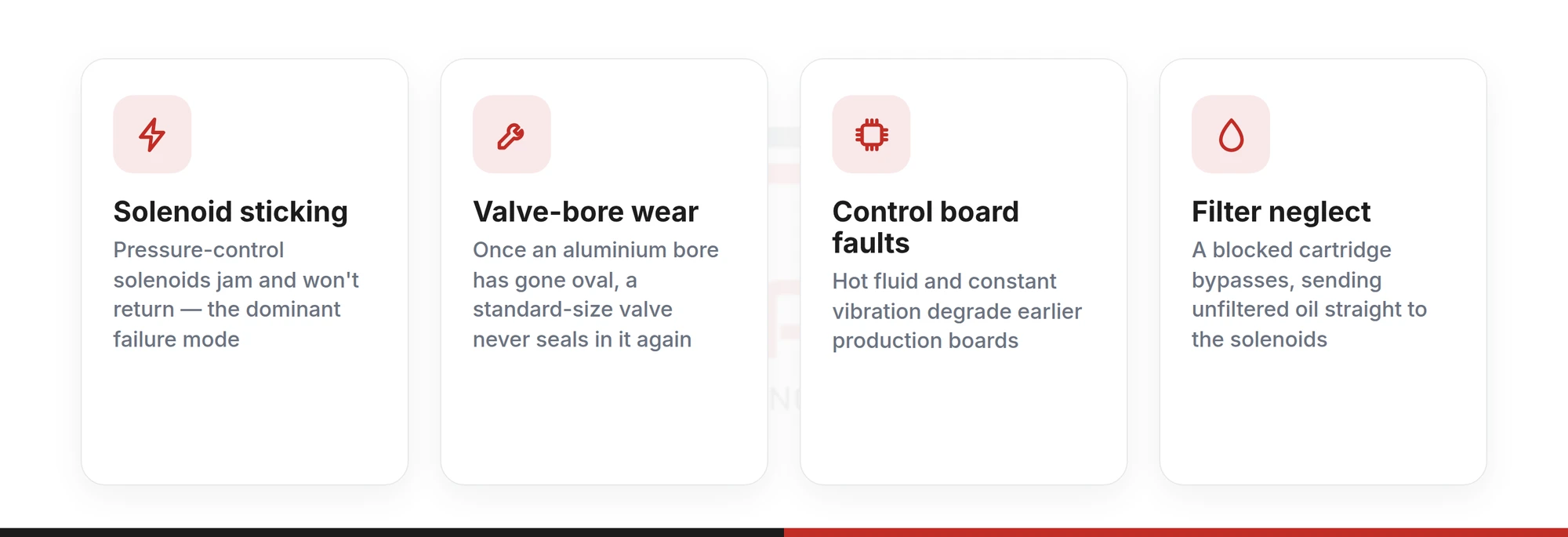
- Pressure-control solenoids sticking or jammed. The dominant failure mode. A solenoid that will not return to its commanded position produces exactly the complaints above — a gear that will not engage, a clutch that will not hold, a gearbox that drops into limp mode once it is warm.
- Wear in the valve bores. Once a bore in the aluminium body has gone oval, a standard-size valve will never seal in it again, and the pressure it leaks past produces the same complaints as a jammed solenoid. Whether a body is still serviceable is a measurement taken on the bench, not something a scan tool can tell you.
- Faults on the control board. The control electronics are bolted to the gearbox itself, working in hot fluid and constant vibration for the life of the car, and earlier production is the more affected. A board that has degraded commands the solenoids wrongly, and at the wheels that feels identical to a hydraulic fault — separating the two is bench work, and getting it wrong is how a sound valve body gets replaced for nothing.
- Filter neglect. A blocked external filter cartridge bypasses, and unfiltered oil then goes straight to the solenoids. These gearboxes take a specified fluid, Ford’s WSS-M2C936-A, and the service interval matters far more on them than most owners are ever told.
On fault codes: specialists working on Ford and Volvo 6DCT450 units commonly report P073E for no reverse gear, P073F for no first gear, and codes through the P0750 to P0765 solenoid range. Our guide to mechatronic unit faults and symptoms covers how this style of assembly behaves as it degrades.
Mechatronic unit, valve body or TCM — one assembly, three names
Ask three people about the same failed part on a wet PowerShift and you will get three words for it. Mechatronic unit. Valve body. TCM, or transmission control unit. On the 6DCT450 they are, in ordinary use, all pointing at one assembly inside the gearbox: the hydraulic control body with its solenoids, together with the electronic control unit that commands them.
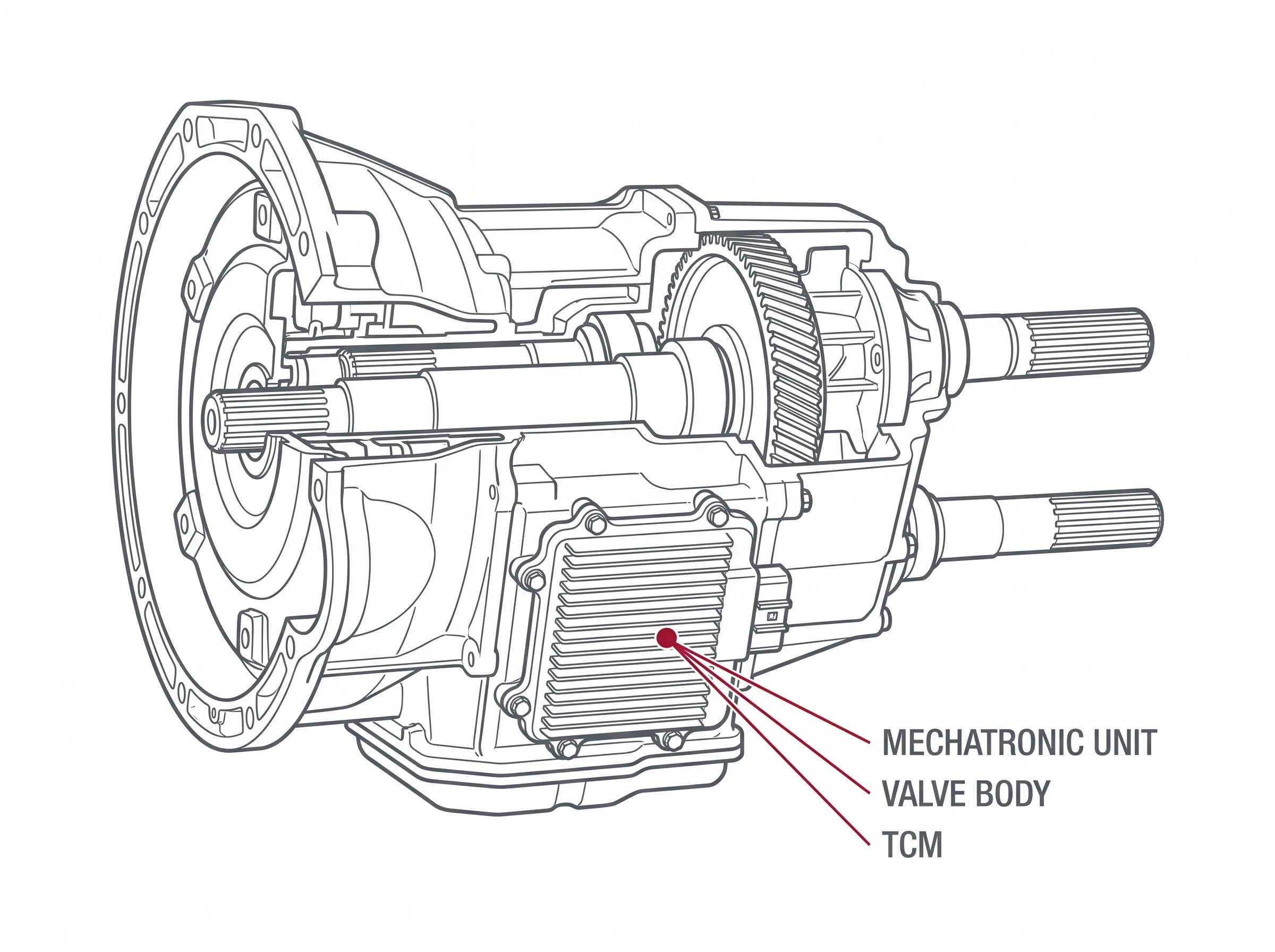
That matters practically. An owner who has been told they need a valve body and an owner who has been told they need a TCM very often have the same fault, and neither realises they are describing the same job.
The clearest documentation of that comes from the neighbouring gearbox. The 6DCT470 fitted to the Mitsubishi Lancer Evolution X as TC-SST belongs to the same Getrag PowerShift design family, with closely related hydraulic control architecture, and Mitsubishi states the position outright: the valve body and the TCM are known together as the mechatronic assembly, permanently attached to one another and not replaceable separately. Parts are not interchangeable between the two — separate part numbers, a different fluid specification and a different shaft arrangement — but the control principle is the same one, and our Mitsubishi SST mechatronic repair work deals with the same class of failure.
On the Ford and Volvo 6DCT450, published sources disagree about whether the electronic half comes off on its own, which is why we identify the unit in front of us rather than infer it from a model name. And on the Mitsubishi unit the manufacturer also records something worth knowing generally: a brand-new mechatronic assembly arrives with its control module unprogrammed, so it has to be configured before the car will use it. A repaired unit keeps the software it already has.
Dry 6DCT250 (DPS6): a control module with motors, not a valve body
The dry unit is a different machine and needs different language. It has no oil bath, no hydraulic pressure control and — the point that gets written incorrectly almost everywhere — no valve body. There is nothing for a valve body to do on a gearbox that does not use fluid pressure to move anything.
What it has instead is a transmission control module with integrated electric actuators: two brushless DC motors, part of the module itself, that turn the gear selector drums. Gear selection here is electro-mechanical rather than hydraulic. So when somebody tells a Fiesta owner the car needs a valve body, the part being described is not on the car.
Its characteristic failures:
- Input-shaft seal leaking. Transmission oil reaches a clutch face that has to stay dry, and the result is the signature take-up shudder in first and second. A clutch replaced without curing the leak buys a short reprieve and no more.
- Dry-clutch wear and overheating. Stop-start town traffic is the hard case: a dry clutch slipping to control creep has nowhere to dump the heat it makes.
- Control module failure, frequently reported with P0606 — an internal processor fault — and often heat-related, or at the connector.
- Clutch actuator motors, typically in the P0900 range, including P090B and P0901.
The split that matters on this gearbox is between a mechanical clutch job and an electronic repair, and the codes are what tell them apart. Our clutch actuator fault codes guide works through that range in detail.
Sinspeed · mail-in repair
Tell us the model and the codes and we will tell you which gearbox you have
The type number decides the repair, and most owners do not know theirs. Send us your vehicle details and the stored transmission codes and we will confirm whether you are looking at a wet mechatronic or a dry control module before anything is removed from the car.
Repaired by our own electronic and hydraulic engineers · Mail-in, UK-wide — your car stays where it is
Volvo Powershift is the same 6DCT450
The 6DCT450 was never a Ford-only gearbox. Volvo fitted the same unit, badged Volvo Powershift, across the C30, C70, S40, V50, V40, S60, V60, S80, V70, XC60 and XC70.
That has two consequences for a Volvo owner. The first is that nearly everything published about PowerShift faults is written about a Ford, so searching for a Volvo Powershift fault turns up very little — while the mechatronic failure behind it is the one described above, in the same unit. The second runs the other way: the Ford reputation people quote at Volvo owners is overwhelmingly about the dry gearbox in the Fiesta and Focus, which no Volvo was ever fitted with.
Chrysler and Dodge used it too, in the Sebring and 200 and the Avenger and Journey. Same unit, same failure pattern, same repair.
Did Ford fix the PowerShift, and which gearbox were the class actions about?
Ford changed the gearbox repeatedly across its production life — software and control calibrations, revised clutch and seal designs, clutch-replacement programmes, and extended transmission warranties for affected owners. Later cars benefited from most of it, and Ford eventually wound its dual-clutch automatics down in favour of conventional torque-converter automatics.
Here is the distinction almost nobody draws. The class actions in the United States and Australia, and the extended warranty programmes that followed them, were about the dry 6DCT250 — the Fiesta and Focus gearbox. They were not about the wet 6DCT450. If you have a Mondeo, a Kuga, an S-Max, a Galaxy or any of the Volvos listed above, that litigation did not concern your gearbox, and the PowerShift reputation being repeated at you belongs to a unit your car was never fitted with.
It cuts both ways. It does not make the wet gearbox faultless — the mechatronic failures set out above are real and common. It means the reputation and the fault are two separate things, and a wet-box owner reading a dry-box story is reading about somebody else’s car.
None of it changes what to do now. A calibration update released years ago does not undo a solenoid that has jammed since, or a clutch that has worn out since.
Can you keep driving with a PowerShift fault?
Limp mode is the gearbox protecting itself, so treat it as a get-home condition rather than something to live with. You can usually drive gently to somewhere safe. You should not carry on for weeks hoping it settles, and a PowerShift that refuses to select a gear will leave you where you stand.
On the wet 6DCT450 there is a specific mechanical reason not to. The fault is contamination, and every additional mile keeps circulating the debris that caused it — through the filter, the solenoids and the valve bores. A gearbox that today needs its mechatronic sorted does not stay in that condition indefinitely; the wear that is already happening is what decides whether the valve bores are still serviceable.
On the dry 6DCT250, driving on a shuddering clutch heats it further, and a dry clutch that overheats takes the parts around it with it.
Either way, the useful move is the same: have the codes read and recorded, establish what has actually failed, and deal with that rather than with the badge on the boot.
How a PowerShift mechatronic or TCM is repaired
We repair the control side of these gearboxes on a mail-in basis: you send the unit, and the car stays where it is.
On the wet 6DCT450 and 6DCT451 that means the mechatronic valve body and its control electronics — solenoids stripped, cleaned and tested, valve bores assessed, and the control board repaired at circuit level. On the dry 6DCT250 it means the transmission control module, including the drive circuits for its integrated actuator motors.
What it does not cover is the mechanical side. Clutch packs, shift forks and internal gearbox work are a separate job, and if the codes point there we will say so rather than accept a unit we cannot help with. Telling the two apart before anything is replaced is the whole point of reading the codes properly — a degraded control unit can make a mechanically sound gearbox behave exactly as though the clutches were finished.
The work is done by our own team of electronic and hydraulic engineers in a cleanroom-standard, ESD-safe workshop, using dealer-level diagnostic tools to program and calibrate a unit before it is dispatched. Every remanufactured unit is then run on our in-house Hardware-in-the-Loop platforms, which simulate the heat, vibration and load a gearbox genuinely sees on the road — the conditions these units fail under are the conditions they ought to be proved under. Where we can, we reinforce the known weak point rather than returning the unit in the state it left the production line in. Most remanufactured parts carry a lifetime, unlimited-mileage warranty.
The service page for these gearboxes specifically is Ford PowerShift repair, which takes the wet MPS6 mechatronic and the dry DPS6 control module a half each. The wider service sits under transmission control module repairs, and if you want the background on the part itself first, what the transmission control module is and what it does explains it from the beginning.
Ford PowerShift problems: FAQs
Is the Volvo Powershift the same gearbox as the Ford PowerShift?
It is the same unit as one of them. Volvo’s Powershift is the Getrag 6DCT450 — the wet, hydraulically controlled gearbox Ford sells as the MPS6 in the Mondeo, Kuga, S-Max, Galaxy and C-Max. It appears in the C30, C70, S40, V50, V40, S60, V60, S80, V70, XC60 and XC70. No Volvo was fitted with the dry 6DCT250, so the shuddering-Fiesta reputation that dominates PowerShift coverage is not about your car, and neither were the class actions.
Does a Ford Fiesta PowerShift have a valve body?
No. The Fiesta’s PowerShift is the dry 6DCT250, and a dry dual-clutch gearbox has no oil bath and no hydraulic pressure control, so there is no valve body on it to fail. What it has is a transmission control module with two integrated brushless electric motors that turn the gear selector drums directly. If a valve body has been quoted for a Fiesta, Focus Mk3, EcoSport, B-Max or Transit Connect, the part being described is not on that vehicle.
Were the PowerShift class actions and warranty extensions about my Mondeo or Kuga?
No. The litigation, and the extended transmission warranties that followed it, concerned the dry 6DCT250 fitted to the smaller cars. The Mondeo, Kuga, S-Max, Galaxy, C-Max and Edge use the wet 6DCT450, which was a separate gearbox with a separate failure pattern. That does not mean the wet unit is trouble-free — mechatronic contamination and solenoid sticking are common on it — only that its faults and its reputation come from two different places.
Is my PowerShift fault the clutch or the mechatronic?
The codes decide it, not the symptoms, because both produce juddering, slipping, delayed engagement and limp mode. Two tells are worth knowing. A wet 6DCT450 fault that worsens as the gearbox warms up is usually hydraulic, which points at the mechatronic. A dry 6DCT250 shudder that appears specifically on take-up in first and second usually means oil has reached a clutch face that should be dry. Have the codes read and recorded before anything is replaced.
What is the difference between a mechatronic unit, a valve body and a TCM?
On a wet 6DCT450, in ordinary use, those three words are usually all naming one assembly: the hydraulic control body with its pressure-control solenoids, together with the electronic control unit that commands them. On the closely related Mitsubishi 6DCT470 the manufacturer states they are permanently attached and cannot be replaced separately. On the dry 6DCT250 the words are not interchangeable at all, because there is no valve body — only a control module with electric actuators.
Sinspeed · mail-in repair
Send us the unit, not the car
Wet mechatronic or dry control module, the process is the same: it comes to the workshop, it is stripped and repaired at component level, it is tested under simulated load, and it goes back to you or your garage to refit. If you are not certain what you have, describe the model and what the gearbox is doing and we will confirm it first.
Tested on in-house Hardware-in-the-Loop platforms before dispatch · Most remanufactured parts carry a lifetime, unlimited-mileage warranty
Final thoughts
The most useful thing you can do with a PowerShift fault is stop treating PowerShift as one gearbox. A badge on the boot lid is not a specification, and on this one it hides two machines that fail differently, are named differently and are repaired differently. A wet 6DCT450 that has jammed a pressure-control solenoid and a dry 6DCT250 that has oiled a clutch face share a set of symptoms and nothing else.
That is also why so much advice about this gearbox is confidently wrong. Someone quotes a Fiesta owner for a valve body their car has never had. Someone else tells a Kuga owner about a class action that was about a different transmission entirely. A Volvo owner searches their own symptoms, finds only Ford pages, and never learns that the unit under discussion is the one in their car.
Establish the type number first. Have the codes read and written down before anything is cleared. Then decide whether you are looking at a mechanical job or an electronic one — and on both of these gearboxes, that second one is a repairable unit rather than a reason to write the car off.