
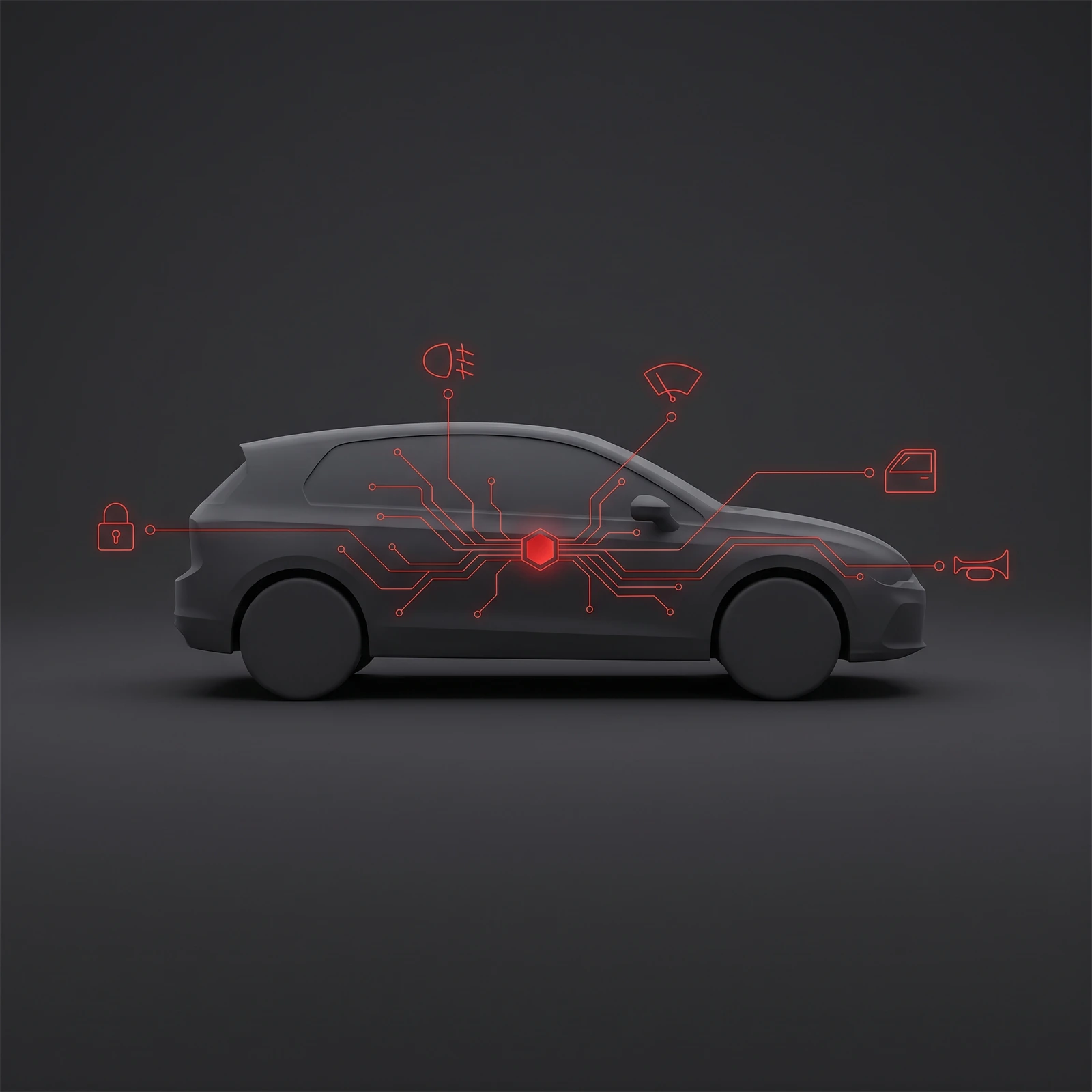
Summary: In a car, BCM means body control module: the electronic unit that runs the body electrics — central locking, interior and exterior lights, indicators and hazards, wipers, electric windows and the horn. It reads the switches you press, decides what should happen and powers the parts that do the work, and on many cars it helps recognise the key. When it fails, faults appear across several of those systems at once; we repair the original module by post and it goes back into the car it came from.
- BCM vs ECU vs TCM: which module does what
- What does a BCM do?
- BCM, BCU, SAM or footwell module: one job, many names
- Body control module symptoms by system
- What damages a body control module?
- Module, switch or wire? Why BCM faults get misread
- Is it safe to drive with a failing BCM?
- Repairing your own BCM vs fitting another
- More about the BCM: common questions
- Final thoughts
BCM vs ECU vs TCM: which module does what
These are the three control units most often confused, and each one fails in a way you can learn to recognise.
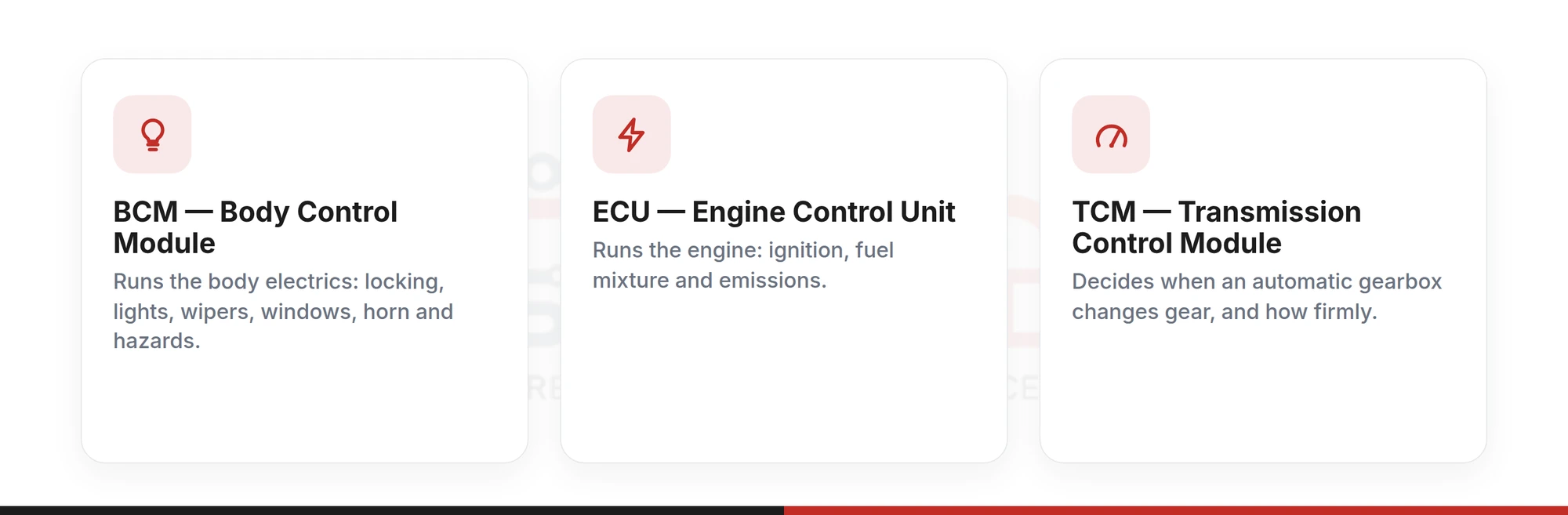
| At a glance | BCM — body control module | ECU — engine control unit | TCM — transmission control module |
|---|---|---|---|
| Its job | Runs the body electrics: locking, lights, wipers, windows, horn and hazards | Runs the engine: ignition, fuel mixture and emissions | Decides when an automatic gearbox changes gear, and how firmly |
| Takes its cue from | The switches and stalks you use, door and boot signals, and the key | The accelerator pedal, the air entering the engine and the engine’s own sensors | Road and engine speed, load, throttle position, selector position and gearbox oil temperature |
| Also called | BCU, body computer, comfort module; SAM on Mercedes-Benz; footwell module on many BMW and MINI models | ECM, or PCM | TCU or gearbox ECU; inside the gearbox on many dual-clutch and CVT designs |
| When it fails, you notice | Several unrelated electrics misbehaving together, a battery flat after standing, a key the car no longer recognises | Poor running, lost power, limp mode, the engine management light or a no-start | Flashing selector lights, harsh or jerky changes, limp mode, the wrong gear or no gear selection |
| Where next | Body control module repair | What is an ECU? | Transmission control module repair |
The quickest way to tell them apart is to ask what the fault affects. Anything to do with how the engine runs points at the ECU; anything to do with gear changes points at the TCM; trouble with things you switch on, lock or unlock points at the BCM.
We repair body control modules and transmission control modules ourselves, and our body control module repair hub sets out the vehicles with their own BCM pages and how the mail-in service works. A failed engine ECU is a different job: its repair is work for an independent specialist such as ecu-repairs.com.
What does a BCM do?
A BCM sits between the controls you use and the parts that respond. Press the lock button on the key, move the indicator stalk or open a door, and the module receives the signal, works out the response and switches power to the lock motors, lamps or wiper motor that carry it out.
Which jobs it takes on depends on the car, but most BCMs run some or all of these:
- Access and security: central locking, the boot or tailgate, keyfob and keyless-entry detection, and the alarm.
- Lighting: headlamps, brake, reverse and indicator lamps, the hazards and the interior lights.
- Wipers and horn: the front and rear wipers, the washers and the horn.
- Comfort: electric windows and mirrors, and heater functions on some models.
On many cars the BCM also takes part in the immobiliser handshake — the exchange that confirms the key belongs to the car before the engine may start. That is why some BCM faults end in a car that will not start, and why a replacement module cannot simply be plugged in.
BCM, BCU, SAM or footwell module: one job, many names
Body control module is a generic term, and car makers label the unit in different ways. On a parts list, an invoice or a scan report you may meet it as:
- BCM — the name on the Ford, VW Transporter, Jaguar and Chrysler units we repair.
- BCU or body computer — the same unit under a different label.
- Comfort module — used on some models; the Chrysler 300C unit is described as a body control / comfort module.
- SAM — Mercedes-Benz shares the role between several SAM units around the car.
- FRM or footwell module — the equivalent on many BMW and MINI models, which has its own footwell module repair service.
Some cars split the work between modules: the Jaguar XF, for instance, has a front BCM, which sits in the driver-side footwell on UK cars.
Body control module symptoms by system
Grouped by where in the car you would notice them, these are the faults our vehicle repair pages trace to the module.
- Locks and keys: central locking that works erratically or not at all, a boot or tailgate that ignores the button, a keyfob the car stops detecting, or a “Key not found” message.
- Lights: brake lights out, reverse lights dark, indicators failing or several lamps dropping out together, and interior lights that stay on or will not come on.
- Hazards and horn: hazards switching on by themselves, or the horn sounding with the indicators — both recorded on the VW Transporter T5.
- Wipers and washers: wipers that stop responding or behave erratically, and washer faults.
- Windows, mirrors and heater: switches that no longer get a response.
- Battery: flat after the car has stood, because the module never settles into sleep once the car is locked.
- Dashboard and scan tool: warnings across several systems at once, and lost-communication codes stored in other modules.
Two clues make the BCM a stronger suspect. The first is overlap: an indicator that has stopped flashing, a window that ignores its switch and a battery that is flat every Monday morning have nothing in common except the module that controls all three. The second is timing — faults that arrive after heavy rain or a leak into the cabin, or straight after a flat battery, a jump start or a battery disconnection.
Sinspeed · body electrics, diagnosed
Match your symptoms to the module before anything comes out
List the car, the systems playing up and any stored codes on the repair form. We will read the pattern and tell you whether it points at a BCM — and, on cars with more than one, which unit.
Circuits tested under load before return · Hardware-in-the-Loop rigs in-house
What damages a body control module?
A BCM has no moving parts to wear out. It fails because of where it is fitted and what happens to the electrical system around it.
- Water. The module usually lives in the cabin, and moisture reaches it through door seals, a leaking screen or along the wiring harness. The S-Max’s unit, under the glove box, is a known victim, and on the Mondeo a faulty screenwash system has been tied to module failures.
- Unstable voltage. The BCM needs a steady supply. Deep discharge, a badly handled jump start or a sudden disconnection all put it through conditions it was not built to ride out; on the Jaguar XF, low voltage and disconnection are known triggers for key and no-start faults.
- Heat, vibration and hard work. Every journey heat-cycles the module, and vans that tow or run auxiliary equipment load its circuits harder; the Ford Transit Mk8 is a typical case.
- A shorted load. Every output feeds a lamp, motor or lock; when one of those develops a short, the output driving it takes the strain.
The practical point is that whatever damaged the module is still in the car after the module comes out, and it will do the same to the next unit unless it is found.
Module, switch or wire? Why BCM faults get misread
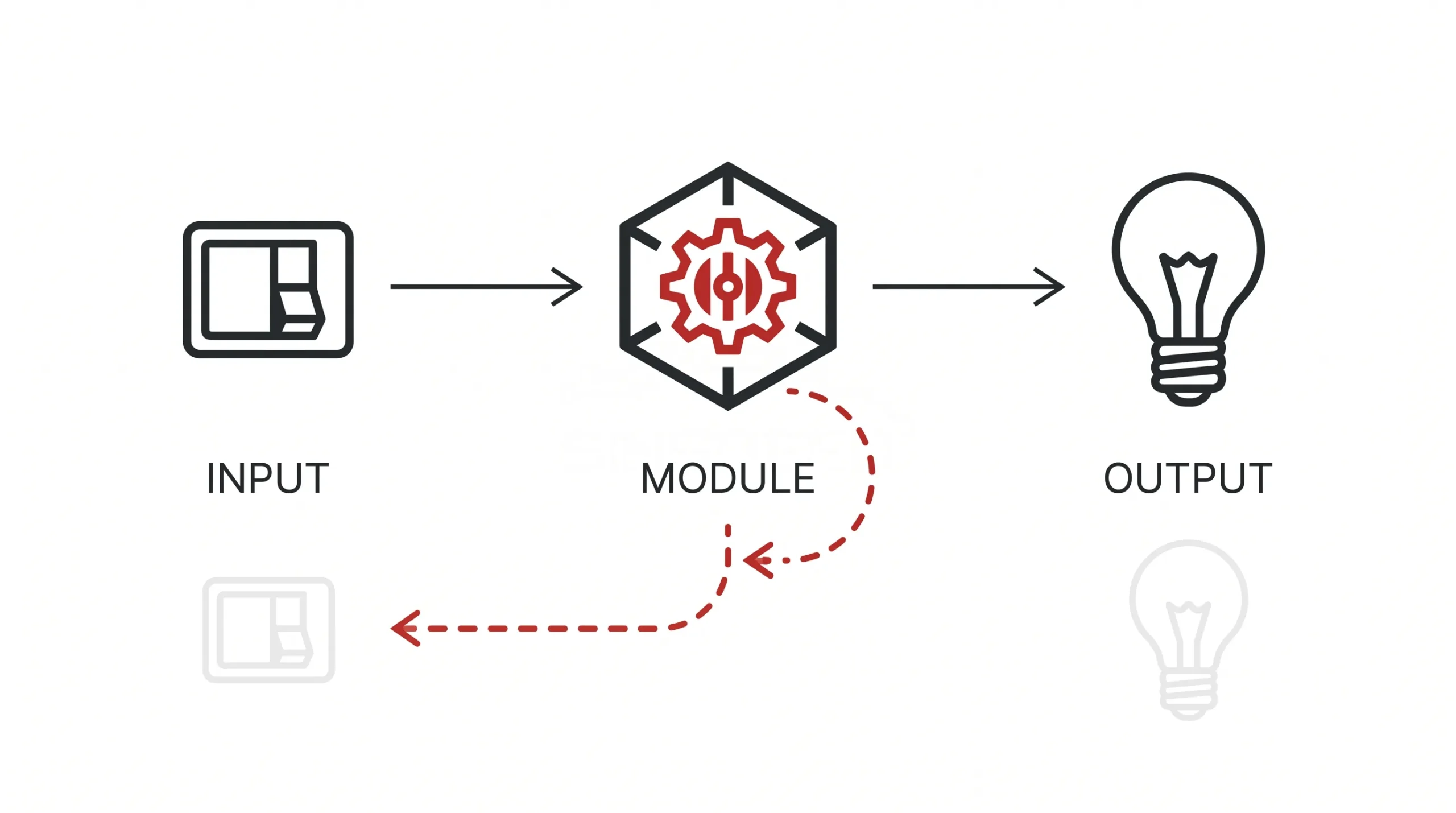
A BCM does two things on every circuit it runs: it listens to an input, such as a switch or a door sensor, and it drives an output, such as a lamp or a motor. When the module fails on either side, the result looks exactly like a fault at the far end of the wire. A module that has stopped hearing the window switch makes the switch seem broken; one that has stopped powering the rear lamps makes the bulbs seem blown.
The confusion runs both ways. On the Ford Galaxy, fitting the wrong type of bulb to a rear lamp cluster has been known to look like a BCM fault, and one failed input can knock out several functions at once as if the module itself had gone. Damaged wiring and a weak battery can paint the same picture.
An engine ECU fault shows in how the car drives, and a TCM fault in how it changes gear; a BCM fault shows in things that stop doing what they are told. That is why replacing switches, bulbs and motors one at a time so often misses it. The dependable answer is to test the module itself, powered on a bench with its outputs under load — the one check that separates a failing module from the wiring and parts around it.
Is it safe to drive with a failing BCM?
That depends on which systems it has reached, because some of them are road-safety systems. Without brake lights the driver behind gets no warning; indicators that do not flash, or hazards that switch themselves on, give everyone around you the wrong message; wipers that stop in the rain leave you unable to see. If a BCM fault has touched any of these, do not drive the car until it is put right.
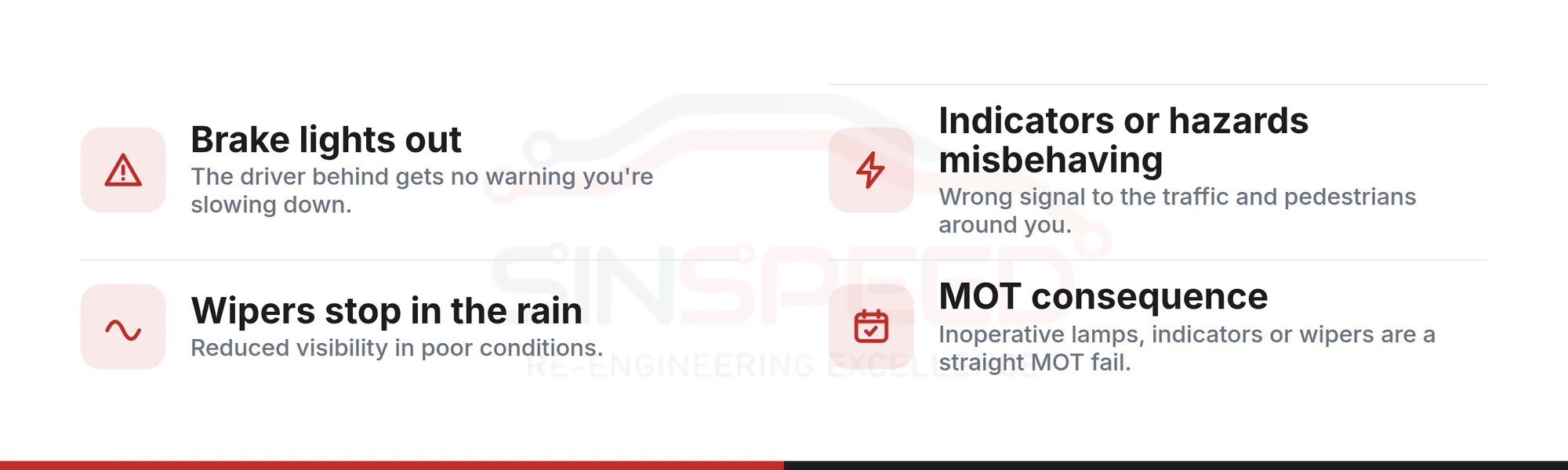
Two other presentations need prompt attention. A module that cuts out on the move — a recorded fault on the VW Transporter T5 — can take lights and wipers with it mid-journey. A car that no longer recognises its key may refuse to start at all, a classic Jaguar XF sign. And an MOT tester will fail lamps, indicators or wipers that do not work, whatever the cause.
Repairing your own BCM vs fitting another
A BCM is set up for the car it lives in. It holds that vehicle’s configuration and, on many cars, its part of the key check, so any other module — new or taken from another vehicle — has to be coded and matched to the car and its keys before everything works. A second-hand unit arrives carrying the set-up of its donor; on the Ford Galaxy that route has brought problems of its own, from matching the module to alarm faults afterwards.
Repairing the unit that came out sidesteps all of that. It goes back with its own coding and immobiliser data, so replacement coding is not normally needed.
Your garage removes the module and posts it to us while the car waits with them. On our bench it is powered up with its lighting, locking, wiper and horn circuits loaded, and run on in-house Hardware-in-the-Loop rigs that recreate the electrical demands of the vehicle, so the fault shows itself and the repair can be proved before the unit leaves. It returns ready to refit with a Lifetime warranty and no mileage limit.
More about the BCM: common questions
Is a BCM the same as an ECU?
Not in everyday use. Strictly, a BCM is one kind of electronic control unit, which is why some sources call it an ECU. But when a garage or a parts list says “ECU” it almost always means the engine control unit, which runs ignition and fuel. The BCM runs the body electrics and plays no part in how the engine performs.
Can a faulty BCM stop the car starting?
Yes, in two ways. Where the BCM takes part in recognising the key, a fault can stop the engine being allowed to start — “Key not found” with an immobilised car is a known Jaguar XF example. And a module that never goes to sleep can drain the battery until the car will not crank. A no-start can also sit in the immobiliser unit itself, which our immobiliser repair hub covers, so the exact messages and stored codes matter.
Why do other modules log faults when the BCM fails?
The modules in a car exchange information over a shared data network. When the BCM stops answering, or answers wrongly, the modules that rely on it store lost-communication faults of their own. The BCM may also record an internal fault; on the Jaguar XF that code is U3000-49, a control module fault. A scan showing network faults across several healthy modules can lead back to one failing BCM.
What else can BCM stand for?
Outside the motor trade, BCM most often means business continuity management — the discipline of keeping an organisation running through disruption — and the initials have plenty of other uses. On a car, a garage invoice or a scan report, BCM means body control module.
Final thoughts
BCM is shorthand for the module that turns your switches into actions: locks, lights, wipers, windows and, on many cars, a share of the key check. It is not the engine ECU and not the gearbox’s TCM, and keeping the three apart tells you where to look when something stops working.
When faults pile up in systems that share nothing but that module, put the BCM first on the list — then have it tested before anything is replaced, and keep the original if it can be repaired.
Sinspeed · locks, lights and wipers back under control
Found your fault in the BCM column?
Tell us the vehicle, which systems are misbehaving and any stored codes. If the evidence points at the BCM, your garage sends the module to us, and the same unit goes back into the car once it has passed on the bench.
Dealer-level diagnostic tools · Cleanroom-standard, ESD-safe workshop · Lifetime warranty, no mileage cap