
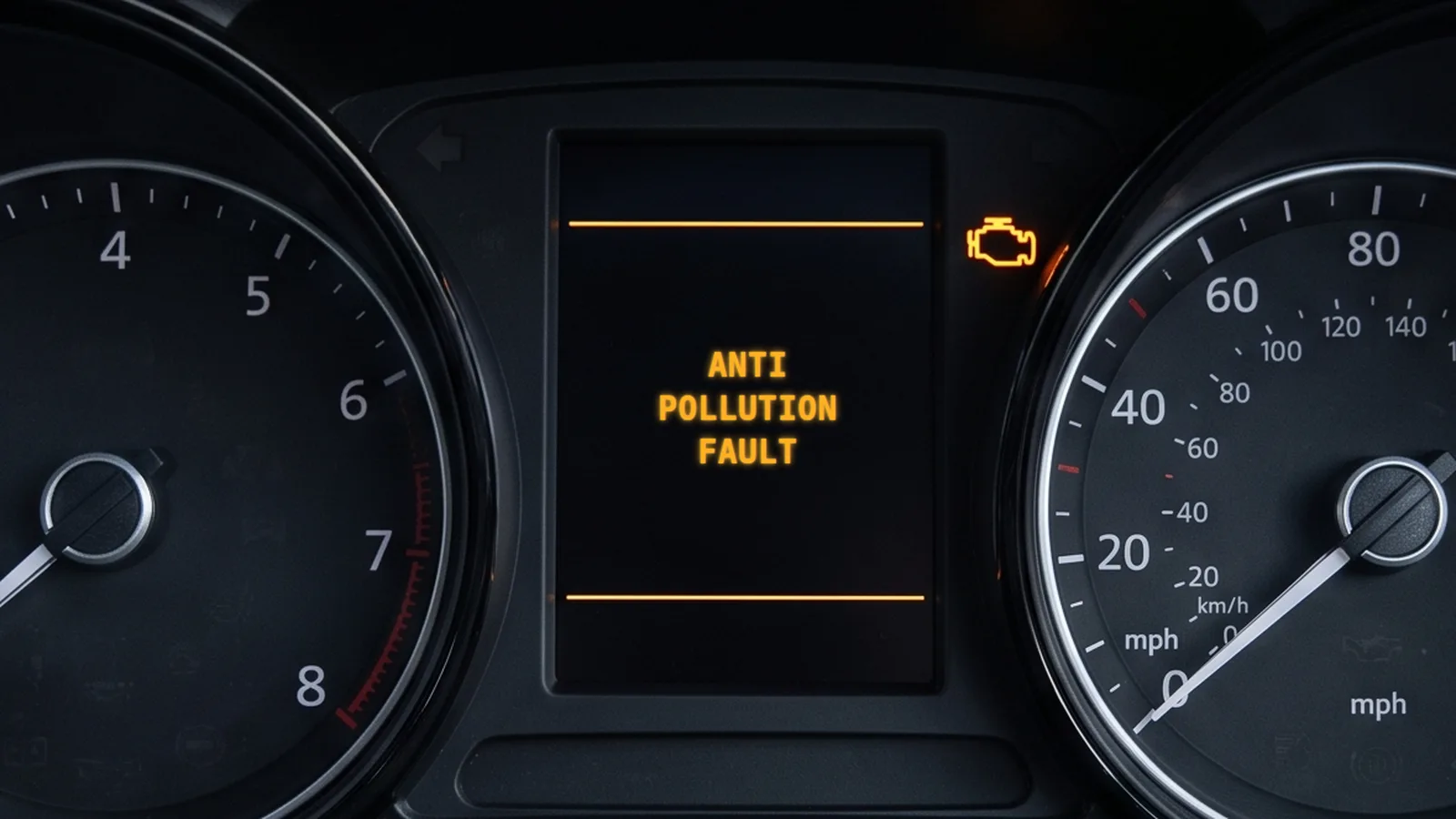
‘Anti-Pollution System Faulty’, ‘Anti-Pollution Fault’ or ‘Check Anti-Pollution System’ is a dashboard warning used mainly by Peugeot, Citroen, DS and Renault. It is a general emissions and engine-management alert — the car has detected a fault somewhere in the system that keeps its emissions in check — and it often appears alongside the engine-management light and a drop into reduced-power mode. It does not name a single failed part: the cause can be anything from a lambda sensor to a mass air flow sensor, throttle body or EGR valve, so it needs the stored fault codes read to pin down. Where the cause turns out to be an electronic engine-management part such as the throttle body or MAF sensor, that is our specialism — we diagnose, repair and remanufacture those units on a mail-in basis, backed by a lifetime warranty.
On this page
- What does the ‘Anti-Pollution System Faulty’ message mean?
- Is an anti-pollution fault serious? Can you keep driving?
- What causes an anti-pollution fault?
- Can you reset an anti-pollution fault?
- How is an anti-pollution fault diagnosed and fixed?
- Frequently Asked Questions
What does the ‘Anti-Pollution System Faulty’ message mean?
The message goes by a few names — “Anti-Pollution System Faulty”, “Anti-Pollution Fault” or “Check Anti-Pollution System” — and it is used mainly on French-built cars from Peugeot, Citroen, DS and Renault. It is the car’s plain-English label for an emissions-related problem: the engine-management system has spotted a fault in one of the parts that keep exhaust emissions within limits, and it has flagged it rather than carry on as if nothing were wrong.“Anti-pollution” simply refers to the emissions-control side of the engine — the sensors, valves and after-treatment parts that keep combustion clean and the exhaust within legal limits. When the engine-management system sees a reading that falls outside what it expects from one of those parts, it logs a fault and warns you. On many cars the message shows together with the engine-management (EML) light, and the car may drop into reduced-power or “limp” mode to protect itself and cut emissions until the fault is dealt with. The warning is deliberately generic — it tells you the emissions system is unhappy, not which part is at fault.Is an anti-pollution fault serious? Can you keep driving?
In most cases you can drive gently in the short term — an anti-pollution fault rarely leaves a car stranded, and if it is still running reasonably you will usually make it to a garage. It is not a warning to live with, though. While it is showing, performance and fuel economy suffer, and if the car has dropped into limp mode it will feel noticeably flat.More importantly, if the underlying problem is a genuine emissions fault it will not clear itself, and the car will fail its MOT emissions test until it is put right. A fault that also causes a misfire can, over time, send extra heat and unburnt fuel through the catalytic converter and damage it — turning a smaller repair into a larger one. If the car is misfiring heavily, stalling, badly down on power or the engine-management light is flashing, treat that as a stronger signal and have it looked at promptly rather than driving on. The sensible course with any anti-pollution fault is to have the codes read sooner rather than later.What causes an anti-pollution fault?
Because the message is a general emissions alert rather than a specific code, it has a wide range of possible causes. What they share is that each one disturbs how cleanly the engine burns fuel, or how accurately the system measures what it is doing. The common causes are:- A faulty lambda (oxygen) sensor. This sensor measures the oxygen in the exhaust so the engine-management system can keep the fuel mixture correct. When it reads slowly or inaccurately, the mixture drifts and an emissions fault is logged — one of the most frequent triggers for this message.
- A dirty or faulty MAF (mass air flow) sensor. The MAF sensor measures how much air is entering the engine so the system knows how much fuel to add. Contaminated with oil or dust, or failing electronically, it under- or over-reads — and the mixture, and the emissions with it, go wrong.
- A throttle body fault. The throttle body controls the air the engine draws in and carries the sensors — and, on drive-by-wire cars, the motor — that report and set that airflow. Carbon build-up or an electronic fault here upsets the airflow and idle control and can trip the warning.
- An EGR valve problem. The exhaust gas recirculation (EGR) valve recirculates a measured amount of exhaust gas to lower emissions. When it sticks open or closed, or clogs with carbon, the emissions system notices and flags a fault.
- A blocked or faulty DPF (diesel particulate filter). On diesel cars a saturated or failing diesel particulate filter — or a fault in the sensors that monitor it — is a common trigger for the anti-pollution warning. The answer is a proper forced regeneration, professional DPF cleaning or diagnosis to get it flowing and reporting correctly again, not ignoring it.
- Ignition and misfire faults. Worn spark plugs, tired ignition coils or a partial misfire leave fuel unburnt, which pushes emissions up and readily sets off an anti-pollution warning.
- Fuel-system issues. Low fuel pressure, a tiring fuel pump, a blocked filter or dirty injectors leave the mixture wrong, and the emissions drift with it. Poor-quality or incorrect fuel can do the same.
- A deteriorating catalytic converter. As a cat ages or is poisoned by an upstream fault, it stops cleaning the exhaust effectively, and the system detects the higher emissions.
Can you reset an anti-pollution fault?
A lot of searches ask how to reset or clear the message, and it is worth being straight about this. Turning the engine off and restarting, or disconnecting the battery, can clear the warning if it was triggered by a one-off transient event — a bad tank of fuel or a momentary glitch, for instance. If that really was all it was, it may not return.But if the fault is real, clearing the light changes nothing about the underlying problem, and the warning will come back — often within a few miles. Wiping the codes before they have been read also throws away the very information a diagnosis needs. If the message keeps returning, the answer is not to keep resetting it but to have the stored codes read so the actual fault can be identified and fixed.How is an anti-pollution fault diagnosed and fixed?
Proper diagnosis starts with reading the stored fault codes and the engine’s live data. The codes point to the system or sensor that is unhappy, and the live data — fuel trims, sensor readings, airflow figures — shows how the engine is actually behaving, which narrows a broad “anti-pollution” warning down to a specific part. From there the suspect component is tested directly rather than swapped on a guess: the lambda and MAF readings are checked, the throttle body and EGR valve are inspected, fuel pressure is measured and the ignition system is examined. Working through it in that order is what separates a targeted repair from a string of replaced parts.Once the fault is pinned down, the repair is whatever the diagnosis points to. Some causes — spark plugs, a fuel pump, an ageing catalytic converter — are mechanical jobs for a local garage. Others are electronic, and that is our side of the work. We are UK automotive-electronics specialists who diagnose, repair and remanufacture engine-management units at component level, so when an anti-pollution fault traces back to the throttle body or the mass air flow sensor, we rebuild your existing unit rather than selling you a complete new part. Each remanufactured unit is bench-tested on our in-house Hardware-in-the-Loop rigs, which replicate the heat, vibration and electrical load it faces on the engine, and most come back ready to fit with no coding required. Our remanufactured parts carry a lifetime, unlimited-mileage warranty.The service is mail-in: you send us the suspect unit and we repair and return it. If a diagnosis has already pointed at the throttle body or air flow sensor, complete our repair form with your vehicle and fault details to get started. If you are not yet sure which part is behind the warning, get in touch and we will help you work out the next step. Where the cause turns out to be something mechanical like the fuel supply or the catalytic converter, a local garage is the right port of call — but for the engine-management electronics, that is what we specialise in.Frequently Asked Questions
What causes an anti-pollution fault?
It is a general emissions warning with many possible causes rather than one specific part. The usual culprits are a faulty lambda (oxygen) sensor, a dirty or failing MAF sensor, a throttle body or EGR valve fault, an ignition or misfire problem, a fuel-supply issue or a deteriorating catalytic converter. Reading the stored fault codes and live data is what identifies which one you have. On diesels, a blocked or failing DPF (or its sensors) is another common cause.
Is the check anti-pollution system warning serious?
You can usually drive gently in the short term, but it should not be left. Performance and fuel economy suffer, the car may drop into limp mode, and a genuine emissions fault will fail the MOT and can, over time, damage the catalytic converter. If the car is misfiring, stalling, badly down on power or the engine-management light is flashing, get it diagnosed promptly.
Can you reset an anti-pollution fault?
A restart or a battery disconnect can clear the message if it was a one-off transient event, and it may not return. But if the fault is real, resetting the light changes nothing and the warning will come back — usually within a few miles — while wiping the codes first throws away information a diagnosis needs. If it keeps returning, have the codes read rather than repeatedly clearing it.
What does ‘anti-pollution’ mean on a car?
It refers to the emissions-control side of the engine — the sensors, valves and after-treatment parts that keep combustion clean and the exhaust within legal limits. An ‘anti-pollution fault’ means the engine-management system has detected a reading outside what it expects from one of those parts. The term is used mainly by Peugeot, Citroen, DS and Renault.