
Summary: A failing mechatronic unit shows itself through the gearbox rather than the engine — harsh or delayed shifts, flare or slip between gears, judder, limp mode, a flashing gear display, or a sudden loss of drive. Which of those symptoms you have, and which gearbox your car uses, narrows the fault a long way: some point at the control unit, and some point past it at the gearbox itself. This page separates the two, family by family. Where the fault is in the unit, we rebuild the original on the bench and return it ready to fit.
- What does a failing mechatronic unit feel like from the driving seat?
- What does each symptom usually mean, and which gearboxes show it?
- Why does a control-unit fault feel so much like a worn gearbox?
- Is “mechatronic” even the right word for your gearbox?
- What does the fault look like on your gearbox family?
- Why does the fault come and go, and what does that tell you?
- What do the fault codes tell you, and what does a clean scan prove?
- What should you do before anyone quotes you for a gearbox?
- Mechatronic unit faults: FAQs
- Final thoughts
What does a failing mechatronic unit feel like from the driving seat?
The first sign is usually a change in character rather than a breakdown. A gearbox that used to change gear invisibly starts announcing every shift — a thump, a hesitation, or a moment where the revs climb and the car does not quite go with them.
From there it tends to follow one of a handful of routes. The car pauses for a second or more after D or R is selected, before drive arrives. One pair of gears misbehaves while the rest of the box is faultless. The gearbox locks itself into a single gear and refuses to leave it. The gear display flashes, or a gearbox or spanner symbol appears on the dash. In the worst version the drive simply goes and the box drops into neutral.
What ties them together is where the trouble sits. If the engine pulls cleanly once a gear is engaged, and the problem is confined to getting into a gear, holding it or leaving it, the fault is on the transmission side of the car.
It also rarely arrives all at once. The specialists who rebuild the Mercedes 7G-Tronic control unit describe the progression plainly: intermittent at first, and it always becomes permanent if it is left. That intermittent phase is the useful window.
What the unit is, where it sits on your particular gearbox and how it is rebuilt is set out on our transmission valve body and mechatronic repair page. This one is about working out whether that is the part you are dealing with at all.
What does each symptom usually mean, and which gearboxes show it?
The same complaint means different things on different gearboxes, which is why a symptom list on its own settles very little. This is what each one usually indicates, and where it turns up most.
| What you notice | What it usually points at | Where it is most often seen |
|---|---|---|
| Harsh, clunky downshifts — classically 3-2 and 2-1 — with judder in second | Wear on the hydraulic side of the unit, so pressure arrives too abruptly | Six-speed wet DSG (Golf, A3, Octavia, Leon) |
| A flashing gear display with a spanner symbol, and a pump buzzing continuously with the ignition on | Control pressure is not being held, and the pump runs constantly to compensate | Seven-speed dry DSG (Polo, A1, Fabia, Ibiza) |
| A pause of a second or more after selecting D or R | Drive applied slowly because control pressure is low or leaking internally | Torque-converter automatics and wet dual-clutch boxes alike |
| Flare or slip between two particular gears while the rest of the box behaves | A cross-leak in one hydraulic circuit rather than a general fault | Aisin (Volvo, Vauxhall, Peugeot, Citroën, Land Rover, Ford, Mazda, Saab) |
| Holding a gear too long, then slamming the next one in | Internal speed sensing degrading, so converter slip can no longer be judged | Mercedes 7G-Tronic (722.9) |
| Half the gears deactivated, no reverse, or nothing above first | Valves and selectors that can no longer be regulated | Audi S tronic (DL501: A4, A5, A6, Q5, S4, S5) |
| Intermittent limp home in third, with a pressure-regulation fault logged | An internal hydraulic leak, most often at the pressure-regulation electrovalve | PSA and Renault AL4 / DP0 (206, 307, 407, Xsara Picasso, C4, C5, Berlingo) |
| Jerking and thumping shifts, shudder, gears disappearing — reverse and first usually first — and limp mode once warm | Pressure-control solenoids sticking and bore wear, from debris circulating in hot fluid | Getrag wet dual-clutch: Ford MPS6, Volvo Powershift, Mitsubishi TC-SST |
| Judder at low speed in a CVT | Genuinely contested — valve body and belt wear on one reading, a calibration mismatch on another | Nissan and Renault CVT (Qashqai, X-Trail, Juke, Micra, Note, Koleos) |
| Harsh reverse engagement and delayed upshifts with no codes stored at all | A mechanically binding shift solenoid, which Ford’s own service bulletin describes | Ford 6F35 (Focus, Kuga, Mondeo, C-Max) |
Read the third column as where a symptom is most often seen, not where it is only seen. It narrows the list; it does not close it.
Why does a control-unit fault feel so much like a worn gearbox?
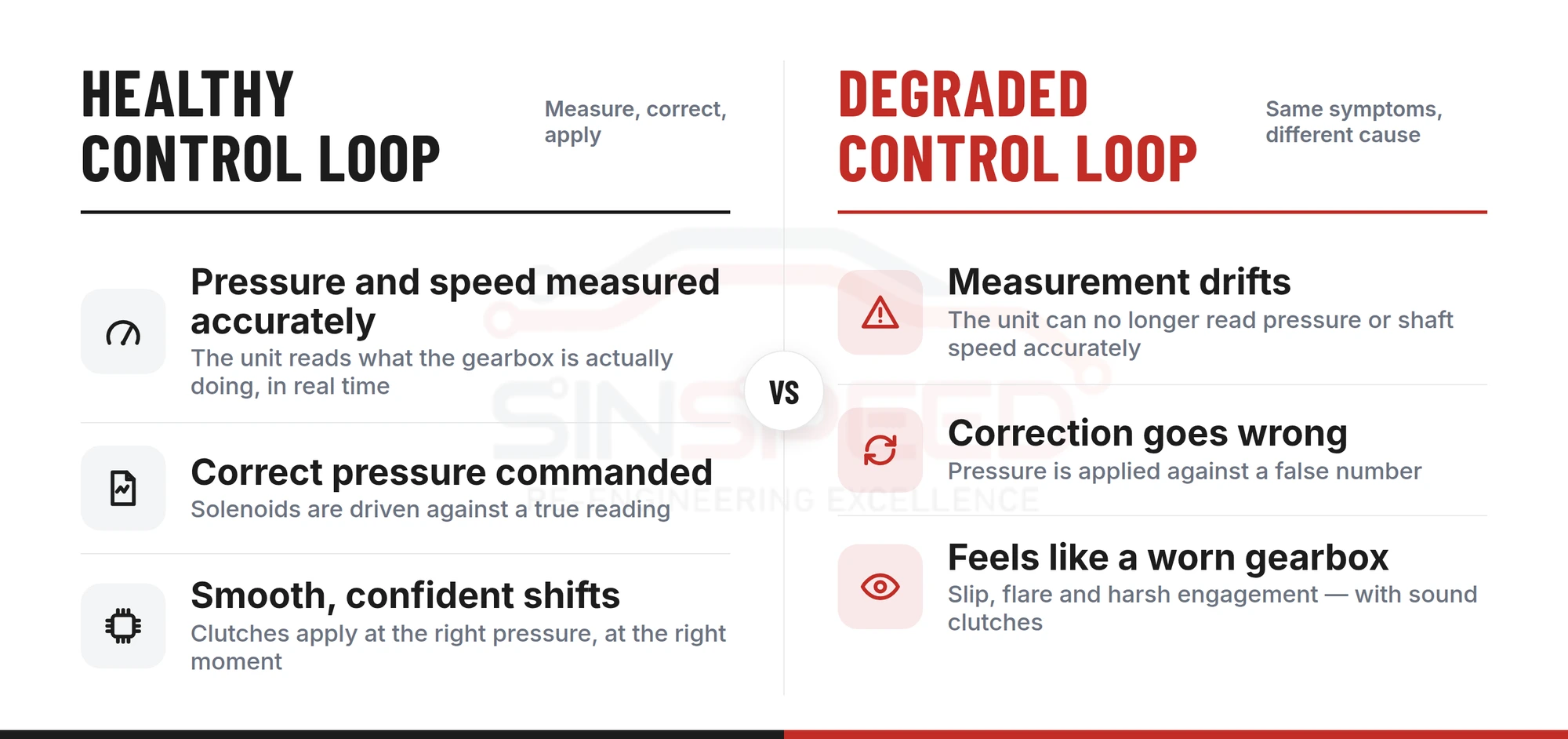
Slip, flare and harsh engagement are exactly what worn clutches feel like. They are also what a control unit produces once it can no longer measure what the gearbox is doing.
These gearboxes do not apply a fixed pressure and hope for the best. The unit commands a solenoid, reads a pressure or speed sensor to confirm what actually happened, and corrects. Degrade the measuring half of that loop and the unit is correcting against a number that is wrong — so clutches which may be in perfectly good condition are applied at the wrong pressure, at the wrong moment.
The Mercedes 7G-Tronic is the documented case. As the control module breaks down internally it can no longer monitor input-shaft speed accurately, so it cannot work out how much the torque converter is slipping, and lock-up becomes ineffective. What the driver feels is a gearbox that will not change smoothly, or that will not select a gear at all. Nothing about it feels electronic.
That is why the first quote a driver is given is so often for a gearbox. From the outside the two conditions present identically, and no road test separates them. A bench does: hydraulic and electrical behaviour is measured against known-good data rather than inferred from how the car drives.
It runs the other way too, and we would rather say so. Where a clutch-actuator temperature code appears alongside iron swarf on the sump magnets, the lock-up clutch has genuinely been damaged and debris has already travelled through the gearbox. That is mechanical work rather than a control-unit repair.
Sinspeed · mail-in repair and return
Have the codes read before anyone quotes you for a gearbox
Send us the stored codes and a description of what the car is actually doing. We will tell you which unit is at fault on your gearbox, and what your garage needs to remove — before anything comes off the vehicle.
Mail-in, UK-wide — only the unit travels · Bench-tested under simulated heat, vibration and load before dispatch
Is “mechatronic” even the right word for your gearbox?
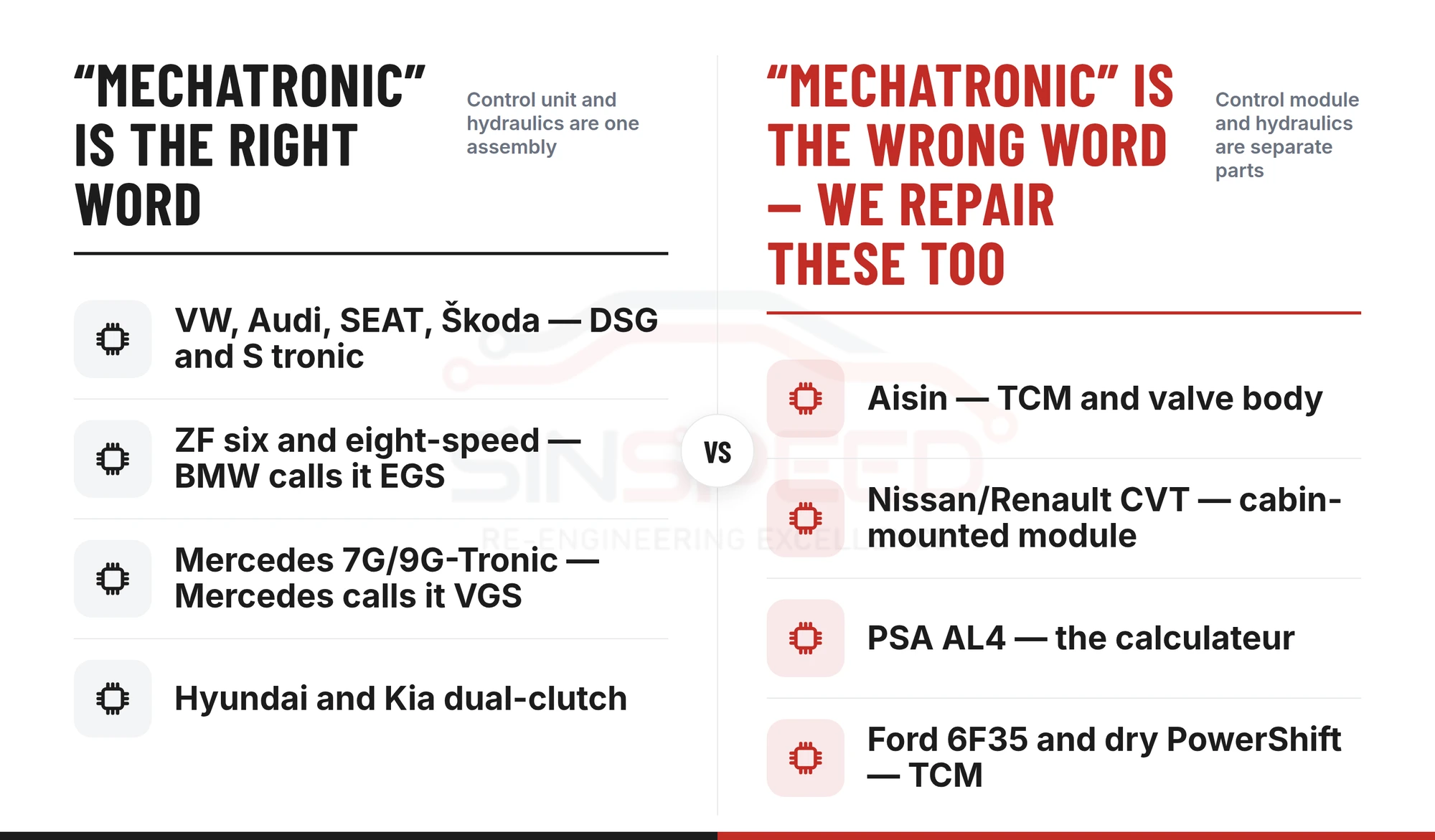
Mechatronic is a precise term that has been stretched to cover every automatic with a computer in it. It is correct where the transmission control unit and the hydraulic block are one assembly, and that is a specific list rather than a general one.
It is the right word for the VW, Audi, SEAT and Škoda DSG and S tronic gearboxes; for ZF’s six and eight-speed automatics, although BMW call the control unit the EGS; for the Mercedes 7G-Tronic and 9G-Tronic, where Mercedes’ own name is the VGS; for the Getrag wet dual-clutch units in the Ford MPS6, Volvo Powershift and Mitsubishi TC-SST; and for the Hyundai and Kia dual-clutch boxes, where it is the standard trade term.
It is the wrong word in five places that matter. Aisin, whose gearboxes sit in Volvos, Vauxhalls and Land Rovers, use TCM and valve body, and no Aisin literature calls the assembly a mechatronic. Nissan’s CVT keeps its control module in the cabin, nowhere near the gearbox. PSA call the AL4 unit the calculateur. Ford use TCM on the 6F35. And the dry-clutch PowerShift fitted to the Fiesta and Focus has no valve body at all — it is a control module with electric actuators driving the selector drums, which is why it fails in a completely different way from the wet unit in a Mondeo or Kuga, a split covered in our guide to Ford PowerShift problems.
This has a practical edge. A part ordered under the wrong name is the wrong part, and a fault searched under a name your manufacturer never uses returns nothing useful. What each gearbox’s unit is called, and where it physically sits, is set out family by family on our valve body and mechatronic repair page.
What does the fault look like on your gearbox family?
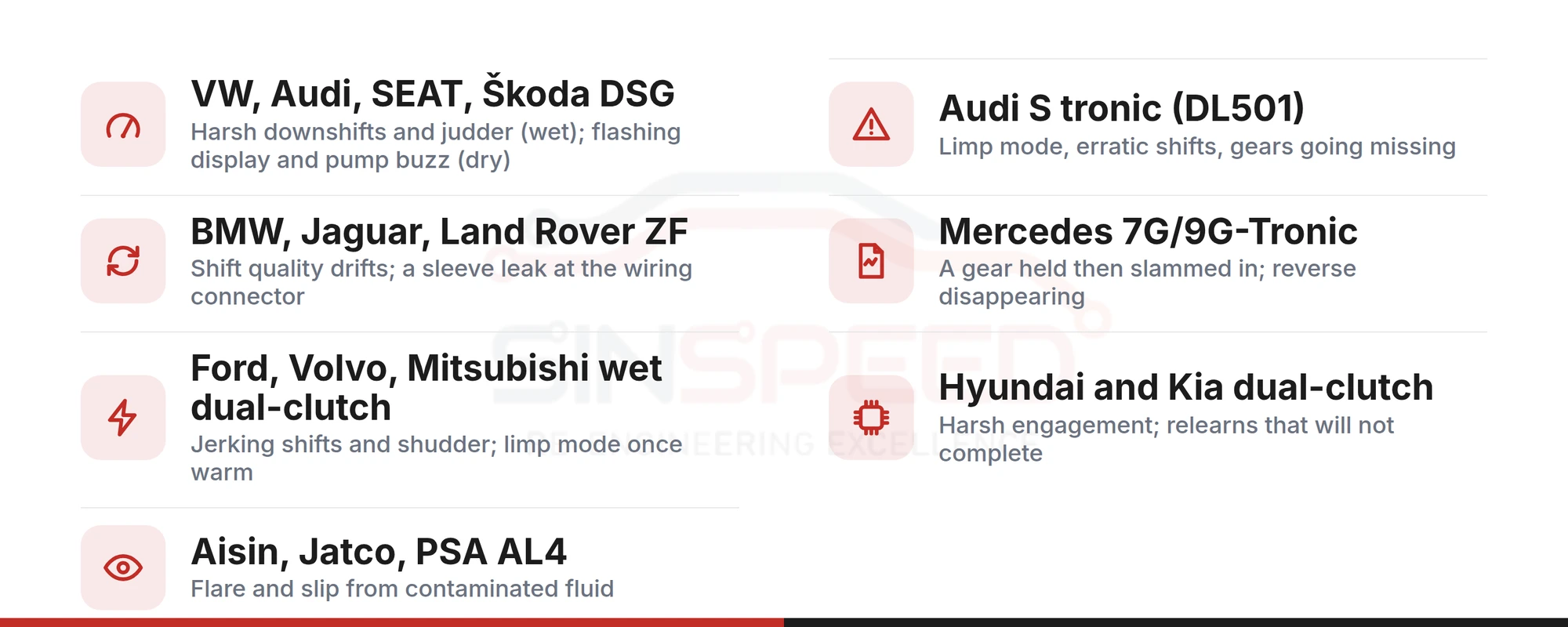
Each family fails in its own way, so each has its own signature.
- VW, Audi, SEAT and Škoda DSG. On the six-speed wet box the signature is harsh 3-2 and 2-1 downshifts with a clunk, judder in second, and pressure-sensing faults logged from inside the unit. On the seven-speed dry box it is the flashing gear display and spanner symbol, a pump buzzing continuously with the ignition on, a shock as the car pulls away and, at worst, a burning smell — and there the chain begins as a loss of pressure and ends with the electronics, which is why treating it purely as an electrical fault has it backwards. We repair these units directly: VW and Audi DSG, Multitronic and CVT controllers, including the seven-speed DSG unit in the A1.
- Audi S tronic. The longitudinal seven-speed starts with EPC and gear-display warnings, then limp mode and erratic shifting, then gears going missing: sticking in gear, half the ratios deactivated, no reverse, or nothing above first. A scan shows electrical valve faults, implausible signals and selectors that cannot be regulated — codes that clear and come straight back.
- BMW, Jaguar and Land Rover on the ZF six and eight-speed. Hydraulic-dominant. Pressure regulation wears first, so shift quality drifts and then turns harsh or slippy. The second fault is the sealing sleeve where the vehicle loom passes into the case: fluid reaches the connector, and because the fluid level sits below the sleeve at rest, the leak is intermittent and elusive. Oil at that connector is worth investigating, but on its own it does not prove the unit has failed internally. Replacing a BMW control unit includes synchronising its ISN with the engine control unit; rebuilding the original never raises the question.
- Mercedes. Three arrangements under one badge. On the 7G-Tronic the unit sits in the sump and fails electronically: a gear held too long then slammed in, limp mode restricted to one forward gear, sometimes no gear selection and no start — the fault our Mercedes 722.9 VGS repair page covers in full. On the 9G-Tronic it usually shows as reverse disappearing, or the box dropping into neutral as D is selected. On the earlier five-speed the real control unit is not in the gearbox at all but an external module, and slipping or delayed engagement often traces to fluid escaping at the case connector and reaching it — which is why a rebuilt module should not go back with the old leaking connector still fitted.
- Ford, Volvo and Mitsubishi wet dual-clutch. Jerking and thumping shifts, clutch shudder, floating engine speed, delayed engagement, gears disappearing with reverse and first usually going first, limp mode once the box is warm, and codes that return after clearing. Debris in hot fluid sticks the pressure-control solenoids and wears the valve bores. Mitsubishi state the packaging plainly — the valve body and the TCM are permanently attached and cannot be replaced separately — which is exactly the unit we rebuild in our Lancer Evolution X SST mechatronic repairs.
- Hyundai and Kia dual-clutch. Here the failures are electronic and electromechanical rather than hydraulic. On the dry seven-speed the clutch actuators are the headline: no drive, harsh engagement, and relearns that will not complete. On the wet version a documented control-module software fault produces limp-home running, while hardware failure shows as a violent shudder at creep speed. A clutch relearn on the vehicle is part of refitting — a fitting step, not an obstacle.
- Aisin, Jatco and PSA — the ones that are not mechatronics. Aisin boxes flare between second and third and slip in third to fourth, with harsh coasting downshifts, because contaminated fluid wears the bores; their solenoids go sticky rather than failing electrically. Nissan and Renault CVTs judder, and the root cause is contested enough that inspection should come before any part is bought. The PSA AL4 logs a pressure-regulation fault and limps home in third, and its dominant failure is hydraulic — the control unit itself is rarely the part at fault.
Every unit named above sits under our transmission control module repair services.
Why does the fault come and go, and what does that tell you?
Intermittency is information rather than noise, and the pattern is worth recording before it hardens into a permanent fault.
Heat is the commonest version. The Getrag wet dual-clutch boxes are documented dropping into limp mode once warm, and a fault that only appears with a hot gearbox is pointing at clearances and pressures that hold when cold and stop holding when hot.
Sometimes the geometry explains it. The ZF sleeve leak is intermittent by construction: the fluid level sits below the sleeve when the car is standing, so fluid only reaches it once the box has been running.
Codes behave in the same telling way. On the Audi longitudinal seven-speed the electrical faults clear and return immediately, which is not stored history — it is a live fault being re-detected as soon as the unit looks again.
The trap is that an intermittent fault gets written up as nothing found, and the car goes back out. Note when it happens — cold start, once warm, pulling away, one particular pair of gears — because that is the one piece of evidence a later scan cannot recover for you.
What do the fault codes tell you, and what does a clean scan prove?
Codes on these gearboxes fall into two broad groups, and they point in opposite directions. Pressure-control codes — commanded pressure against measured pressure, solenoid circuits — point at the hydraulic side. Speed and position codes — turbine, input and output shaft speed, clutch and selector position — point at the unit’s ability to measure what it is controlling.
On the Mercedes 7G-Tronic that split is published as a formal taxonomy by the people who remanufacture the unit: the internal speed-sensor codes are the set a rebuild addresses, the pressure-control solenoid band is not, and where both appear together the control unit is dealt with first and the codes are re-read afterwards. The order matters, because the second set often stops appearing once the first is resolved.
A clean scan proves less than most people assume. Ford’s own bulletin for the 6F35 describes harsh reverse engagement and delayed upshifts caused by a mechanically binding shift solenoid, with no fault codes stored at all. A gearbox can be badly wrong and still pass a code read.
Two cautions before a code is treated as a verdict. On a DSG, low or degraded oil sets the same pressure-regulation codes as a worn unit, so the level and condition of the fluid are worth confirming first. And on a Nissan or Renault CVT the judder codes are real, but their root cause is contested — they justify an inspection rather than a part.
What should you do before anyone quotes you for a gearbox?
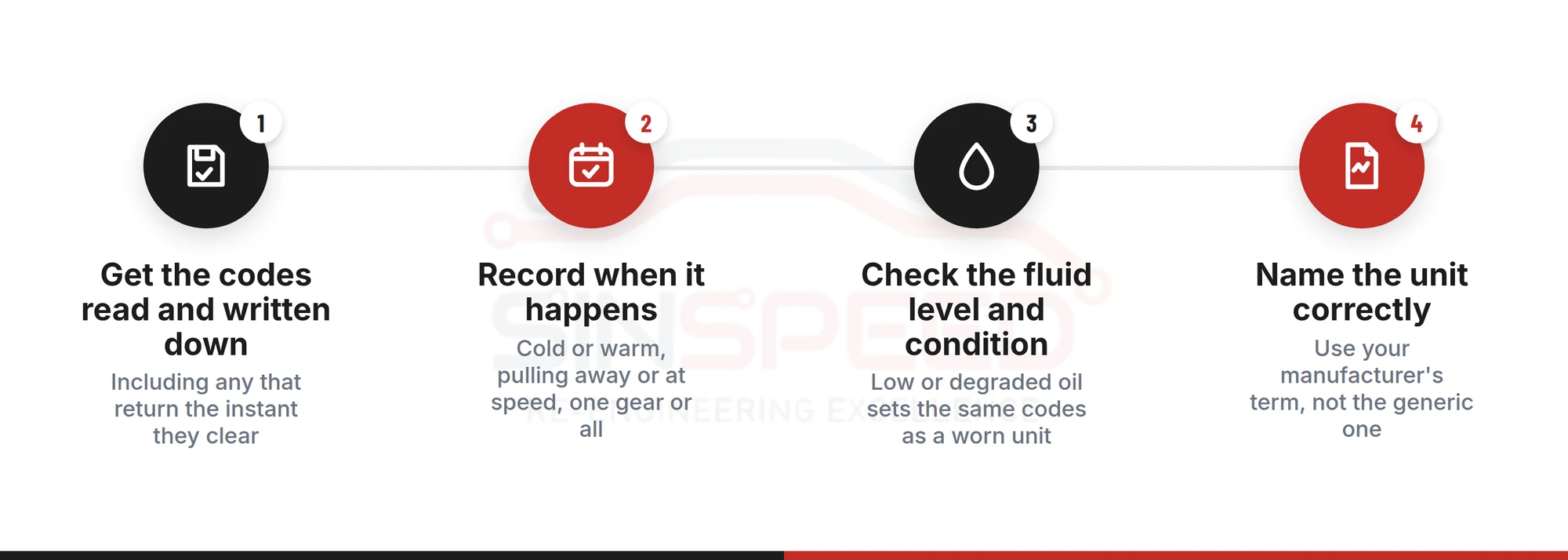
Four things, in order, and none of them costs a part.
- Have the codes read and written down
Including any that return immediately after clearing — those are the most useful ones you have.
- Record when it happens
Cold or warm, pulling away or at speed, every gear or one pair. That pattern is diagnostic and nothing recovers it later.
- Check the fluid level and condition
Before anything is removed. Low or degraded oil produces the same codes as a worn unit.
- Establish what your gearbox’s unit is actually called
Under the name your manufacturer uses rather than the generic one, so you are asking about the right part.
Then send us the symptoms and the codes through the repair form. We will tell you which unit is at fault, what it is called on your gearbox and what needs to come off. Your garage removes it and posts it in, so the vehicle stays where it is.
On the bench the unit is measured rather than guessed at, and run on in-house Hardware-in-the-Loop rigs that simulate the heat, vibration and load it meets in service — which is how an intermittent fault is made to repeat on a bench instead of on a motorway slip road. A rebuilt unit also keeps its own coding, where a new one arrives blank. That holds across the DSG family, the ZF six-speed, and the Mercedes 7G-Tronic, whose control unit is married to the vehicle’s immobiliser and chassis number — so a second-hand one is a dead end. Where a step on the car is still needed, such as adaptation on a DSG, ISN synchronisation on a BMW or a clutch relearn on a Hyundai or Kia, we name it before the unit is dispatched. Most remanufactured parts carry a lifetime, unlimited-mileage warranty.
Mechatronic unit faults: FAQs
What are the first signs of a mechatronic unit failing?
Shift quality changing is usually first: a thump, a hesitation, or a flare where the revs climb between gears. After that comes a pause before drive engages, a gearbox warning light or flashing gear display, and limp mode. Early on it is often intermittent and tied to the gearbox being warm, which is exactly when it is worth having the codes read rather than waiting.
Can you keep driving with a failing mechatronic unit?
Limp mode is a protective measure and it will usually get you home, but it is not a condition to live with. What limp looks like varies by gearbox: a PSA AL4 limps home in third, while an older Mercedes five-speed holds the gear you were in until you stop, switch off for ten seconds and restart, after which second is available and reverse always is. Some faults end in no drive at all, with the box dropping into neutral. Have it read rather than finding out which yours is.
Can a mechatronic fault feel like worn clutches?
Yes, and that is the central difficulty on these gearboxes. A unit that can no longer measure pressure or shaft speed accurately applies the clutches at the wrong moment, and the result is slip, flare and harsh engagement that feel identical to wear from the driving seat. Fault codes narrow it considerably, and measurement on a bench against known-good data settles it.
Does every automatic gearbox have a mechatronic unit?
No. Every self-shifting gearbox has hydraulic control of some kind, and a CVT has a control valve body like any other automatic. What varies is whether the electronics are part of that assembly. On plenty of gearboxes the control module is a separate part mounted elsewhere — on the case, in the engine bay, or inside the cabin — and the dry-clutch PowerShift has no valve body at all.
My unit is inside the gearbox casing. Can it still be sent in?
Yes. On these designs the gearbox stays in the car: the sump or a side cover comes off and the unit comes out from underneath or from the engine bay. Your garage removes it, posts it to the workshop, and refits it when it comes back. Where the unit sits changes who takes it out. It does not change what we can do with it once it arrives.
Will a gearbox oil service fix a mechatronic fault?
It will not repair a worn valve or a degraded control unit. It is still worth confirming the level and condition of the fluid before anything is removed, because low or degraded oil sets the same pressure-regulation codes. And gearbox fluid is not sealed for life in any useful sense — ZF specify a change on the eight-speed at 50,000 to 75,000 miles or eight years, whichever comes first.
Sinspeed · mail-in repair and return
Find out which unit has failed before you commit to a gearbox
Tell us the vehicle, the symptoms and the stored codes. If the fault is in the control unit or the hydraulic control body, that is bench work we do — and your original unit comes back tested, with its own coding intact wherever the design allows.
Lifetime, unlimited-mileage warranty on most remanufactured parts · Cleanroom-standard, ESD-safe workshop
Final thoughts
Two questions carry most of this. Which gearbox is in the car, and which half of the loop has given up — the muscle that applies the pressure, or the measurement that decides when to apply it. The symptoms on their own will not tell you, because a unit that can no longer measure accurately produces the same slip and the same harshness as a gearbox that is genuinely worn.
What does tell you is the combination: what the car does, which family it belongs to, what the scan is holding, and finally what the unit does on a bench under load. Taken in that order the ambiguity disappears fairly quickly, and it disappears before anything expensive is bought.
The one thing worth acting on early is timing. These faults start out occasional, and the documented pattern on the families we see most is that they do not stay that way. For as long as the unit is degraded, the rest of the gearbox is being operated at pressures it was never designed around.