
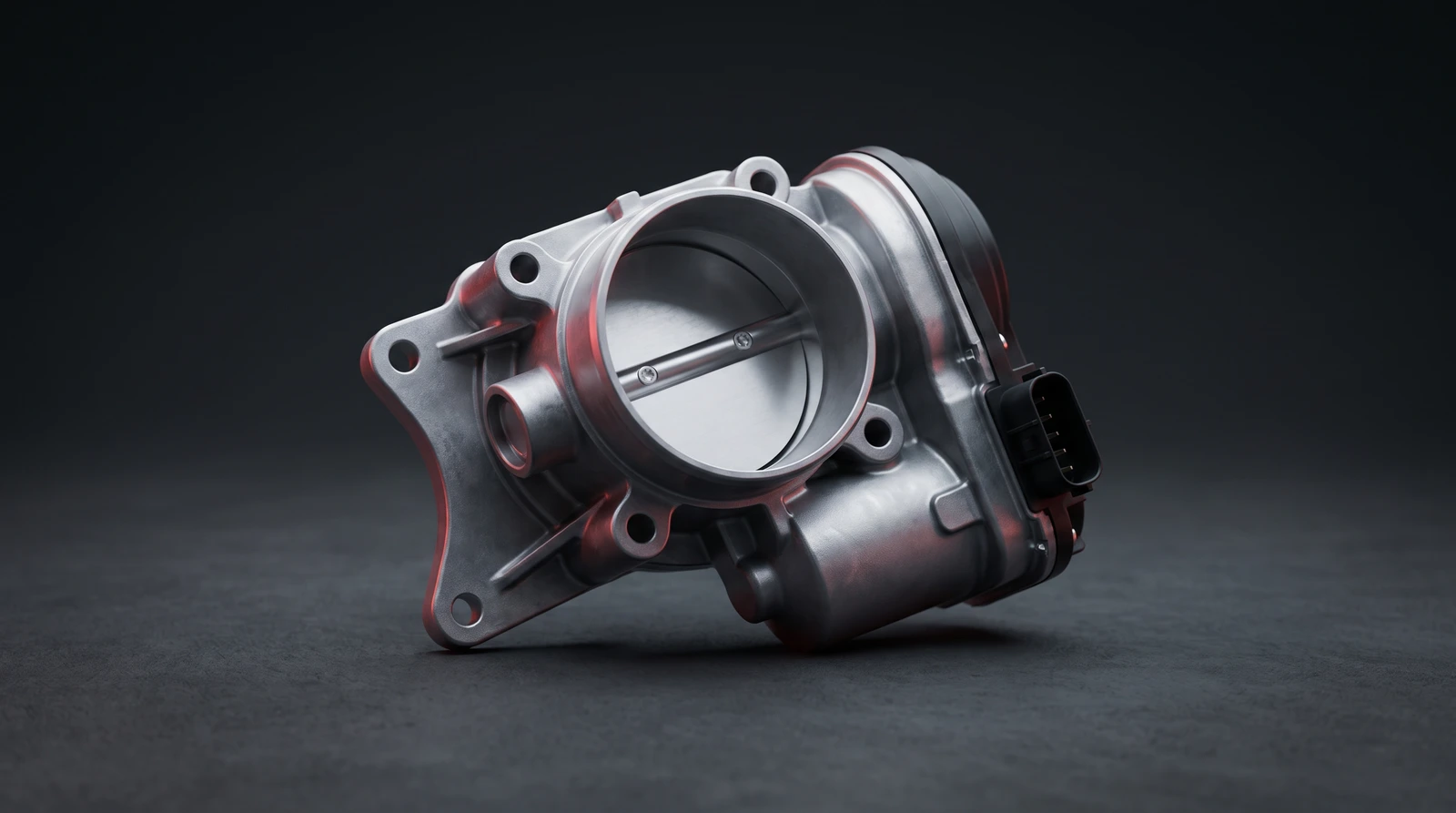
Summary: A throttle body is the air valve at the entrance to your engine’s inlet manifold: a round plate in a short bore that turns to let more or less air in, and so sets how much power a petrol engine makes. On most modern cars it is electronic — the engine ECU reads the pedal, a small motor moves the plate and two sensors report its angle back. When one misbehaves, the cause is either carbon, which a clean can shift, or a fault in the motor or position sensing, which we repair on the bench and return to your garage to refit.
- What does a throttle body do?
- How an electronic throttle body works
- Cable-operated vs drive-by-wire
- What makes a throttle body fail?
- Signs of a bad throttle body
- Throttle body or look-alike? Telling them apart
- If it happens on the road: limp mode, high idle, stalling
- Clean, recalibrate or rebuild
- Throttle body questions, answered
- Final thoughts
What does a throttle body do?
It decides how much air the engine gets. The word is literal: to throttle something is to choke it, and a petrol engine’s power is controlled by choking its air supply. With the plate almost closed the engine draws only enough air to idle; open it and the cylinders fill, the ECU adds fuel to match, and the car pulls.
That is why a small part matters so much. The ECU calculates fuel from the air it measures and the angle it believes the plate is at, so a plate that is not where the ECU thinks puts every figure after it out.
- Where it is: bolted to the inlet manifold, at the end of the large air duct from the air filter box.
- What it controls: the air entering the engine, and with it idle speed and power.
- Inside an electronic unit: a round plate on a spindle, an electric motor, a return spring, two position sensors and a connector.
- What it is not: the accelerator pedal, the mass air flow sensor or the injectors — though each can cause symptoms that look like a throttle fault.
How an electronic throttle body works
On an electronic throttle — also called drive-by-wire or electronic throttle control — nothing physical links your foot to the plate. A closed loop does the job instead.
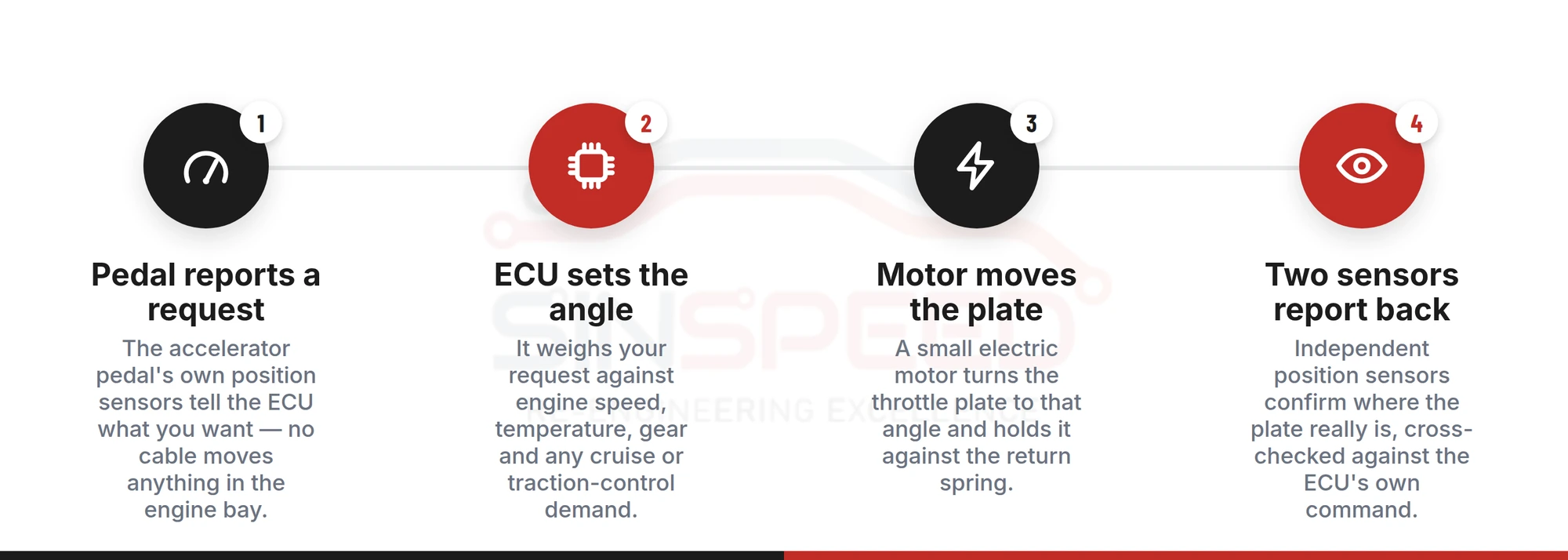
- The pedal reports a request
The accelerator pedal has its own pair of position sensors. Pressing it tells the ECU what you want; it moves nothing in the engine bay.
- The ECU sets the angle
It weighs that request against engine speed, temperature, gear and any cruise or traction control demand, and picks the plate angle it wants.
- The motor moves the plate
A small electric motor turns the plate to that angle and holds it against the return spring.
- Two sensors report back
Two independent position sensors tell the ECU where the plate really is, and it checks them against each other and against its own command.
So your pedal is a request, not a command — the part most explanations leave out. The ECU can open the plate with your foot off the pedal to steady the idle as the air-conditioning cuts in, and hold it back with your foot flat when traction control detects wheelspin. It is also why a fault in the loop can make the car do something the pedal never asked for.
The paired sensors exist for safety: an engine that opens its own throttle has to prove where the plate is. If the readings disagree or the plate stops following commands, the ECU cuts the motor out and the return spring parks the plate at a small default opening — limp mode, the system protecting you rather than failing you.
Cable-operated vs drive-by-wire
Older petrol cars use a cable from the pedal to the plate, with a single sensor reporting its position. Most modern cars have dropped it, largely because traction control, stability control and cruise control need the ECU to set the throttle rather than just watch it. No cable to the throttle body means it is electronic.
| Feature | Cable-operated | Drive-by-wire |
|---|---|---|
| How the plate moves | Directly, by the cable | By a motor the ECU drives |
| Position sensing | Usually one sensor | Two sensors that cross-check |
| Idle control | A separate idle air valve bleeds air past the plate | The ECU holds the plate at a precise small opening |
| Cruise and traction control | A separate actuator, where fitted | Built into the throttle control |
| When it fails | Poor idle and hesitation; the pedal still works the plate | Idle faults and hesitation, often a sudden drop into limp mode |
What makes a throttle body fail?
Failures come in two kinds, and telling them apart is most of the diagnosis.
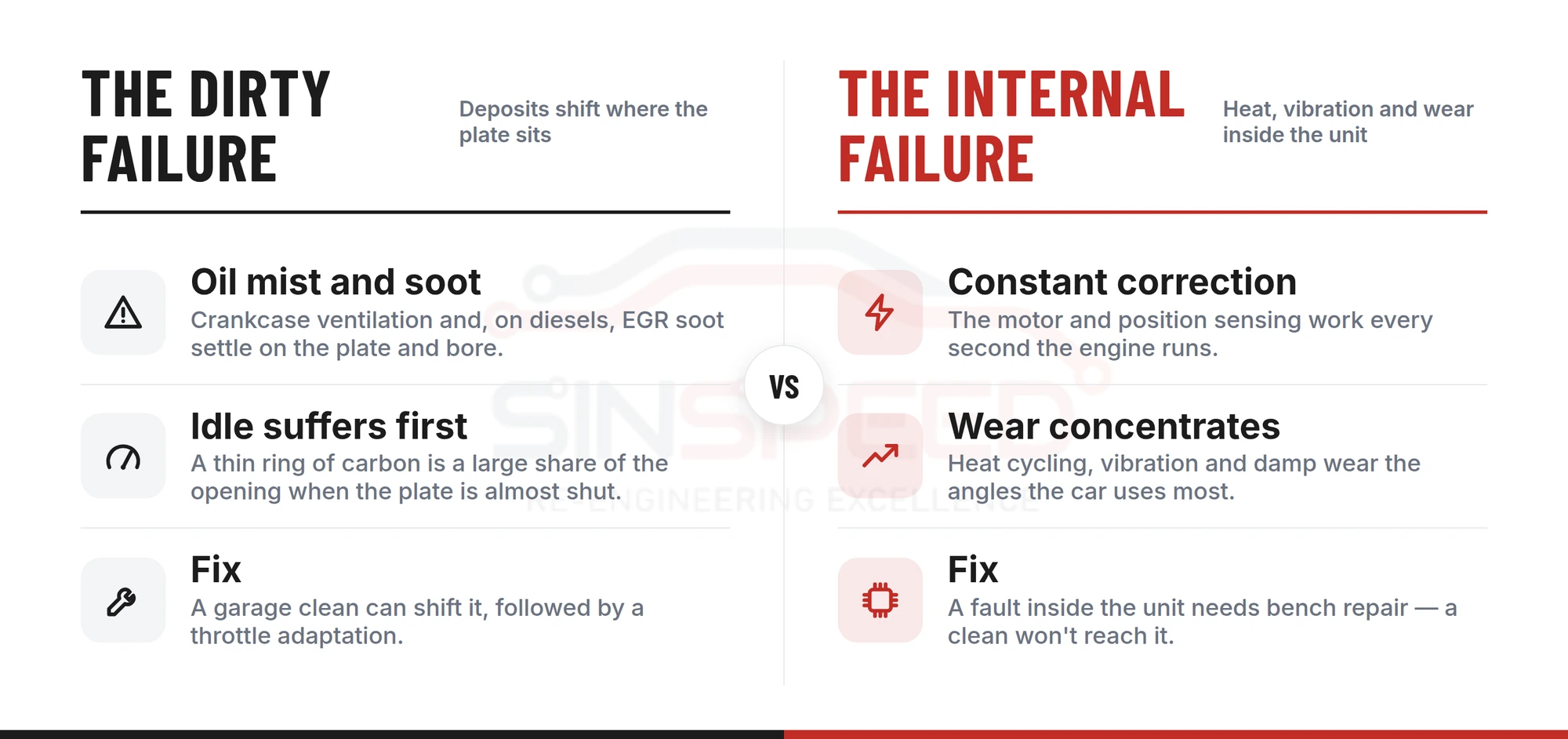
The dirty failure. Every engine breathes some oil mist into its inlet through the crankcase ventilation, and a diesel adds soot from exhaust gas recirculation. Some of it settles on the plate and bore, shifting the point where the plate really closes, so the position the ECU learned no longer matches the air getting past. Idle suffers first, because with the plate almost shut a thin ring of carbon is a large share of the opening.
The internal failure. An electronic unit never rests: it makes small corrections all the time the engine runs. Heat cycling, vibration and damp at the connector work on the motor and the position sensing, and the wear concentrates in the narrow band of angles where an ordinary car spends its life. The result is a motor that cannot hold the plate steady, or a position signal that drifts or drops out in part of its range — often only when hot at first, and beyond the reach of any clean.
Some designs reach us more often than others — the VDO-type unit shared across VW, Audi and Mercedes models, and the throttle body on VAG’s 1.2 TSI petrol engines in cars such as the Audi A3.
Signs of a bad throttle body
When a symptom appears says a lot about its cause.
At idle and coming to a stop. Revs that hunt, an idle that sits high once the engine is warm, or an engine that dies as you roll up to a junction. Deposits show here first.
As you accelerate. A pause before the car responds, a flat spot at one pedal position, or surging at a steady speed. On an automatic, gear changes can turn harsh or late, because the gearbox uses throttle position to judge when to shift.
All at once. A warning light — the engine management light, or EPC on Volkswagen Group cars — with a sudden loss of power and a pedal that does very little. That is limp mode: the ECU has stopped trusting its control of the throttle, whatever the cause.
Over weeks. Fuel use creeps up as the engine runs rich or lean on an airflow figure that is no longer right — our guide to an engine running rich explains where that leads. Most of these arrive with stored codes, which our throttle body fault codes guide takes one at a time.
Sinspeed · throttle body diagnosis
Recognise the symptoms? Check before you buy a new onePut the car, the engine, what it is doing and every stored code on the repair form. We will tell you whether the evidence points at the throttle body at all before anything is posted.
Heat, vibration and load simulated on our own HIL rigs · Your original unit, repaired and returned
Throttle body or look-alike? Telling them apart
A throttle body gets blamed for anything that upsets idle or power, and its neighbours produce many of the same complaints.
| Suspect | Its job | Points towards it | Points away from it |
|---|---|---|---|
| Throttle body | Sets and reports the plate angle | Position, actuator or correlation codes; faults that change with engine-bay heat | Codes that name only other parts |
| Accelerator pedal sensor | Reports your foot to the ECU | Pedal-sensor codes; on some makes, “sensor B” and correlation codes mean the pedal | Pedal readings that stay smooth while throttle codes return |
| Mass air flow sensor | Measures the air getting past the plate | Airflow codes such as P0101; poor running across the rev range | A fault confined to idle or one pedal position |
| Intake air leak | Lets in air nothing measured | Lean-running codes; a high or hunting idle; a hiss from the inlet | Position or correlation codes — a leak cannot make two sensors disagree |
| Wiring and connector | Carries power and signals | Faults that come and go with damp, bumps or engine movement; circuit high or low codes | The same fault reproduced by the unit on a bench |
| Engine ECU | Drives the throttle motor from its own output | Motor-circuit codes that stay with a known-good throttle body fitted | Any fault the unit reproduces on its own |
Two of those rows deserve a word more. The pedal is a separate part, so if it is at fault a new throttle body leaves the problem exactly where it was. And if diagnosis lands on the ECU’s own drive output, that is an engine ECU repair, not a throttle body one — work for an independent specialist such as ecu-repairs.com.
If it happens on the road: limp mode, high idle, stalling
A throttle fault can turn from a driveability problem into a safety one without warning, usually in one of three ways.
- Limp mode. Power drops and the pedal stops responding normally. Leave the flow of traffic, stop where it is safe, and do not count on the car to accelerate out of a tight spot.
- An idle that rises on its own. The engine revs with your foot off the pedal and the car creeps harder than you expect. Once safely stopped, switch off and do not drive on.
- Stalling as you slow. An engine that cuts out as you brake for a junction leaves a heavy brake pedal and, on many cars, heavier steering until it restarts. One stall is a warning that another is coming.
If power has gone or the idle is running away, have the car recovered rather than driven home. Either way, get the codes read before anyone clears them — the stored code and its snapshot of conditions at the moment of failure are the best evidence there is. A warning light that stays on will also count against the car at its MOT.
Clean, recalibrate or rebuild
Once the throttle body is confirmed as the problem, the fix is one of three things.
A clean is right when deposits are the cause and the unit’s electronics test sound. On an electronic unit it is a garage job — the plate is motor-driven and the sensing is easily damaged — and it is always followed by the next step.
A recalibration, usually called a throttle adaptation or relearn, tells the ECU where the plate now rests. It is needed after a clean, after a throttle body is refitted, and on many cars after the battery has been disconnected. It cures a mismatch rather than a fault: if the unit itself is failing, an adaptation only buys time.
A rebuild is the answer when the fault is inside the unit — the motor, the position sensing or the electronics between them. Our throttle body repair hub explains why a clean can seem to cure one of these for a while; in short, deposits and electrical faults share symptoms, and only one of them washes off.
The rebuild is our part of the job. Your garage removes the throttle body and posts it to us; we exercise it from closed to wide open on our own Hardware-in-the-Loop rigs under simulated engine-bay heat, vibration and load until the failing part shows itself, repair it at circuit level, calibrate it and test it again. Your garage refits it and runs the adaptation as part of fitting.
Throttle body questions, answered
Is the throttle body the same as the throttle position sensor?
No, though the two are often confused. On an electronic unit the throttle position sensors — there are two — are built into the throttle body to read the plate angle, and on most units they are not serviced separately. A position-sensing fault is therefore a fault in the throttle body itself.
What is the difference between a throttle and a throttle body?
“Throttle” is the general word for whatever regulates an engine’s power, and people use it loosely for the accelerator pedal too. The throttle body is the specific part that restricts the air: the housing, the plate and, on electronic units, the motor and sensors that control it.
Do diesel engines have a throttle body?
Most modern diesels do, but not to control power — a diesel sets power by how much fuel it injects. The plate is partly closed to help draw exhaust gas back through the EGR valve, and closed fully at switch-off so the engine stops without shuddering. Soot from that exhaust gas makes diesel units a dirtier environment, but the electrical design is the same.
Can my garage take the throttle body off and send it to you?
Yes — that is how it works. The garage removes it and posts it with the stored codes and vehicle details; we repair and test your original unit and send it back. The car stays with the garage while the unit is away, and the adaptation is run when it is refitted.
Sinspeed · electronic throttle repair
Throttle body confirmed, or still only a suspect?Tell us the make, model and engine, what the car does and the codes it has stored. If the throttle body is to blame, your garage posts it in and your own unit comes back repaired and tested.
Circuit-level repair in a cleanroom-standard, ESD-safe workshop · Lifetime, unlimited-mileage warranty on most remanufactured parts
Final thoughts
A throttle body is a simple idea — a valve that chokes the engine’s air — inside a control loop that has to be right many times a second. What goes wrong is usually one of two things: dirt that changes where the plate sits, or an electrical fault that changes what the ECU believes about it.
The useful skill is telling which symptoms belong to the throttle body and which to its neighbours, so the part that gets repaired is the part that failed. Get the codes read, keep them, and let them choose between a clean, an adaptation and a rebuild.