
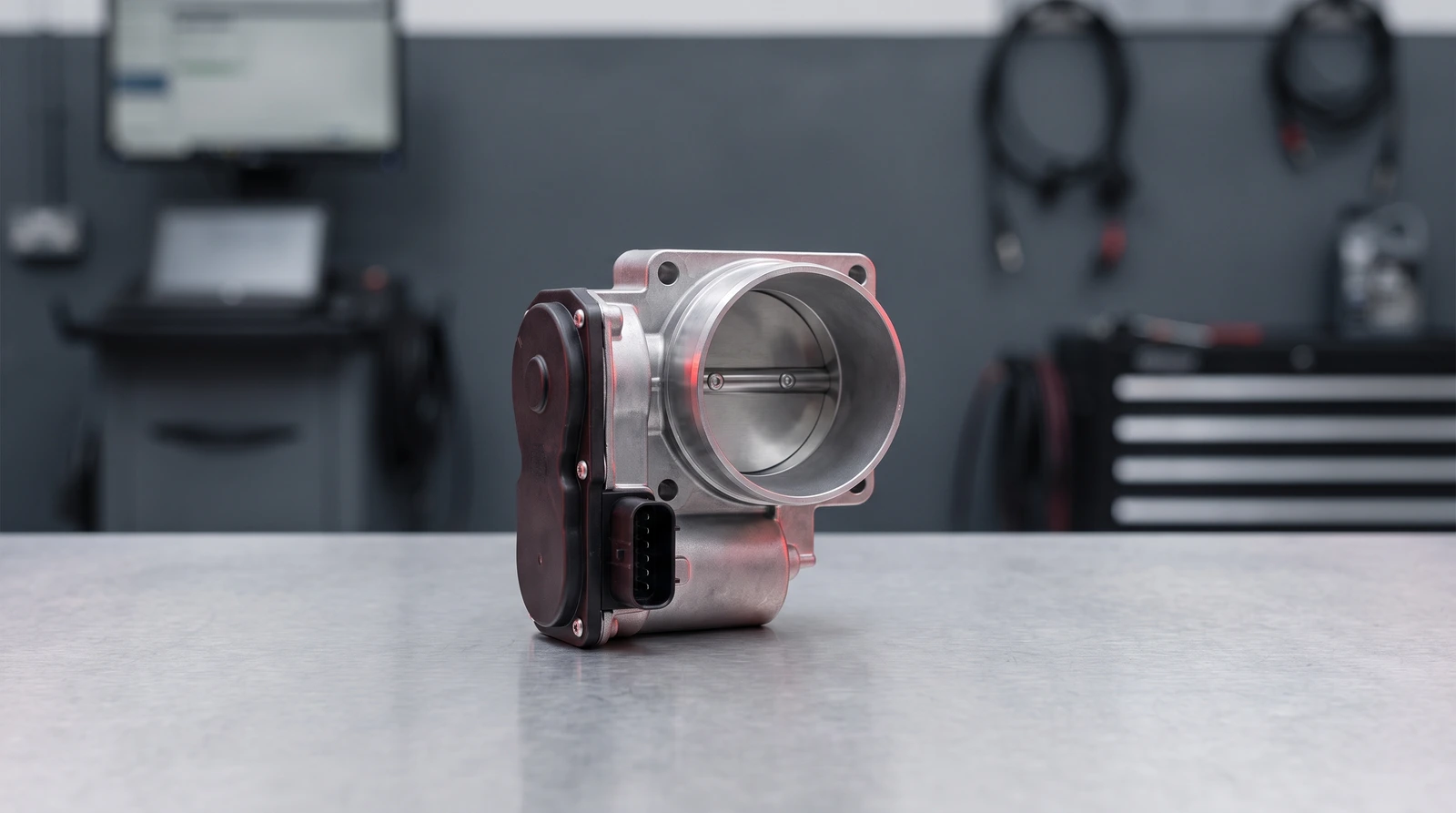
Summary: A throttle body fault code tells you what the engine ECU measured, not what has failed. P0121, P0122, P0221, P0222, P0638, P2100, P2101 and P2135 all point at one assembly — a butterfly plate, a small electric motor that moves it, and two position sensors that have to agree with each other. This page takes each code in turn and answers the same four questions: what the ECU actually measured, which physical failure produces that reading, what the driver feels, and whether the honest answer is a clean, a sensor or a replacement unit.
- What all eight of these codes have in common
- The eight throttle body fault codes at a glance
- P0121 and P0122: throttle position sensor A
- P0221 and P0222: the second position channel
- P0638: the plate did not go where it was told
- P2100 and P2101: the motor circuit itself
- P2135: when the two sensors disagree
- Limp mode, and whether you can drive
- Clean, sensor or unit: how the decision is made
- Throttle body fault code FAQs
- Final thoughts
What all eight of these codes have in common
Every one of these codes describes a check that failed, not a part that broke. An engine ECU cannot see a worn sensor track or a ring of carbon round a throttle plate. It sees voltages, currents, and whether the numbers it is reading still make sense against each other — and when one of those tests fails it stores the code for the test. Everything between that stored code and the actual fault is diagnosis, and it is where most of the money wasted on throttle bodies goes.
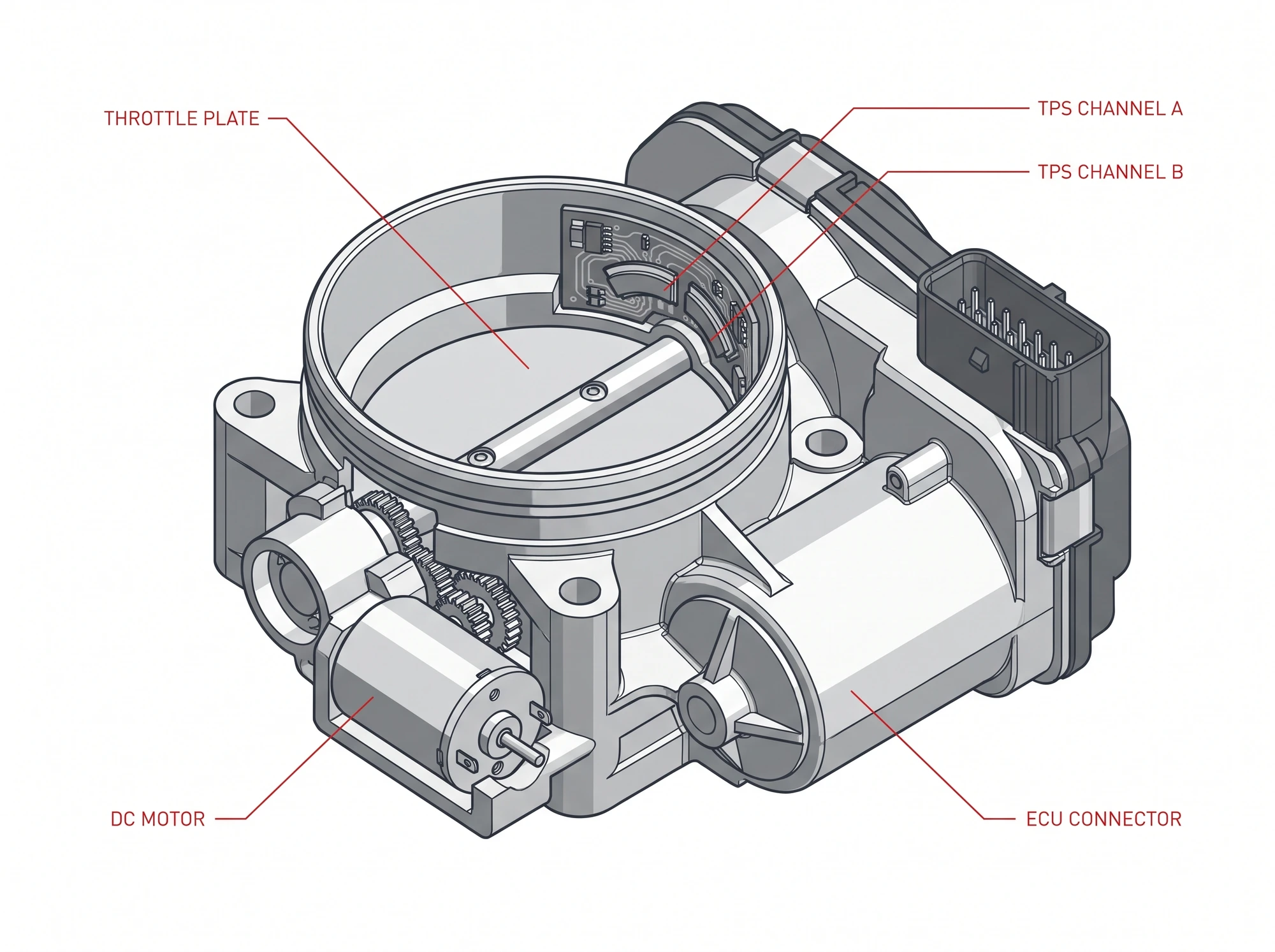
The part underneath all eight is a single sealed assembly bolted to the inlet manifold. Inside the housing there is a butterfly plate on a spindle, a small DC motor turning that spindle through a reduction gear train, a return spring that pulls the plate to a default position when power is removed, and a position sensor with two independent channels reading the plate angle. There is no cable from your foot. The accelerator pedal carries its own pair of sensors; the ECU reads those, decides how far open the throttle should be, drives the motor, and then reads the plate angle back to confirm it got there.
Two position channels rather than one is a safety decision. A single sensor can fail in a way that still looks entirely plausible, and an engine that opens its own throttle cannot be allowed to act on a number it has no way of checking. So the two channels are arranged to move in opposite directions, or at a fixed offset, and the ECU compares them continuously. A fault that hits both — a lost five-volt reference, a short to ground — moves them together and gives itself away. A fault that hits one shows up as a disagreement.
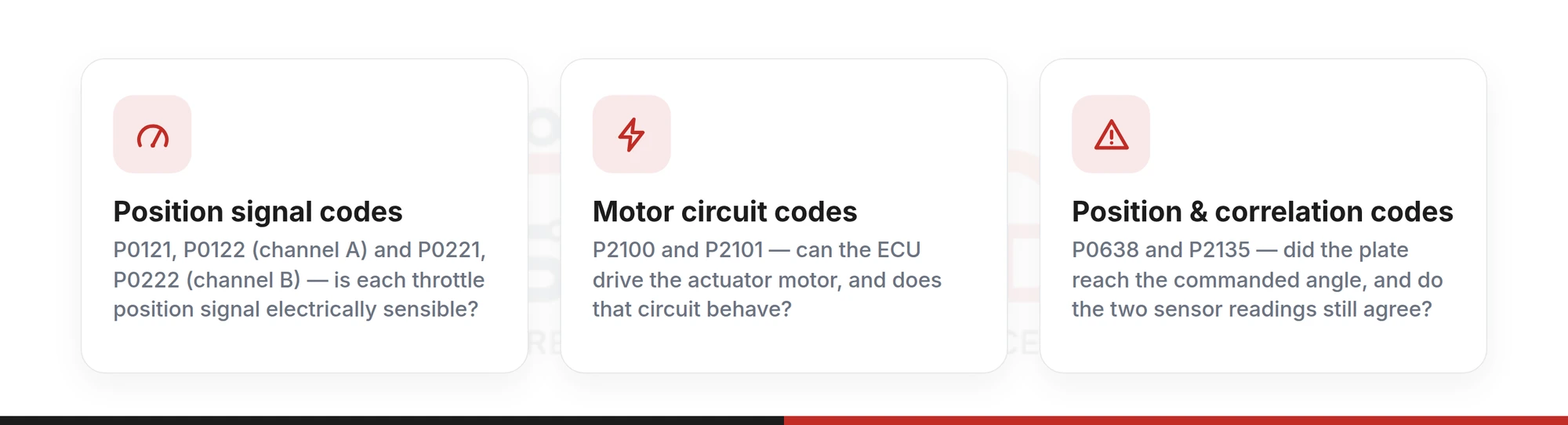
That leaves the ECU three separate things to be unhappy about, and the eight codes sort themselves into the three.
- Is each position signal electrically sensible? P0121 and P0122 for the first channel; P0221 and P0222 for the second.
- Can I drive the motor, and does that circuit behave? P2100 and P2101.
- Did the plate end up where I sent it, and do my two readings still agree? P0638 and P2135.
They rarely arrive alone. A worn sensor track will set a range code and a correlation code in the same journey; a binding plate sets an actuator code and drags a position code in behind it. That combination is more diagnostic than any single code, which is the first reason to read past the one you came for. The second is that all eight land on the same bench — throttle body repair and remanufacturing is one of the lines we run, and what follows is what we find when the units are open.
The eight throttle body fault codes at a glance
The definitions below are the generic ones every manufacturer builds on top of. Where a make uses its own label — VAG calls the first throttle position sensor G69 and the second throttle angle sensor G188 — the label tells you which channel is complaining and the generic code tells you which check failed. The last two columns are the ones a code database cannot fill in for you.
| Code | What the ECU measured | Likely physical cause | Clean, sensor or unit? | Safe to drive? |
|---|---|---|---|---|
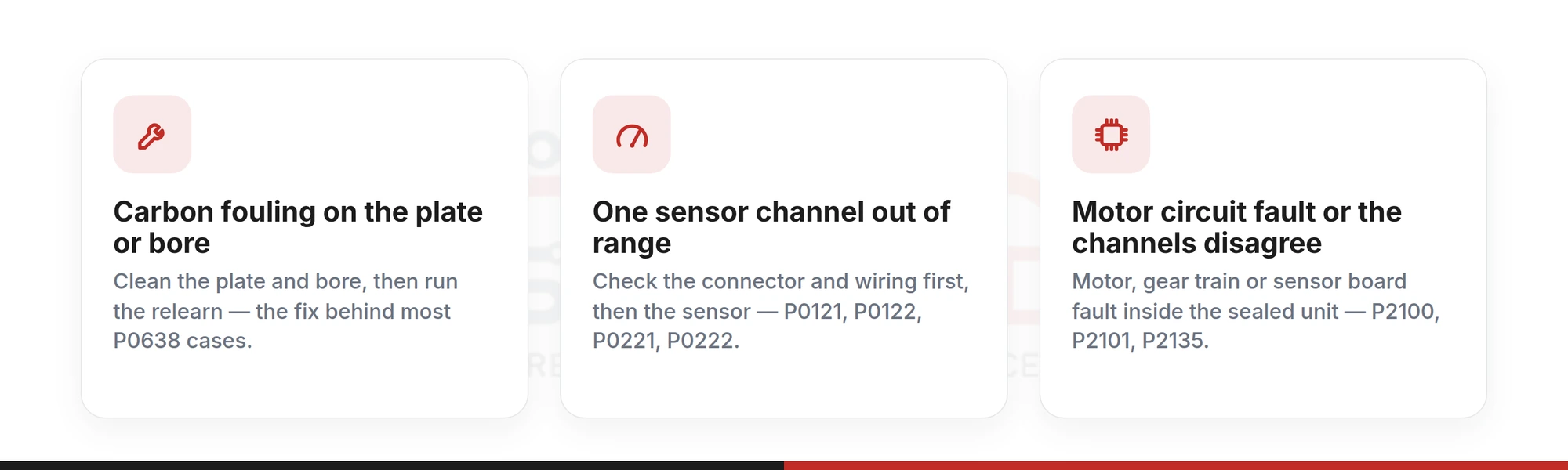
| P0121 Sensor A range/performance | Channel A is inside its voltage range but does not behave plausibly against the other inputs. | Worn spot on the sensor track, or a learned closed position that no longer matches a carboned plate. | Clean and relearn first, then the unit. | Often still drives, but treat limp mode as a matter of time. |
| P0122 Sensor A circuit low | Channel A’s signal sat below the bottom of its allowed window. | Open five-volt supply, signal shorted to ground, corroded connector pin, failed sensor. | Wiring and connector first, then the unit. | Only as far as somewhere safe if power has dropped. |
| P0221 Sensor B range/performance | Channel B is in range but implausible against channel A or the pedal. | Wear on the second track — or a pedal sensor, on makes that label the pedal B. | Sensor or unit. Rarely a clean. | As P0121. Establish first which sensor B is. |
| P0222 Sensor B circuit low | Channel B’s signal sat below its allowed window. | The same circuit faults as P0122, on the second channel. | Wiring and connector first, then the unit. | As P0122. |
| P0638 Actuator range/performance | The plate did not reach the commanded angle within tolerance. | Carbon binding the plate, adaptation lost after a battery disconnect or a clean, tired motor, worn gears, loose connector pins. | Clean and relearn first. This is the code that most often is. | Usually limp mode already, with engine speed capped. |
| P2100 Actuator motor circuit open | The ECU commanded the motor and no current flowed. | Broken wire, corroded pin, open motor winding, worn brushes. | Wiring first, then the unit. | No. The plate may sit at its spring default and the engine only idle. |
| P2101 Actuator motor range/performance | Current flowed, but the plate would not follow the command or the circuit is out of range. | Binding plate, weakening motor, worn gears — or the driver stage inside the engine ECU. | Clean, then the unit, then the ECU. | No. Sudden power loss is the usual presentation. |
| P2135 A/B voltage correlation | The two channels no longer correlate, though each may look sensible on its own. | One track worn mid-sweep, moisture on the track, a chafed signal wire. | Usually the unit. A clean does not fix a disagreement. | No. Unexpected revving and stalling both occur. |
P0121 and P0122: throttle position sensor A
What the ECU measured. P0122 is the simpler of the two: the signal from the first position channel sat below the bottom of the window the ECU allows. Manufacturers set that window themselves and publish it. Mitsubishi’s own workshop procedure for this code judges the fault when the main sensor’s output stays at 0.2 volts or less for 0.3 of a second, against a normal reading of 0.3 to 0.7 volts with the plate closed and over 4 volts with it fully open. P0121 is the harder one. The signal is inside its electrical range, so nothing is obviously broken — it simply does not behave plausibly against everything else the ECU knows. VAG’s own wording draws the line neatly: signal too low for P0122, implausible signal for P0121.
Which physical failure produces that reading. A permanently low signal is almost always a circuit: a broken five-volt feed, a signal wire shorted to ground, or a connector pin corroded until its contact resistance is high enough that the ECU reads nothing usable. An implausible signal is usually wear. On a potentiometer-type sensor the wiper runs over a resistive track, and the part of that track used most — idle to light throttle, thousands of times a journey — wears first, so the signal drops out momentarily at exactly the angle the engine spends its life at. Carbon does it differently: deposits round the plate move where mechanically closed actually is, so the position the ECU learned no longer matches the position the sensor now reports.
What the driver feels. An engine management lamp, a flat spot or hesitation at one particular pedal position, poor throttle response, and an idle that is rough or hunts. On an automatic, gear changes go harsh or arrive at the wrong moment, because throttle position is one of the inputs the shift strategy uses — which sends a fair number of these cars to a gearbox specialist first. It is frequently intermittent: the light clears for a few days and returns. If the gearbox controller stored something of its own in the same scan, read the P0700 transmission control module codes first, because P0700 names no part at all.
Clean, sensor or unit. Low-voltage codes go to the connector and the harness before anything is unbolted. Implausible codes go the other way: if the plate is clean and the adaptation has been run, a signal that drops out at one point of its sweep is a worn track, and on a sealed assembly that is the unit. This pair is a recognised cluster on VAG’s 1.2 TSI petrol engines of roughly 2010 to 2015, across the Audi A1 and Audi A3, the Seat Ibiza, the Skoda Octavia and Rapid, and the Golf, Polo and Touran, all sharing the same Magneti Marelli throttle body. Other makes publish their own diagnostic path to the same conclusion — Mitsubishi’s checks the connector, then the harness, then the sensor output, and only then the throttle body assembly.
P0221 and P0222: the second position channel
What the ECU measured. Exactly what P0121 and P0122 measure, one channel across. P0222 is a signal below its allowed window; P0221 is a signal inside range that does not agree with what the rest of the system says it should be.
Which physical failure, and what you feel. The same list: a worn track, a corroded pin, a shorted or open wire, a fault inside the sensor. The symptoms are often milder than the sensor A pair, and that is worth knowing rather than reassuring. Channel B exists to check channel A, so a fault on B can sit there producing very little you would notice until the ECU decides it can no longer trust the pair and derates the engine without much warning.
Clean, sensor or unit. The one thing to establish before anything comes off the car is what your manufacturer means by B. The generic definition covers both the throttle-side and the pedal-side sensor, and makes differ: VAG’s P0221 names the throttle angle sensor G188 inside the throttle body, while other makes use the same code for the second accelerator pedal sensor. If it is the pedal, the throttle body is innocent and replacing it changes nothing. If it is the throttle body, the answer is rarely a clean — carbon moves the closed reference, it does not make two channels disagree. Units using VDO and Magneti Marelli internals across VW, Audi and Mercedes are among the most common to reach us with this pair stored.
P0638: the plate did not go where it was told
What the ECU measured. Nothing about a sensor being faulty. P0638 — throttle actuator control range/performance, bank 1 — is a comparison: the ECU commanded an angle, read back the angle the sensors reported, and found the two further apart than the tolerance the manufacturer allows. It is a complaint about the outcome, and every part of the assembly is a candidate for causing it.
Which physical failure produces that reading. Carbon and oil mist round the plate and bore are the leading cause. Deposits make the plate stick or lag, so it arrives late or short and the comparison fails. The second cause is not a failure at all: a lost adaptation. Disconnect the battery, or clean the throttle body without running the relearn afterwards, and the ECU’s stored closed position no longer matches the plate in front of it. After those come a motor that has weakened, worn plastic teeth in the reduction gear train, and loose or backed-out pins in the connector — common enough that at least one manufacturer’s workshop information explicitly warns against replacing the actuator until the pins have been checked. On diesels the throttle housing works alongside the EGR system and often shares wiring with it, so a fault in one can present as the other. If EGR codes appear in the same scan, take them through the EGR flow and circuit codes before the throttle housing is blamed.
What the driver feels. Rough or hunting idle, an engine that will not rev past a ceiling, hesitation, and limp mode. Because a plate that is not where it should be lets in the wrong amount of air, the mixture drifts and the car can run noticeably rich or lean — the same territory as the P0171 lean-running code, which is why the two sometimes appear together.
Clean, sensor or unit. Of all eight codes, this is the one most often fixed by a clean and a relearn, in that order, and we would rather say so than route it to a repair. Take the plate and bore back to clean metal, run the adaptation procedure, and drive it. If it returns, it is mechanical or electrical inside the unit: the motor, the gears, the board or the connector. That is bench work, and it is the same work whether the unit came off a Renault 1.2 petrol — where this code is a known pattern across the Clio, Kangoo, Modus and Twingo and the Dacia models sharing the engine — or off a Saab, where P0638 is a familiar entry in the workshop information.
P2100 and P2101: the motor circuit itself
What the ECU measured. These two are about the motor rather than the sensors. P2100 is an open circuit: the ECU energised the actuator motor circuit and no current flowed where current should have. P2101 is range and performance: current flowed, but the result was wrong — the plate did not follow the command, or the circuit drew outside what the ECU expects.
Which physical failure produces that reading. For P2100, anything that breaks the circuit: a chafed or broken wire, a connector pin corroded through by damp and road salt, brushes worn down inside the motor, or an open winding. For P2101 the list widens, because the circuit is intact and the behaviour is wrong. A plate binding on carbon makes the motor pull harder than it should; a motor with a partially failed winding cannot hold position; worn gear teeth let the plate lag. And there is one cause outside the throttle body altogether: the motor is driven by an output stage inside the engine ECU, and that stage can fail. When it does, fitting a new throttle body achieves nothing, because nothing is driving it.
What the driver feels. Sudden and unmistakable. The pedal does little or nothing, the engine is held to a low ceiling, and it often appears from cold or at low speed. If the motor cannot move the plate at all, the return spring holds it at its default opening — enough to idle, not enough to drive — and the engine may stall as you come to a stop. On an older diesel, sudden power loss with the engine capped like that is also what a failing pump control unit produces, so the diesel pump EDC codes are worth checking against the scan before the throttle housing is condemned.
Clean, sensor or unit. P2100 is a wiring code until proved otherwise; measure at the connector before condemning a part. P2101 needs the plate cleaning and the adaptation running first, and if it survives that, the motor and gear train inside the unit are next. Motor and board-level work is what a bench is for, and it is what we do to the units on our Volvo and BMW M5 pages. If diagnosis points instead at the driver stage inside the engine ECU, that is engine ECU repair rather than throttle body repair, and it belongs with the independent specialists at ecu-repairs.com.
P2135: when the two sensors disagree
What the ECU measured. This is the correlation code, and it is different in kind from everything above it. Nothing here is out of range. Both channels can be sitting at perfectly ordinary voltages; they simply do not describe the same throttle angle. If one channel reports half throttle while the other reports full, both readings cannot be true, so the ECU stops believing either of them. That is also why it is the code drivers find most alarming — the system has decided it does not know where the throttle is.
Which physical failure produces that reading. Almost always something affecting one channel and not the other, which rules out most of the shared circuit straight away. The classic is uneven track wear: the pair agrees at closed and at full throttle, where the tracks are barely used, and disagrees through the middle of the sweep where the car actually drives. Next is a heat- or vibration-related breakdown on the sensor board itself, giving a fault that comes and goes with temperature. Then moisture or contamination on one track, and a chafed signal wire pulling one channel off value. A lost five-volt reference is worth ruling out but usually moves both channels together, which sets range codes rather than a correlation code.
What the driver feels. Reduced power or fail-safe mode, hesitation or surging under acceleration, an idle that hunts or sits high, and in some cases an engine that revs with the pedal released or stalls at rest. Any of those in traffic is a reason to stop rather than press on.
Clean, sensor or unit. This is the code that most often means the unit, and being straight about that matters as much as being straight about P0638 going the other way. A disagreement between two channels inside one sealed assembly is not something cleaning the plate can resolve, and on most units the two channels are not separately serviceable. Two honest exceptions. First, establish whether the disagreeing pair is in the throttle body or in the accelerator pedal, because the generic definition covers both. Second, a few manufacturers publish a sensor kit and a reprogramming procedure for this fault on specific models rather than a whole assembly — General Motors issued exactly that as a service bulletin for P2135 on some of its vehicles. Where no kit exists, the choice is a new assembly or a rebuild of yours, which is the work behind our Alfa Romeo 159 and Mercedes-Benz A-Class W169 pages.
Sinspeed · throttle body repair
Send us the codes before you send anyone the partTell us every code stored rather than only the one you were quoted on, and what the car does when it happens. The combination is what separates a clean from a sensor from a failed motor — and if the answer is a clean, we will tell you that too. Where the unit does need to come off, it posts to the workshop and comes back to you or your garage to refit.
Mail-in repair and return, UK-wide · Most remanufactured parts carry a lifetime, unlimited-mileage warranty
Limp mode, and whether you can drive
Every code on this page can put the car into a restricted running mode, and on a drive-by-wire engine that is the correct behaviour rather than a malfunction. The ECU has lost confidence in its control of the throttle, so it stops exercising an authority it cannot verify. An automated gearbox does the same thing with a clutch it can no longer locate, which is what the clutch actuator position codes describe.
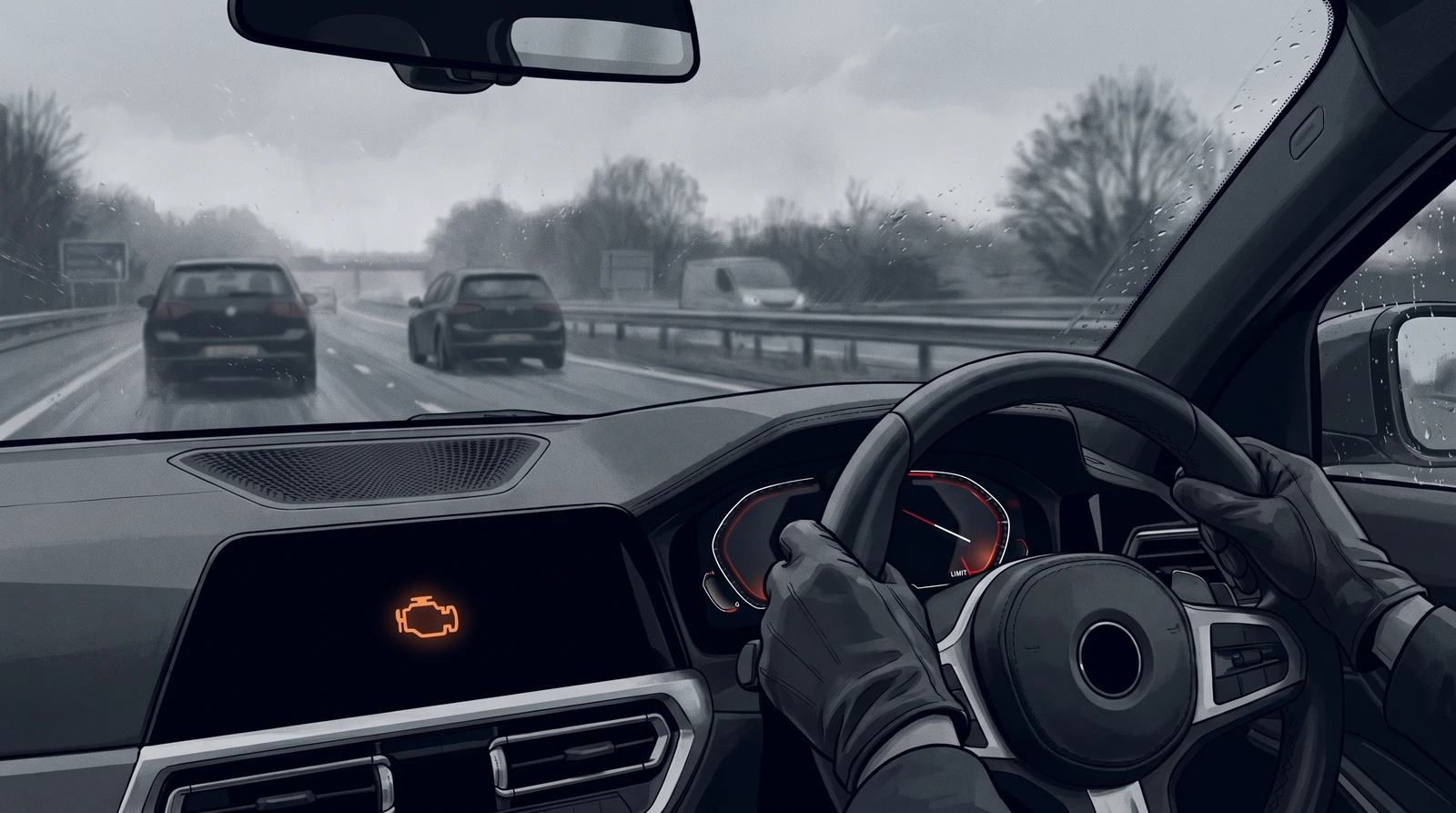
- Caps engine speed and throttle opening — the pedal stops meaning what it usually means.
- Forces idle in the worst case — the companion codes P2104, forced idle, and P2110, forced limited engine speed, name that state explicitly.
- Falls back to the spring position — with the motor unpowered the plate returns to a small default opening, enough to idle and little more.
- Arrives without warning — commonly from cold, at low speed, or partway into a journey.
- May clear on a restart — and come back. A car that switches in and out of limp mode has the same fault throughout.
So can you drive it? Our answer errs towards no, and the reason is specific. The hazard with a throttle fault is not that the car goes too fast; it is that it will not go when you need it to. Pulling out of a junction, joining a dual carriageway, or committing to an overtake with an engine that has just capped itself is a genuinely dangerous place to find out. If a throttle plate defaults closed the engine can also cut at low speed, taking your power steering assistance and brake servo effort with it.
If it has happened once, plan on it happening again. Keep off fast roads, do not start a long journey, and if the car has lost power in traffic, have it recovered rather than driven. There is a paperwork consequence too: an engine management lamp that stays on is an MOT failure, so the fault has a deadline attached to it whatever else you decide.
One thing not to do is clear the code to make the light go out. The stored fault carries freeze-frame data with it — engine speed, load, road speed, coolant temperature and battery voltage at the moment the check failed — and that snapshot is often what separates a cold-start electrical fault from a hot binding plate. Clearing it throws the evidence away and leaves you waiting for the fault to happen again.
Clean, sensor or unit: how the decision is made
This is the sequence that decides which of the three you are dealing with, in the order that costs least and proves most.
- Read everything, and write it down, before you clear anything.
Every stored and pending code, from every module, with the freeze frame. Which codes travel together tells you more than any single one of them. If U-codes come back in the same scan, sort those first — lost communication codes such as U0100 mean a module went quiet, and a list read through a network fault is not a reliable list.
- Check the connector and the harness before condemning the part.
Manufacturers’ own diagnostic paths put the connector, the pins and the wiring ahead of the throttle body, and they do that because it is so often where the fault is. Look for green corrosion, spread or backed-out terminals, and chafing where the loom crosses a bracket.
- Watch commanded against actual throttle angle in live data.
Sweep the pedal slowly with the ignition on and the engine running. Lag, a step, or a plate that will not hold position shows up immediately.
- Watch both position channels together.
They should move smoothly and in opposite directions with no cuts and no spikes. A dropout at one point of the sweep is a worn track; a difference that grows with heat is a joint on the sensor board.
- Clean, then relearn — and never skip the relearn.
Skipping the adaptation after cleaning recreates the code on a part that is now perfectly good, and that single omission condemns more sound throttle bodies than any actual failure.
- Judge only after that.
A code that survives a clean, a relearn and a sound connector is a genuine fault inside the unit, or upstream of it in the ECU’s driver stage.
Step four is where a bench beats a driveway. On a test rig the motor can be driven through its full sweep under load, both position channels logged against commanded angle, and the whole assembly held at temperature and vibrated while it runs — our units are tested on in-house Hardware-in-the-Loop platforms for exactly that reason, because the faults that matter here are the ones that only appear hot, cold or shaken. What comes out of that is a specific answer: a track, a motor winding, a gear train, the internal electronics, or a housing that needs cleaning and resealing.
One last check before you settle on the throttle body at all. A code names the check that failed, and more than one part of the intake can make the same check fail — an air-metering fault upstream produces symptoms that overlap closely, which is why the Nissan Micra K11 and K12 page covers throttle bodies and air mass meters together, and why the P0101 mass air flow code is worth ruling out if it is stored alongside. The full range of units we test and rebuild is on what we repair.
Throttle body fault code FAQs
Can I drive with a throttle body fault code?
Our advice is not to, beyond getting somewhere safe. These codes commonly bring limp mode with them, and the danger is not excess speed but the absence of it — an engine that caps itself as you pull out of a junction, or a plate that defaults closed and stalls the car at low speed, taking steering assistance and brake servo effort with it. If it has happened once, expect it again, stay off fast roads, and have the fault read.
Will cleaning the throttle body clear the code?
Sometimes, and it depends which code. Carbon round the plate and bore genuinely causes P0638 and contributes to P2101 and P0121, so a proper clean followed by the relearn procedure is the right first move for those. It will not fix P2135, because a disagreement between two sensor channels is not a deposit problem, and it will not fix a low-voltage code, which is a circuit problem. Clean first where cleaning is plausible, then judge.
Do I have to do a throttle relearn after cleaning or fitting a unit?
Yes, and it is the step most often skipped. The ECU stores a learned closed-throttle position, and cleaning the plate, disconnecting the battery or fitting a different unit all invalidate it. Without the adaptation the ECU is comparing live readings against a stale reference, so the code returns on a part that is now perfectly sound. Clean, relearn, then drive and re-read the codes — in that order, every time.
Which of these codes usually means the throttle body itself has failed?
P2135 more than any other. It reports that the two position channels inside the assembly no longer agree with each other, which cleaning cannot resolve and which on most units cannot be repaired by swapping a separate sensor. P2100 with an open motor winding is the other. P0638 is at the opposite end — it is the code most often cured by a clean and a relearn, and it is worth doing that before condemning anything.
Can something other than the throttle body set these codes?
Yes, and three possibilities are worth ruling out. The accelerator pedal carries its own sensor pair, and the generic definitions of P0221, P0222 and P2135 cover the pedal as well as the throttle. The wiring and connector between the two can produce every symptom the part does. And the output stage inside the engine ECU that drives the actuator motor can fail, in which case a new throttle body will not move either.
Can a throttle body be repaired, or does it have to be replaced?
Most can be repaired. The failures behind these codes are a worn sensor track, a motor winding or worn brushes, a gear train, the internal electronics, or a housing that needs cleaning and resealing — all of them things that can be put right on a bench by engineers doing circuit-level work, rather than reasons to buy a whole assembly. Repairing your own unit also keeps the original part matched to your car.
Sinspeed · mail-in repair
Not sure whether it is the throttle body or the wiring to it?Send us the stored codes, the vehicle details and what the car does when the fault appears, and our engineers will tell you what to send before anything comes off. Throttle bodies are stripped, repaired at circuit level, cleaned and resealed, then tested under simulated load and temperature before they go back.
Diagnosed, repaired and calibrated by an in-house team of electronic engineers and diagnostic specialists · Many units go back ready to fit
Final thoughts
The eight codes on this page describe eight different failed checks and one part. That is the useful thing to hold on to when a scanner hands you a five-character string and someone suggests a new throttle body.
Work in the order the codes themselves suggest. A low-voltage code points at a circuit before it points at a sensor, so the connector and the harness come first. An actuator range code points at a plate that could not move freely, so a clean and a relearn come first. A correlation code points at two channels inside one assembly that no longer agree, and that is the one where the unit itself is usually the answer.
The step that gets skipped is the relearn, and it is the reason sound throttle bodies get condemned. Clean the plate, run the adaptation, drive it, and read the codes again. Whatever survives that is a genuine fault in the unit or in the wiring to it — and at that point you know what you are dealing with instead of guessing.