
Summary: When the ABS and traction control lights come on together, the car has switched off anti-lock braking, traction control and, on most modern cars, stability control at the same moment. All three run through one ABS module and the same four wheel-speed signals, so a single fault in either takes the lot offline. Your ordinary braking still works, without the anti-lock assistance. The usual causes are a lost wheel-speed signal, low system voltage, a brake-light switch fault or a failing ABS module, and a fault code read tells you which way to look. Where the module itself has failed, your original unit is bench-repaired and returned ready to refit.
Two lamps, one module, usually one fault — and the code read decides which one, not guesswork.
- Why do the ABS and traction control lights come on together?
- Flashing, steady or switched off: reading the lamps
- What causes the ABS and traction control lights to come on?
- Is it safe to drive with the ABS and traction control lights on?
- Why a failing ABS module looks like a sensor fault
- By make: Ford Transit and Mercedes C-Class
- Repair or replace the ABS module, and what to send
- ABS and traction control light FAQs
- Final thoughts
Why do the ABS and traction control lights come on together?
Anti-lock braking and traction control are two jobs done by one unit. The ABS module — an electronic control unit mounted on a hydraulic block of valves and a pump — watches a speed signal from each of the four wheels. Under braking it uses those signals to stop a wheel locking. Under acceleration it uses the same signals to spot a wheel spinning, then brakes that wheel and asks the engine for less torque.
Stability control is a third job for the same hardware. Makers call it ESP, ESC, DSC or VSC, but the principle is shared: a steering angle sensor and a yaw-rate sensor let the module compare where you are steering with where the car is actually going, and it brakes individual wheels to pull the car back into line. Hill-start assist, where fitted, uses the same valves to hold brake pressure for a moment as you pull away. If you want the background first, we have explained what ESP does on a car and how an ABS pump works.
So when the module loses confidence in its own information — a wheel-speed signal it cannot trust, a supply voltage it cannot work with, or a fault inside itself — it does not switch off one function and leave the others running on bad data. It switches off everything that depends on that data and lights every lamp that goes with it. Two or three lamps arriving together is not two or three faults. It is usually one.
Flashing, steady or switched off: reading the lamps
Not every traction control lamp means something has failed. The pattern on the dash tells you which situation you are in before anyone plugs in a diagnostic tool.
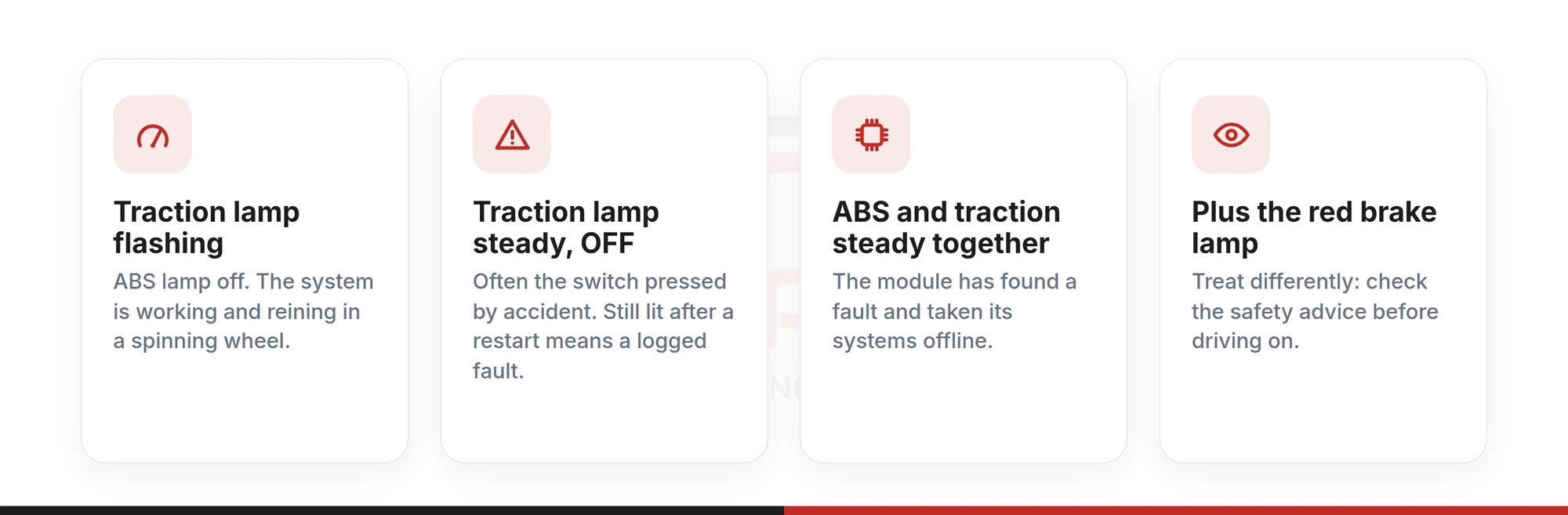
- Traction lamp flashing while you drive, ABS lamp off. The system is working, not failing. It has caught a wheel spinning on a wet, icy or loose surface and is reining it in. Ease off the throttle and the flashing stops.
- Traction lamp steady on its own, often with the word OFF. On many cars that is the traction control switch, pressed by accident. If the lamp is still lit after a restart and nobody has touched the switch, the system has logged a fault.
- ABS and traction lamps steady together, often with the stability lamp. The module has found a fault and taken its systems offline. This is the pattern the rest of this page deals with.
- Any of the above with the red brake warning lamp. Treat this one differently — the safety section below explains why.
One more behaviour catches people out. On many cars the lamps go out when the engine is switched off and restarted, then return a few miles later. The module re-runs its self-check at every start and only flags the fault again once it sees it again. A lamp that comes and goes is an intermittent fault rather than a cured one, and the stored code is still there to be read.
What causes the ABS and traction control lights to come on?
The causes below run roughly from the most common to the least. The order matters, because the commoner and cheaper causes are worth ruling out before anyone condemns the module — and the last column matters too, because half of these are jobs on the car and half are not.
| Cause | Why it lights both lamps | Clues on the car | Where it gets fixed |
|---|---|---|---|
| Lost wheel-speed signal — the sensor, its wiring, or the ring it reads | The module can no longer compare wheel speeds, so every function relying on them stops. | Lamps appear at low speed or soon after setting off; the code names one wheel; often follows hub, bearing or suspension work. | Your garage — sensors, rings and hubs are fitted on the car. |
| Low system voltage — tired battery, charging fault, recent jump start | The module shuts its functions down rather than run a brake intervention on an unstable supply. | Several unrelated lamps together, often after a flat battery or on a cold morning. | Your garage or an auto electrician. |
| Brake-light switch | The module uses the switch to know you are braking; a signal that disagrees with what it sees is flagged as implausible. | Brake lights stuck on or not working; lamps that appear as you brake. | Your garage. |
| Steering angle sensor (cars with stability control) | Stability control cannot run without a believable steering angle, and on many cars ABS and traction go offline with it. | The stability lamp leads; often appears after wheel alignment, battery disconnection or steering work, when the sensor needs calibrating. | Your garage — calibration is a diagnostic-tool job. |
| Lost communication with the ABS module | Other modules stop hearing it on the vehicle network, so the dash lights its lamps. | U0121 stored; speedometer may drop out; several lamps at once. | Power, earth and wiring first; the module if those prove sound. |
| ABS module fault — the control unit or its pump and valve block | The fault is inside the unit that runs every one of these systems. | Internal module, valve or pump-motor codes; or a wheel-sensor code on a sensor that tests healthy and returns after replacement. | Us — the module is a bench repair. |
Wheel-speed signals: the most common trigger
Each wheel has a sensor reading a toothed or magnetic ring that turns with the hub. It lives in the worst place on the car — behind the wheel, in road spray, salt and brake dust — and the signal can be lost in three places: the sensor, the wiring that flexes with the suspension, or the ring itself. A ring that has corroded, cracked or been damaged during bearing work produces a signal that drops out once every revolution, which the module reads as a wheel that keeps slowing and speeding up. Excess play in a worn wheel bearing has a similar effect. Our guide to how an ABS wheel speed sensor fault is diagnosed covers how a garage separates these.
Codes in this group name a wheel — front left, rear right and so on — and describe its signal as missing, erratic or implausible. That last word is worth noticing. Implausible means the module could read the signal but did not believe it, which points towards the ring, the bearing or the module’s own reading of the signal, rather than a sensor that has died outright.
Voltage, the brake-light switch and the steering angle sensor
An ABS module needs a steady supply to drive its valves and pump, and when voltage sags it shuts down rather than risk a half-working intervention. A battery near the end of its life, a charging fault or a jump start can leave stored codes in several modules at once. Once the supply has been proven good, a fresh read shows which of those codes are real.
The brake-light switch and the steering angle sensor are the two inputs most often overlooked. The switch tells the module you are braking, and when its signal disagrees with what the module sees, the systems switch off. The steering angle sensor only matters on cars with stability control, and it often needs calibrating with a diagnostic tool after alignment or battery work. That is a fitting step for your garage, and a common reason a stability lamp appears the day after a car has been in for other work.
Inside the ABS module
When the fault is in the module itself, it is usually the electronics rather than the hydraulics. The control unit is mounted on a pump and valve block that heats and cools with the engine bay, shakes with every pothole and switches heavy current through its valves each time it intervenes. Over enough miles that wear tells, and it shows up as internal fault codes, valve or pump-motor faults, or the misleading sensor faults described further down. Lost communication is its own topic — our page on ABS module no-communication faults sets out the order to check power, earth, wiring and unit, and the same order applies here.
Is it safe to drive with the ABS and traction control lights on?
Your ordinary brakes still work. The pedal pushes fluid to the calipers through the hydraulic block whether the module is working or not, so the car will stop. What you have lost is everything that happens on top of that: the wheels can lock under hard braking, the car can slide if you steer during an emergency stop, and nothing will catch a wheel spinning or the back of the car stepping out on a wet roundabout.
That makes the car drivable with care, to a garage, in normal conditions — longer gaps, gentler braking, extra caution in rain or frost. It does not make it something to live with. These systems exist for the one moment nobody can predict.
- The red brake warning lamp is lit as well. It can mean low brake fluid, or that the car has also lost electronic brake-force distribution, which balances braking between the front and rear axles.
- The brake pedal feels soft, long or different from how it normally feels.
- The ABS unit keeps running or you hear it buzzing with your foot off the brake.
- The steering has gone heavy at the same time as the lamps came on.
The MOT side is simpler. An ABS warning lamp that stays lit is an MOT failure, and our page on whether the ABS light is an MOT fail sets out what the tester checks. Clearing the code shortly before a test only hides a fault that is still there.
Why a failing ABS module looks like a sensor fault
This is the fault that costs owners the most, because the evidence points the wrong way. The module does not simply receive wheel-speed signals; it reads and interprets them. If the part of the module that reads one wheel’s signal starts to fail, the module has no way of knowing the problem is its own. It sees a bad signal from that wheel and stores a code blaming that wheel’s sensor.
So the sensor gets replaced. The codes are cleared, the lamps go out, and a few days later they are back. Then the wiring is checked and found sound, the ring is inspected and found clean, and sometimes a second sensor goes on. Every part on the car tests healthy because every part on the car is healthy.
Three patterns point at the module rather than the wheel:
- The same wheel’s code returns after a new sensor, with the wiring to it proven sound.
- The fault moves between wheels, or names more than one wheel with no shared wiring or common cause.
- The fault appears when the engine bay is hot or on rough roads, and disappears once the car has cooled.
On the car, a sensor fault and a module fault produce the same code, and reading it again will not separate them. The bench answers the question directly. We feed the module simulated wheel-speed signals on our in-house Hardware-in-the-Loop platforms, at the speeds and patterns a real drive produces, while heat, vibration and load are applied. A module that misreads a clean, known signal has proved the fault is its own. One that reads every channel correctly under those conditions sends the search back to the car — and we tell you that rather than repair a unit that is not at fault.
Sinspeed · ABS module repair
New sensor fitted and the lamps came back?That is the pattern that points at the module. Tell us the codes, which wheel they named and what has already been replaced, and our engineers will tell you whether the ABS unit is worth sending before anything else is bought.
Bench-tested on in-house HIL platforms under heat, vibration and load · Lifetime, unlimited-mileage warranty on most remanufactured parts
By make: Ford Transit and Mercedes C-Class
The lamps and the wording on the dash differ from maker to maker. The system underneath does not. Two vehicles bring more owners to this question than most, and each has its own way of presenting the same fault.
Ford Transit: ABS, traction control and hill-start assist lights together
On a Transit the warnings usually arrive as a set of three: ABS, traction control and hill-start assist. The third one confuses people, but it follows directly from how the van works. Hill-start assist holds brake pressure for a moment as you pull away on a slope, and it does that with the ABS module’s valves. When the module has taken itself offline, hill-start assist goes with it. A van showing all three has one fault, not three.
The causes run in the same order as on any other vehicle, but a working van tends to make them more likely: high mileage under load is hard on hubs, sensors and wiring alike. A loom that has chafed through on a working van can take the ABS module off the network altogether, which stores a lost-communication code rather than a sensor code. If other lamps are lit on the dash at the same time, our guide to Ford Transit warning lights explains what each one means.
Where the module itself is at fault, a Transit ABS unit is repaired like any other. It comes off at your garage, comes to us for testing and repair, and once refitted the van has its brakes bled and the system checked with a diagnostic tool — part of the job, not an extra.
Mercedes C-Class: ABS, BAS and ESP inoperative
Mercedes words the fault rather than just lighting a lamp. A C-Class with a fault in this system typically shows messages such as ABS inoperative, ESP inoperative or BAS inoperative on the instrument display, alongside the matching lamps. BAS is Brake Assist, the function that recognises an emergency stop from how quickly the pedal is pressed and adds full braking force. Like ABS and ESP, it is controlled by the same ESP control unit, which is why the messages tend to appear together.
The usual suspects are the same as on any car: a wheel-speed signal, low voltage, the brake-light switch, and the steering angle sensor, which can need calibrating after battery or steering work. A single lost wheel-speed signal is enough to switch off ABS together with every function that depends on it, so one sensor fault can produce all three messages at once. So can a fault in the ESP control unit itself.
If the messages persist once the supply, the switch and the sensors have been proven sound, the control unit is the next suspect — and it is a repairable unit, not a part that has to be bought new.
Repair or replace the ABS module, and what to send
If the diagnosis has landed on the module, there are three routes, and only one of them deals with the fault rather than moving it around.
- A new unit from the dealer. It works, but it usually has to be coded to the car, and it is built to the same design as the one that failed.
- A used unit from a breaker. It is the same age as yours, with an unknown history, and often needs coding too. You may be fitting the next fault.
- Repairing your own unit. The original module is diagnosed, repaired and tested, with its known weak points reinforced rather than reproduced. It keeps its match to your car, many go back on with no coding required, and most remanufactured parts carry a lifetime, unlimited-mileage warranty. This is our ABS pump and module repair service.
What to send, and how it works
On most cars the electronic control unit and the hydraulic block come off as one assembly, and that complete unit is what we need unless we have told you otherwise for your vehicle. Removing it means opening the brake lines, so it is a job for your garage, and after refitting the system is bled and checked with a diagnostic tool. Both are normal fitting steps your garage will already plan for.
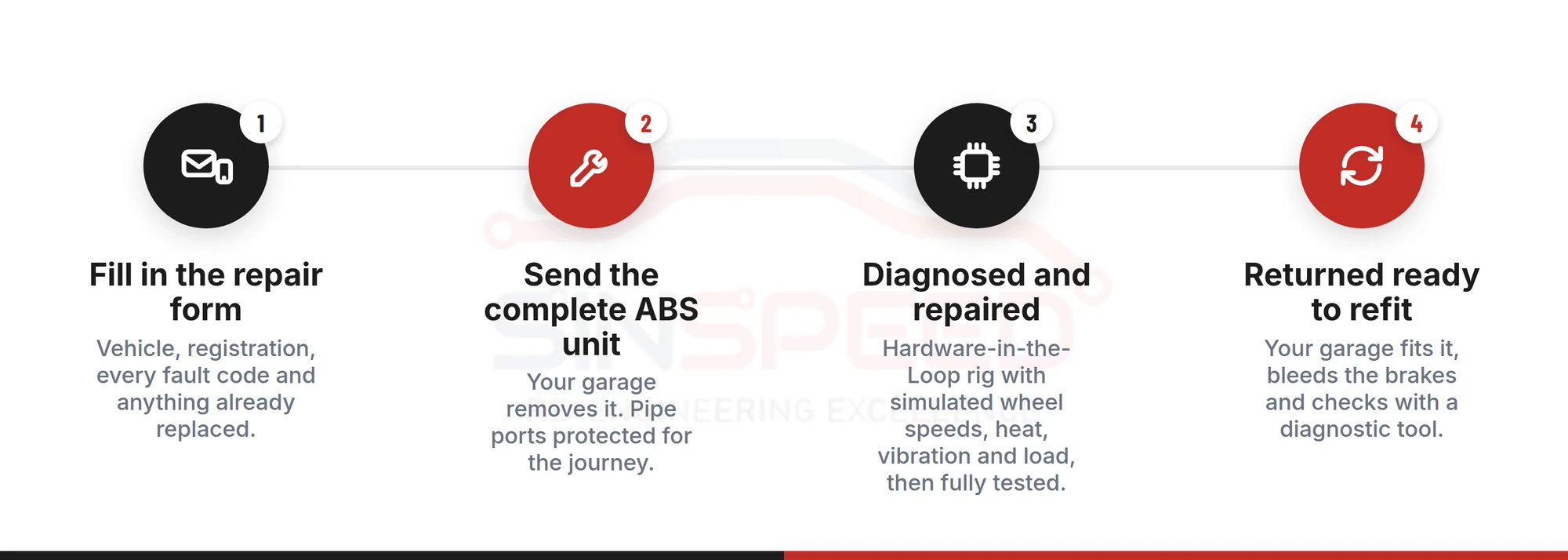
- Fill in the repair form
Give us the vehicle and registration, every fault code and which wheel or module it named, and anything already replaced. The repair form takes a few minutes.
- Send the complete ABS unit
Pack it with the form, with its pipe ports protected so nothing gets in while it travels.
- We diagnose and repair it
The unit is driven on our Hardware-in-the-Loop platforms with simulated wheel-speed signals, heat, vibration and load, repaired, and put through a full functional test before dispatch.
- It returns ready to refit
Your garage fits it, bleeds the brakes and checks the system with a diagnostic tool.
Tell us about any work done on the wheels, hubs or brakes just before the lamps appeared. A fault that started the week after a bearing was changed is a different investigation from one that crept in on a cold morning, and it is often the most useful line on the form.
ABS and traction control light FAQs
Is it safe to drive with the ABS and traction control lights on?
Carefully, and to a garage, in most cases yes. Your ordinary brakes still work, but without anti-lock or traction assistance, so leave longer gaps and brake gently. If the red brake warning lamp is lit as well, the pedal feels soft or different, or the steering has gone heavy at the same time, stop and have the car checked before driving any further.
Will the ABS and traction control lights fail an MOT?
An ABS warning lamp that stays lit is an MOT failure. Our guide on whether the ABS light is an MOT fail explains what the tester looks at. Clearing the code shortly before a test only hides a fault that is still there, and the module will flag it again once it re-runs its checks.
Can a bad battery cause the ABS and traction control lights to come on?
Yes. The ABS module switches its functions off when supply voltage drops below what it needs to work safely, so a weak battery, a charging fault or a recent jump start can bring both lamps on, often alongside lamps from other systems. Have the battery and charging proven first, then read which codes remain — those are the real fault.
Can low brake fluid or worn brake pads cause it?
Low brake fluid normally lights the red brake warning lamp rather than the ABS pair, and it usually means worn pads or a leak — both worth having checked straight away. Worn pads on their own are not a usual cause of an ABS fault code, although work done near the wheel to replace them can disturb a sensor or its wiring.
Why do the ABS and traction control lights come on and then go off again?
The module re-checks the system every time the car starts. An intermittent fault — a signal that drops out over bumps, or a unit that misbehaves only when the engine bay is hot — passes the check at start-up and is flagged again when the module next sees it. The code is stored either way, so have it read while the pattern is fresh.
How do I know whether it is the wheel-speed sensor or the ABS module?
The fault code alone cannot tell you, because a failing module blames the sensor whose signal it can no longer read properly. A code that returns after a new sensor, moves between wheels or follows engine-bay heat points at the module. Bench testing settles it: the module is given a known, clean signal and either reads it correctly or does not.
Does a repaired ABS module need coding to the car?
In many cases no. Your own unit goes back with its match to the car intact, so it refits as a direct replacement for itself. The brake system is bled and checked with a diagnostic tool after refitting, which is a standard part of fitting any ABS unit.
Sinspeed · ABS, traction and stability systems
Both lights on and the codes do not add up?Send us the fault codes, the vehicle details and what has been tried so far. Our engineers will tell you whether the ABS module is the part to send — and if the evidence points at a sensor or a switch on the car instead, you will hear that first.
Cleanroom-standard, ESD-safe workshop · Dealer-level tools for programming and calibration · Many units returned ready to fit
Final thoughts
Two lamps, one module, one question: what made it stop trusting its own information? Most of the time the answer is on the car — a wheel-speed signal, the battery, a switch — and those are worth ruling out first because they are commoner and cheaper.
The expensive mistake runs the other way. A failing module that presents as a sensor fault can eat through several new sensors before anyone looks at the unit doing the reading. If the same code keeps returning on parts that test healthy, stop buying parts and have the module tested.
And until it is sorted, drive as though the car has no anti-lock brakes and no stability control — because for now, it does not.