
Summary: A steady ESP light means the car’s stability control has found a fault and switched itself off, so it will not step in if the car starts to skid. A light that flashes briefly while you drive is normal: the system is braking a wheel to hold your line. A steady light needs the fault code read soon. If that code leads to the ABS/ESP unit, the unit can be repaired rather than replaced, and that is our work.
- ESP light on: what does it mean?
- Steady, flashing or ‘ESP OFF’: reading the light
- Is it safe to drive with the ESP light on?
- Why the ESP and ABS lights come on together
- What causes the ESP light to stay on?
- What is ESP, and how does it work?
- Should you drive with ESP on or off?
- When the fault is the ABS/ESP unit
- What decides the cost of an ESP repair?
- ESP light FAQs
- Final thoughts
ESP light on: what does it mean?
The ESP warning lamp is amber or yellow and usually shows a car with two wavy skid marks behind it. Some makers label the same system ESC, DSC, VSC or VSA. It lights briefly each time you switch the ignition on, while the system checks itself, and then goes out.
After that, the lamp says one of three things. A short flicker on the move means ESP is working. A lamp that comes on and stays on means the system has been switched off, or has found a fault and shut itself down. A separate lamp marked OFF, where your car has one, means the ESP OFF button has been pressed.
Steady, flashing or ‘ESP OFF’: reading the light
The state of the lamp matters more than the symbol. Each one reads differently:
| What you see | What it means | What to do |
|---|---|---|
| Lights at start-up, then goes out | The system checking itself | Nothing |
| Flashes briefly while you drive | ESP is braking a wheel and easing engine power to stop a slide | Ease off and drive for the conditions |
| Flashes on a dry, straight road with no slip | It may be reacting to false sensor readings | Have it checked, even if it comes and goes |
| Steady, and the ESP OFF button has not been touched | A fault: stability control has switched itself off | Drive gently and have the code read soon |
| Steady after you pressed ESP OFF | Switched off on purpose | Press it again; on many cars ESP also returns at the next start |
| Stays on whatever you do with the button | The system has shut itself down because of a fault | Treat it as a fault, not a setting |
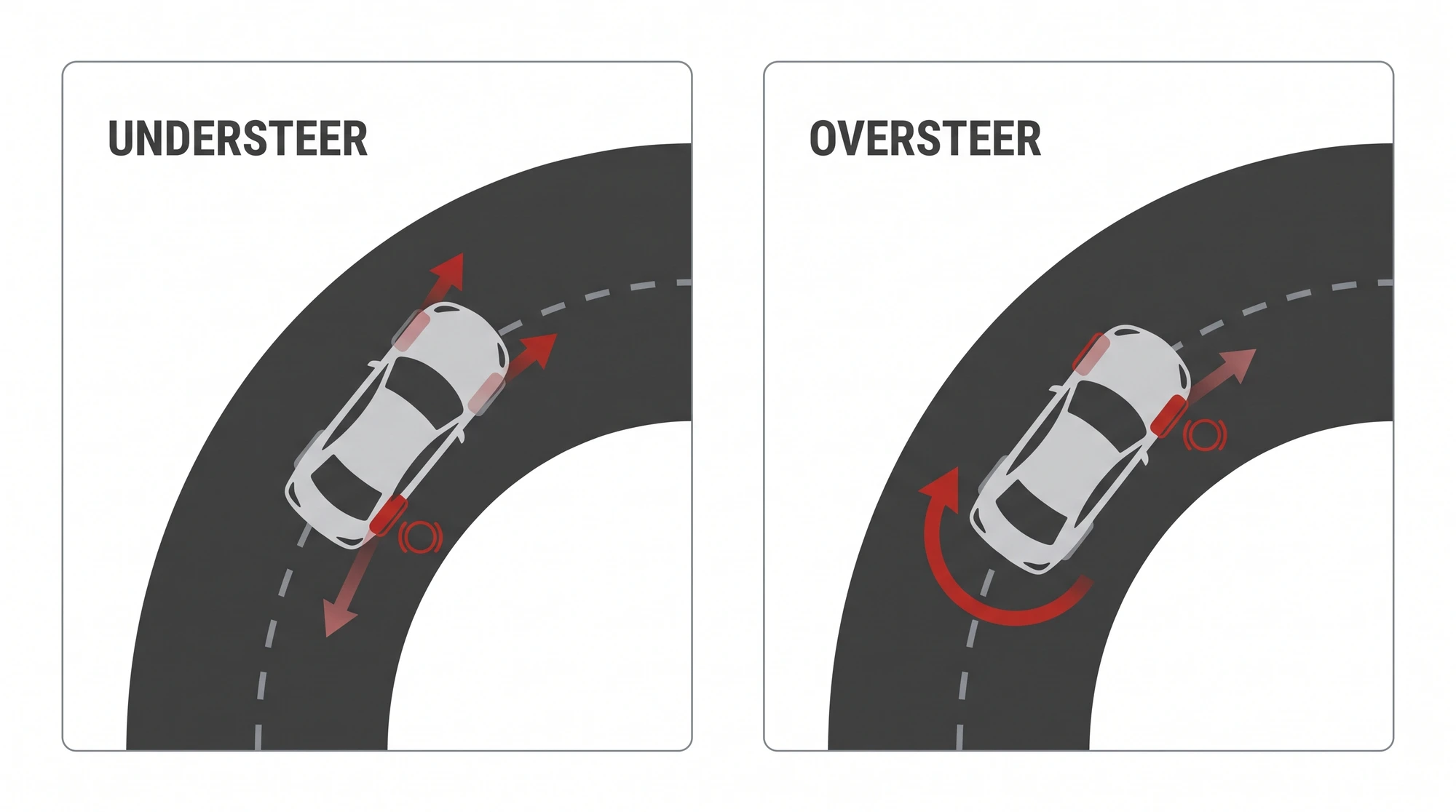
When the lamp flashes, this is what ESP is correcting: the front of the car running wide of your line, or the back stepping out.
Is it safe to drive with the ESP light on?
Usually, as far as a garage and with care. The car still steers and brakes normally. What it has lost is the skid protection that matters most in the wet, on ice or in a sudden swerve.
If the ABS lamp is lit as well, anti-lock braking may be off too. The brakes still work, but the wheels can lock under hard braking, so leave far more distance than usual.
Stop rather than drive on if the red brake warning lamp lights or the pedal feels different. That points at the brakes themselves, not at stability control.
A stability or ABS lamp that stays lit can also fail the MOT.
Why the ESP and ABS lights come on together
ESP is built on the ABS. It reads the same wheel speed sensors, works through the same hydraulic unit and is run by the same control module. When one of those parts reports a fault, the module switches both functions off and lights both lamps, often with the traction control lamp beside them.
Most double warnings come from a wheel speed sensor, a brake pressure sensor fault or the ABS/ESP unit itself, and the stored code tells them apart. Before anyone thinks about resetting an ABS light, have that code read: clearing it turns the lamps off without touching the cause.
Where the third lamp is traction control, the same shared hardware sits behind it; our page on the ABS and traction control light on covers that pairing.
What causes the ESP light to stay on?
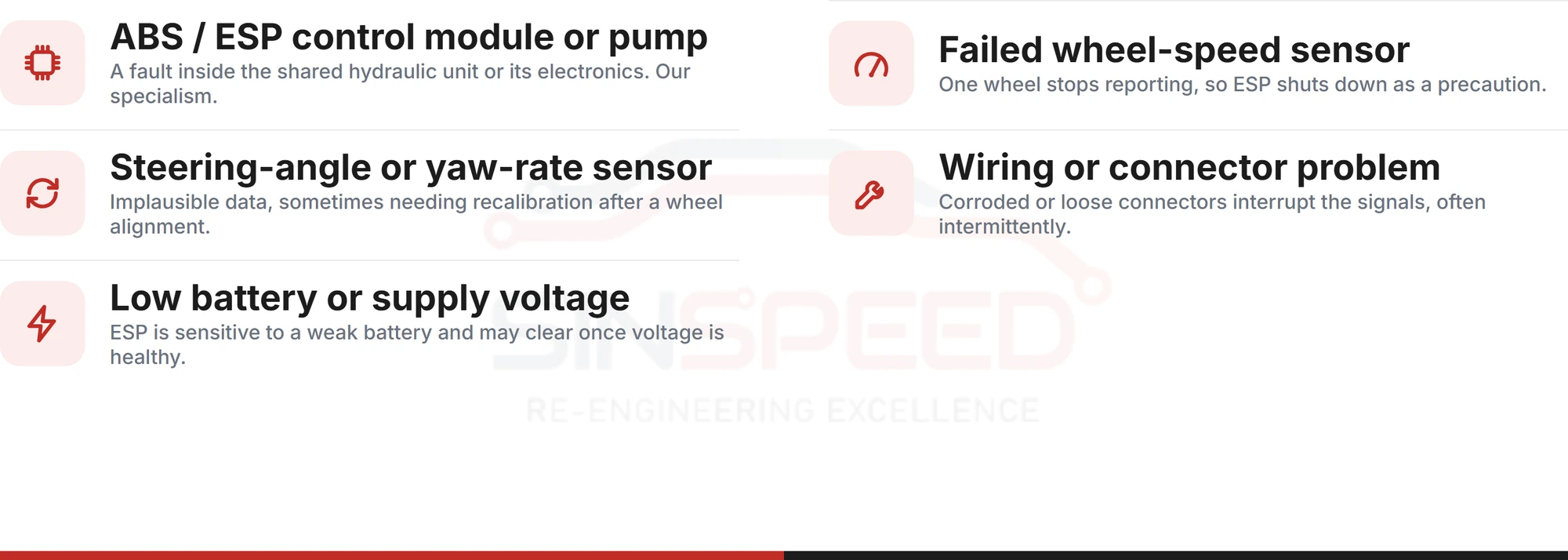
A steady lamp can start anywhere in the chain the system relies on. The usual sources are:
- A wheel speed sensor. Each wheel reports its speed to the control module. If one reading drops out, ESP cannot judge a slide and shuts down as a precaution.
- The steering angle sensor. It tells the system where you are steering. Failed, or out of calibration after steering, suspension or alignment work, it disagrees with the car’s movement and ESP flags a fault.
- The brake pressure sensor. The module uses it to judge how hard you are braking. On many cars it sits inside the ABS/ESP unit, so a brake pressure sensor fault becomes a unit repair.
- The brake light switch. The module checks the switch against the pressure reading. If the two disagree, it logs a fault.
- Low battery voltage. A weak battery can bring the lamp on, and it may clear once the supply is healthy again.
- The ABS/ESP unit. The module and pump that do the work. Engine-bay heat, vibration and constant pressure cycles wear on it, and a fault inside disables ESP and ABS together.
Damaged wiring, a yaw-rate sensor fault or uneven tyre pressures can light the same lamp. That is why the code comes first: replacing sensors on a guess is how an ESP fault gets expensive without ever being fixed.
What is ESP, and how does it work?
ESP stands for Electronic Stability Program, a computer-controlled safety system that steps in the moment your car begins to lose grip. It is badged ESC (Electronic Stability Control), DSC (Dynamic Stability Control) on BMW, VSC on Toyota or VSA on Honda; the name changes, the job does not. It has been compulsory on all new cars sold in the UK and EU from November 2014.
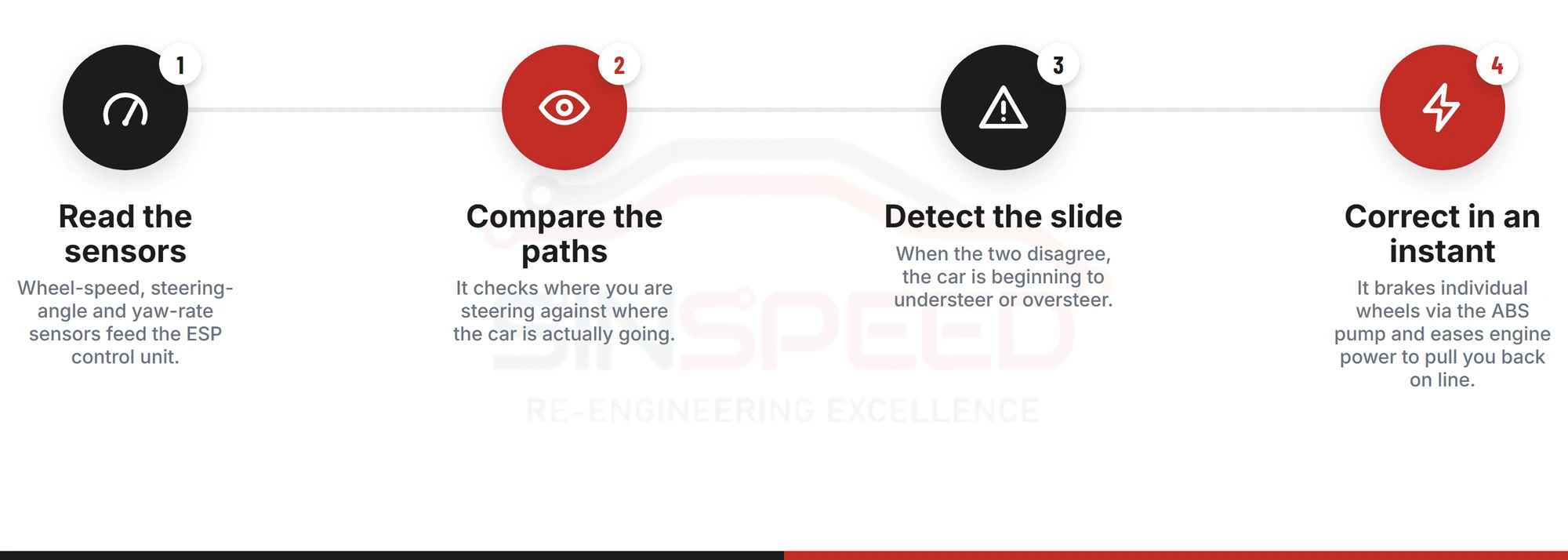
It reads three inputs: the wheel speed sensors, which ABS also uses; the steering angle sensor, for where you are pointing the front wheels; and a yaw-rate sensor, for how much the car is actually rotating. Many times a second it compares where you are steering with where the car is going.
When the two disagree, because the front is washing wide or the back is stepping out, ESP brakes individual wheels through the ABS pump and can ask the engine to ease off, far faster than any driver could react.
Should you drive with ESP on or off?
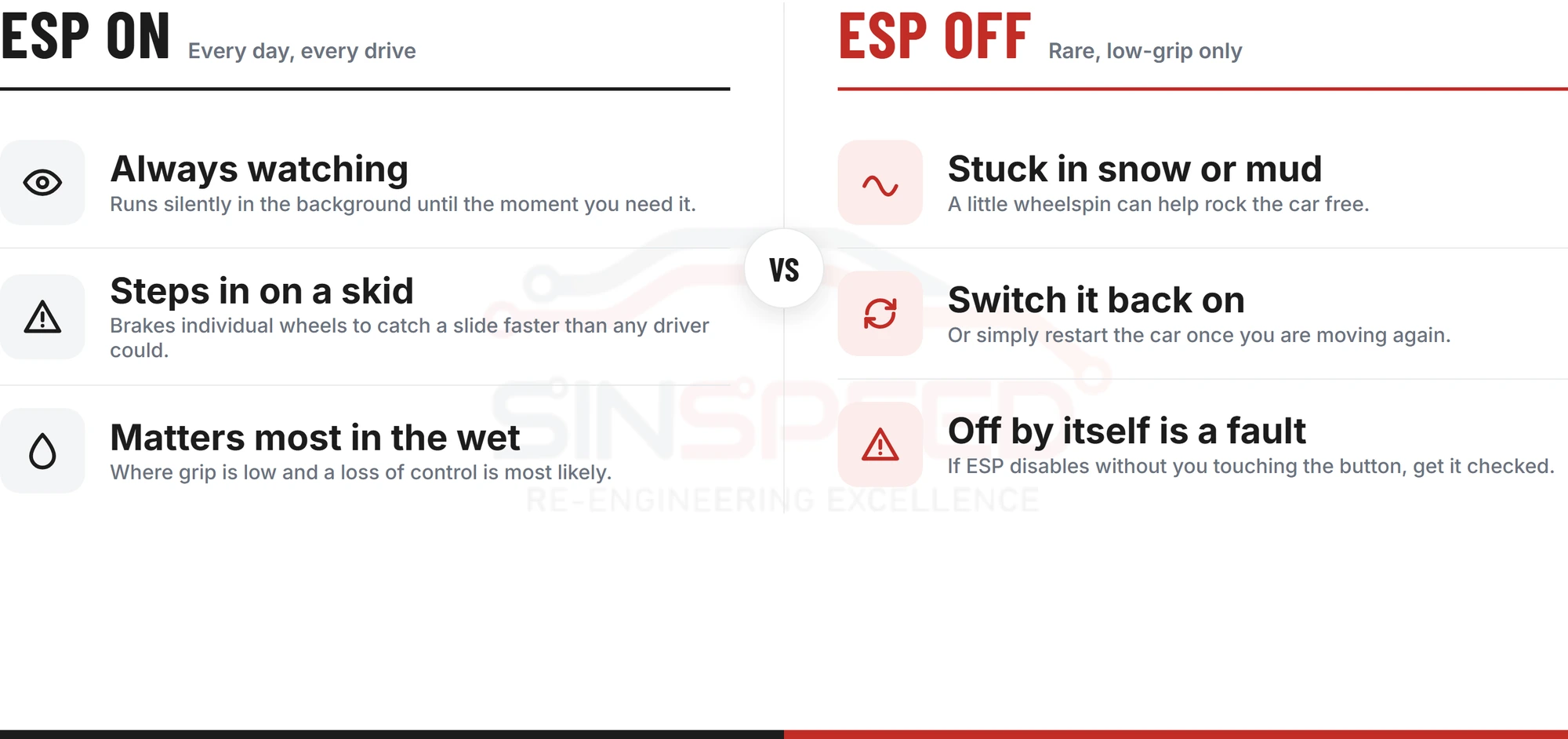
For everyday driving, leave ESP on. It works in the background until the moment you need it.
The ESP OFF button is for the rare times a little wheelspin helps, such as rocking the car free in snow, mud or soft sand. Switch it back on once you are moving. If ESP turns itself off without you touching the button, that is a fault, not a setting.
When the fault is the ABS/ESP unit
Some codes point past the sensors to the unit: brake pressure codes where the sensor is sealed inside it, valve or pump circuit codes, or a scan tool that cannot reach the ABS module at all. Warnings that come and go for weeks before settling in fit the same pattern.
Three of our pages take it further:
- Bosch 8.0 ABS/ESP module repairs: a unit fitted across a very wide range of cars, from Audi, BMW and Ford to Mercedes-Benz, Peugeot and Volkswagen, with its common codes.
- The brake pressure sensor fault page: the codes each make stores, and why the sensor is part of the unit on ATE/Teves MK60 cars.
- Suzuki ESP light and C1028 fault: the internal pressure sensor failure that leaves the ESP OFF button doing nothing.
Your car does not need to come to us. Your garage removes the unit and posts it to our Epsom workshop, where it goes onto a Hardware-in-the-Loop rig that recreates road heat, vibration and electrical load, so an intermittent fault is caught here rather than after refitting. Our engineers repair it, test it again and send it back. It is the unit your car already had, so its coding is still on it; your garage bleeds the brakes and clears the codes when it goes back in. Every unit we cover is listed under ABS and ESP unit repairs.
Sinspeed · ABS/ESP units
Has the scan named the ABS/ESP unit?Send us the code as the scan tool words it, the registration and the part number off the unit. We will say whether the unit is the likely cause before your garage takes it off.
Road heat, vibration and load recreated on our own test rigs
What decides the cost of an ESP repair?
Nobody can price an ESP repair properly until the code has been read, because the lamp can mean anything from a tired battery to the ABS/ESP unit. Four things decide the bill:
- What the code points at. The scan narrows a long list of possible causes to one area, and that sets everything else.
- Sensor or unit. A wheel speed sensor or brake light switch outside the unit is a smaller job than a fault inside the ABS/ESP unit.
- Repair or replace. A failed unit can be swapped for a new or used one, or your own can be repaired. A used unit comes with an unknown history.
- Coding and calibration. A replacement unit has to be programmed to the car before it works properly; a repaired original keeps its coding. A steering angle sensor may need calibrating after steering or alignment work.
Diagnosis first is what keeps the bill down, because it stops you paying for parts that were never the problem.
ESP light FAQs
Is it safe to drive with the ESP light on?
Usually you can drive carefully to a garage, but the car has lost its skid protection, and if the ABS light is on as well, ABS may be off too. Ordinary braking still works. Drive smoothly, allow extra distance in the wet or on ice, and get the fault code read soon.
Why are the ESP and ABS lights on together?
ESP is built on the ABS system. It uses the same wheel speed sensors, the same hydraulic unit and the same control module, so when one of them reports a fault the car switches both functions off and lights both lamps. A wheel speed sensor, a brake pressure sensor fault or a failed ABS/ESP unit are the usual causes.
What causes the ESP light to stay on?
The common causes are a faulty wheel speed sensor, a steering angle sensor that has failed or lost its calibration, a brake pressure sensor fault, a brake light switch fault, low battery voltage, or a failed ABS/ESP control unit. The fault code tells them apart, so have it read before replacing anything.
Does pressing the ESP OFF button clear the light?
No. The button switches the system off on purpose, and on many cars brings up its own ‘ESP off’ lamp. If the warning stays on whatever you do with the button, or the button does nothing at all, the system has shut itself down because of a fault and the button cannot override it.
Can an ESP fault be repaired?
Yes. When the fault code points at the ABS/ESP unit rather than a sensor, the unit can usually be repaired instead of replaced. Your garage removes it and posts it to us; we test it, repair it and send it back. Send your fault code and part number through our repair form to get started.
Sinspeed · ESP warning light
Steady ESP light, and a code that names the unit?Use the repair form to send us the code and the car’s details. Your garage takes out the ABS/ESP unit and posts it to us, and the car stays where it is while we repair the unit it came with.
Lifetime, unlimited-mileage warranty on all remanufactured units · Cleanroom-standard, ESD-safe workshop · Electronic and hydraulic engineers in-house
Final thoughts
The ESP lamp speaks in two voices. A flicker on a wet roundabout is the system earning its place; a steady glow is the same system telling you it has stood down. Knowing which one you are looking at is the first step.
When it is the steady one, the fault code decides everything that follows: a sensor, a switch, the battery or the unit. Have it read and keep a note of it. If it names the ABS/ESP unit, repairing the one already matched to your car is the direct way back to working stability control.