
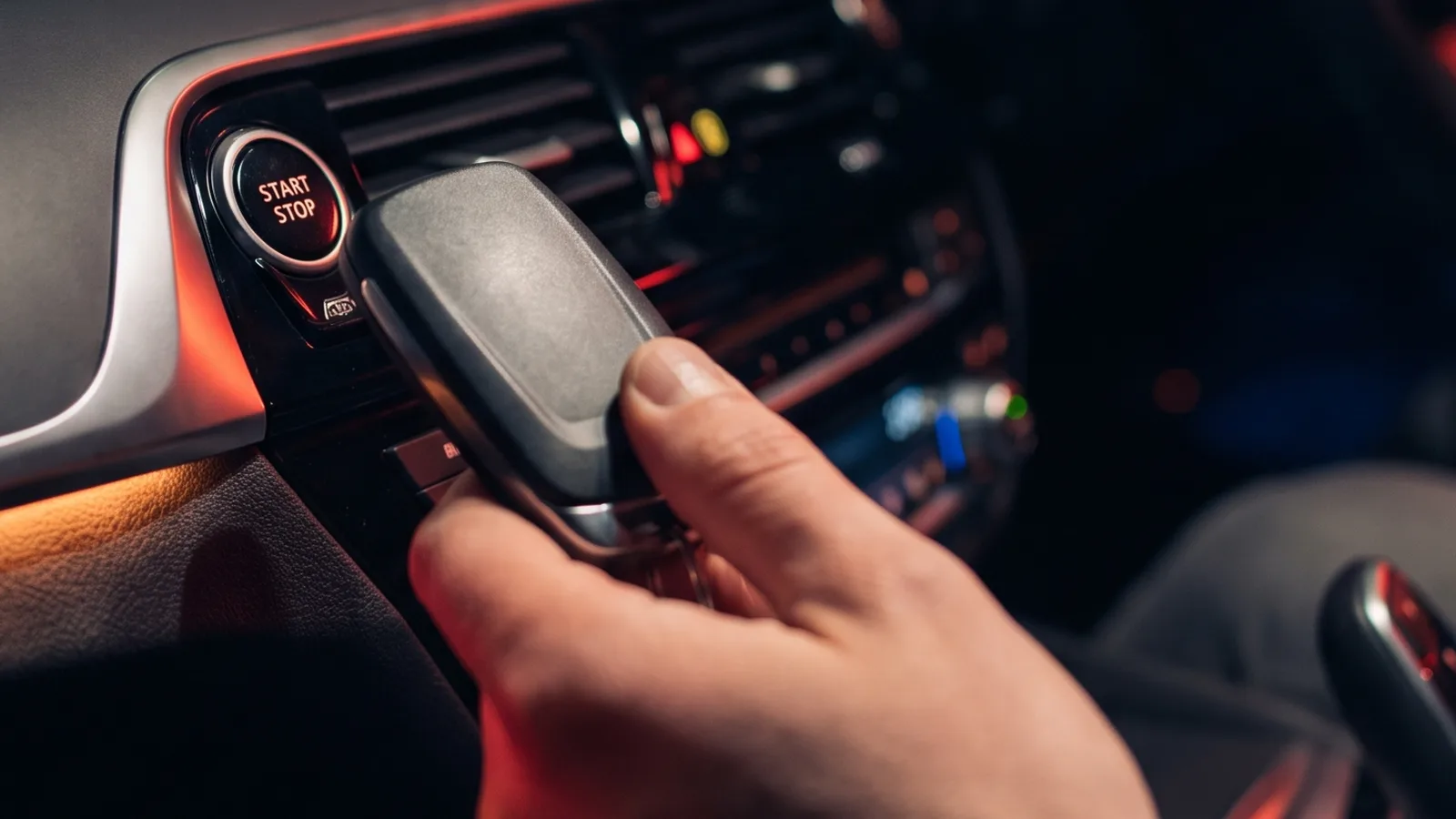
Summary: If your BMW cranks but won’t fire — or won’t crank at all — with a healthy battery, the Car Access System (CAS) is a prime suspect. This guide explains what the CAS does, how to tell a genuine CAS fault from a flat battery or key problem, why the module fails, and how a failed unit is repaired with your keys and coding kept intact.
In this guide
- What the BMW CAS (Car Access System) actually is
- Symptoms of CAS failure
- Is it actually the CAS? Safe first checks
- CAS generations and which BMWs and MINIs use them
- Why CAS modules fail
- How a CAS fault is diagnosed and repaired
- FAQs
What the BMW CAS (Car Access System) actually is
The Car Access System — CAS — is the electronic gatekeeper between your BMW key and its engine. It is the immobiliser and ignition-authorisation module rolled into one, and until it confirms that the key belongs to the car, nothing happens: no start, and often no crank.
Inside every BMW key is an integrated transponder chip, and around the ignition lock sits a coil ring, or loop antenna. The chip carries no battery of its own — the coil energises it when the key is present, and the key’s data is read by the CAS control module.
If the key is valid, the CAS does two things at once. It sends an enable signal to the starter, and it passes a rolling random code to the engine control unit — the DME on petrol engines, the DDE on diesels. The DME or DDE checks that code against the value it has stored, and only when the two match is fuel injection released and the engine allowed to start.
Crucially, the CAS holds security and configuration data that is married to your specific vehicle. That is why a unit cannot simply be lifted out of another car and dropped into yours — and it is the single fact that shapes how a CAS fault is properly fixed. Earlier BMWs, before the CAS, used a system called EWS — a different module entirely.
Symptoms of CAS failure
A CAS rarely dies cleanly. More often it warns you first, with faults that come and go before the car finally refuses to start. The signs we see most often are:
- No crank, no start — you turn the key or press the button and nothing happens, even though the battery is healthy.
- Intermittent starting — the car is fine for a week, then dead, then fine again.
- Key not recognised — a key-not-detected message, or the immobiliser warning light staying on.
- Starts then stalls — the engine catches for a second and cuts out as authorisation drops.
- No communication with the module — a diagnostic scan tool cannot talk to the CAS at all.
- Electrical gremlins — erratic central locking, the alarm triggering on its own, or warning messages appearing and clearing for no clear reason.
If there is one pattern worth singling out, it is the intermittent one — and especially a fault that behaves when the car is cold and plays up once it has warmed through. Owners tend to dismiss a car that starts on the second or third try, but that is precisely the early stage of CAS failure. The time it finally leaves you stranded is rarely a convenient one.
It is also worth noting how the car fails. A dead, no-crank BMW with a healthy battery points one way; a car that cranks over briskly but never fires points another. We come back to that distinction in the next section, because it is central to telling a CAS fault apart from the simpler things it can mimic.
Is it actually the CAS? Safe first checks
Before you assume the worst, rule out the simple things — a surprising number of suspected CAS failures turn out to be something cheaper and easier to fix.
Start with the battery. A weak or flat battery can mimic almost every CAS symptom: no crank, intermittent starting and electrical oddities all appear when voltage is low. A battery that reads fine at rest can still collapse under the load of cranking, so a proper voltage and load check — not just a glance at the dashboard — is the first step.
Try the spare key. Because the fault can sit in the key’s transponder or the coil that reads it, swapping to your second key is a quick, no-cost test. If the car starts reliably on the spare, the problem may be the first key rather than the module.
Then look at how the car behaves. If it cranks over normally but will not fire, the CAS may be authorising the starter while failing the rolling-code handshake with the DME or DDE. If it will not crank at all with a known-good battery, the fault sits earlier in the chain. Neither result is a home diagnosis on its own, but both help a specialist narrow things down quickly.
The tell-tales that point firmly at the CAS are the warm-up pattern described above, a key the car intermittently refuses to recognise, and a scan tool that cannot communicate with the module. When those line up — and the battery and spare key have been ruled out — the right next step is to have the unit tested rather than to keep guessing. If you are not yet sure the immobiliser is involved at all, our guide on whether a no-start is your immobiliser walks through the wider picture.
CAS generations and which BMWs and MINIs use them
The CAS has been through several generations, and getting the right one matters — the modules are not interchangeable. We repair all of the generations below.
CAS2 was the second generation, fitted to mid-2000s cars: the 1 Series (E81/E87), 3 Series (E90/E91), 5 Series (E60/E61), 6 Series (E63/E64) and early-to-mid-2000s X and Z models. If yours is a CAS2, the dedicated BMW CAS2 immobiliser module repair service covers it.
CAS3 was the third generation, fitted from the mid-2000s through to around 2014, across BMW and MINI alike. Common platforms include the 5 Series (E60/E61), 3 Series (E90/E91/E92/E93), 1 Series (E81/E82/E87/E88), X5 (E70), X6 (E71), Z4 (E89) and MINI (R55/R56). CAS3 work is handled on our CAS3 immobiliser repair page.
CAS3+ is a later CAS3 variant with an additional level of security encryption. The repair principle is the same, but correct identification matters — which is why the exact variant is always confirmed before any work begins.
CAS4 and CAS4+ are the later, F-chassis generation fitted to more recent BMWs. We repair these too, confirmed from the unit itself rather than assumed from the year. There is no separate CAS4 page to send you to, so CAS4 work runs through our immobiliser repair category and the repair form.
One word of caution on age. Around 2006 to 2007, some cars left the factory with CAS2 and others with CAS3, and the cut-off varies by model. Do not assume the generation from the registration year alone — it is confirmed from the part number, the chassis and build date, or a diagnostic read.
Why CAS modules fail
Heat is the primary reason CAS modules fail. The unit endures constant heat cycling — warming and cooling with the car — and over time that takes a toll on the electronics. The electronics drift out of specification, and the board itself fatigues as it repeatedly expands and contracts. The result is the classic signature: a module that works when cold and fails once the car is warm.
Heat is not the only culprit. Water ingress and corrosion can attack the board. Overvoltage — from a careless jump-start or a failing alternator — can damage components in an instant. And the internal software can be corrupted by botched key programming or an update interrupted with the wrong tools. Data corruption is real, but it sits among the secondary causes rather than the headline; in the units we see, heat does most of the damage.
On a diagnostic read, a failing CAS often stores a recognisable set of codes — A0A9 for a control-unit fault, A0B4 around engine start, and A0BE, A0BF or A0C0 on the Terminal 15 outputs, with the CAS 14 to 17 range covering door-open signals. The tell-tale combination is A0A9 alongside one or more Terminal 15 codes, frequently surfacing once the car is warm. Treat codes as a guide to the area at fault rather than a guaranteed single diagnosis.
How a CAS fault is diagnosed and repaired
The first job is to confirm it really is the CAS, and not the battery, a key or the DME/DDE. That is done on the bench, not by swapping parts on the driveway. A genuine fault is verified before any repair is quoted, so you are never paying to replace a healthy module.
Because the fault is so often heat-related, the unit is tested on bespoke in-house Hardware-in-the-Loop rigs that simulate real-world heat, vibration and load — the conditions that make an intermittent fault reveal itself. A module that only misbehaves when hot is caught on the bench rather than after it is back in the car.
The original unit is then repaired at component level rather than replaced. Because the module that is married to your car is the one rebuilt, your keys and coding are retained — and on CAS3, your recorded mileage too. The repaired unit comes back plug and play: you refit it and the car starts, with no recoding and no trip to a dealer to marry in a new module.
It is worth being clear about what this is not. There is no safe do-it-yourself CAS reset, no key-cloning shortcut, and no legitimate way to simply start the car without the system. The CAS is a security module, and defeating it is neither lawful nor something a reputable workshop will do. The only re-synchronisation involved is the professional one carried out as part of the repair, with your existing coding kept intact.
If your BMW or MINI is showing the symptoms on this page and the simple checks have been ruled out, the next step is to have the unit repaired. Tell us the vehicle and what it is doing through our repair form, or contact us if you are not sure which module you have. For CAS2 see the BMW CAS2 immobiliser module repair service, for CAS3 the CAS3 immobiliser repair page, and for CAS4 or anything else immobiliser-related, the immobiliser repair category.
FAQs
What is the BMW CAS (Car Access System)?
The CAS is the immobiliser and ignition-authorisation module on a wide range of BMWs and MINIs. It confirms your key belongs to the car, then authorises the starter and clears the engine control unit — the DME or DDE — to run. No valid CAS authorisation, no start.
How do I know if my BMW CAS module is bad?
The common signs are a no-start or intermittent starting with a healthy battery, a key the car will not recognise, an immobiliser warning light, or a scan tool that cannot communicate with the module. The most recognisable tell is a fault that behaves when cold and returns once the car is warm. Rule out a flat battery and try the spare key first, then have the unit tested to confirm.
Can a CAS module be repaired?
Yes. Rather than replacing the unit, the original module can be repaired at component level — which is what allows your keys, coding and (on CAS3) mileage to be retained, and the module to return plug and play. A dealer replacement, by contrast, has to be programmed and coded to the car before it will start.
Does a faulty CAS stop the car cranking?
It can. A CAS fault can leave the car dead with no crank, or it can let the engine crank without firing when the rolling-code handshake with the DME or DDE fails. How the car behaves helps tell a CAS fault apart from a flat battery or a fuelling problem, but it is confirmed on a bench test rather than from the symptom alone.
How much does it cost to replace a BMW CAS module?
It depends on the unit and what the diagnosis finds, so there is no flat figure. What is worth knowing is that repairing the original module avoids the programming and recoding a replacement needs, because your coding is kept intact. For a figure specific to your vehicle, request a quote through the repair form.
Is it the CAS or the FRM footwell module?
They are different units. The FRM — the footwell module — controls lighting and window functions, and an FRM fault is a separate issue from a CAS fault, even though both can throw up electrical oddities. If you suspect the immobiliser side specifically, the immobiliser repair category is the place to start.
Final thoughts
A BMW that will not start is alarming, but a CAS fault is both common and fixable — and it does not have to mean an expensive replacement and a day at the dealer. Rule out the battery and the spare key first; if the warm-up pattern, the unrecognised key or the silent module point to the Car Access System, the original unit can be repaired with your keys and coding kept intact. When the need turns from “is it the CAS?” to “get mine fixed”, that is the point to send the unit in.