
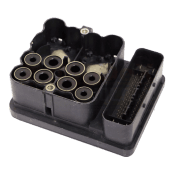
Summary: The ABS control module (the brain of the anti-lock braking system) is the single most common failing part we see on the thousands of units that arrive at our workshop every year. Internal faults — especially brake-pressure sensor failure, burnt or cracked circuit boards, cold solder joints, and corrosion — trigger the orange ABS light, random wheel locking, unresponsive pedals, and sometimes even speedometer dropout.
These are permanent electronic/hydraulic failures that no scanner reset, sensor clean, or fuse swap will ever cure. The two biggest culprits are the Bosch 8.0 (fitted to most VAG, Ford, Mazda, Volvo) and ATE Teves MK70 series — both notorious for the exact “brake pressure sensor” and no-communication” faults we repair daily.
If your ABS light is on and basic checks (fluid, fuses, sensors) haven’t fixed it, the problem is almost certainly inside the module itself. We’re the UK’s largest specialist ABS remanufacturer — explore our ABS pump & module repair services with full testing, component-level rebuild and lifetime warranty.
The ABS (anti-lock braking system) control module is equipped with microprocessors capable of handling real-time data signals and interpreting the exact moment a vehicle loses handling/traction. The ABS unit can determine when to apply/release braking pressure and to which wheels, in order to prevent the wheel from locking up or skidding.
This article assumes you know what the ABS pump is but if not, you may want to start with this easy to follow explanation on what is an ABS pump and how it works.
A great number of accidents can be caused by vehicles that either don’t have ABS or suffer from ABS-related issues. According to the NHTSA, “in a few years, all new vehicles will be equipped with electronic stability control and will almost certainly also be equipped with ABS. The ABS will prevent a large proportion of fatal and nonfatal crashes.” – This was written back in 2009 and it has become an industry standard for every road vehicle to be manufactured with ABS.
The effectiveness of the ABS control module in vehicles has been demonstrated through numerous stopping tests by expert drivers at test tracks. These tests have illustrated that four-wheel ABS is successful, especially on wet pavements, in improving overall vehicle stability during braking.
As you will probably be able to understand now, ensuring that the ABS is in top condition, is essential. Therefore, regular checkups and the necessary stop-break tests should be added to your car maintenance schedule, to make sure your vehicle is always safe for driving!
What do you need to look out for when dealing with ABS problems?
Below are 4 signs that you may come across:

Brake locking issues – The whole purpose of an ABS control module is to prevent locking of the wheels, so if you notice that your wheels are locking up while you are driving, then this obviously means that your ABS control module is faulty or damaged. You should not ignore this sign, rather it should prompt you to take your vehicle to a reliable auto repair shop and get this repaired as soon as you can, as it will only get worse and cause a lot more locking on the road.
ABS Light is On – It’s a pretty dreadful feeling seeing a light flash up on your dashboard, however, we’ve established that these signs need to be acknowledged and not ignored. So, if you own a newer vehicle and there is an issue with your ABS control module, then a specific ABS light should present itself on the dashboard. The indicator light will likely be an amber colour so it will be easy to recognize. However, if you have an older car, then the “check engine” light will be used to indicate this problem, instead of the ABS light.
Unresponsive brake pedal – If you put your foot on the brake pedal and the vehicle does not slow down, this is an obvious sign that there is a problem. The symptom will start out gradually, where you will have to press your foot down on the pedal a couple of times to get it to work. But then as time goes on, you will have to press down more times just to perform one breaking function. It will eventually get to the point where it stops working altogether. Therefore, it is best to get the issue resolved before it has to completely fail.
Speedometer failure – In some rare cases where your ABS control module doesn’t work, the speedometer on the dashboard will also stop working. Either it will show you an incorrect speed or the needle will just rest at 0 mph. This should be followed by the ABS or check engine light appearing on the dashboard. However, even if the light doesn’t come on, a faulty speedometer should be reason enough to get your car checked out by a professional.
If you suspect an ABS malfunction, then using your vehicle manual, locate and check the condition of the wiring and brake sensors first. If you discover any metal shavings or fragments during your assessment of the brake sensors, this could be the cause of the malfunction, as the electronic ABS controller may be receiving false feedback due to them.
Is it safe to drive with an ABS module problem?
The failure of the ABS control module will not disable your vehicle, however, it is not safe to drive when it is faulty. We, therefore, recommend towing your vehicle to a repair facility if the brakes feel unusual.
The most common problem found on both the Bosch 8.0 and ATE Teves Mk70 units, which are fitted to most modern vehicles, is the ‘Brake Pressure Sensor’ problem. To better assess and diagnose this issue, Sinspeed will carry out the full, necessary tests in order to evaluate the ABS fault and pinpoint the required and necessary repair. This is a very common issue and Sinspeed offer full Bosch 8.0 ABS ESP testing and repairs for this type of fault with a Lifetime Warranty.