
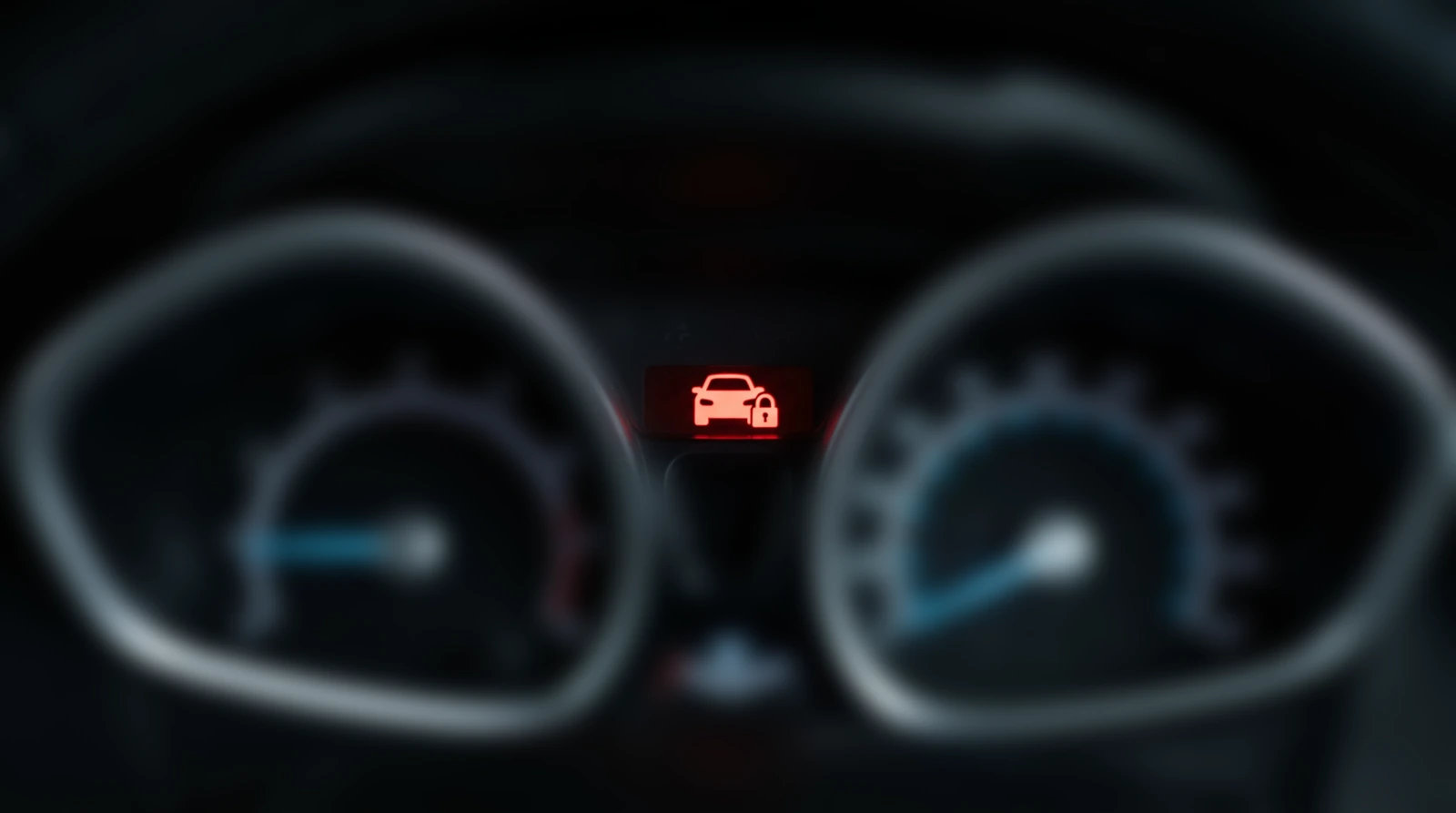
Summary: If your Ford’s theft or security light is on and the engine won’t start, the PATS immobiliser is blocking it — but the fault almost never sits where people assume. This guide explains what PATS is, then routes you by where the fault actually lives: the key or antenna (often the simplest and cheapest), the instrument cluster, a standalone PATS module, or the engine ECU. There is no safe DIY reset or bypass — the honest fix depends on which part has failed.
In this guide
- What Ford PATS is
- Which part has failed on your Ford? The routing table
- What to do for each outcome
- Start with the simple, cheaper causes
- Safe first checks before you call anyone
- FAQs
What Ford PATS is
PATS — the Passive Anti-Theft System — is Ford’s factory immobiliser, branded SecuriLock on many models. “Passive” means it arms itself automatically the moment the key leaves the ignition; you never switch it on. Until it recognises a coded key, it blocks the engine and flags the problem with the theft or security light on the dashboard.
The system works as a short conversation between three parts. A transponder chip is built into the key. A transceiver — an antenna ring around the ignition barrel — energises that chip and reads its code. The PATS function then checks the code, and only if it matches does it release the start. Present a valid key and the engine fires; present an unrecognised one and fuel and ignition stay locked out.
When that check fails, the dashboard tells you. On most UK Fords the theft or security light stays on or flashes rather than going out after the usual few seconds, and some models display an “engine disabled” or “engine immobilised by PATS” message outright. The car usually cranks but will not fire, because the immobiliser blocks fuelling and ignition — though some faults leave it dead with no crank at all.
You may also see the system called SecuriLock — that is Ford’s own name for the same thing, so the two terms are interchangeable. It is fitted right across the UK Ford range, from the Focus, Fiesta and KA to the Transit, Mondeo, Galaxy and S-Max, which is why the same theft-light no-start turns up on so many different models even though where the fault sits varies between them.
And that is the part most people get wrong: where PATS actually lives. On some generations it is a standalone anti-theft module. On many UK Fords — the Focus, Galaxy and S-Max especially — the instrument cluster itself is the immobiliser brain. On others the function sits inside the engine ECU. The key and the antenna ring are common to all of them. Which part has failed decides the fix, so the next section routes you by location rather than guesswork.
Which part has failed on your Ford? The routing table
Use the table below as a map. It pairs each part of the PATS chain with how a fault in it typically shows up, and where that fault is properly put right. None of this replaces a diagnostic read — the codes and the behaviour together confirm the location — but it tells you which conversation to start.
| Where the fault sits | How it typically presents | Where it goes for the fix |
|---|---|---|
| Instrument cluster (on many UK Focus, Galaxy and S-Max the cluster is the PATS brain) | No-start with dashboard or instrument-cluster symptoms; codes such as U1900, P1260 or U0155 on a diagnostic read. | Ford instrument cluster repair — a fault we repair. |
| Standalone PATS module (a dedicated anti-theft control unit on some generations) | Theft light on or flashing and a no-start, with a module-level fault confirmed by diagnosis. | Contact us and we’ll advise on the right route — we don’t offer this as a fixed repair. |
| PCM / engine ECU (where the immobiliser function lives in the ECU on some generations) | No-start with the security data held inside the engine ECU rather than a separate module. | ecu-repairs.com — a specialist ECU-repair company we refer these cases to. |
| Key transponder (the chip inside the key) | Starts on one key but not the other; intermittent recognition. | Contact us — usually a key and coding job, not a module repair. |
| Transceiver / antenna ring (the coil around the ignition barrel, behind the column shroud) | Intermittent reads, theft light, a no-start that comes and goes. | Contact us — a key-and-antenna job; we’ll point you the right way. |
A word on reading it: more than one of these can look identical from the driver’s seat. A flashing theft light and a no-start tell you PATS is involved — not which part is at fault. That is what a proper diagnosis settles, and it is why we route by location rather than treating every Ford no-start as the same job.
What to do for each outcome
Here is the honest version of what happens for each outcome, because not all of them are a job we take in.
If the diagnosis points at the instrument cluster — common on the Focus, Galaxy and S-Max, where the cluster is coded to PATS and sits on the car’s CAN bus — that is a fault we repair. A failed cluster can itself cause a no-start, and codes such as U1900, P1260 or U0155 often point that way. The original unit is repaired at component level and returned coded to your car, so your keys and configuration are kept intact. See our Ford instrument cluster repair service, or the wider immobiliser repair category.
Because a cluster fault is so often heat-related and intermittent, the unit is tested on bespoke in-house Hardware-in-the-Loop rigs that reproduce real-world heat, vibration and load. A fault that only shows up once the car has warmed through is caught on the bench, rather than after the unit is back in the car and the problem returns.
If it is a standalone PATS module, a key or transponder issue, the ignition barrel, or the transceiver ring, the right step is to get in touch. We do not offer these as a fixed, productised repair, so rather than send you down the wrong path we would rather advise you on the right route — and point you to the right specialist where that is what is needed. Contact us with the model and what the car is doing.
If the immobiliser function lives in the engine ECU on your generation, or an ECU-level repair is the chosen route, that work goes to ecu-repairs.com — a specialist ECU-repair company we refer these cases to. It is a referral, not an in-house service, and they will confirm the right approach for your vehicle.
What none of these routes involves is a bypass. Search the topic and you will find “PATS delete”, “disable the immobiliser” and “remove the chip from the ECU” content, much of it aimed at American trucks. We will not do any of it. Defeating a car’s immobiliser is neither lawful nor something a reputable workshop will touch, and it does not fix the underlying fault — it just strips out the security the car was built with.
Start with the simple, cheaper causes
Before anyone talks about repairing a module, rule out the cheaper, more common culprits — because they genuinely are more common.
A worn or failing key transponder is near the top of the list. The chip inside the key can stop reading reliably, and the tell-tale sign is a car that starts on one key but not the other, or one that recognises the key only intermittently. This is usually a key-and-coding job rather than a module repair, and it is often cheaper than people fear.
The transceiver ring around the ignition barrel is the other. It sits behind the column shroud and reads the key every time you start the car, so a failing ring or a poor connection there produces exactly the intermittent reads and theft-light flashes that look, from the driver’s seat, like a dead immobiliser. Again, this is a simpler fix than a module.
It is also worth noting how the car fails. A PATS no-start most often cranks briskly but never fires, because the immobiliser blocks fuelling rather than the starter motor. A car that is completely dead with no crank — and a healthy battery — points more towards wiring, a ground fault or a module issue. Neither is a home diagnosis on its own, but both help a specialist narrow things down quickly.
The point is not to talk you out of a repair — it is to stop you paying for the wrong one. A specialist confirms which part has failed before any work is quoted, so you are not replacing a healthy cluster or ECU when a key or an antenna was the real problem.
Safe first checks before you call anyone
There are two safe checks worth doing first. Neither is a reset, a relearn or a workaround — those are not DIY jobs — but both can tell a specialist a great deal, and one of them occasionally gets you moving.
Try your spare key
Many PATS systems are designed around two programmed keys, so swapping to the second one is a free, no-risk test. If the car starts reliably on the spare, the fault is very likely in the first key’s transponder rather than in any module — which points you straight at the cheaper end of the table above.
Check the battery and its terminals
A weak battery, or a corroded or loose terminal, can mimic almost every PATS symptom — intermittent starting, warning lights and electrical oddities all appear when voltage is low. A battery that looks fine at rest can still collapse under the load of cranking, so a proper voltage check is worth more than a glance at the dashboard.
If neither the spare key nor the battery resolves it, stop there. The next step is a diagnostic read, not a video reset. A legitimate PATS key-relearn needs the correct programmed keys and Ford-level diagnostic equipment, and it is carried out as part of a professional repair — it is not a battery-disconnect trick, and it will not “reset” away a genuine module, cluster or ECU fault. If you are not yet sure the immobiliser is the cause at all, our guide on whether a no-start is your immobiliser sets out the wider picture.
FAQs
What is Ford PATS, and what does “engine disabled by PATS” mean?
PATS — the Passive Anti-Theft System, branded SecuriLock — is Ford’s factory immobiliser. It only allows the engine to start once it recognises a coded key. An “engine disabled by PATS” message means the system has not recognised a valid key and has blocked the start; using the wrong key, or a key whose transponder is no longer being read, will produce it.
Why is the anti-theft light on but my Ford won’t start?
A theft or security light that stays on or flashes is PATS telling you it has not authorised the start. The immobiliser blocks fuel and ignition until it reads a valid key, so a light that does not go out after a few seconds, paired with a no-start, almost always means a key, antenna or immobiliser-module fault rather than an engine problem. The safe checks narrow it down; a diagnostic read confirms it.
How do I fix a flashing security light and no-start on a Ford Focus?
Start with the safe checks: try the spare key, and check the battery and its terminals. If those do not resolve it, the honest answer is diagnosis. On the Focus the instrument cluster is often the immobiliser brain, so a no-start with cluster symptoms and codes like U1900, P1260 or U0155 points there, while a fault that clears on the second key points at the key itself. There is no DIY reset or bypass that safely fixes a genuine fault.
How do I reset my Ford PATS or immobiliser?
You cannot legitimately reset it with a battery-disconnect trick or a key-twisting sequence, despite what the videos claim — those address central locking or an alarm, not the immobiliser. A genuine PATS relearn needs the correct programmed keys and Ford-level diagnostic equipment, and is done as part of a professional repair. If the car has a real module, cluster or ECU fault, no reset will clear it; the fault has to be found and fixed.
Can a Ford PATS fault be repaired?
Yes — but where it goes depends on where it sits. An instrument-cluster fault is one we repair, with the unit rebuilt at component level and your coding kept intact. A key or antenna problem is a simpler job. A fault in the engine ECU goes to the ECU specialist we refer those cases to. Diagnosis decides the route, which is why confirming the location comes first.
How much does it cost to fix a Ford PATS no-start?
There is no flat figure, because the cost depends entirely on which part has failed — a key or antenna issue sits at the simpler end, while a cluster or ECU repair is a larger job. Rather than quote blind, we would rather diagnose the fault first. Tell us the vehicle and the symptoms through our repair form, or contact us for a quote specific to your car.
Final thoughts
A Ford with the theft light on and a refusal to start is stressful, but it is rarely the disaster the bypass videos imply — and it almost never needs one. The immobiliser is doing its job; the task is to work out which part of it has failed. Start with the spare key and the battery, then let a diagnosis place the fault: a key or antenna at the simpler end, the instrument cluster on many Focus, Galaxy and S-Max models, a standalone module, or the engine ECU. Each has an honest route, and none of them is defeating the system the car was built with.