
 In short
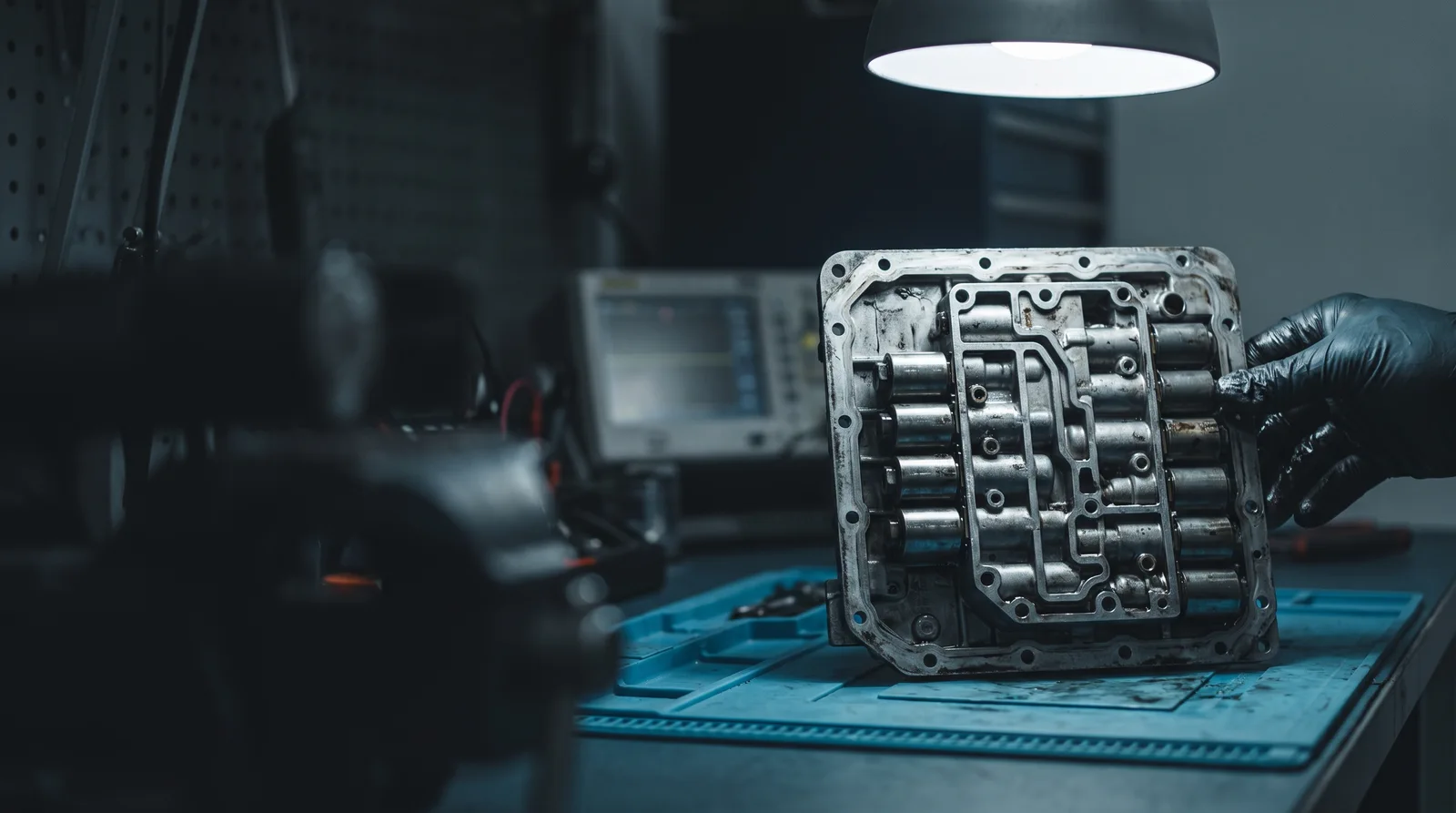
The Mitsubishi Twin Clutch SST is the Getrag-designed dual-clutch six-speed fitted to the Lancer Evolution X MR and the Lancer Ralliart, and its mechatronic unit — the transmission ECU, sensors, solenoids and valves housed together in the valve body — is one of two very different things that put an SST into limp mode. The other is mechanical, deeper inside the gearbox, and no mechatronic repair will touch it. This page sets out how to tell them apart before a unit comes off the car, and what our mail-in SST mechatronic rebuild involves.
- What is the Mitsubishi SST mechatronic unit?
- What are the symptoms of a failing SST mechatronic unit?
- What actually fails inside an SST mechatronic unit?
- Is it the mechatronic unit or a mechanical gearbox fault?
- How do you confirm it is the mechatronic before removing anything?
- What do the SST fault codes actually tell you?
- What does the mail-in SST mechatronic repair involve?
- Mitsubishi SST mechatronic FAQs
- Final thoughts
What is the Mitsubishi SST mechatronic unit?
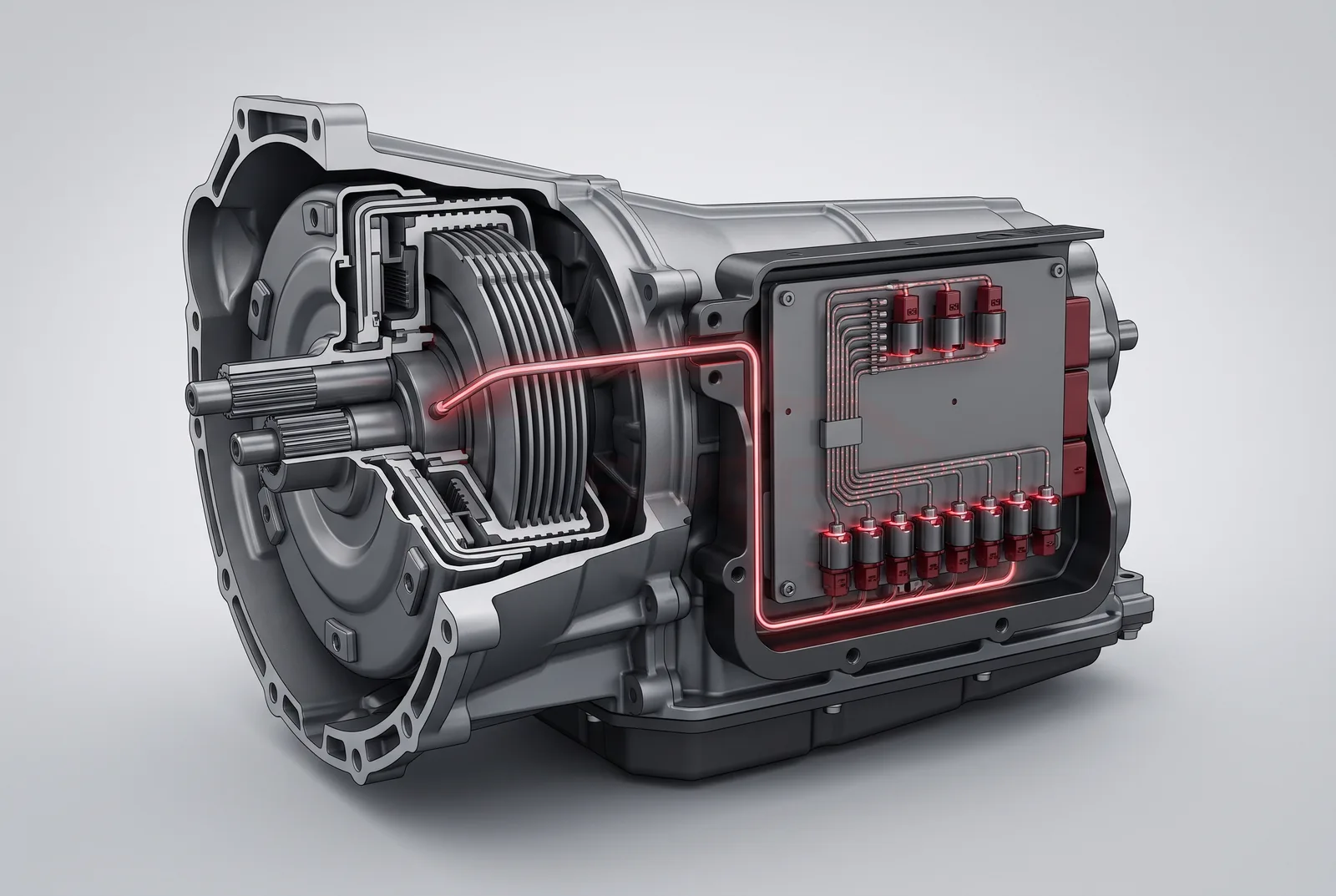
The Twin Clutch SST — Sport Shift Transmission — is a dual-clutch six-speed gearbox designed by Getrag for Mitsubishi Motors. Mechanically it is a manual gearbox; the clutch work and the gear selection have simply been handed over to electronics and hydraulics.
There are two clutches and two input shafts. One carries the odd gears and reverse, the other the even gears. While you are driving in third, the gearbox has already pre-selected fourth on the other shaft, so a change is a handover between two clutches rather than a break in drive. That is what makes the shifts quick — and it is why an SST fault often takes out a whole group of gears rather than one.
The mechatronic unit runs all of it: the transmission ECU, the sensors, the solenoids and the valves, housed together within the transmission valve body. Because the control electronics and the hydraulics share a single assembly on this gearbox, “mechatronic unit”, “TCM” and “valve body” all get used for the same part on an Evo X. Our guide to what the transmission control module does covers the electronics side in isolation.
Its real job is pressure. It meters hydraulic pressure to each clutch to control how firmly and how quickly that clutch takes up, drives the shift actuators, and reads back what actually happened through position and pressure sensors. Every symptom below is a version of that loop going wrong.
The assembly is commonly listed under Mitsubishi reference 2800A135, PNC 21276A. Fitment on cars of this age is worth confirming rather than assuming — check the number on your own unit before anything is ordered against it.
What are the symptoms of a failing SST mechatronic unit?
An unhappy SST announces it through the way it takes up drive and the way it changes gear:
- Limp mode — the gearbox drops into fail-safe, holds one gear or a small set of gears, and the car is left slow and unwilling.
- Power loss with no engine fault behind it — the drive is being limited by the gearbox.
- Jerking in and out of gear, or changes that have gone harsh and abrupt where they used to be smooth.
- It works until it gets hot — normal from cold, faulting after a spell of driving or in traffic, then behaving again once it has stood.
- Not going into gear at all, or a long pause before drive arrives.
- Loss of reverse.
- Slipping — the revs rise but the car does not gather speed with them.
- No automatic changes in D while manual selection still works, or the reverse of that.
- Juddering or snatching pulling away, particularly from cold or on a hill.
- Transmission warning messages and stored gearbox codes, or no communication with the unit on a scan tool.
The temperature pattern is the most diagnostically useful item on that list. A gearbox that is fine cold and faults hot is describing something that changes with heat: an electrical connection inside the control electronics, or a solenoid or valve whose behaviour shifts as the oil thins and the housing expands. Mechanical wear does not usually switch itself on and off like that.
Treat limp mode as a get-home condition rather than driving round it. It typically holds a fixed gear and caps road speed, which restricts your ability to pull out of a junction or join fast-moving traffic. Our guide to a car won’t go into gear covers the wider set of causes, and where a car signals a transmission fault by flashing its gear-position display, our explainer on a PRNDS light flashing sets out what that indicator means.
What actually fails inside an SST mechatronic unit?
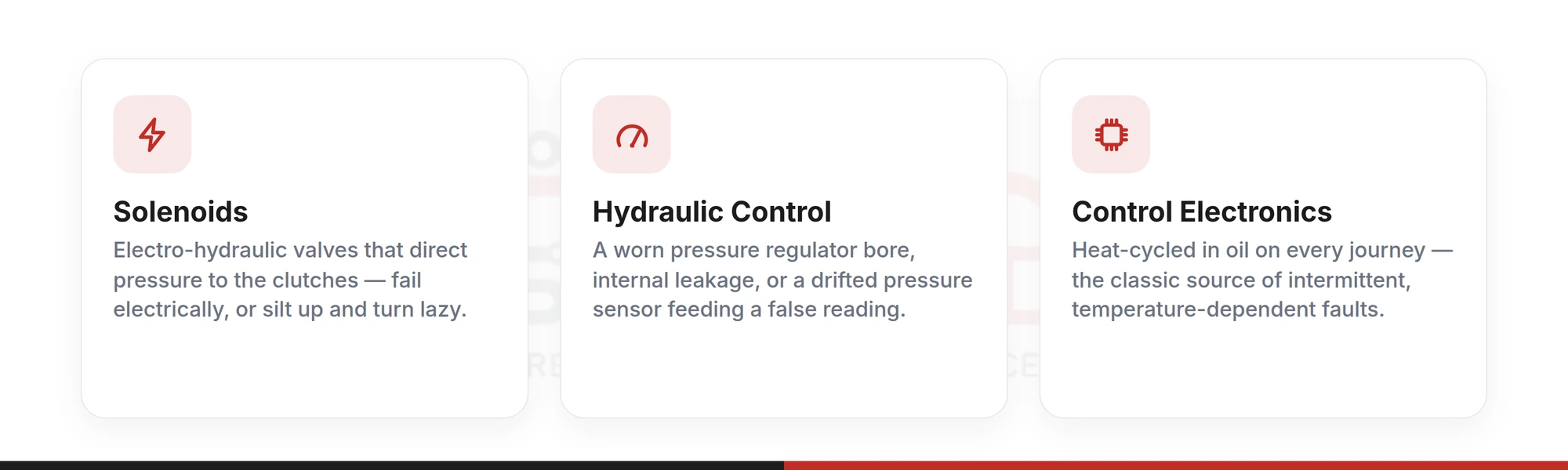
The failures fall into three groups, and they behave differently.
The solenoids. These are the electro-hydraulic valves that direct pressure to the clutches and the shift actuators. They fail electrically, with a coil gone open or short circuit, and they fail hydraulically, silting up and becoming lazy so the valve no longer moves cleanly or quickly. A lazy solenoid gives you slurred, late or harsh changes long before it gives you a hard fault.
The hydraulic control. The pressure regulator valve and its bore wear, and a worn bore no longer holds the pressure the unit is commanding. Internal leakage does the same thing by another route — pressure that escapes past a core plug or a tired internal seal never reaches the clutch it was meant for, and the car reads as though it is slipping. Drifted pressure sensors are the third variant: the hydraulics can be perfectly healthy while the control loop works from a false reading.
The control electronics. This board sits inside the gearbox, in oil at working temperature, and it is heat-cycled on every journey. That is what eventually breaks electrical connections on it, and it is why the resulting faults are so often intermittent and temperature-dependent. A solenoid that short circuits can take the driver stage feeding it with it, so the electrical fault and the hydraulic one then arrive together.
Fluid condition sits behind a great deal of this. The SST uses a specific Mitsubishi transmission fluid, Dia Queen SSTF, and running the wrong fluid — or leaving fluid and filter past their service interval — is a well-known route into solenoid and clutch trouble. Our explainer on mechatronic unit faults and symptoms covers the same pattern across other dual-clutch gearboxes.
Sinspeed · mail-in repair
Send us the transmission controller before you commit to a gearboxA great many gearbox diagnoses turn out to be the controller, not the mechanical unit. Send us the module with your fault codes and we test, repair and calibrate it on our in-house rigs before returning it.
Lifetime, unlimited-mileage warranty on all remanufactured parts · Mail-in, UK-wide · Tested on Hardware-in-the-Loop rigs before dispatch
Is it the mechatronic unit or a mechanical gearbox fault?
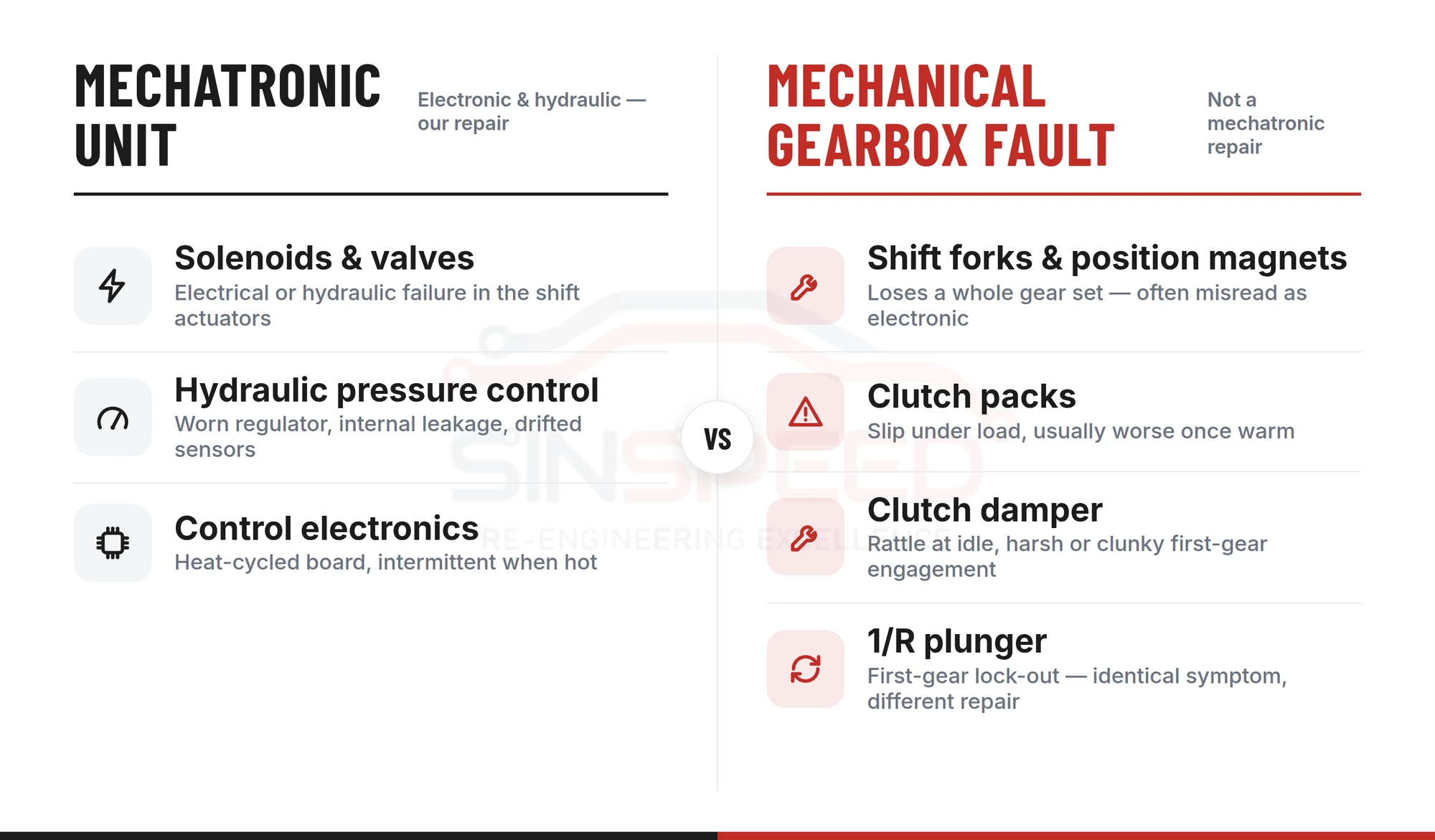
This is the question the page exists to answer, and answering it honestly means saying plainly that several of the best-known Evo X SST failures are mechanical. They are not mechatronic repairs, and no work on the unit will cure them.
Shift forks and their position magnets. The forks that move the selector sleeves carry magnets, and their position is read back so the control side knows which gear is actually engaged. When a fork breaks, or when the material carrying its magnets degrades and the reported position stops matching reality, the control side can no longer confirm engagement on that shaft — and it shuts that half of the gearbox down rather than risk it. The signature is unmistakable: you lose an entire gear set. An SST that will select only odd gears is describing a shift fork on the even-gear shaft, commonly the fourth, not a mechatronic fault. Worth knowing, too, that this can log codes which look electronic, because the signal genuinely is wrong — the cause behind it is not.
Clutch packs. Worn clutches slip under load, usually in one gear before the others and usually worse once everything is warm. Slip of that kind is a mechanical wear item and it is a clutch job.
The clutch damper. A rattle at idle that changes or disappears as drive is taken up, harsh engagement and a clunky first gear are the classic damper symptoms. They sit outside the mechatronic unit too.
The 1/R plunger. Because first gear and reverse share a shaft on this gearbox, a failing 1/R plunger produces a first-gear lock-out — the same headline complaint a blocked or failed mechatronic can produce. Two very different repairs, one symptom.
One more catches people out because it is not in the gearbox at all. Clutch take-up is scheduled against the engine’s reported torque, so an engine-side signal fault — a throttle body giving poor data, for instance — can produce abrupt, badly timed clutch engagement on a gearbox that is entirely healthy.
We would rather tell you all of that before your unit is posted than after it has been on the bench. What a specialist is genuinely useful for on an SST is not a claim to fix everything, but a straight answer about which half of the gearbox your fault is in.
How do you confirm it is the mechatronic before removing anything?
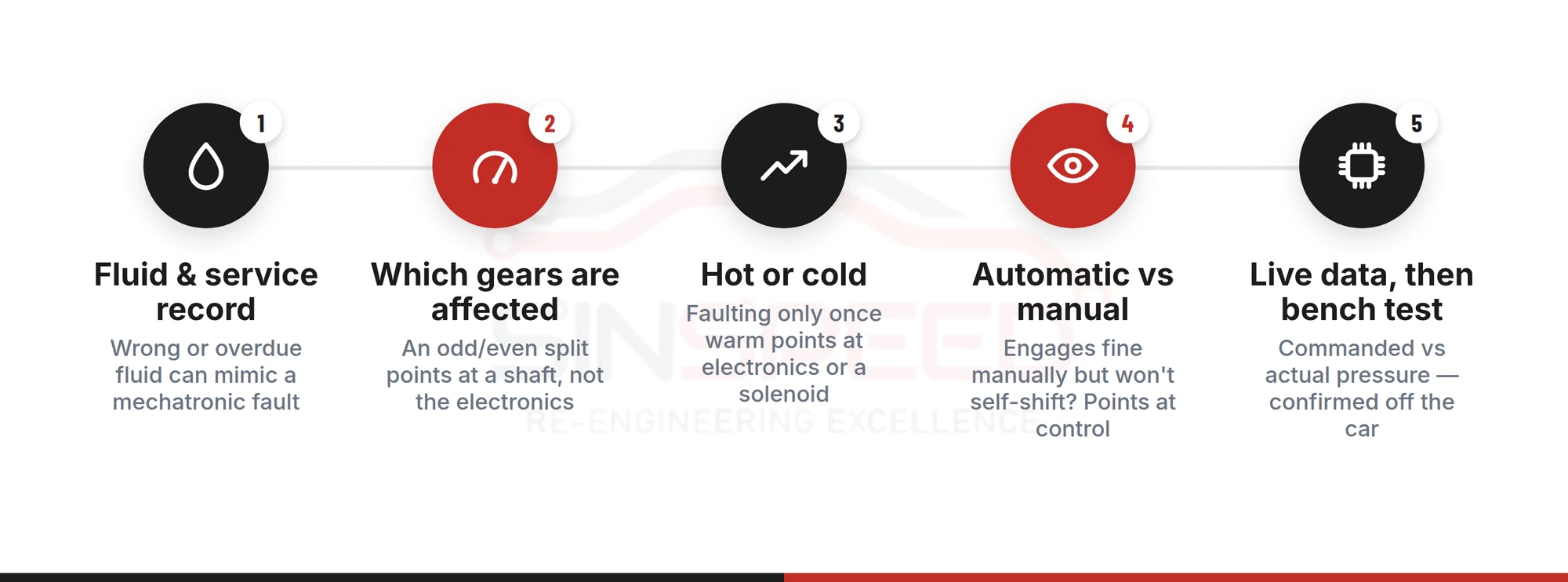
The evidence is available before a spanner is picked up, and it is worth gathering in this order.
- Start with the fluid and the service record. Wrong or overdue fluid and a blocked filter produce pressure and solenoid symptoms in a unit that is otherwise sound. That has to be excluded first, not afterwards.
- Establish which gears are affected. A clean odd-or-even split points at one input shaft, and therefore at the forks, sleeves or clutch serving it. Faults spread across all gears point at the control side.
- Note whether it is hot or cold. A fault that only appears once the gearbox is up to temperature is the strongest single indicator of a control-electronics or solenoid problem.
- Compare automatic against manual. A gearbox that engages every gear when you ask for it manually, but will not schedule its own changes, is not describing a gearbox that cannot engage gears.
- Listen. Rattle at idle, clunk on take-up and noise during a change are mechanical descriptions. Mechatronic faults are usually silent apart from the way the car drives.
- Read live data, not just stored codes. Commanded clutch pressure against actual pressure, solenoid currents, fork positions and gearbox oil temperature tell you far more than a code list. A code names a circuit the control unit was unhappy with; it does not name the part that failed.
- Then test the unit itself. Once the evidence points at the mechatronic, the definitive answer comes from powering it up away from the car and driving it through its solenoid and pressure outputs in an isolated environment, so the fault is confirmed in operation rather than inferred from a code. That needs the electronic and the hydraulic halves examined together, which is exactly what this assembly is: a control board and a hydraulic valve body sharing one housing.
We are deliberately not publishing a strip-down procedure. A mechatronic that has been opened, guessed at and reassembled outside a controlled environment is frequently no longer repairable, and the fault it arrived with then becomes the smaller of the two problems.
What do the SST fault codes actually tell you?
P1871 is the code most SST owners arrive with. It is a transmission-slip fault: the control side commanded a clutch engagement, compared the speeds either side of that clutch, and found they did not agree. That is genuinely useful and frequently misread — it reports that slip is happening, not what is causing it. Worn clutch packs set it. So does a mechatronic that cannot hold commanded pressure. So does degraded fluid. The code narrows the search to the clutch and pressure side of the gearbox; it does not pick the repair.
P1876 describes a first-gear lock-out, and it splits the same way: a failing 1/R plunger on the mechanical side, or a mechatronic that is blocked or has failed on the pressure side. Both produce an identical complaint, and only testing separates them.
For everything else, read the description rather than the number. If a code names a solenoid, a pressure regulator or a pressure sensor, it is describing the mechatronic’s hydraulic control. If it names a shift fork, a gear-engagement position or a specific ratio, it is describing the mechanical side. If it names clutch slip or clutch torque it could be either, and it needs live data to settle. We would rather give you that framework than publish a confident meaning for every code — this is a gearbox on a fast car, and a wrong code definition sends someone to the wrong repair.
The table below lists the diagnostic trouble codes associated with the Mitsubishi SST.
| Fault Code | Fault Description |
|---|---|
| P0630 | VIN not recorded |
| P0701 | EEPROM system (Malfunction) |
| P0702 | Internal control module, monitoring processor system (Malfunction) |
| P0711 | TC-SST-ECU temperature sensor system (Gradient error) |
| P0712 | TC-SST-ECU temperature sensor system (Output low range out) |
| P0713 | TC-SST-ECU temperature sensor system (Output high range out) |
| P0715 | Input shaft 1 (odd number gear axle) speed sensor system (Output high range out) |
| P0716 | Input shaft 1 (odd number gear axle) speed sensor system (Poor performance) |
| P0717 | Input shaft 1 (odd number gear axle) speed sensor system (Output low range out) |
| P0725 | Engine speed signal abnormality |
| P0746 | Line pressure solenoid system (Drive current range out) |
| P0753 | Shift select solenoid 1 system (Open circuit) |
| P0758 | Shift select solenoid 2 system (Open circuit) |
| P0776 | Clutch cooling flow solenoid system (Drive current range out) |
| P0777 | Clutch cooling flow solenoid system (Stuck) |
| P0841 | Clutch 1 pressure sensor system (Poor performance) |
| P0842 | Clutch 1 pressure sensor system (Output low range out) |
| P0843 | Clutch 1 pressure sensor system (Output high range out) |
| P0846 | Clutch 2 pressure sensor system (Poor performance) |
| P0847 | Clutch 2 pressure sensor system (Output low range out) |
| P0848 | Clutch 2 pressure sensor system (Output high range out) |
| P0960 | Line pressure solenoid system (Open circuit) |
| P0961 | Line pressure solenoid system (Overcurrent) |
| P0962 | Line pressure solenoid system (Short to ground) |
| P0963 | Line pressure solenoid system (Short to power supply) |
| P0964 | Clutch cooling flow solenoid system (Open circuit) |
| P0965 | Clutch cooling flow solenoid system (Overcurrent) |
| P0966 | Clutch cooling flow solenoid system (Short to ground) |
| P0967 | Clutch cooling flow solenoid system (Short to power supply) |
| P0968 | Shift/cooling switching solenoid system (Open circuit) |
| P0970 | Shift/cooling switching solenoid system (Short to ground) |
| P0971 | Shift/cooling switching solenoid system (Short to power supply) |
| P0973 | Shift select solenoid 1 system (Short to ground) |
| P0974 | Shift select solenoid 1 system (Short to power supply) |
| P0976 | Shift select solenoid 2 system (Short to ground) |
| P0977 | Shift select solenoid 2 system (Short to power supply) |
| P1637 | EEPROM system (DTC storing malfunction) |
| P1676 | Coding incomplete |
| P1802 | Shift lever system (LIN communication malfunction) |
| P1803 | Shift lever system (CAN or LIN time-out error) |
| P1804 | Shift fork position sensor 1 and 2 system (Power supply voltage low range out) |
| P1805 | Shift fork position sensor 1 and 2 system (Power supply voltage high range out) |
| P1806 | Shift fork position sensor 3 and 4 system (Power supply voltage low range out) |
| P1807 | Shift fork position sensor 3 and 4 system (Power supply voltage high range out) |
| P1808 | TC-SST-ECU temperature, fluid temperature sensor system (Correlation error) |
| P180C | Clutch pressure cut spool sticking |
| P181B | Clutch 1 (Pressure low range out) |
| P181C | Clutch 1 (Pressure high range out) |
| P181E | Clutch 2 (Pressure low range out) |
| P181F | Clutch 2 (Pressure high range out) |
| P1820 | Shift fork position sensor 1 system (Voltage low range out) |
| P1821 | Shift fork position sensor 1 system (Voltage high range out) |
| P1822 | Shift fork position sensor 1 system (Output range out) |
| P1823 | Shift fork position sensor 1 system (Neutral) |
| P1824 | Shift fork position sensor 1 system (Poor performance) |
| P1825 | Shift fork position sensor 2 system (Voltage low range out) |
| P1826 | Shift fork position sensor 2 system (Voltage high range out) |
| P1827 | Shift fork position sensor 2 system (Output range out) |
| P1828 | Shift fork position sensor 2 system (Neutral) |
| P1829 | Shift fork position sensor 2 system (Poor performance) |
| P182A | Shift fork position sensor 3 system (Voltage low range out) |
| P182B | Shift fork position sensor 3 system (Voltage high range out) |
| P182C | Shift fork position sensor 3 system (Output range out) |
| P182D | Shift fork position sensor 3 system (Neutral) |
| P182E | Shift fork position sensor 3 system (Poor performance) |
| P1831 | Shift fork position sensor 4 system (Voltage low range out) |
| P1832 | Shift fork position sensor 4 system (Voltage high range out) |
| P1833 | Shift fork position sensor 4 system (Output range out) |
| P1834 | Shift fork position sensor 4 system (Neutral) |
| P1835 | Shift fork position sensor 4 system (Poor performance) |
| P1836 | Shift fork 1 malfunction |
| P183D | Shift fork 2 malfunction |
| P1844 | Shift fork 3 malfunction |
| P184B | Shift fork 4 malfunction |
| P1852 | Shift fork 1 or 2 opposite direction movement |
| P1855 | Shift fork 3 or 4 opposite direction movement |
| P1857 | Odd number gear axle interlock |
| P1858 | Even number gear axle interlock |
| P1859 | Disengagement too late with clutch 1 |
| P185A | Engagement too late with clutch 1 |
| P185B | Disengagement too late with clutch 2 |
| P185C | Engagement too late with clutch 2 |
| P185D | Clutch open not possible |
| P1862 | High side 1 system (Overcurrent) |
| P1863 | High side 1 system (Open circuit) |
| P1864 | High side 1 system (Short to power supply) |
| P1866 | High side 2 system (Overcurrent) |
| P1867 | High side 2 system (Open circuit) |
| P1868 | High side 2 system (Short to power supply) |
| P186A | High side 3 system (Overcurrent) |
| P186B | High side 3 system (Open circuit) |
| P186C | High side 3 system (Short to power supply) |
| P186D | High side 1 system (Voltage low range out) |
| P186E | High side 2 system (Voltage low range out) |
| P186F | High side 3 system (Voltage low range out) |
| P1870 | Engine torque signal abnormality |
| P1871 | APS system (Signal abnormality) |
| P1872 | Between shift lever and TC-SST system (Q-A function abnormality) |
| P1873 | Clutch 1 system (Pressure abnormality) |
| P1874 | Clutch 2 system (Pressure abnormality) |
| P1875 | Damper speed sensor system (Poor performance) |
| P1876 | Gear block 1st |
| P1877 | Gear block 2nd |
| P1878 | Gear block 3rd |
| P1879 | Gear block 4th |
| P187A | Gear block 5th |
| P187B | Gear block 6th |
| P187C | Gear block reverse |
| P1880 | EOL Mode Active |
| P1881 | Twin clutch SST control mode switch system (Malfunction) |
| P2718 | Clutch/shift pressure solenoid 1 system (Open circuit) |
| P2719 | Clutch/shift pressure solenoid 1 system (Overcurrent) |
| P2720 | Clutch/shift pressure solenoid 1 system (Short to ground) |
| P2721 | Clutch/shift pressure solenoid 1 system (Short to power supply) |
| P2727 | Clutch/shift pressure solenoid 2 system (Open circuit) |
| P2728 | Clutch/shift pressure solenoid 2 system (Overcurrent) |
| P2729 | Clutch/shift pressure solenoid 2 system (Short to ground) |
| P2730 | Clutch/shift pressure solenoid 2 system (Short to power supply) |
| P2733 | Clutch/shift switching solenoid 1, spool stuck |
| P2736 | Clutch/shift switching solenoid 1 system (Open circuit) |
| P2738 | Clutch/shift switching solenoid 1 system (Short to ground) |
| P2739 | Clutch/shift switching solenoid 1 system (Short to power supply) |
| P2741 | Fluid temperature sensor system (Gradient error) |
| P2742 | Fluid temperature sensor system (Output low range out) |
| P2743 | Fluid temperature sensor system (Output high range out) |
| P2766 | Input shaft 2 (even number gear axle) speed sensor system (Poor performance) |
| P2809 | Clutch/shift switching solenoid 2, spool stuck |
| P2812 | Clutch/shift switching solenoid 2 system (Open circuit) |
| P2814 | Clutch/shift switching solenoid 2 system (Short to ground) |
| P2815 | Clutch/shift switching solenoid 2 system (Short to power supply) |
| U0001 | Bus off |
| U0100 | Engine time-out error |
| U0103 | Shift lever time-out error |
| U0121 | ASC time-out error |
| U0136 | AWC time-out error |
| U0141 | ETACS time-out error |
What does the mail-in SST mechatronic repair involve?
Your car does not need to go anywhere — only the mechatronic makes the journey. Private owners and independent garages use the service in the same way.
The unit comes out of the gearbox, so removal is workshop work and the fluid and filter come out with it; plan it as one job rather than two. Send the unit with the symptoms, any fault codes and a note of how the car behaves hot and cold, and that history goes onto the bench with it.
The rebuild begins with a full teardown and clean. Each solenoid and sensor is then tested individually rather than judged as a set, and pressure control is checked against what the unit is commanding. Worn hydraulic and sealing components are replaced with genuine OE parts, the control electronics are repaired at component level, and where a part is a known weak point on this assembly it is uprated rather than put back as it was — a like-for-like rebuild returns the original design along with the reason it failed. The unit is retested before it is packed.
It comes back plug and play: no additional programming or coding is required when it goes back on the car, because it is your own unit with its own software still on it. Our remanufactured mechatronic units carry a Lifetime warranty. One practical note — after clutch or gearbox work an SST needs its teach-in and adaptation procedures carried out, and a fault that reappears immediately after a repair is sometimes an adaptation that was never done.
The SST is one gearbox among many here; you can see the full range of our transmission control module repair services. To begin, send us your vehicle and fault details through our repair form, or contact us if you would like the symptoms looked at first. If you would rather talk it through, call us on 0203 815 9441.
Mitsubishi SST mechatronic FAQs
Can a Mitsubishi SST mechatronic unit be repaired?
Yes. A franchised dealer works to a replace-the-assembly method, which is how the network is set up rather than a judgement on the part. The mechatronic is a control board and a hydraulic valve body in one housing, and solenoids, pressure-control components and the control electronics are all serviceable at component level.
What are the symptoms of a failing SST mechatronic unit?
Limp mode, power loss, jerking or harsh changes, slipping, a long delay before drive arrives, loss of reverse, no gear selection at all, and a gearbox that works from cold then faults once it is hot. Stored transmission codes usually accompany them.
Does a repaired SST mechatronic need coding or programming?
No. Your own unit comes back with its own software on it, so no additional programming or coding is required when it is refitted. A replacement assembly is the opposite case: it arrives without your car’s data and has to be set up before the car will drive properly.
What does P1871 mean on a Mitsubishi Evo X?
It is a transmission-slip code. The control side commanded a clutch engagement and found the speeds either side of that clutch did not agree. It tells you slip is occurring, not what is causing it — worn clutch packs, degraded fluid and a mechatronic that cannot hold pressure all set it.
Why has my Evo X lost all its even gears?
A dual-clutch gearbox splits its gears across two input shafts, so losing a complete set points at that shaft rather than at the control electronics — most often a broken shift fork, or fork position sensing, on the even-gear side. That is a mechanical repair, not a mechatronic one.
Is it safe to drive an SST in limp mode?
Treat it as a get-home condition, not something to live with. Limp mode is protective: it holds a fixed gear and limits road speed, which restricts your ability to pull away or join fast traffic. Driving on an unresolved gearbox fault also risks turning a repairable unit into a larger job.
Can the wrong gearbox fluid damage an SST mechatronic?
It is a well-known route into trouble. The SST uses a specific Mitsubishi fluid, Dia Queen SSTF, and running the wrong fluid or leaving fluid and filter beyond their service interval accelerates wear on the solenoids and valves, often alongside clutch problems.
Which Mitsubishi models use the SST gearbox?
The Twin Clutch SST is the Getrag-designed dual-clutch six-speed fitted to the Lancer Evolution X MR and the Lancer Ralliart. Part numbers vary, so confirm the reference on your own unit rather than ordering against a model name.
Sinspeed · mail-in repair
Not sure which unit has failed?Send us your fault codes and vehicle details and we will tell you which unit is at fault before you remove anything.
Your own unit remanufactured, not a like-for-like replacement · Lifetime, unlimited-mileage warranty · Dealer-level programming and calibration