
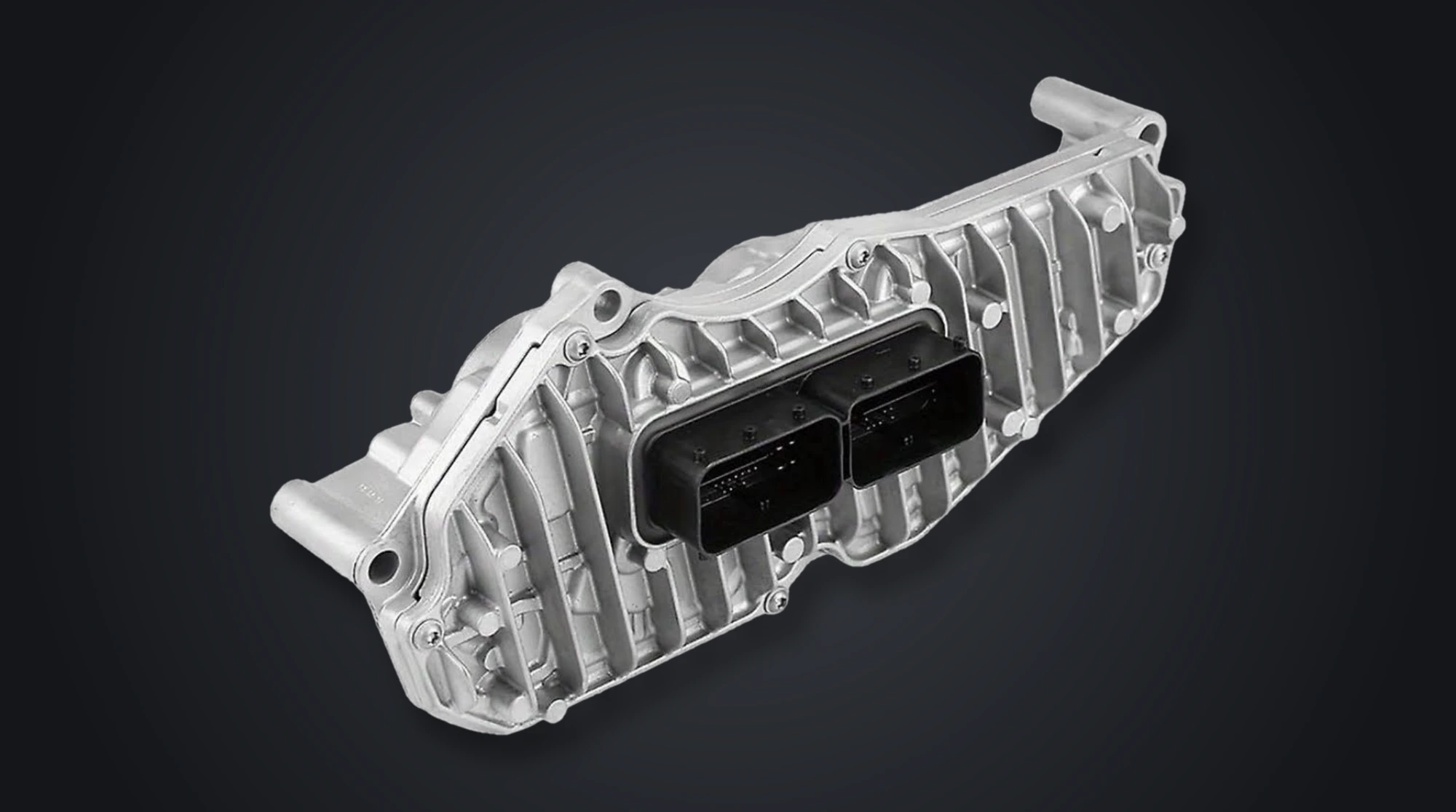
A transmission control module (TCM) is the electronic unit that runs an automatic gearbox, reading sensor data to decide when and how it shifts. When it fails you get harsh or stuck shifting, slipping and limp mode — and in most cases a faulty TCM can be repaired rather than replaced.
Table of Contents
- What is a transmission control module?
- TCM or mechatronic unit — what’s the difference?
- What does a TCM actually do?
- Which TCM does my car have?
- Symptoms of a failing TCM, by gearbox type
- Can a TCM be repaired, or must it be replaced?
- How is a TCM tested and diagnosed?
- Frequently asked questions
What is a transmission control module?
A transmission control module is the small electronic control unit that runs an automatic gearbox. You will also see it called a transmission control unit (TCU) or a gearbox control unit (GCU) — three names for the same component. Whatever the badge, the job is identical: take in data from sensors around the car and decide, moment by moment, which gear the transmission should be in.
It reads vehicle speed, engine load, throttle position and the gear you have selected, then works out when and how to change gear. The module does not move any gears itself. It makes the decision and sends the command — the hydraulics and clutches inside the gearbox carry it out.
Because it is a type of automotive ECU, the TCM also talks constantly to the engine control unit and the ABS. That cross-talk is why a transmission fault can surface as a warning light you would not immediately connect with the gearbox.
TCM or mechatronic unit — what’s the difference?
On many modern automatics — VW Group DSG and Multitronic units in particular — the TCM is not a standalone box. It is built into a larger assembly called the mechatronic unit, and the two get confused constantly. They are related, but they are not the same thing.
The mechatronic unit is the combination of the control electronics and the hydraulics. The TCM is the brain inside it: it processes the sensor signals and decides what should happen. The hydraulic valves, solenoids and pressure circuits around it are the muscle that carries the decision out by engaging and releasing clutches.
This distinction matters the moment something fails. A fault stored against the TCM is not always an electronic fault — it can be a solenoid or pressure-control problem inside the mechatronic unit that the TCM has detected and logged. Telling one from the other is the difference between a repair that lasts and a part swapped for nothing.
What does a TCM actually do?
Strip away the jargon and a TCM does a handful of core jobs, each of them depending on the sensor data it reads many times a second.
- Gear-shift control — deciding the timing and method of every up- and down-shift from speed, load and throttle inputs.
- Adaptive shifting — learning your driving style and shifting earlier for economy or later for performance to suit it.
- Fault monitoring and diagnostics — watching the transmission for abnormalities and storing diagnostic trouble codes (DTCs) when something is wrong, so a technician can read what happened.
- Talking to other modules — sharing data with the engine ECU and ABS so the engine, brakes and gearbox behave as one system, for example holding a gear under heavy braking.
- Protecting the gearbox — managing transmission-fluid temperature and shift quality to keep the unit within safe limits and the changes smooth.
Adaptive shifting is the one most drivers feel without realising it. The module tracks how you use the throttle and shifts to match: lift off gently and it changes up early to keep the engine in an economical rev range; press on and it holds each gear longer for response. Over time that learned behaviour is part of what makes your car feel like yours — and part of what a blank replacement module has to relearn from scratch.
When the module is healthy you never think about any of this. When it is not, several of those jobs can go wrong at once — which is why the symptoms can look so varied and so hard to pin down.
Which TCM does my car have?
The exact module, where it sits and the faults it throws depend heavily on the make and the gearbox. This is the part a generic definition never gives you. Use the table below to find the type fitted to your car as a starting point, then confirm it against your own diagnostic read — variants exist within every range.
| Make / range | Transmission & TCM type | Where it sits | Typical fault codes |
|---|---|---|---|
| VW · Audi · SEAT · Škoda | DSG dual-clutch (DQ200 dry clutch, DQ250 wet clutch) with the TCM built into the mechatronic unit; Audi Multitronic CVT uses a separate module | Mechatronic unit inside the gearbox (DSG); separate control module (Multitronic) | P0730, P0750, P1815 (VAG 17114 / 17134 / 18223) |
| Ford | PowerShift dual-clutch (DPS6 dry, MPS6 wet) with a mechatronic-mounted TCM; older Durashift EST automated manual uses an external TCU | Within the transmission housing (PowerShift); external module (Durashift) | P0700, P0715 (generic transmission codes) |
| Mazda 2 (2003–2007) and some Ford Fiesta | Bosch Durashift automated-manual TCU — the same Bosch unit is shared across both | External control module | No-communication and incorrect-gear-ratio faults (Bosch part 0132900007) |
| BMW Mini R50 / R52 (1999–2006) | Motorola TCU fitted to the CVT automatic | External control module | Cold-start gear-selection faults — ‘jumping’ into gear or refusing to select |
Within a single range the detail still matters. A VW Group DSG comes in a dry-clutch form (the DQ200) and a wet-clutch form (the DQ250), and they fail in different ways, so the right diagnosis depends on knowing which you have. The same is true on Audi’s Multitronic: the early A4 and A6 module is a known weak point, but the Quattro versions were fitted with a different unit that does not carry the same faults. Identify the exact variant before assuming a fix that worked on one will work on the other.
If your car is one of these, there is a model-specific repair page with the exact symptoms and common part numbers for that unit:
- VW DSG and Multitronic transmission controller repairs
- Audi A4 / A6 Multitronic CVT control module repairs
- BMW Mini CVT transmission controller repairs
- Mazda 2 Durashift TCU / TCM repairs
Symptoms of a failing TCM, by gearbox type
A failing TCM rarely announces itself politely. The symptoms cluster by gearbox type, so the same underlying fault feels different in a dual-clutch DSG than it does in a torque-converter automatic. The table below maps what you are likely to feel to the kind of gearbox you are driving.
| Gearbox type | Typical TCM-fault symptoms | Example DTCs |
|---|---|---|
| Torque-converter automatic | Harsh or delayed shifts, slipping out of gear, stuck in a single gear, sudden limp mode | P0700, P0715, P0730 |
| Dual-clutch (DSG / PowerShift) | Jerking in and out of gear, clutch shudder, ‘PRNDS’ selector light flashing, limp mode | P0730, P0750, P1815 |
| CVT (Multitronic, Mini) | Will not come out of Park, gear-selector warning lights, ‘jumping’ into gear when cold, general drive-ability faults | P0700 plus sensor-implausibility codes |
| Automated manual (Durashift) | Not selecting the correct gear, the selected gear not shown on the dash, loss of communication with the module | U0101, P0613 |
Underneath the make-specific codes sits a set of standard OBD-II codes that point at the transmission control system on almost any car built from 1996 onward:
- P0613 — internal transmission control module fault
- P0700 — transmission control system malfunction (a request to look closer)
- U0101 — lost communication with the TCM
- P0715 — input / turbine speed sensor circuit fault
- P0730 — incorrect gear ratio
- P0750 — shift solenoid A malfunction
Limp mode deserves a word of its own. It is not a fault in itself — it is the car protecting the gearbox by dropping to a single safe gear and reduced power once the module sees something it cannot reconcile. It will get you off a motorway, but it is a warning to stop driving normally, not a problem to drive through. Continuing to push a transmission that has flagged a fault is how a repairable electronic problem turns into mechanical damage.
A single one of these codes on its own is a clue, not a verdict. Read in context — alongside live data and whatever other codes are stored — they tell a technician whether the module itself has failed or whether it has correctly flagged a fault elsewhere in the gearbox.
Can a TCM be repaired, or must it be replaced?
Here is the question the generic pages never answer: if your TCM has failed, do you have to replace it? In most cases, no. The majority of TCM and mechatronic faults are electronic or hydraulic faults in a unit that is otherwise sound — and those can be repaired and reconditioned rather than thrown away.
We are a specialist UK automotive-electronics remanufacturer. The unit is repaired at component level — circuit-board faults traced and fixed, worn solenoids and known weak points rebuilt — then tested on in-house Hardware-in-the-Loop rigs that simulate the heat, vibration and load the module sees in the car before it goes back to you. Work that garages and main dealers rely on as much as private owners. Often the original weak point is reinforced, so you are not refitting a like-for-like part carrying the same design flaw.
There is a second, less obvious reason to repair rather than replace: coding. A brand-new or blank replacement TCM has to be programmed and coded to your specific vehicle before it will work — frequently a dealer-only job, with the delay and cost that brings. Reconditioning your original unit keeps its existing coding and learned adaptations intact, which is why many of our remanufactured units come back ready to fit with no coding required.
| Option | What it involves | Programming needed? | Keeps your original unit? |
|---|---|---|---|
| Repair / recondition | You send us your faulty unit; we diagnose it, rebuild the weak points and test it, then return the same unit to you | No — returned ready to fit, with coding and adaptations retained | Yes |
| Remanufactured exchange | A fully remanufactured equivalent unit is sent out and your old one goes back as the core | Usually pre-coded where the unit allows; some need coding on fitment | No — you keep a different unit |
| New replacement (dealer) | A brand-new module is supplied | Yes — must be programmed and coded to your VIN, often dealer-only | No |
Most TCM faults are repairable. Send your faulty unit to our UK workshop through our repair form, or see the full transmission control module repair and exchange service.
How is a TCM tested and diagnosed?
A TCM is diagnosed by reading it, not by guessing. A technician connects a diagnostic tool, pulls the stored DTCs and — crucially — watches live data while the gearbox is working: input and output shaft speeds, solenoid commands, fluid temperature, the signals the module is actually receiving. That live picture is what separates a failed module from a healthy module reporting a failed sensor.
For most units this is not a reliable do-it-yourself multimeter job. You can check a fuse and a battery voltage, but the faults that matter live inside sealed mechatronic assemblies and on the module’s circuit board, where a meter at the connector tells you very little. Dealer-level diagnostic tools and the means to test the unit under load are what give a definitive answer.
There is no fixed lifespan for a TCM and no interval at which it ‘wears out’ — it is not a consumable. A module can last the life of the car or fail early, and when one does fail it is usually heat, vibration and fluid temperature that have done it rather than mileage. That is also why a careful rebuild, with the weak point reinforced, can outlast a new unit fitted with the same design weakness.
Frequently asked questions
What is a transmission control module?
A transmission control module (TCM), also called a TCU or gearbox control unit, is the electronic control unit that runs a vehicle’s automatic transmission. It reads sensor data — speed, load, throttle, selected gear — and decides when and how the gearbox changes gear.
What are the symptoms of a bad TCM?
Common signs are erratic or delayed shifting, the gearbox becoming stuck in one gear, jerking between gears, slipping, sudden limp mode and transmission or check-engine warning lights. On a CVT you may also find the car will not come out of Park.
Can a TCM be repaired, or does it need replacing?
In most cases it can be repaired. The majority of TCM and mechatronic faults are repairable at component level, so the original unit can be reconditioned and refitted rather than replaced with a new module.
Does a replacement TCM need programming?
A new or blank replacement TCM does — it must be programmed and coded to your vehicle before it will work, often by a dealer. A reconditioned original keeps its existing coding and adaptations, and many remanufactured units come back ready to fit with no coding required.
What is the lifespan of a TCM?
There is no set lifespan. A TCM is not a wear item with a service interval; it can last the life of the car or fail early. When one fails it is usually down to heat, vibration and fluid temperature rather than mileage.
Where is the TCM located?
It depends on the vehicle. On dual-clutch and many CVT gearboxes it is built into the mechatronic unit inside the transmission; on others it is a separate module under the bonnet near the gearbox, or beneath the dashboard or centre console.
Can you drive with a faulty TCM?
Sometimes you can, but you should not rely on it. A failing TCM often forces the car into limp mode, limiting speed and gears, and it can leave you unable to select a gear at all. Have it diagnosed promptly rather than risk being stranded or causing further damage.
Final thoughts
A transmission control module is simple to describe and unforgiving when it goes wrong — but a failed one is rarely the end of your gearbox. Identify the unit fitted to your car, read it properly rather than guessing at the symptoms, and in the majority of cases the original can be repaired and returned with its coding and adaptations intact — see transmission control module repair for the makes and gearboxes we cover. That is the difference between a straightforward reconditioning and an expensive dealer replacement.