
Summary: A wheel speed sensor is the small magnetic sensor at each wheel hub that reports how fast that wheel is turning to the ABS module, which shares the reading with traction control, ESP and, on many cars, the speedometer and gearbox. When one fails, the amber ABS light comes on — usually with traction control or ESP — and the module stores a code naming the corner. Replacing a sensor is routine garage work, but when a healthy sensor is in place and the light stays on, the evidence points at the ABS module, which we repair by post.
- What is a wheel speed sensor?
- Where is the wheel speed sensor fitted?
- Active vs passive wheel speed sensors
- Wheel speed sensor symptoms, and what each one suggests
- Wheel speed sensor fault codes: what C0035 does and does not tell you
- Why wheel speed sensors fail
- Wheel speed sensor or ABS module? How to tell which has failed
- Can you drive with a wheel speed sensor fault?
- Replacing the sensor, or sending the ABS unit in
- Wheel speed sensor questions
- Final thoughts
What is a wheel speed sensor?
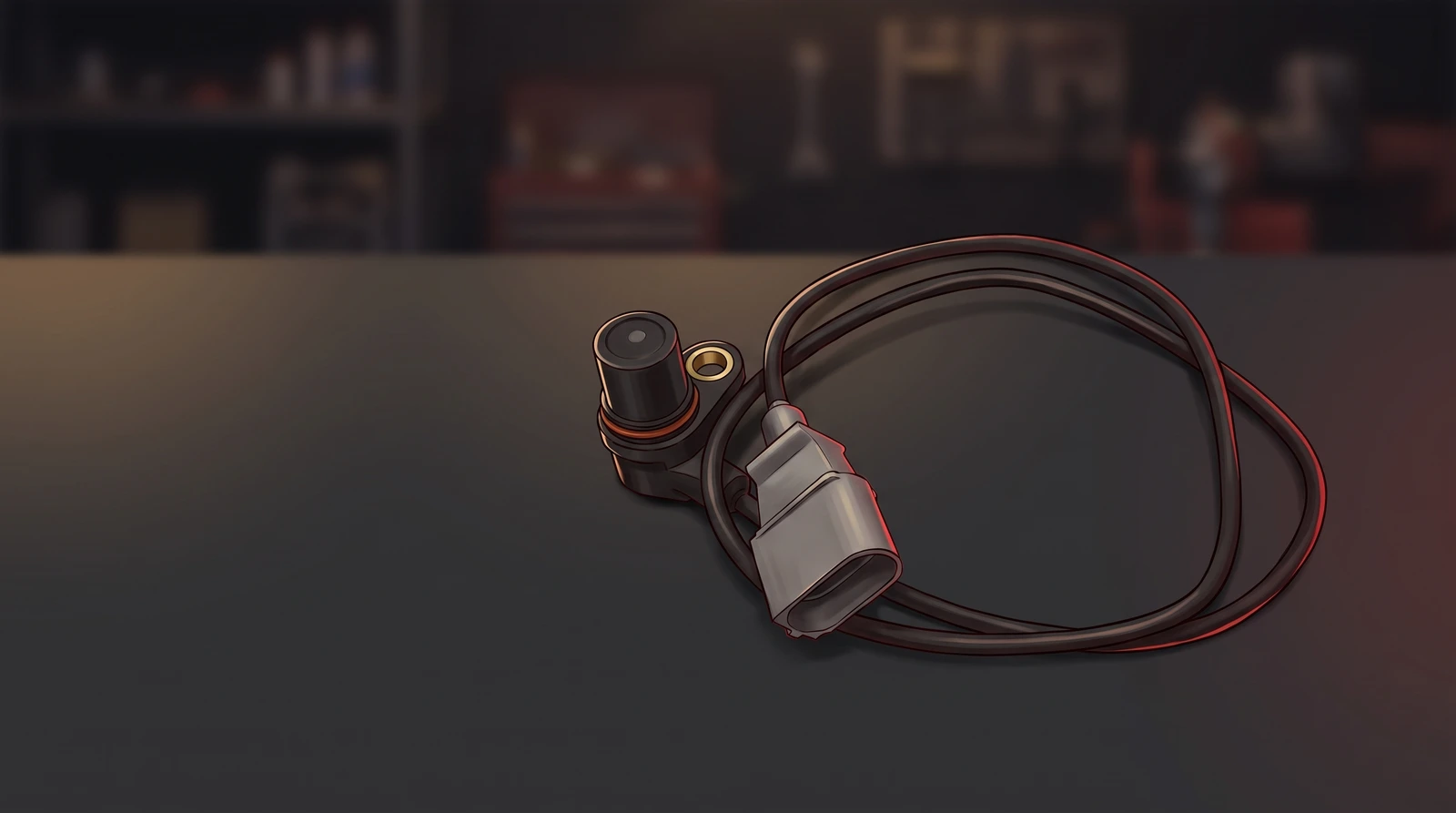
A wheel speed sensor is a small magnetic sensor mounted at a wheel hub that measures how fast that wheel is turning and sends the reading to the ABS module. Each wheel has its own. It is the same part sold as an ABS sensor or ABS wheel sensor — different names, one component.
The ABS module compares the four readings continuously. When one wheel starts slowing much faster than the others under braking, the module treats it as a wheel about to lock and briefly releases the brake pressure at that corner, so the tyre keeps turning and the car can still be steered.
The same signals do a lot more than ABS. The module passes them over the car’s data network to traction control and ESP, and on many vehicles to the speedometer, the automatic gearbox, hill-start assist and adaptive cruise control. That is why a single failed sensor can switch off several systems and light several warnings at once.
Where is the wheel speed sensor fitted?
The sensor sits at the hub, its tip a small, fixed distance from a ring that turns with the wheel. On many older designs that ring is toothed steel pressed onto the hub, driveshaft or CV joint. On many modern cars it is built into the wheel bearing, and on some it is a magnetic encoder inside the bearing seal — invisible from outside, so nothing about the bearing tells you it does a job for the ABS.
A lead runs from the sensor along the suspension to the main wiring loom and on to the ABS module, which sits on the hydraulic unit in the engine bay. That route puts the sensor, the ring and the cable in about the harshest spot on the car for anything electrical: in the path of road spray, salt and brake dust, beside hot brakes, and flexing with every movement of the suspension.
The ring has a guide of its own: how reluctor rings crack, corrode and are checked is covered in testing and replacing ABS reluctor rings.
Active vs passive wheel speed sensors
Wheel speed sensors come in two families, and which one your car has shapes how a fault behaves.
| Passive (inductive) | Active (Hall-effect or magnetoresistive) | |
|---|---|---|
| How it makes a signal | A permanent magnet inside a coil; each tooth passing the tip induces a voltage | An electronic sensing element switches its output as the ring’s teeth or magnetic poles pass |
| Power | None — it generates its own signal | Supplied by the ABS module |
| Signal sent to the module | An alternating voltage that grows stronger and faster as the wheel speeds up | A digital on-off signal of fixed strength; only its frequency rises with speed |
| At crawling speed | Too weak to read reliably | Reads right down to a standstill |
| Ring it reads | Toothed steel ring | Toothed ring, or a magnetic encoder ring in the bearing |
| Extra information | Speed only | Many report direction of rotation; later designs keep signalling when the wheel is stopped, so the module can tell a parked car from a dead sensor |
| Found on | Mainly older cars | Most cars on UK roads |
The difference shows most clearly when something starts to go wrong. A passive sensor’s signal weakens as the gap to its ring grows, so bearing play, debris or a chipped tooth tends to produce a fault that comes and goes with speed. An active sensor switches cleanly or not at all — and because it runs on a supply from the ABS module, a sensor that looks dead may simply have lost its power through the wiring or the module.
One buying point applies to both types. Sensors that look identical can differ inside, and front and rear sensors on the same car are not always interchangeable, so a replacement should be matched to the car and the corner by part number or VIN rather than by eye.
Wheel speed sensor symptoms, and what each one suggests
A failing sensor rarely shows itself through the brakes first. It shows on the dashboard, and in the systems that borrow its signal.
- The amber ABS light. It should come on for a moment at ignition as a self-check and then go out. If it stays on, or appears once the car is moving, the module has found a fault and has usually switched the anti-lock function off.
- Traction control and ESP lights alongside it. They rely on the same four signals, so they drop out together; our page on the ABS and traction control lights on together covers that pairing.
- ABS acting when it should not. A juddering, pulsing pedal during a gentle stop on a dry road means the module is releasing pressure because it believes a wheel is locking — typically a false slow-wheel signal from one corner.
- An erratic speedometer. On cars that take road speed from the wheel sensors, the needle can jump, stick or fall to zero.
- Harsh or odd automatic gear changes. Where the gearbox uses wheel speed to decide when to change gear, a bad signal upsets its timing.
The pattern over time is a clue in its own right. A light that appears only above a certain speed, only in the wet or only after a pothole points at the corner — the ring, the gap, the connector or the cable. A light that came on one day and has stayed on at every speed since leans the other way, towards the ABS module, though on its own it proves nothing.
Wheel speed sensor fault codes: what C0035 does and does not tell you
An ABS-capable scan tool will name the corner. On the generic chassis-code scheme many tools use, C0035 is the left-front wheel speed sensor, and the other corners and fault types have codes of their own. Manufacturers add their own numbering and wording, and tools do not always describe the same code the same way, so go by the description your scanner gives for your car.
An ABS wheel speed sensor fault code records what the module perceived: a signal from that corner that was missing, implausible or out of step with the other three. It names the place, not the cause. The same code is set by a failed sensor, a cracked or rusted ring, a gap widened by bearing play, a chafed cable or a corroded connector — or by the module itself misreading a sensor that is working perfectly well.
| Code | What the module is reporting | Where it points |
|---|---|---|
| C0035 (generic scheme) | A fault in the left-front wheel speed sensor signal or circuit | The left-front corner first — sensor, ring, bearing, cable and connector; if all prove sound, the module’s reading of that sensor |
| Sensor codes on different corners | Faults logged at more than one wheel, together or on different days | Something the corners share — the wiring or the ABS module — rather than several sensors failing at once |
| Valve circuit codes, such as C0060 to C0095 on the generic scheme | A fault in the circuits that control brake pressure at each wheel | The ABS unit itself, not the sensor — even though some sensor guides list them among sensor faults |
| U0121, stored in other modules | Lost communication with the ABS module | The module off the network — its supply, its wiring or the unit itself; our guide to ABS module no-communication faults covers it |
Note the codes, the corner and any freeze-frame detail first; clearing them wipes the only record of which wheel failed and when.
Sinspeed · sensor or module?
Codes pointing at a wheel, but the wheel checks out?Give us the car, each code and the corner it names, plus anything already replaced. We will say whether the pattern fits a sensor, a ring or the ABS module before anyone takes the unit off.
Codes reviewed by electronic and hydraulic engineers · Units proved on Hardware-in-the-Loop rigs
Why wheel speed sensors fail
Wheel speed sensors have no moving parts. What wears them out is where they live.
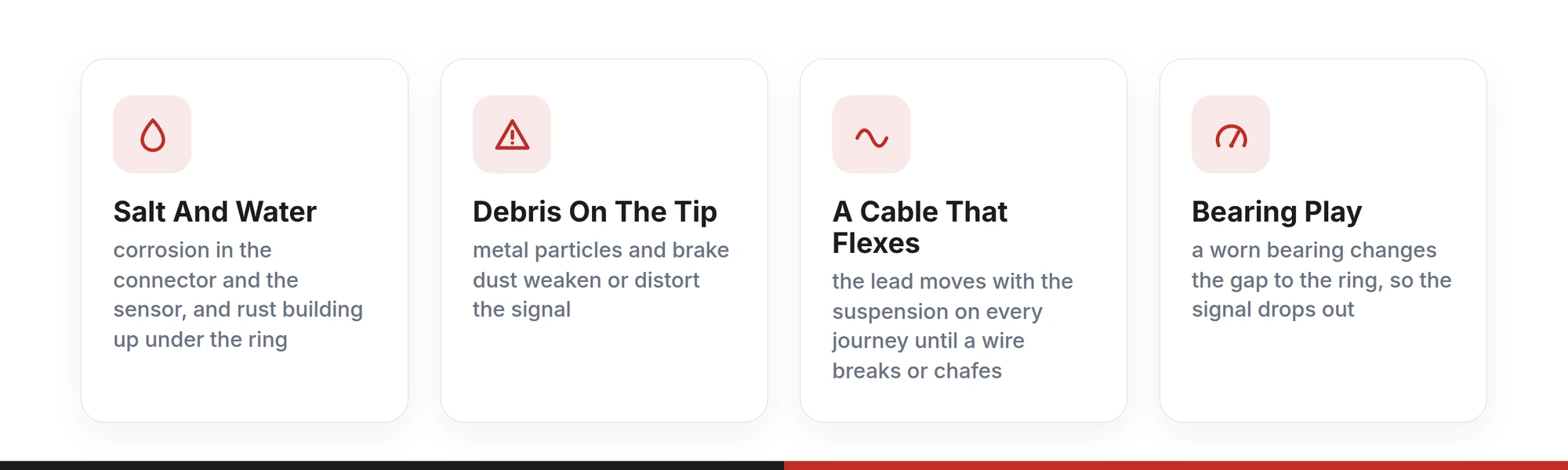
- Salt and water. Moisture works into the connector and the sensor, and corrosion raises resistance in the circuit. Salt is also the main enemy of the ring behind the sensor on UK cars, where rust builds up beneath it until it cracks.
- Debris on the tip. The sensor’s tip gathers metal particles from wearing pads and discs, along with brake dust and dirt, which weaken or distort the signal.
- A cable that never stops moving. The lead flexes with the suspension on every journey, and broken wires, or insulation chafed through against suspension parts or heat shields, are routine finds.
- Heat and vibration. Sitting beside the brakes, the sensor is heated and cooled on every journey and shaken for every mile.
- Wheel bearing play. A worn bearing lets the hub move, so the gap between sensor and ring changes as the car drives and the signal drops out.
- Knocks and nearby work. Impacts from road debris, and damage while pads, discs, bearings or driveshafts are being changed.
- Internal failure. Active sensors contain electronics that can fail on their own, and internal short circuits are recorded on sensors generally.
Almost all of these begin at the corner of the car, which is why that is where diagnosis starts. Many of them come and go with weather, speed and road surface before they settle into a permanent fault.
Wheel speed sensor or ABS module? How to tell which has failed
This is the question that decides the job. A wheel speed sensor is a routine part a garage replaces at the wheel. The ABS module is the control unit that reads all four sensors and runs the anti-lock valves — and it can log a sensor fault that no sensor caused.
The module does more than listen. On active sensors it supplies the power each sensor runs on, and it judges for itself whether the signal coming back is believable. If the part of the module that powers or reads one wheel’s sensor begins to fail, the module sees a missing or implausible signal from that wheel and records the code a failed sensor would: same corner, same description, same lights on the dashboard.
Heat cycling and moisture, working on a unit that lives in the engine bay, are the usual causes at system level. That is how cars reach us with a new sensor, sometimes a new bearing too, and the same light. Each part was a reasonable guess from the code; none of them was the fault.
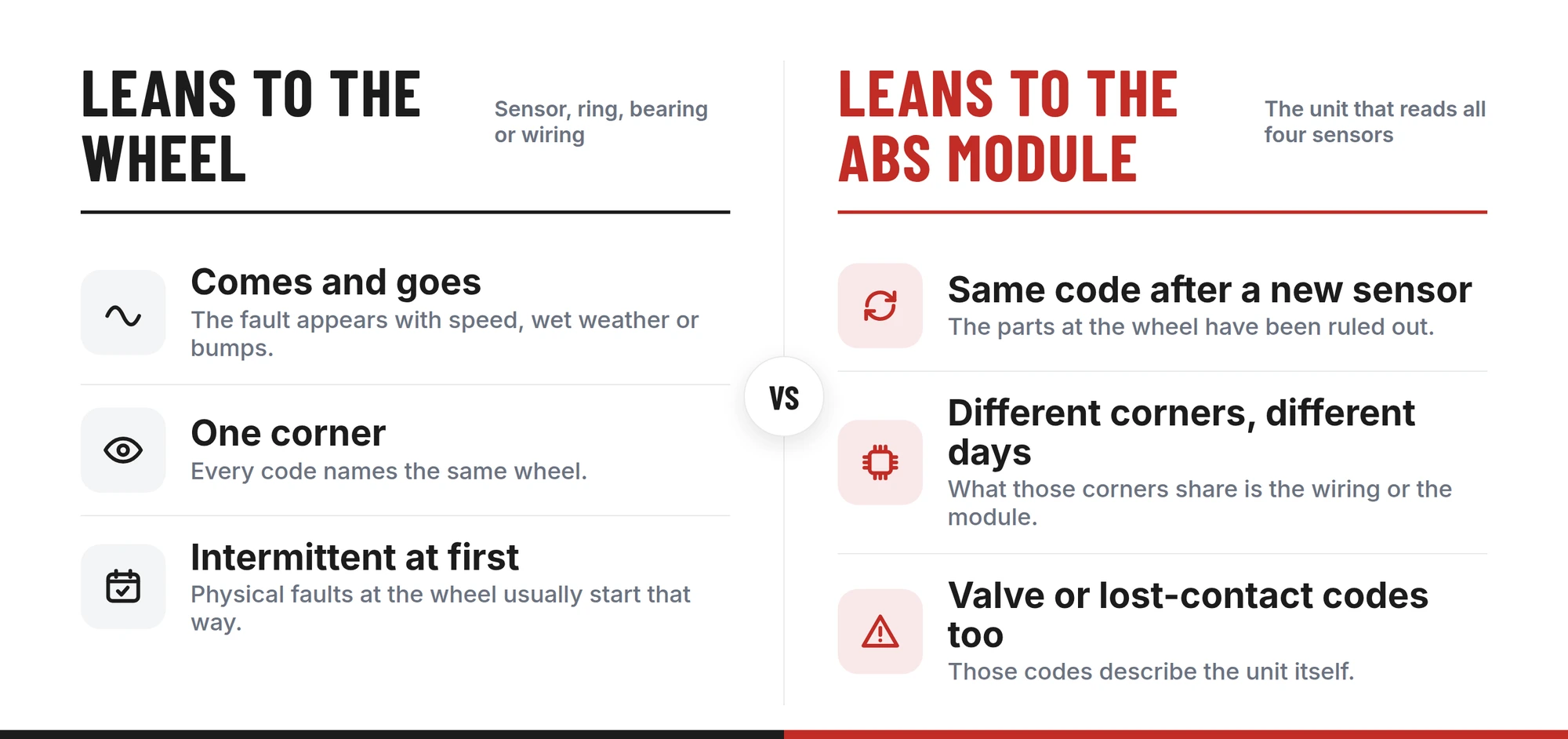
| What you see | Leans towards | Why |
|---|---|---|
| The fault comes and goes with speed, wet weather or bumps | The sensor, ring, bearing or wiring at that corner | Physical faults at the wheel are usually intermittent at first |
| Codes on different corners on different days, or several at once | Shared wiring or the ABS module | Different corners failing points at what they have in common |
| A new, correct sensor fitted, ring and cable checked, same code back | The ABS module | The parts at the wheel have been ruled out |
| On a road test, live data shows all four wheels reading sensibly, yet the module still flags one | The ABS module | The signal is arriving; the module is not accepting it |
| Sensor codes alongside valve circuit codes, or other modules logging lost contact with the ABS unit | The ABS module | Those codes describe the unit itself |
| A light that came on and has stayed on at every speed since | The ABS module, as a lean rather than a verdict | Internal module faults tend to be permanent once they appear |
None of these is a test on its own; together they are the pattern to look for. Proving the sensor and wiring in or out is scan-tool and instrument work for a garage, and our guide to diagnosing an ABS wheel speed sensor sets out the sequence.
The rule to take away is short. A sensor that tests good with the light still on is not a sensor fault, and the ABS module becomes the next suspect — the unit our ABS pump and module repairs are built around.
Can you drive with a wheel speed sensor fault?
A wheel speed sensor fault leaves the brakes themselves working normally. The pedal, the hydraulics, the discs and the pads are unaffected, and the car stops as a car without ABS would. The casualty is the anti-lock function, along with traction control and ESP, which share its signals.
That matters most in an emergency. In a hard stop, or on ice, rain or gravel, nothing prevents a wheel locking; a locked wheel takes your steering away, and there is no stability control left to catch a slide. Leave more distance, brake early and gently where you can, and have the fault diagnosed promptly rather than living with it.
If the ABS is pulsing through gentle, low-speed stops, treat it as more urgent still: the system is releasing brake pressure when it should not.
A red brake warning lamp lit together with the ABS light is a different matter. Pull over when it is safe and do not carry on, and treat a pedal that has gone soft or long, or brakes that drag or pull, the same way: those are faults in the hydraulic braking system, not the sensor.
An ABS light that stays on is also recorded as a major defect at the MOT, so the car will fail until the fault is put right; our guide to whether the ABS light is an MOT fail explains what the tester looks at. Clearing the code will not get it through, for the reason in the questions below.
Replacing the sensor, or sending the ABS unit in
If the diagnosis lands on the sensor, replacing it is a normal garage job at the wheel, and what it typically costs is covered in our guide to ABS sensor replacement cost. Fit the correct part for the car and the corner, and have the ring, bearing and cable looked at while the wheel is off — a new sensor reading a damaged ring inherits the old fault.
If it lands on the ABS module, the job moves to our workshop and the car goes nowhere. The ABS unit comes off at your garage and travels to us by tracked courier. Bleeding the brakes, and any calibration the car asks for once the unit is back on, are part of refitting it — routine steps for any garage that works on ABS.
On our bench the module is diagnosed with dealer-level equipment and run on in-house Hardware-in-the-Loop platforms that recreate the car around it, heat, vibration and load included, so a fault that only appears when the unit is hot or working is found and the repair is proved before it leaves. Your own unit comes back to you. Because it keeps its own data, many units refit with no coding, and most remanufactured parts carry a lifetime, unlimited-mileage warranty.
The units and vehicles we cover are listed in our ABS pump and module repair hub, and our explainer on what an ABS pump is and how it works shows how the module, pump and valve block fit together.
Wheel speed sensor questions
Is an ABS sensor the same as a wheel speed sensor?
Yes. ABS sensor, ABS wheel sensor and wheel speed sensor, sometimes shortened to WSS, all describe the same part: the sensor at each wheel that reports its speed to the ABS module. It is not the ABS module itself, which reads the sensors and controls the brakes, and it is not the reluctor ring the sensor reads.
Can a faulty wheel speed sensor affect the speedometer or gearbox?
On many cars, yes. The ABS module shares wheel speed with the instrument cluster and the automatic gearbox, so a failed sensor, or a module that has stopped sharing the data, can leave the speedometer erratic or at zero and make gear changes harsh. When those arrive together with the ABS light, the wheel-speed signal is the common thread.
Why is the ABS light still on after a new wheel speed sensor?
Because the sensor may not have been the fault. The code named a corner, and the same code comes from a cracked or rusted ring, a worn bearing, a damaged cable or connector, the wrong sensor for that position, or the ABS module misreading a healthy signal. If the parts at the wheel check out and the code returns, the module is the next thing to test.
Will clearing the fault code fix a wheel speed sensor fault?
No. A cleared code is a cleared record; the fault behind it is untouched. The ABS module tests the system afresh each time the car is started, so if the signal from that wheel is still missing or implausible, the light is back — at once, or as soon as the car moves off.
Final thoughts
A wheel speed sensor is a simple part with a large audience: four small sensors whose readings the ABS, traction control, ESP and often the speedometer and gearbox all depend on. When one goes quiet, the code tells you where the trouble showed up, not what caused it.
Work from the corner inwards — sensor, ring, bearing, cable — and replace only what is proved faulty. If the parts at the wheel test sound and the light is still on, stop buying sensors: the evidence has moved to the ABS module, and that is a unit to repair rather than replace.
Sinspeed · ABS units repaired by post
Sensor checked, light still on?If a new sensor has gone on and the scan tool still names the same corner, the ABS module is the next suspect. Your garage sends the unit in, and your own module comes back tested and ready to refit.
Lifetime warranty, unlimited mileage · Programmed and calibrated on dealer-level equipment · Many units refit with no coding